seeds wrote: ↑Tue Jul 16, 2024 6:30 am
Prove it.
Show me where any branch of science or physics has made a quantum-like (or whatever) measurement of the
"dreamer" of dreams and the
"thinker" of thoughts I asked for earlier.
You assumed it must be there to be discovered and measured.
This assumption is circular.
How can you believe it is there before it is justified to be true.
Whatever is justified to be true by science is merely a polished conjecture.
There is no way science can confirm ontologically, there is
"dreamer" of dreams and the
"thinker" of thoughts, because these are non-starters for science.
From the website - BIG THINK (bolding and underling mine)...
One of the toughest and most discussed problems in philosophy concerns how the mind and body interact. The mind-body problem has been a staple of modern philosophy since Descartes. Although the problem has yet to be solved, we currently have a better idea of how difficult it is.
Since Descartes, all the way up to the present day, no human - philosopher or otherwise - has been able to solve the
"mind-body problem"...
...until now!!!
Same as the above, you are engaging in circularity.
You
assumed there is 'mind' independent of the body must be there to be discovered and measured.
This assumption is circular.
How can you believe it is there before it is justified to be true.
Whatever is justified to be true by science is merely a polished conjecture.
There is no way science can confirm ontologically, there is a mind independent of the empirical body because these is a non-starter for science.
It is only out of psychological desperation your assumed based on faith, there is a mind that is absolutely independent of the body.
Seriously V, you need to contact the BIG THINK website, and Wiki, and the editors of the Stanford Encyclopedia of Philosophy, etc., etc., and give them the good news that you have done it, as is clearly laid out in your 7-point counter argument.
I suggest you start with our very own site-host Rick Lewis, because I'm sure he would love to be the first to publish your findings in Philosophy Now Magazine.
Note this:
Case Two: The Mind-Body Problem
The mind-body problem is the problem of understanding what the relation between the mind and body is, or more precisely, whether mental phenomena are a subset of physical phenomena or not. There are many philosophical positions associated with this problem—substance dualism (“mind and body are two different substances”), property dualism (“there is only one, physical substance, but mental properties of subjects cannot be reduced to their physical properties”), and physicalist reductionism (“mental properties can be identified with, or can be spelled out in terms of, physical properties”), among other positions.
Some philosophers in recent decades have argued that modern neuroscience has already given us an answer to this question:
Mental states are nothing other than neural states, and we can talk of mental phenomena through physical vocabulary without any loss of meaning or reference.
The founders of what is called “neurophilosophy,” Patricia and Paul Churchland, have been among the most famous advocates of this position, even though their views oscillated between reductionism and eliminativism, the latter view being that mentality (or certain aspects of it) is a prescientific construct that will have no place in the scientific understanding of the world once we have a fully developed neuroscience (see, e.g., Churchland, 1988).
https://www.sciencedirect.com/topics/ne ... dy-problem#:
The Mind-Body Problem is driven by philosophical realism's mind-independent reality which is grounded on an illusion.
Veritas Aequitas wrote: ↑Tue Jul 16, 2024 3:01 am
My counter argument is;
1. Humans infer,
2. Reality is all-there-is [all things].
3. All things within reality are interdependent with each other [re your point-A above].
4. All things includes humans which are entangled with everything within reality.
5. The human body and mind are also part & parcel of each human.
6. The human body and mind are are interdependent with every thing else in the reality [point-A]
7. Therefore, there is no independent mind that is independent of the human [4] and all of reality.
Anyway, getting back to reality,...
Veritas Aequitas wrote: ↑Tue Jul 16, 2024 3:01 am
If the human body and mind are part & parcel of reality which is all-there-is, how can the human body be absolutely independent of the mind regardless of the different 'substance' they are made of?
First of all, if you actually believe that this...
...is a representation of
"all there is to reality," then you (like most humans) are simply not conscious enough to understand what I am trying to convey to you.
Nevertheless, to answer your question, the body is independent of the mind in the same way that
my mind is independent of
your mind.
It's as simple as that.
Sure, the mind and body are not fully independent of each other
right now, for your body and brain functioned as the means by which your mind was awakened into existence, and continues to operate as a multi-sensory
"interface" that momentarily connects your mind to the inner dimension of God's mind (the universe),...
...which, in turn, allows you to see, feel, hear, taste, and smell God's very own (super advanced) mental holography.
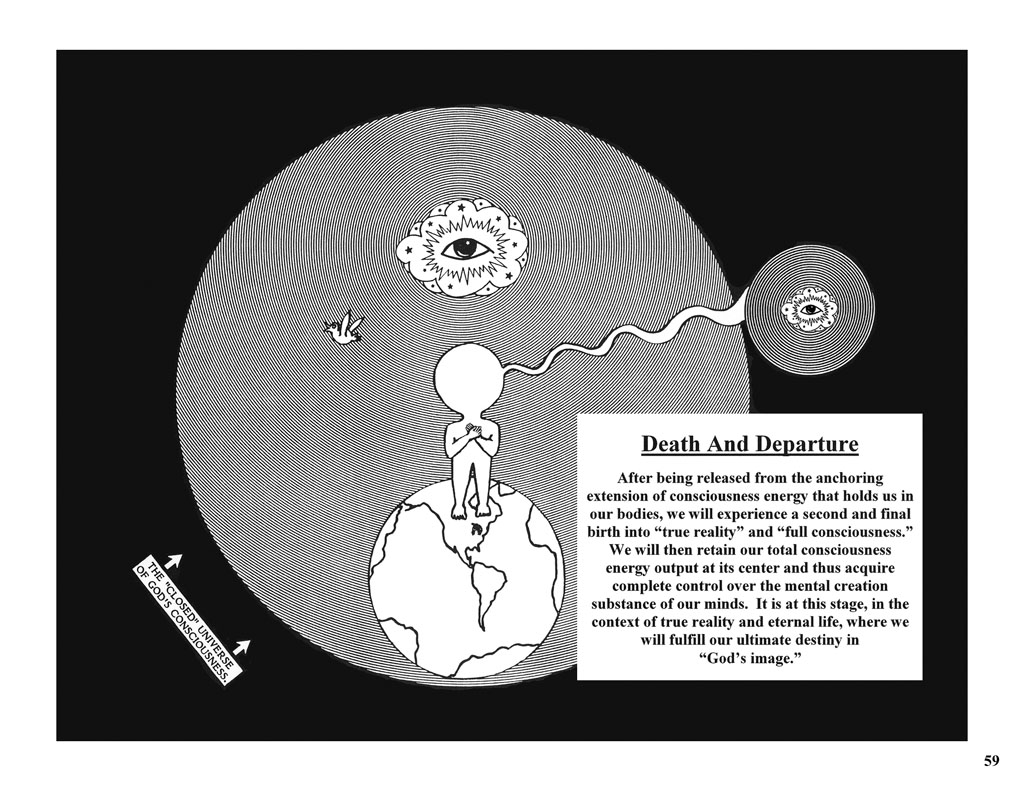
However, a full separation will take place at the moment of death, as depicted in yet another of my fanciful illustrations...
(Yeah, yeah, I know, "...it's impossible for God to exists [sic] as real..."  )
)
_______
Seed:
Nevertheless, to answer your question, the body is independent of the mind in the same way that my mind is independent of your mind.
My mind is only relatively independent of your mind which is empirically obvious, but your mind is not absolutely independent of my mind, given that we are all part and parcel of same reality - all-there-is -[same jacuzzi].
Personally, I wish we are absolutely independent and I would not want to share the same 'jacuzzi' reality with you, but I have no choice because that is the real reality.
Note the fact, at present my mind is invoking terror in your mind with my arguments. So my mind is only relatively independent from your mind but not in any absolute sense within the same reality soup we are all in.
Analogy:
It is like two different ice blocks are independent of each other in a pool of water.
But taken as a whole the two seemingly independent block are not absolutely independent of each other, but are interdependent with each other as influencing the temperature, waves, etc. within that environment.
Everything is within an all-there-is reality as a whole system and they are fully interdependent with each other. Note Chaos Theory. Your fart could cause a typhoon in China because everything within a system is interdependent.
Your belief of mind-independent thingy, i.e. God, minds and whatever is due to an evolutionary default driven by an existential crisis that drive you into desperation.
Note, all you do is to focus externally but not 'know thyself' and how your internal psychology is pushing you to cling to illusions as real things.
As a test, what have you got to lose if you were to give up your desperate belief in God and absolutely mind-independent things??
What is your answer to this?
The answer is nothing other than a threat of a cold turkey within your psyche.
If you can bear with this temporary cold turkey you will surely get a peace of mind.
In ancient philosophy,
skepticism was understood as a way of life associated with
inner peace. WIKI