Indirect Realism is Not Realistic

For all things philosophical.

Moderators: AMod, iMod

Gary Childress
Posts: 11748
Joined: Sun Sep 25, 2011 3:08 pm
Location: It's my fault

Re: Indirect Realism is Not Realistic

Post by Gary Childress »

Veritas Aequitas wrote: Sun Jul 14, 2024 5:20 am
Gary Childress wrote: Sat Jul 13, 2024 12:51 pm I'm not sure what I am, "realist" or "anti-realist" or "indirect realist", All I know is that I have limits in the world and they are real limits to the best of my reckoning. I don't know what the world is "in itself" without me looking at it, touching it or smelling it etc., however, taking into account that I may be incorrect in every perception I have, I will proceed with the assumption that my limitations are real.

The above is my manifesto. I've always wanted to produce one. :D
"Not sure" with acknowledge of real human fallibility is the most effective pragmatic step.
Basically, my position translates into this:

Example: I don't know if there's really a cliff ahead of me or not that I will fall off of and die if I step off it, however, if I see what looks like a cliff, I'm going to treat it as though it's a cliff and not step off it. The same goes for moral judgements. I'm going to make decisions which I think are the right ones to make morally, despite the fact that I don't even know for certain if I'm not the only conscious being in the universe. That's really all I'm saying. Seems like a wise position to take to me. Is that not your position also?
Atla
Posts: 9936
Joined: Fri Dec 15, 2017 8:27 am

Re: Indirect Realism is Not Realistic

Post by Atla »

Veritas Aequitas wrote: Sun Jul 14, 2024 9:23 am
Atla wrote: Sun Jul 14, 2024 8:42 am
Veritas Aequitas wrote: Sun Jul 14, 2024 7:41 am [Did you watch the video?
Tell me where I am wrong about Al-Khalili.

Explain your indirect realist position, QM or otherwise,

why there is no "clear cut boundary and fundamental separation" between the indirect realist and the 'tree out there".
Already explained multiple times. Last time on this page of this topic. And most of it is not "my" position but "the" position. Also, you did not watch that video.
Since this is a critical point, if it not too troublesome why not explain again,

Explain your indirect realist position, QM or otherwise,
why there is no "clear cut boundary and fundamental separation" between the indirect realist and the 'tree out there".

Do you agree with
the moon exists regardless of whether there are humans or not?
i.e. the moon was there before humans and will be there even if humans are extinct.
Yes the Moon exists whether there are humans or not. I wrote this above:
Atla the KG wrote:Okay I suppose those coming from a more philosophical perspective are more likely to associate indirect realism with dualism. One of its names is epistemological dualism. Once again, it could be Kant's bad influence at work here, who set up the noumena-phenomena dualism, and it's easy to see this noumena-phenomena dualism as fundamental, and then project this idea of fundamental dualism onto indirect realism.

Except not only is that not required, but quite irrational from a more scientific perspective. The inside of our brains/minds seems to be made of the same kind of stuff as the external world, just arranged differently. Our brains/minds are continuous with the external world. No fundamental duality here.

Except you also claim that science is the most credible so you'll have to accept the latter view.
Why/where should there be a "clear cut boundary and fundamental separation" in the continuous world?

Al-Khalili (again):
God wrote:The idea that "the Moon isn't there when we aren't looking" is a philosophical interpretation rather than a scientific fact within the framework of quantum mechanics (QM). This notion is often attributed to the Copenhagen interpretation of quantum mechanics, which posits that physical systems generally do not have definite properties until they are measured.

Here's a breakdown of the relevant concepts:

1. **Quantum Mechanics and Measurement**: Quantum mechanics describes the behavior of particles at microscopic scales. According to the theory, particles exist in a superposition of states until a measurement is made. Upon measurement, the wavefunction collapses to a specific state.

2. **Copenhagen Interpretation**: One of the most well-known interpretations of quantum mechanics, the Copenhagen interpretation suggests that the properties of quantum systems are not well-defined until they are observed. This leads to the famous Schrödinger's cat thought experiment, where a cat in a box can be considered both alive and dead until the box is opened and an observation is made.

3. **Macroscopic Objects**: The statement about the Moon reflects an extrapolation of quantum mechanical principles to macroscopic objects. However, the behavior of macroscopic objects like the Moon is governed by classical physics, where such objects have definite properties regardless of observation. Quantum decoherence explains why we don't observe quantum effects at macroscopic scales—the interactions with the environment cause the superposition states to effectively collapse into definite states.

4. **Philosophical Debate**: The statement "the Moon isn't there when we aren't looking" raises questions about the nature of reality and observation. Philosophers and physicists have debated the implications of quantum mechanics on reality, but this remains in the realm of interpretation and philosophy rather than empirical scientific fact.

5. **Scientific Facts**: In science, facts are established through empirical evidence and reproducible experiments. The existence of the Moon when not being observed is a scientific fact supported by vast amounts of observational and theoretical evidence from classical mechanics and astronomy.

In summary, while quantum mechanics does introduce fascinating questions about observation and reality, the idea that the Moon isn't there when we aren't looking is a philosophical interpretation and not a scientific fact.
seeds
Posts: 2880
Joined: Tue Aug 02, 2016 9:31 pm

Re: Indirect Realism is Not Realistic

Post by seeds »

Veritas Aequitas wrote: Sun Jul 14, 2024 7:41 am
Atla wrote: Sun Jul 14, 2024 6:03 am
Veritas Aequitas wrote: Sun Jul 14, 2024 5:40 amIndirect Realism is a subset of philosophical realism.
An indirect realist will claim the moon exists regardless of whether there are human or not.
This imply a clear cut boundary and fundamental separation.
Where? Why?
Otherwise, if there is a clear cut boundary and fundamental separation, then the moon do exists regardless of whether there are human or not.
Thus if there is no humans there is no moon.
English please.
So which is yours? 1 or 2,
1. he moon exists regardless of whether there are human or not.
2. if there are no human, then is no moon [FSERC].

if not, what is your indirect realist view re whether the moon existed regardless of whether there are human or not.
I have given this example:
Here at 54:30
https://www.youtube.com/watch?v=ISdBAf-ysI0
Professor Jim Al-Khalili stated,
"In some strange sense, it really does suggest the moon doesn't exists when we are not looking. It truly defies common sense."
First of all, let's get the quote from the video exactly right. Al-Khalili said...
"In some strange sense, it really does suggest the moon doesn't exist [not "exists"] when we're not looking. It truly defies common sense."
(Sorry, but VA constantly using exist/exists incorrectly, even when he could clearly hear Al-Khalili say "exist" in the video, gets on my nerves. :x :D)

Now with that out of the way,...

....I suggest that the moon is still there in the same way that the vivid dream you may have had last night is "still there" after you woke up this morning.

I suggest that the moon is still there in the same way that the actors, sound, and scenes in a movie on a DVD...

Image

...are still there if you remove the TV monitor and speakers from a running DVD player.

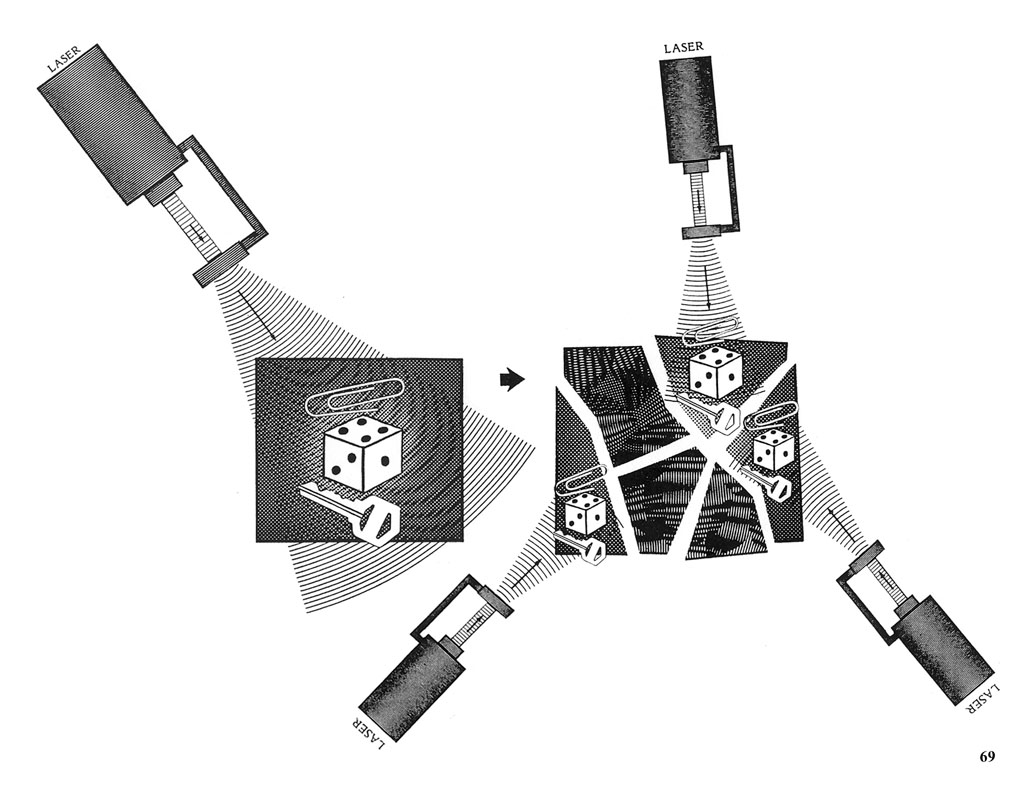
I suggest that the moon is still there in the same way that the key, the die, and the paperclip in the laser hologram...

Image

...are still there if the laser (a metaphor for consciousness) is no longer shining into the photographic plate (a metaphor for the informational underpinning of the universe).

And the point is that the manifestation of 3-D reality requires the conjoined relationship between coded information and of something capable of explicating into 3-D reality whatever it is that the coded information represents, such as, for example, the 3-D phenomenal features of a dream...

Image

...or the 3-D phenomenal features of an apple tree...

Image

...or the 3-D phenomenal features of the moon we keep referring to...

Image

...etc., etc., etc..

(And, no, "decoherence" does not solve the problem of what it is that collapses the wavefunction.)

Without the existence of mind and consciousness, not only would matter have no way of becoming anything that we call "real," but it would have absolutely no reason or purpose for existing.

And without the existence of matter, mind and consciousness would have absolutely no way of sensing anything or expressing itself, as in there would be nothing to see, feel, hear, taste, or smell.
_______
seeds
Posts: 2880
Joined: Tue Aug 02, 2016 9:31 pm

Re: Indirect Realism is Not Realistic

Post by seeds »

Atla wrote: Sun Jul 14, 2024 4:01 am
seeds wrote: Sat Jul 13, 2024 8:05 pm
Atla wrote: Sat Jul 13, 2024 3:49 am
We always "directly" experience our own minds,...
Agreed.

Hence why I referred to it as "direct realism."

It is direct because when we encounter the phenomenal features of our own thoughts and dreams, our experience of them is not being filtered through any intermediary structures such as physical eyes, skin, ears, nose, or tongue,...

...all of which are simply "windows" that function as an "interface" that allows us to peer out from the inner dimension of our mind and into the outer dimension of the universe.
Atla wrote: Sat Jul 13, 2024 3:49 am we are part of them too.
Of course we are a part of them. They (our minds) are an integral part of our overall being, for they function as the living "arena" in which we construct our own personal reality.
Atla wrote: Sat Jul 13, 2024 3:49 am When we are awake the contents of our minds are largely constructed from external input, and when we dream from internal input.
Agreed.

However, it is important to note that whether or not it is being influenced by "external input" or "internal input," the contents of our mind (the phenomenal features of our thoughts and dreams) are constructed from the living fabric of our very own being.
Atla wrote: Sat Jul 13, 2024 3:49 am Sometimes I'm quite conscious when the switching between the two modes happens.
That may be so, but for most people, the switching back and forth between those two modes...

(more specifically, the switching from full-blown awareness of the outer dimension of the universe while awake, to that of the full-blown awareness of your dreams when you fall asleep)

...always entails that the "mode" you switched away from pretty much vanishes from your awareness.

In other words, when you direct your consciousness inward, it explicates the phenomenal features of your dreams into existence from the fields of information that underpin (code for) their reality,...

...which means you are no longer explicating the features of the universe into existence from similar fields of information, and thus you are no longer aware of the "reality" of the universe.

And it's vice versa with respect to your dreams when you direct your consciousness outward while awake. When you awaken from sleep, your consciousness is directed back out through the body's five sensory "windows" and outward into the universe, and thus you are no longer aware of the vivid reality of your dreams.

Also note that when you do direct your full consciousness (your full attention) inward while asleep and dreaming, the contents of your mind appear to be "almost as real" as the contents of the universe.

I'll stop there, because I don't want to bore you with my theory of what all of this implies.

(My goodness, the truth of reality is so freakin' obvious if only you heathens would be more open minded about the existence of higher levels of consciousness above us. I mean, it is utterly ridiculous to believe that in all of eternity, humans represent the highest level that mind and consciousness have been able to reach. :roll: )
_______
Well you know where I stand and that you don't like it.
Yes.

And you don't like where I stand either.

What a surprise. There are two people on the Internet who disagree with each other. :shock:

(Btw, I appreciate and respect your intelligent approach to all of this, but what I actually "don't like" is when (as in the past) you become caustic in your replies when we express our contrasting opinions.)
Atla wrote: Sun Jul 14, 2024 4:01 am And while it's freaking obvious that in an infinite world we aren't the highest form of consciousness,...
What "world" are you referring to that you think is "infinite"?
Atla wrote: Sun Jul 14, 2024 4:01 am it's also freaking obvious that that doesn't mean that we aren't the highest form of consciousness here.
What do you mean by "here"?

Where, exactly, is "here"?
Atla wrote: Sun Jul 14, 2024 4:01 am That's just your perpetual wishful thinking supported by psychedelic trips to find a higher consciousness here, even though there doesn't seem to be any. Unless you can show that there is indeed a higher consciousness here.
How can I possibly show anything to someone who is as stubborn and closed-minded as you?

Are you really one of those types (just like VA, btw) who believe that just because you personally haven't experienced anything in your life that would convince you that a higher Being exists, that nobody else has? Really, Atla? You speak for the estimated 117 billion humans who have lived and died on this planet?

It is becoming clearer and clearer to me that even though you "seem to be" a proponent of "Indirect Realism" (of which I agree with), at root you are actually a "Naïve Realist" who cannot see past the thin veneer of the (holographic-like) illusion of objective reality.

According to Wiki:
According to the naïve realist, the objects of perception are not representations of external objects, but are in fact those external objects themselves. The naïve realist is typically also a metaphysical realist, holding that these objects continue to obey the laws of physics and retain all of their properties regardless of whether or not there is anyone to observe them. They are composed of matter, occupy space, and have properties, such as size, shape, texture, smell, taste and colour, that are usually perceived correctly.
Now I know that you will vehemently refuse to accept any of the following, and I am always willing to admit that I could be wrong (are you?),...

...however, just for the record, and for the sake of others who might be reading our little exchange (and metaphorically speaking, of course), if you want to see the higher (spirit) body of a higher consciousness, then just look around you and realize that you are viewing said higher consciousness from a "fetal-like" perspective.

And, unfortunately, that means from a "fetal-like" level of awareness relative to the higher ontological status of said higher consciousness...

Image

(Yeah, yeah, I know, it's all just my spaced-out "wishful thinking." Never mind what happened to me almost five and a half decades ago...
viewtopic.php?t=41452&sid=041845c4ddbd1 ... cf608deb45)

_______
Veritas Aequitas
Posts: 15722
Joined: Wed Jul 11, 2012 4:41 am

Re: Indirect Realism is Not Realistic

Post by Veritas Aequitas »

Gary Childress wrote: Sun Jul 14, 2024 10:19 am
Veritas Aequitas wrote: Sun Jul 14, 2024 5:20 am
Gary Childress wrote: Sat Jul 13, 2024 12:51 pm I'm not sure what I am, "realist" or "anti-realist" or "indirect realist", All I know is that I have limits in the world and they are real limits to the best of my reckoning. I don't know what the world is "in itself" without me looking at it, touching it or smelling it etc., however, taking into account that I may be incorrect in every perception I have, I will proceed with the assumption that my limitations are real.

The above is my manifesto. I've always wanted to produce one. :D
"Not sure" with acknowledge of real human fallibility is the most effective pragmatic step.
Basically, my position translates into this:

Example: I don't know if there's really a cliff ahead of me or not that I will fall off of and die if I step off it, however, if I see what looks like a cliff, I'm going to treat it as though it's a cliff and not step off it.
'You know' but it is always a qualified and conditional 'know' [not with 100% certainty] to the best of your abilities.
Within the empirical world, if there is cliff ahead of me, I will rely on instinct and common & conventional sense that it really real [not 100%] and this can be justified to be real via the scientific system to be real [not 100%].
Whatever is empirical or empirically possible, I take as real and are mind independent but only relative mind-independent NOT absolutely mind independent.

The point is there are many perspectives and a hierarchy of complexity to reality that is possible to humans.
With a sense of relative mind-independence, I will always apply this principle to whatever the level of complexity we are dealing with.

The problem with philosophical realists [PH & gang], Einstein and others is, they insist the concept of mind-independence is ABSOLUTE thus exists regardless of whether there are humans or not.
That was why Einstein could not advance with QM [a higher complexity of reality] because he belief the moon exist absolute mind-independently, i.e. the moon exists regardless of whether there are human or not.
It is the same with Atla's Indirect Realism and PH absolute mind-independent facts.

So the point is, for philosophy sake, one must not be rigid e.g. insisting on the Absolute mind-independence of reality.
The same goes for moral judgements. I'm going to make decisions which I think are the right ones to make morally, despite the fact that I don't even know for certain if I'm not the only conscious being in the universe. That's really all I'm saying. Seems like a wise position to take to me. Is that not your position also?
Yes, at present, with morality, one just do within the best of one abilities, it is not easy to change to be more moral overnight.

The majority at present do not bother to make even the least possible moral improvements at all; most likely it is because they do not have the moral competencies.
Fortunately at present we have the pacifist Christianity to mitigate some level of "morality".

Say, if X is born with inherent psychopath tendencies, he will just be a natural potential killer.
However, all humans are programmed with the potential for improvements and progress.
For those with lesser infliction of psychopathy, there are sociopaths who rely on their rationality to suppress their psychopathy tendencies to harm or kill others.

There are potentials within all humans for moral progress, but the inherent function is not active and is dormant in many.
For the present generations moral progress is going to take a slow boat and the state of morality will not improve drastically overnight or within one or two generations.

With the current trend of the exponential expansion of knowledge and technology, there are opportunities for humanity to expedite the average moral progress of humanity.
To do so, we need to recognize the inherent moral functions, i.e. moral facts within the brain so that we that we can understand the mechanisms invoke and therefrom make improvements for moral progress.

Indirect Realism is Not Realistic:
At present, we have the tribe of philosophical realists and indirect realists who do not recognize the existence of the inherent moral facts within, thus hindering the path to moral progress.
Gary Childress
Posts: 11748
Joined: Sun Sep 25, 2011 3:08 pm
Location: It's my fault

Re: Indirect Realism is Not Realistic

Post by Gary Childress »

Veritas Aequitas wrote: Mon Jul 15, 2024 3:40 am
Gary Childress wrote: Sun Jul 14, 2024 10:19 am
Veritas Aequitas wrote: Sun Jul 14, 2024 5:20 am
"Not sure" with acknowledge of real human fallibility is the most effective pragmatic step.
Basically, my position translates into this:

Example: I don't know if there's really a cliff ahead of me or not that I will fall off of and die if I step off it, however, if I see what looks like a cliff, I'm going to treat it as though it's a cliff and not step off it.
'You know' but it is always a qualified and conditional 'know' [not with 100% certainty] to the best of your abilities.
Within the empirical world, if there is cliff ahead of me, I will rely on instinct and common & conventional sense that it really real [not 100%] and this can be justified to be real via the scientific system to be real [not 100%].
Whatever is empirical or empirically possible, I take as real and are mind independent but only relative mind-independent NOT absolutely mind independent.

The point is there are many perspectives and a hierarchy of complexity to reality that is possible to humans.
With a sense of relative mind-independence, I will always apply this principle to whatever the level of complexity we are dealing with.

The problem with philosophical realists [PH & gang], Einstein and others is, they insist the concept of mind-independence is ABSOLUTE thus exists regardless of whether there are humans or not.
That was why Einstein could not advance with QM [a higher complexity of reality] because he belief the moon exist absolute mind-independently, i.e. the moon exists regardless of whether there are human or not.
It is the same with Atla's Indirect Realism and PH absolute mind-independent facts.

So the point is, for philosophy sake, one must not be rigid e.g. insisting on the Absolute mind-independence of reality.
The same goes for moral judgements. I'm going to make decisions which I think are the right ones to make morally, despite the fact that I don't even know for certain if I'm not the only conscious being in the universe. That's really all I'm saying. Seems like a wise position to take to me. Is that not your position also?
Yes, at present, with morality, one just do within the best of one abilities, it is not easy to change to be more moral overnight.

The majority at present do not bother to make even the least possible moral improvements at all; most likely it is because they do not have the moral competencies.
Fortunately at present we have the pacifist Christianity to mitigate some level of "morality".

Say, if X is born with inherent psychopath tendencies, he will just be a natural potential killer.
However, all humans are programmed with the potential for improvements and progress.
For those with lesser infliction of psychopathy, there are sociopaths who rely on their rationality to suppress their psychopathy tendencies to harm or kill others.

There are potentials within all humans for moral progress, but the inherent function is not active and is dormant in many.
For the present generations moral progress is going to take a slow boat and the state of morality will not improve drastically overnight or within one or two generations.

With the current trend of the exponential expansion of knowledge and technology, there are opportunities for humanity to expedite the average moral progress of humanity.
To do so, we need to recognize the inherent moral functions, i.e. moral facts within the brain so that we that we can understand the mechanisms invoke and therefrom make improvements for moral progress.

Indirect Realism is Not Realistic:
At present, we have the tribe of philosophical realists and indirect realists who do not recognize the existence of the inherent moral facts within, thus hindering the path to moral progress.

So I take it, in the case of abortion, the ideal is to never have an abortion and moral "progress" is how close to that ideal a person adheres? Is that correct?
Veritas Aequitas
Posts: 15722
Joined: Wed Jul 11, 2012 4:41 am

Re: Indirect Realism is Not Realistic

Post by Veritas Aequitas »

Atla wrote: Sun Jul 14, 2024 10:36 am
Veritas Aequitas wrote: Sun Jul 14, 2024 9:23 am
Atla wrote: Sun Jul 14, 2024 8:42 am
Already explained multiple times. Last time on this page of this topic. And most of it is not "my" position but "the" position. Also, you did not watch that video.
Since this is a critical point, if it not too troublesome why not explain again,

Explain your indirect realist position, QM or otherwise,
why there is no "clear cut boundary and fundamental separation" between the indirect realist and the 'tree out there".

Do you agree with
the moon exists regardless of whether there are humans or not?
i.e. the moon was there before humans and will be there even if humans are extinct.
Yes the Moon exists whether there are humans or not. I wrote this above:
Atla the KG wrote:Okay I suppose those coming from a more philosophical perspective are more likely to associate indirect realism with dualism. One of its names is epistemological dualism. Once again, it could be Kant's bad influence at work here, who set up the noumena-phenomena dualism, and it's easy to see this noumena-phenomena dualism as fundamental, and then project this idea of fundamental dualism onto indirect realism.

Except not only is that not required, but quite irrational from a more scientific perspective. The inside of our brains/minds seems to be made of the same kind of stuff as the external world, just arranged differently. Our brains/minds are continuous with the external world. No fundamental duality here.

Except you also claim that science is the most credible so you'll have to accept the latter view.
Why/where should there be a "clear cut boundary and fundamental separation" in the continuous world?

Al-Khalili (again):
God wrote:The idea that "the Moon isn't there when we aren't looking" is a philosophical interpretation rather than a scientific fact within the framework of quantum mechanics (QM). This notion is often attributed to the Copenhagen interpretation of quantum mechanics, which posits that physical systems generally do not have definite properties until they are measured.

Here's a breakdown of the relevant concepts:

1. **Quantum Mechanics and Measurement**: Quantum mechanics describes the behavior of particles at microscopic scales. According to the theory, particles exist in a superposition of states until a measurement is made. Upon measurement, the wavefunction collapses to a specific state.

2. **Copenhagen Interpretation**: One of the most well-known interpretations of quantum mechanics, the Copenhagen interpretation suggests that the properties of quantum systems are not well-defined until they are observed. This leads to the famous Schrödinger's cat thought experiment, where a cat in a box can be considered both alive and dead until the box is opened and an observation is made.

3. **Macroscopic Objects**: The statement about the Moon reflects an extrapolation of quantum mechanical principles to macroscopic objects. However, the behavior of macroscopic objects like the Moon is governed by classical physics, where such objects have definite properties regardless of observation. Quantum decoherence explains why we don't observe quantum effects at macroscopic scales—the interactions with the environment cause the superposition states to effectively collapse into definite states.

4. **Philosophical Debate**: The statement "the Moon isn't there when we aren't looking" raises questions about the nature of reality and observation. Philosophers and physicists have debated the implications of quantum mechanics on reality, but this remains in the realm of interpretation and philosophy rather than empirical scientific fact.

5. **Scientific Facts**: In science, facts are established through empirical evidence and reproducible experiments. The existence of the Moon when not being observed is a scientific fact supported by vast amounts of observational and theoretical evidence from classical mechanics and astronomy.

In summary, while quantum mechanics does introduce fascinating questions about observation and reality, the idea that the Moon isn't there when we aren't looking is a philosophical interpretation and not a scientific fact.
When you believe;
"Yes the Moon exists whether there are humans or not"
You are a philosophical realist, i.e. a belief in absolute mind-independence from reality.
'Absolute mind-independence' imply there is a clear-cut boundary and fundamental separation.

When you believe, reality is continuous and not discrete, you cannot have absolute mind-independence from reality.

Reality is all-there-is.
Humans are part and parcel of reality [continuous].

Here is the very subtle point;
Reality is all-there-is.
Humans are intricately part and parcel [continuous] of reality.
The moon is also intricately part and parcel [continuous] of reality.
Therefore the moon cannot exist in absolute independence from humans.

Reality is all-there-is.
Apply the Principles of emergence.
Reality emerged as conditioned within all-there-is.
Humans emerged as intricately part and parcel [continuous] of reality.
The moon is also emerged intricately part and parcel [continuous] of reality.
As such, humans and the moon emerged interdependently.
Therefore, the moon cannot exists absolutely independent of the human conditions, i.e. exist regardless of whether there are humans or not.
In this case, there is no moon pre-existing and awaiting discovery or be perceived.

You are unable to grasp the above because you are restraint by the evolutionary default to cling to absolute mind-independence dogmatically and ideologically.
In summary, while quantum mechanics does introduce fascinating questions about observation and reality, the idea that the Moon isn't there when we aren't looking is a philosophical interpretation and not a scientific fact.
"The Moon isn't there when we aren't looking is a philosophical interpretation" as claimed by Indirect Realist. As I had argued above, it is not realistic.

Whatever is a scientific fact is always qualified to the human-based scientific framework and system.
As such, all scientific facts cannot be absolutely independent of the human conditions.
The most science can assert is, the moon exists because science said so.
But science is merely a conjecture-polishing-machine, science does not confirm the ontological existence of the moon.

It is scientific realism, i.e. a philosophical position that claim there is something-in-itself that exists absolutely independent of the mind and the scientific method.
Scientific realism, indirect realism are a subset of philosophical realism which I have argued is chasing after an illusion.
Veritas Aequitas
Posts: 15722
Joined: Wed Jul 11, 2012 4:41 am

Re: Indirect Realism is Not Realistic

Post by Veritas Aequitas »

Gary Childress wrote: Mon Jul 15, 2024 4:07 am So I take it, in the case of abortion, the ideal is to never have an abortion and moral "progress" is how close to that ideal a person adheres? Is that correct?
Yes, the ideal is ZERO abortion.
Abortion is never a pleasure and pleasing for all parties concern except the doctors & hospitals who perform it.
At the current psychological state of the majority, the need for abortion is prevalent due to unplanned birth [uncontrollable sexual lusts] and other reasons.
So, at present, the majority can do whatever they want and can abort whenever they choose to.

Yes, there is a need to moral progress to get as close as possible to the 'impossible' ideal.
But this will not happen at present or the next few generations, but we have to start now to facilitate and expedite the moral competency in the future [50, 100 or > years from now].

As a starting point, we need to recognize the inherent moral potential [inactive or dormant] within ALL humans, beginning now or ASAP.
Indirect Realism is hindering this recognition of the inherent moral facts [biologically based].
Gary Childress
Posts: 11748
Joined: Sun Sep 25, 2011 3:08 pm
Location: It's my fault

Re: Indirect Realism is Not Realistic

Post by Gary Childress »

Veritas Aequitas wrote: Mon Jul 15, 2024 4:18 am
Gary Childress wrote: Mon Jul 15, 2024 4:07 am So I take it, in the case of abortion, the ideal is to never have an abortion and moral "progress" is how close to that ideal a person adheres? Is that correct?
Yes, the ideal is ZERO abortion.
Abortion is never a pleasure and pleasing for all parties concern except the doctors & hospitals who perform it.
At the current psychological state of the majority, the need for abortion is prevalent due to unplanned birth [uncontrollable sexual lusts] and other reasons.
So, at present, the majority can do whatever they want and can abort whenever they choose to.

Yes, there is a need to moral progress to get as close as possible to the 'impossible' ideal.
But this will not happen at present or the next few generations, but we have to start now to facilitate and expedite the moral competency in the future [50, 100 or > years from now].

As a starting point, we need to recognize the inherent moral potential [inactive or dormant] within ALL humans, beginning now or ASAP.
Indirect Realism is hindering this recognition of the inherent moral facts [biologically based].
Isn't it the case that some people have abortions and aren't put off by it? And if that is the case, then why is abortion (albeit at an early stage) immoral?
Veritas Aequitas
Posts: 15722
Joined: Wed Jul 11, 2012 4:41 am

Re: Indirect Realism is Not Realistic

Post by Veritas Aequitas »

seeds wrote: Sun Jul 14, 2024 10:32 pm ....I suggest that the moon is still there in the same way that the vivid dream you may have had last night is "still there" after you woke up this morning.

I suggest that the moon is still there in the same way that the actors, sound, and scenes in a movie on a DVD...
There are nuances to the above.

I have not deny in an absolute sense;
I agree the moon is not there when we do not look at it.
BUT that is only within the common sense, conventional sense and in a RELATIVE sense.
In this case, I believe in relative mind-independence, NOT in the absolute sense

In your case, you believe the moon exists in an absolutely mind-independent sense, i.e. the moon exists regardless of whether there are humans or not.

How can you prove this?
You rely on science?
I wrote this on the limitation of science,

Whatever is a scientific fact [the moon exists] is always qualified to the human-based scientific framework and system.
As such, all scientific facts cannot be absolutely independent of the human conditions.
The most science can assert is, the moon exists because science [scientists] said so.
But science is merely a conjecture-polishing-machine, science does not confirm the ontological existence of the moon or anything else.
Thus it said, all scientific facts at best are merely polished conjectures which are useful to be used for predictions.
Science do not confirm the ontological existence of anything physical.

It is scientific realism, i.e. a philosophical position that claim there is something-in-itself that exists absolutely independent of the mind and the scientific method.
Scientific realism, indirect realism, theism are a subset of philosophical realism which I have argued is chasing after an illusion.

What you are arguing for is based on the common sense and conventional sense, and insist your conclusions are in the ultimate sense.

There is hierarchy of senses [perspective] to reality.
Whatever the level of reality, things cannot be absolutely mind-independent.

So, there is no moon that exists absolutely independent of the human conditions.

Al-Khalili, the famous Physicist agree with the above, it is only his primal impulse driven by an existential crisis that triggered his hesitation to agree totally.
Atla
Posts: 9936
Joined: Fri Dec 15, 2017 8:27 am

Re: Indirect Realism is Not Realistic

Post by Atla »

seeds wrote: Sun Jul 14, 2024 10:33 pm
Atla wrote: Sun Jul 14, 2024 4:01 am
seeds wrote: Sat Jul 13, 2024 8:05 pm
Agreed.

Hence why I referred to it as "direct realism."

It is direct because when we encounter the phenomenal features of our own thoughts and dreams, our experience of them is not being filtered through any intermediary structures such as physical eyes, skin, ears, nose, or tongue,...

...all of which are simply "windows" that function as an "interface" that allows us to peer out from the inner dimension of our mind and into the outer dimension of the universe.


Of course we are a part of them. They (our minds) are an integral part of our overall being, for they function as the living "arena" in which we construct our own personal reality.


Agreed.

However, it is important to note that whether or not it is being influenced by "external input" or "internal input," the contents of our mind (the phenomenal features of our thoughts and dreams) are constructed from the living fabric of our very own being.


That may be so, but for most people, the switching back and forth between those two modes...

(more specifically, the switching from full-blown awareness of the outer dimension of the universe while awake, to that of the full-blown awareness of your dreams when you fall asleep)

...always entails that the "mode" you switched away from pretty much vanishes from your awareness.

In other words, when you direct your consciousness inward, it explicates the phenomenal features of your dreams into existence from the fields of information that underpin (code for) their reality,...

...which means you are no longer explicating the features of the universe into existence from similar fields of information, and thus you are no longer aware of the "reality" of the universe.

And it's vice versa with respect to your dreams when you direct your consciousness outward while awake. When you awaken from sleep, your consciousness is directed back out through the body's five sensory "windows" and outward into the universe, and thus you are no longer aware of the vivid reality of your dreams.

Also note that when you do direct your full consciousness (your full attention) inward while asleep and dreaming, the contents of your mind appear to be "almost as real" as the contents of the universe.

I'll stop there, because I don't want to bore you with my theory of what all of this implies.

(My goodness, the truth of reality is so freakin' obvious if only you heathens would be more open minded about the existence of higher levels of consciousness above us. I mean, it is utterly ridiculous to believe that in all of eternity, humans represent the highest level that mind and consciousness have been able to reach. :roll: )
_______
Well you know where I stand and that you don't like it.
Yes.

And you don't like where I stand either.

What a surprise. There are two people on the Internet who disagree with each other. :shock:

(Btw, I appreciate and respect your intelligent approach to all of this, but what I actually "don't like" is when (as in the past) you become caustic in your replies when we express our contrasting opinions.)
Atla wrote: Sun Jul 14, 2024 4:01 am And while it's freaking obvious that in an infinite world we aren't the highest form of consciousness,...
What "world" are you referring to that you think is "infinite"?
Atla wrote: Sun Jul 14, 2024 4:01 am it's also freaking obvious that that doesn't mean that we aren't the highest form of consciousness here.
What do you mean by "here"?

Where, exactly, is "here"?
Atla wrote: Sun Jul 14, 2024 4:01 am That's just your perpetual wishful thinking supported by psychedelic trips to find a higher consciousness here, even though there doesn't seem to be any. Unless you can show that there is indeed a higher consciousness here.
How can I possibly show anything to someone who is as stubborn and closed-minded as you?

Are you really one of those types (just like VA, btw) who believe that just because you personally haven't experienced anything in your life that would convince you that a higher Being exists, that nobody else has? Really, Atla? You speak for the estimated 117 billion humans who have lived and died on this planet?

It is becoming clearer and clearer to me that even though you "seem to be" a proponent of "Indirect Realism" (of which I agree with), at root you are actually a "Naïve Realist" who cannot see past the thin veneer of the (holographic-like) illusion of objective reality.

According to Wiki:
According to the naïve realist, the objects of perception are not representations of external objects, but are in fact those external objects themselves. The naïve realist is typically also a metaphysical realist, holding that these objects continue to obey the laws of physics and retain all of their properties regardless of whether or not there is anyone to observe them. They are composed of matter, occupy space, and have properties, such as size, shape, texture, smell, taste and colour, that are usually perceived correctly.
Now I know that you will vehemently refuse to accept any of the following, and I am always willing to admit that I could be wrong (are you?),...

...however, just for the record, and for the sake of others who might be reading our little exchange (and metaphorically speaking, of course), if you want to see the higher (spirit) body of a higher consciousness, then just look around you and realize that you are viewing said higher consciousness from a "fetal-like" perspective.

And, unfortunately, that means from a "fetal-like" level of awareness relative to the higher ontological status of said higher consciousness...

Image

(Yeah, yeah, I know, it's all just my spaced-out "wishful thinking." Never mind what happened to me almost five and a half decades ago...
viewtopic.php?t=41452&sid=041845c4ddbd1 ... cf608deb45)

_______
I'm caustic because I have a low tolerance for people who hallucinate out of their own damn fault, after ingesting psychedelics. And then double down on it, again out of their own damn fault, by spending the rest of their lives preaching about how they saw the truth and others should wake up too.

Whereas I was either born with some kind of brain problem, or developed one very early on (probably both), maybe it was just a lot of autoimmune problems, and was thrown into hallucinations from the start and basically had to fight for my life for decades just to stay afloat. Now I'm finally out of it. I know much better than most people how little such "burning bush" experiences should be taken seriously. If someone wants to show that there is a higher consciousness here, then they'll have to find more objective methods. (Okay let's not say that the world is infnite but then also let's not say that it is eternal. Just show that right now here in the known world, there is enough evidence to see that we're in a cosmis womb.)
Veritas Aequitas
Posts: 15722
Joined: Wed Jul 11, 2012 4:41 am

Re: Indirect Realism is Not Realistic

Post by Veritas Aequitas »

Gary Childress wrote: Mon Jul 15, 2024 4:35 am
Veritas Aequitas wrote: Mon Jul 15, 2024 4:18 am
Gary Childress wrote: Mon Jul 15, 2024 4:07 am So I take it, in the case of abortion, the ideal is to never have an abortion and moral "progress" is how close to that ideal a person adheres? Is that correct?
Yes, the ideal is ZERO abortion.
Abortion is never a pleasure and pleasing for all parties concern except the doctors & hospitals who perform it.
At the current psychological state of the majority, the need for abortion is prevalent due to unplanned birth [uncontrollable sexual lusts] and other reasons.
So, at present, the majority can do whatever they want and can abort whenever they choose to.

Yes, there is a need to moral progress to get as close as possible to the 'impossible' ideal.
But this will not happen at present or the next few generations, but we have to start now to facilitate and expedite the moral competency in the future [50, 100 or > years from now].

As a starting point, we need to recognize the inherent moral potential [inactive or dormant] within ALL humans, beginning now or ASAP.
Indirect Realism is hindering this recognition of the inherent moral facts [biologically based].
Isn't it the case that some people have abortions and aren't put off by it? And if that is the case, then why is abortion (albeit at an early stage) immoral?
It is not a matter of not being put off by it.
I don't think anyone would deliberately anticipate an abortion.
I am sure, most if not all would wish they don't end up with an abortion that cost money, surgery, psychological impacts and all the related inconveniences.

Abortion is justified in theory to be immoral as a subset of the 'outghtnotness to kill humans' which include born and unborn.
If killing of humans and abortion is made universal, then that leave a possibility of the extinction of the human species.
This is why a fool-proofing [idiot proofing] restraint is necessary to avoid the slightest possibility. Fallible humans cannot be 100% sure, that will not happen.
But this is an ideal not something enforceable on individuals.
Atla
Posts: 9936
Joined: Fri Dec 15, 2017 8:27 am

Re: Indirect Realism is Not Realistic

Post by Atla »

Veritas Aequitas wrote: Mon Jul 15, 2024 4:09 am
Atla wrote: Sun Jul 14, 2024 10:36 am
Veritas Aequitas wrote: Sun Jul 14, 2024 9:23 am
Since this is a critical point, if it not too troublesome why not explain again,

Explain your indirect realist position, QM or otherwise,
why there is no "clear cut boundary and fundamental separation" between the indirect realist and the 'tree out there".

Do you agree with
the moon exists regardless of whether there are humans or not?
i.e. the moon was there before humans and will be there even if humans are extinct.
Yes the Moon exists whether there are humans or not. I wrote this above:
Atla the KG wrote:Okay I suppose those coming from a more philosophical perspective are more likely to associate indirect realism with dualism. One of its names is epistemological dualism. Once again, it could be Kant's bad influence at work here, who set up the noumena-phenomena dualism, and it's easy to see this noumena-phenomena dualism as fundamental, and then project this idea of fundamental dualism onto indirect realism.

Except not only is that not required, but quite irrational from a more scientific perspective. The inside of our brains/minds seems to be made of the same kind of stuff as the external world, just arranged differently. Our brains/minds are continuous with the external world. No fundamental duality here.

Except you also claim that science is the most credible so you'll have to accept the latter view.
Why/where should there be a "clear cut boundary and fundamental separation" in the continuous world?

Al-Khalili (again):
God wrote:The idea that "the Moon isn't there when we aren't looking" is a philosophical interpretation rather than a scientific fact within the framework of quantum mechanics (QM). This notion is often attributed to the Copenhagen interpretation of quantum mechanics, which posits that physical systems generally do not have definite properties until they are measured.

Here's a breakdown of the relevant concepts:

1. **Quantum Mechanics and Measurement**: Quantum mechanics describes the behavior of particles at microscopic scales. According to the theory, particles exist in a superposition of states until a measurement is made. Upon measurement, the wavefunction collapses to a specific state.

2. **Copenhagen Interpretation**: One of the most well-known interpretations of quantum mechanics, the Copenhagen interpretation suggests that the properties of quantum systems are not well-defined until they are observed. This leads to the famous Schrödinger's cat thought experiment, where a cat in a box can be considered both alive and dead until the box is opened and an observation is made.

3. **Macroscopic Objects**: The statement about the Moon reflects an extrapolation of quantum mechanical principles to macroscopic objects. However, the behavior of macroscopic objects like the Moon is governed by classical physics, where such objects have definite properties regardless of observation. Quantum decoherence explains why we don't observe quantum effects at macroscopic scales—the interactions with the environment cause the superposition states to effectively collapse into definite states.

4. **Philosophical Debate**: The statement "the Moon isn't there when we aren't looking" raises questions about the nature of reality and observation. Philosophers and physicists have debated the implications of quantum mechanics on reality, but this remains in the realm of interpretation and philosophy rather than empirical scientific fact.

5. **Scientific Facts**: In science, facts are established through empirical evidence and reproducible experiments. The existence of the Moon when not being observed is a scientific fact supported by vast amounts of observational and theoretical evidence from classical mechanics and astronomy.

In summary, while quantum mechanics does introduce fascinating questions about observation and reality, the idea that the Moon isn't there when we aren't looking is a philosophical interpretation and not a scientific fact.
When you believe;
"Yes the Moon exists whether there are humans or not"
You are a philosophical realist, i.e. a belief in absolute mind-independence from reality.
'Absolute mind-independence' imply there is a clear-cut boundary and fundamental separation.

When you believe, reality is continuous and not discrete, you cannot have absolute mind-independence from reality.

Reality is all-there-is.
Humans are part and parcel of reality [continuous].

Here is the very subtle point;
Reality is all-there-is.
Humans are intricately part and parcel [continuous] of reality.
The moon is also intricately part and parcel [continuous] of reality.
Therefore the moon cannot exist in absolute independence from humans.

Reality is all-there-is.
Apply the Principles of emergence.
Reality emerged as conditioned within all-there-is.
Humans emerged as intricately part and parcel [continuous] of reality.
The moon is also emerged intricately part and parcel [continuous] of reality.
As such, humans and the moon emerged interdependently.
Therefore, the moon cannot exists absolutely independent of the human conditions, i.e. exist regardless of whether there are humans or not.
In this case, there is no moon pre-existing and awaiting discovery or be perceived.

You are unable to grasp the above because you are restraint by the evolutionary default to cling to absolute mind-independence dogmatically and ideologically.
In summary, while quantum mechanics does introduce fascinating questions about observation and reality, the idea that the Moon isn't there when we aren't looking is a philosophical interpretation and not a scientific fact.
"The Moon isn't there when we aren't looking is a philosophical interpretation" as claimed by Indirect Realist. As I had argued above, it is not realistic.

Whatever is a scientific fact is always qualified to the human-based scientific framework and system.
As such, all scientific facts cannot be absolutely independent of the human conditions.
The most science can assert is, the moon exists because science said so.
But science is merely a conjecture-polishing-machine, science does not confirm the ontological existence of the moon.

It is scientific realism, i.e. a philosophical position that claim there is something-in-itself that exists absolutely independent of the mind and the scientific method.
Scientific realism, indirect realism are a subset of philosophical realism which I have argued is chasing after an illusion.
Well that's just hilarious. We spent years trying to make you understand that the word "absolute" isn't in the definition of realism. Then you said that "absolute" just means independent. Okay have it your way, use the word incorrectly then.

And now you come back and say that absolute does mean absolute, a fundamental, total, clear-cut seperation. NO THAT'S NOT WHAT REALISM SAYS BY DEFAULT.

What a fucking joke.
Gary Childress
Posts: 11748
Joined: Sun Sep 25, 2011 3:08 pm
Location: It's my fault

Re: Indirect Realism is Not Realistic

Post by Gary Childress »

Veritas Aequitas wrote: Mon Jul 15, 2024 4:57 am
Gary Childress wrote: Mon Jul 15, 2024 4:35 am
Veritas Aequitas wrote: Mon Jul 15, 2024 4:18 am
Yes, the ideal is ZERO abortion.
Abortion is never a pleasure and pleasing for all parties concern except the doctors & hospitals who perform it.
At the current psychological state of the majority, the need for abortion is prevalent due to unplanned birth [uncontrollable sexual lusts] and other reasons.
So, at present, the majority can do whatever they want and can abort whenever they choose to.

Yes, there is a need to moral progress to get as close as possible to the 'impossible' ideal.
But this will not happen at present or the next few generations, but we have to start now to facilitate and expedite the moral competency in the future [50, 100 or > years from now].

As a starting point, we need to recognize the inherent moral potential [inactive or dormant] within ALL humans, beginning now or ASAP.
Indirect Realism is hindering this recognition of the inherent moral facts [biologically based].
Isn't it the case that some people have abortions and aren't put off by it? And if that is the case, then why is abortion (albeit at an early stage) immoral?
It is not a matter of not being put off by it.
I don't think anyone would deliberately anticipate an abortion.
I am sure, most if not all would wish they don't end up with an abortion that cost money, surgery, psychological impacts and all the related inconveniences.

Abortion is justified in theory to be immoral as a subset of the 'outghtnotness to kill humans' which include born and unborn.
If killing of humans and abortion is made universal, then that leave a possibility of the extinction of the human species.
This is why a fool-proofing [idiot proofing] restraint is necessary to avoid the slightest possibility. Fallible humans cannot be 100% sure, that will not happen.
But this is an ideal not something enforceable on individuals.
So does that make you a "realist", "indirect realist", "philosophical realist", or "anti-realist" with respect to the phenomenon of abortion?
Veritas Aequitas
Posts: 15722
Joined: Wed Jul 11, 2012 4:41 am

Re: Indirect Realism is Not Realistic

Post by Veritas Aequitas »

Gary Childress wrote: Mon Jul 15, 2024 5:07 am
Veritas Aequitas wrote: Mon Jul 15, 2024 4:57 am
Gary Childress wrote: Mon Jul 15, 2024 4:35 am
Isn't it the case that some people have abortions and aren't put off by it? And if that is the case, then why is abortion (albeit at an early stage) immoral?
It is not a matter of not being put off by it.
I don't think anyone would deliberately anticipate an abortion.
I am sure, most if not all would wish they don't end up with an abortion that cost money, surgery, psychological impacts and all the related inconveniences.

Abortion is justified in theory to be immoral as a subset of the 'outghtnotness to kill humans' which include born and unborn.
If killing of humans and abortion is made universal, then that leave a possibility of the extinction of the human species.
This is why a fool-proofing [idiot proofing] restraint is necessary to avoid the slightest possibility. Fallible humans cannot be 100% sure, that will not happen.
But this is an ideal not something enforceable on individuals.
So does that make you a "realist", "indirect realist", "philosophical realist", or "anti-realist" with respect to the phenomenon of abortion?
Based on definition,
re epistemology I am ANTI-philosophical_realism, is an Empirical Realist.
re morality, I am a Moral Realist, i.e. moral facts [FSERC-ed] exist.
re science, I am scientific antirealism.
Post Reply