Whoa, whoa! Keep it on the QT.
PH's Thing, Fact, Object is a Thing-in-Itself
-
Iwannaplato
- Posts: 8860
- Joined: Tue Aug 11, 2009 10:55 pm
Re: PH's Thing, Fact, Object is a Thing-in-Itself
Keep It Veiled?
-
Veritas Aequitas
- Posts: 15719
- Joined: Wed Jul 11, 2012 4:41 am
Re: PH's Thing, Fact, Object is a Thing-in-Itself
Yours is stupid in falsely accusing others are stupid.Peter Holmes wrote: ↑Sat Jul 06, 2024 7:09 pmNow. Stop and think. This doesn't mean these creatures are in different realities. And there's no evidence that they are. Think. Look at the following non sequitur.Veritas Aequitas wrote: ↑Sat Jul 06, 2024 5:25 am This is so evident based on evidences.
There are so many scientific experiments that conclude non-humans do not realize the same reality as humans do.
P Non-humans do not realise [?] the same reality as humans.
C Therefore, different species are in different realities.
This is a patently false and stupid conclusion.
Stop and THINK!
This doesn't mean these creatures are in different realities.
You are ignorant to have used "in" different realities.
Here you are presuming based on faith that is a reality that is the same for all without first proving there is such a reality.
You are just speculating and ASSUMING based on your personal experiences and faith as declared by others.
P Non-humans do not realise [?] the same reality as humans.
Obvious you do not understand what 'realize' means here.
Whatever is 'reality' to any living entity is based on whatever is realized from an emergence in relation to the inherent nature of the specific living entity.
So the reality realized is relative not absolute.
What is "water" is relative to the living entity's inherent nature in realizing that 'which humans realized, cognize and realized as water or H20'.
There is no 'water-in-itself' which exists regardless of whether there are humans or not.
If you insist, demonstrate what is 'water-in-itself' precisely which exists regardless of whether there are humans or not.
Your basis is you are merely assuming that is a reality-in-itself, thus things-in-themselves and so, water-in-itself.
PH's Thing, Fact, Object is a Thing-in-Itself
viewtopic.php?t=42534
There are two perspective to natural science, i.e.Where is your proof that there isn't? The burden is yours.It is not a matter of logical comfort.Is it not more rational to conclude that there is one reality, which can be perceived, known and (at least by humans) described differently?
It is matter of proof with evidence.
Where is your proof that there is one absolute independent external reality?What? Empirical evidence comes from observation. And all the empirical evidence we have indicates that there is indeed one reality which can be experienced differently. That's where the credibility and reliability of natural science conclusions come from.Note the challenge in this thread;
Realism[Philosophical] is Circular
viewtopic.php?t=42538
My claim that an absolute independent reality is not tenable while a relative independent reality is tenable is my claim starts and end with empirical evidence.
Your claim is based on inference [infer from observations] and not on a direct matter of fact, observations and empirical evidences.
1. Scientific antirealism -empirical FSERC human based
2. Scientific realism - absolute human & mind independent - delusional
You are relying [ideologically] on scientific realism which do not have an ultimate respect for empirical evidence but rather insist there is something very real beyond the empirical world, i.e. things-in-themselves which are absolutely independent of the empirical evidences.
As I had argued [with Kantian], things-in-themselves, noumena are at best illusory things.
As such your credibility and reliability of natural scientific conclusions are grounded on an illusion, i.e. delusional.
On the other hand, I am relying on,
1. Scientific antirealism -empirical FSERC human based,
where reality-as-it-is is realized and cognized as far as the empirical evidences can support which is reinforced with critical thinking and rationality.
I have any psychological insecurities to speculate and assume there is some thing [thing-by-itself] more real beyond the realized empirical world.
I have already explained 'emergence' and realization of reality a 'million' times.And wtf is the reality that 'emerges' and 'realises'? It's the reality that humans perceive, know and describe in human ways.You are so ignorant your philosophical realism of human independence is merely based on your thinking only and inferencing from observations.
My alternative approach is based on FSERC i.e. direct emergence and realization of reality and its subsequent perception, cognition and description.
Your main premise is false.
Note this and the related threads:
What is Emergence & Realization
viewtopic.php?t=40721
You have to suspend judgment and think very deep & wide on it.
BUT I don't expect you to understand [not agree] the above because you have a hardwired cognitive deficit in apprehending the reality of the above.
You need to give consideration to this psychological deficiency.
Btw, your cognitive limit and restraint is due to an evolutionary default [sense of external_ness] which is universal to all humans, so I am also infected with it and was actively grasping at in in the past as an ideology.
However, like many others, I have learned to modulate this evolution default impulse of absolute human independence and sense of external-ness/
Re: PH's Thing, Fact, Object is a Thing-in-Itself
And of course he pretends away 3. Indirect realism, because he knows by now that that's the correct one.Veritas Aequitas wrote: ↑Sun Jul 07, 2024 2:41 am There are two perspective to natural science, i.e.
1. Scientific antirealism -empirical FSERC human based
2. Scientific realism - absolute human & mind independent - delusional
-
Veritas Aequitas
- Posts: 15719
- Joined: Wed Jul 11, 2012 4:41 am
Re: PH's Thing, Fact, Object is a Thing-in-Itself
I have already trashed Indirect Realism as delusional [not realistic] here;
Indirect Realism is Not Realistic
viewtopic.php?t=42063
Here is summary of the discussion up to Mar, 30, 2024:
Indirect Realism is Not Realistic
viewtopic.php?p=704336#p704336
The main problem why Indirect Realism is not realistic.
SCEPTICISM AND THE VEIL OF PERCEPTION
A problem for indirect realism is that it leads to scepticism about the nature and existence of the external world.
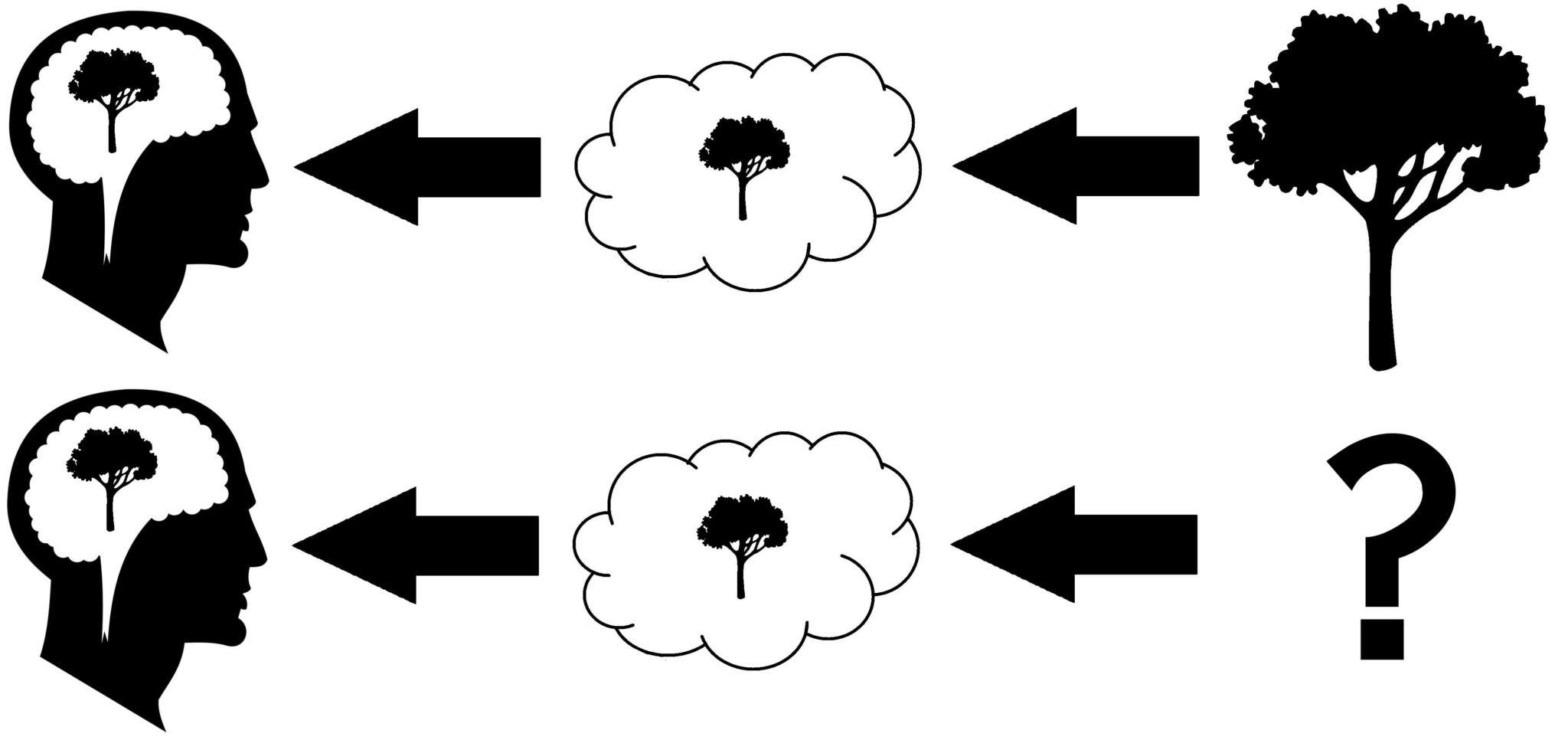
Look at the two diagrams above. What would be the difference from the perceiver’s perspective between the two?
What difference would it make to the perceiver if there was no physical world at all? [as postulated by Indirect Realists]
This is asking, what if we deny Indirect Realism?
The answer, surely, is nothing.
If we only perceive sense data, and not the object itself, how can we know anything about the external world?
There is no way of telling if the sense data is an accurate representation of the external world – or even that there is an external world at all!
We can’t get beyond the veil of perception (sense data) to access the external world behind it.
So, how can indirect realism justify its claim that there is a mind-independent external world that causes sense data if we never actually perceive the mind-independent external world itself?
Without thoroughly understanding and grasping the criticism of the OP, Atla seek out ChatGpt [which has limitations]
viewtopic.php?p=704485&sid=780c9f4dc85c ... ea#p704485
The point is, ChatGpt will respond accordingly to one's levels of intelligence. If one approach from low intelligence level, ChatGpt will respond accordingly. ChatGpt [even though capable] will not provide PhD level, if the one who question is asking a kindi-level question.
Obviously this is more realistic than Indirect Realism which speculate and assume [based on faith] there is something existing beyond the empirical.
Here is a better move by Atla in asking the question what is the main critiques of indirect realism, from a transcendental idealist perspective?
Indirect Realism does rely on empirical evidence but not ultimately on empirical evidence rather Indirect Realism speculate and assume there is an absolute ultimate reality beyond the empirical, i.e. the things-in-themselves or things-by-themselves existing regardless whether there are human or not.
Indirect Realism is Not Realistic
viewtopic.php?t=42063
Here is summary of the discussion up to Mar, 30, 2024:
Indirect Realism is Not Realistic
viewtopic.php?p=704336#p704336
The main problem why Indirect Realism is not realistic.
SCEPTICISM AND THE VEIL OF PERCEPTION
A problem for indirect realism is that it leads to scepticism about the nature and existence of the external world.
Look at the two diagrams above. What would be the difference from the perceiver’s perspective between the two?
What difference would it make to the perceiver if there was no physical world at all? [as postulated by Indirect Realists]
This is asking, what if we deny Indirect Realism?
The answer, surely, is nothing.
If we only perceive sense data, and not the object itself, how can we know anything about the external world?
There is no way of telling if the sense data is an accurate representation of the external world – or even that there is an external world at all!
We can’t get beyond the veil of perception (sense data) to access the external world behind it.
So, how can indirect realism justify its claim that there is a mind-independent external world that causes sense data if we never actually perceive the mind-independent external world itself?
Without thoroughly understanding and grasping the criticism of the OP, Atla seek out ChatGpt [which has limitations]
viewtopic.php?p=704485&sid=780c9f4dc85c ... ea#p704485
ChatGpt responded to Atla based on his narrow view.Atla the KG wrote:
Which explanation is more likely to be correct according to empirical observation?
The point is, ChatGpt will respond accordingly to one's levels of intelligence. If one approach from low intelligence level, ChatGpt will respond accordingly. ChatGpt [even though capable] will not provide PhD level, if the one who question is asking a kindi-level question.
I understand ChatGpt is interacting with Atla at the kindi-level, so I interrupted from the PhD level as discussed with ChatGpt as follows;ChatGpt to Atla:
According to empirical observation, indirect realism is more likely to align with our understanding of reality. Empirical evidence consistently suggests that there is an external world that exists independently of our perception. Through scientific experiments and observations, we gather data that supports the existence of objective features and properties of the external world.
I provided details with reference to Kant’s ideas and ChatGpt responded as follows;VA to ChatGpt wrote:
Topic: Kant Empirical Realism & Transcendental Realism:
viewtopic.php?p=704492&sid=104b44d1700d ... 3c#p704492
My interlocutor provided the following from ChatGpt.
(I believe my interlocutor did not provide the proper perspective for ChatGpt's consideration.)
[ChatGpt]"Yes, this could be considered an example of inconsistency when attempting to incorporate empirical realism within transcendental idealism. Empirical realism typically asserts the existence of an objective reality independent of human cognition, while transcendental idealism emphasizes the subjective nature of reality and the role of human cognition in shaping our understanding of the world. When trying to reconcile these perspectives, conflicts may arise, such as in explaining the disparity between classical intuitions of space and time and the findings of Einsteinian relativity. "
With Kant's Transcendental Idealism, the basic approach to reality is to rely solely on empirical evidences plus critical thinking without assuming there is something real beyond the empirical.”ChatGpt” wrote:Yes, your points are reasonable and provide a more nuanced understanding of Kant's philosophical framework.
Overall, your interpretation provides a more accurate portrayal of Kant's philosophical position and his attempt to reconcile empirical realism with transcendental idealism within the framework of the CPR.
viewtopic.php?p=704586&sid=75644e120d01 ... b8#p704586
Obviously this is more realistic than Indirect Realism which speculate and assume [based on faith] there is something existing beyond the empirical.
Here is a better move by Atla in asking the question what is the main critiques of indirect realism, from a transcendental idealist perspective?
ChatGpt gave a detailed critique of Indirect Realism from the Transcendental Idealist’s perspective and concluded with the following;Atla the KG wrote:
What are the main critiques of indirect realism, from a transcendental idealist perspective?
This is pointed out in the OP, i.e. Indirect Realism is not realistic, i.e. there is a Veil of Perception that lead to skepticism, thus cannot be realistic.Overall, from a transcendental idealist perspective, indirect realism is critiqued for its potential to undermine the possibility of knowledge of the external world and for its implications regarding the nature of perception and the limits of human understanding.
Indirect Realism does rely on empirical evidence but not ultimately on empirical evidence rather Indirect Realism speculate and assume there is an absolute ultimate reality beyond the empirical, i.e. the things-in-themselves or things-by-themselves existing regardless whether there are human or not.
Re: PH's Thing, Fact, Object is a Thing-in-Itself
But where are your actual counters to my arguments? I went through all the points. Even according to your God, indirect realism is more realistic from a scientific point of view than transcendental idealism. And you haven't added anything.Veritas Aequitas wrote: ↑Sun Jul 07, 2024 5:51 am I have already trashed Indirect Realism as delusional [not realistic] here;
Indirect Realism is Not Realistic
viewtopic.php?t=42063
Here is summary of the discussion up to Mar, 30, 2024:
Indirect Realism is Not Realistic
viewtopic.php?p=704336#p704336
The main problem why Indirect Realism is not realistic.
SCEPTICISM AND THE VEIL OF PERCEPTION
A problem for indirect realism is that it leads to scepticism about the nature and existence of the external world.
Look at the two diagrams above. What would be the difference from the perceiver’s perspective between the two?
What difference would it make to the perceiver if there was no physical world at all? [as postulated by Indirect Realists]
This is asking, what if we deny Indirect Realism?
The answer, surely, is nothing.
If we only perceive sense data, and not the object itself, how can we know anything about the external world?
There is no way of telling if the sense data is an accurate representation of the external world – or even that there is an external world at all!
We can’t get beyond the veil of perception (sense data) to access the external world behind it.
So, how can indirect realism justify its claim that there is a mind-independent external world that causes sense data if we never actually perceive the mind-independent external world itself?
Without thoroughly understanding and grasping the criticism of the OP, Atla seek out ChatGpt [which has limitations]
viewtopic.php?p=704485&sid=780c9f4dc85c ... ea#p704485ChatGpt responded to Atla based on his narrow view.Atla the KG wrote:
Which explanation is more likely to be correct according to empirical observation?
The point is, ChatGpt will respond accordingly to one's levels of intelligence. If one approach from low intelligence level, ChatGpt will respond accordingly. ChatGpt [even though capable] will not provide PhD level, if the one who question is asking a kindi-level question.
I understand ChatGpt is interacting with Atla at the kindi-level, so I interrupted from the PhD level as discussed with ChatGpt as follows;ChatGpt to Atla:
According to empirical observation, indirect realism is more likely to align with our understanding of reality. Empirical evidence consistently suggests that there is an external world that exists independently of our perception. Through scientific experiments and observations, we gather data that supports the existence of objective features and properties of the external world.
I provided details with reference to Kant’s ideas and ChatGpt responded as follows;VA to ChatGpt wrote:
Topic: Kant Empirical Realism & Transcendental Realism:
viewtopic.php?p=704492&sid=104b44d1700d ... 3c#p704492
My interlocutor provided the following from ChatGpt.
(I believe my interlocutor did not provide the proper perspective for ChatGpt's consideration.)
[ChatGpt]"Yes, this could be considered an example of inconsistency when attempting to incorporate empirical realism within transcendental idealism. Empirical realism typically asserts the existence of an objective reality independent of human cognition, while transcendental idealism emphasizes the subjective nature of reality and the role of human cognition in shaping our understanding of the world. When trying to reconcile these perspectives, conflicts may arise, such as in explaining the disparity between classical intuitions of space and time and the findings of Einsteinian relativity. "With Kant's Transcendental Idealism, the basic approach to reality is to rely solely on empirical evidences plus critical thinking without assuming there is something real beyond the empirical.”ChatGpt” wrote:Yes, your points are reasonable and provide a more nuanced understanding of Kant's philosophical framework.
Overall, your interpretation provides a more accurate portrayal of Kant's philosophical position and his attempt to reconcile empirical realism with transcendental idealism within the framework of the CPR.
viewtopic.php?p=704586&sid=75644e120d01 ... b8#p704586
Obviously this is more realistic than Indirect Realism which speculate and assume [based on faith] there is something existing beyond the empirical.
Here is a better move by Atla in asking the question what is the main critiques of indirect realism, from a transcendental idealist perspective?
ChatGpt gave a detailed critique of Indirect Realism from the Transcendental Idealist’s perspective and concluded with the following;Atla the KG wrote:
What are the main critiques of indirect realism, from a transcendental idealist perspective?
This is pointed out in the OP, i.e. Indirect Realism is not realistic, i.e. there is a Veil of Perception that lead to skepticism, thus cannot be realistic.Overall, from a transcendental idealist perspective, indirect realism is critiqued for its potential to undermine the possibility of knowledge of the external world and for its implications regarding the nature of perception and the limits of human understanding.
Indirect Realism does rely on empirical evidence but not ultimately on empirical evidence rather Indirect Realism speculate and assume there is an absolute ultimate reality beyond the empirical, i.e. the things-in-themselves or things-by-themselves existing regardless whether there are human or not.
Nothing but ad hom. I already better understood the arguments 20 years ago than you do now. If you ever wondered why your God keeps agreeing with me and not you.Veritas Aequitas wrote: ↑Sun Jul 07, 2024 5:48 am Without thoroughly understanding and grasping the criticism of the OP, Atla seek out ChatGpt [which has limitations]
...
The point is, ChatGpt will respond accordingly to one's levels of intelligence. If one approach from low intelligence level, ChatGpt will respond accordingly. ChatGpt [even though capable] will not provide PhD level, if the one who question is asking a kindi-level question.
...
I understand ChatGpt is interacting with Atla at the kindi-level, so I interrupted from the PhD level as discussed with ChatGpt as follows;
-
Veritas Aequitas
- Posts: 15719
- Joined: Wed Jul 11, 2012 4:41 am