Christianity

For all things philosophical.

Moderators: AMod, iMod

User avatar
Immanuel Can
Posts: 27604
Joined: Wed Sep 25, 2013 4:42 pm

Re: Christianity

Post by Immanuel Can »

Alexis Jacobi wrote: Sat Jun 04, 2022 6:36 pm
Immanuel Can wrote: Sat Jun 04, 2022 4:57 pmAtheists (if any are paying attention) would it be fine with you if we say the Jewish and Christian God does not exist, but Zeus, Odin, Baal, Brahma, Crom, Ashtoreth, Set, Apollo and the Yoruban "gods", or at least one of them, do exist? Is that the sort of disbelief you actually have? Are you prepared to accept as a given that SOME God or gods exist, and move on happily to debating HIs/their nature?
As per usual I think my points sail over your head.
No, it's perfectly responsive to your query, and appeals to the authoritative source, Atheists themselves. I can see no reasonable objection to us eliciting their input.
The real issue -- and this is the issue we Moderns face (I am speaking of those participating in this thread) -- is that we are in a situation where it is not possible to arrive at a definition of what sort of 'god'
Sure we are.

What makes you think it would even be difficult?

For example, one thing we can know for sure is that either God exists, or He does not. A second is that either there are gods (superbeings, like Zeus, Thor, etc.) or there is a singular God (Supreme Being), or there is none of either. There are no further logical alternatives.

And that's just a start. If God speaks, for example, then we have a choice to believe Him or not. But if He does, then to reveal His own nature is so easy that literally, a child can do it...why would we think it would present a difficulty to the Supreme Being, then?

You're too happy with not knowing. That's an overrated state...especially when information is available.
User avatar
Alexis Jacobi
Posts: 8301
Joined: Tue Oct 26, 2021 3:00 am

Re: Christianity

Post by Alexis Jacobi »

Immanuel Can wrote: Sat Jun 04, 2022 7:36 pmWhat makes you think it would even be difficult?
This, it seems to me, is not just a non-intelligent question (even as a rhetorical question) and borders on the asinine.

If it were *easy* to confirm, with absolute certainty, the existence of a god of the sort that Christianity visualizes, it would be as easy, say, as dialing a number on your phone and having the call picked-up by the supreme lord of all creation. Or simple saying *Jesus! Appear before me now, please! I have my doubts and need a verifiable confirmation* and ::: shazzam! ::: He appears just as He appeared to the Apostles.

[Since I always try to maintain my humor I must include this image here -- but for Heaven's sake do not take it too literally ...]

Image

What does it mean that -- whatever sort of divinity or originating conscious and designing power exists -- the existence of god has to be taken through second-hand inferences? But me asking this question, and given your proclivities, you will take it to mean that I am an atheist. For all that I have explained over months you have not read well even one paragraph. You seem to me locked out of any understanding. The fact of the matter is that if god exists (I will of course respect the convention of capitalizing god if referring directly to the Christian God but I am here speaking more generally). If god exists (so perceive many people) he does not make it at all easy to *believe in him*. You might infer a wondrous god by examining nature and everything surrounding us, but this does not *speak* in any way to the sort of god generally pictured in most religions. The god of nature is utterly silent and inscrutable.

I am describing to you not necessarily how I see things or how my own spiritual life has been, or felt, but rather what the general perception is. And what is perceived seems to me very sound.
For example, one thing we can know for sure is that either God exists, or He does not. A second is that either there are gods (superbeings, like Zeus, Thor, etc.) or there is a singular God (Supreme Being), or there is none of either. There are no further logical alternatives.
No, we can suppose or believe very strongly, and we may even have certain *evidences* that bolster our belief, but we do not ever receive overt, mass-perceived revelations of god's existence. Thus there is the belief of believers (who are certain, through interior experiences, that *god exists*) and there are others who have faith-belief (something less certain but, perhaps, intuited); and there are even those who declare faith and belief without really having it (I would suspect the Benny Hinns are of this camp). But absolute and sure knowledge that god exists? comparable to my certainty that the sun in the sky exists and cannot be denied? No, that god is not evident.

For all your self-acclaimed 'logic' you seem to me to completely fail in sound reasoning. This is a bizarre problem and I admit that I am really puzzled by you. You pretend to be able to reason, and you even know the terms of reason, but you cannot reason! I have never encountered someone like you. Forgive me for being in a state of wonderment.
And that's just a start. If God speaks, for example, then we have a choice to believe Him or not. But if He does, then to reveal His own nature is so easy that literally, a child can do it...why would we think it would present a difficulty to the Supreme Being, then?
Now here I have a different perspective. I believe that higher awareness, or something that seems goddish (I am uncertain what word to use) can definitely present itself. But where I differ (from you obviously) is that I am uncertain how to define it.

So I will, for the sake of simplicity, use a Jungian term: Self, higher self, of god-image (as a reflection or manifestation of something mysteriously internal (but this does not mean simply a facet of my own self or my personality). How does this 'god' (awareness, intelligence) speak? Again I can't do much more than to employ Jungian terms. In 'synchronicities' ('acausal connecting principle' is how Jung described it, marvelously pretentiously), through situations which occur that seem 'arranged' and replete with meaning that I can capture (and have captured).

There is also revelation with a small 'r' and also the sort of meaning and consciousness that is often revealed in dreams or epiphanies. There are also life-events that, mysteriously, produce awareness and increase of consciousness. Then, additionally, there is wisdom-scripture (which is second-hand material) as well as the benefit of association with men or women who are realized in some way.

When you say 'God speaks' what you mean is that you have determined that the utterances in the New Tsetament (or OT) are direct quotes of the God who spoke. And you may also 'testify' (though you never do here) to the wonderful things God has done for you. I could imagine you testifying, for example, in your church.

But any evidence, of a clear, tangible and repeatable sense that we understand evidence to be, of 'God speaking' would be of a second- and third-hand sort. Or as I say through what is recorded in the Gospels.
You're too happy with not knowing. That's an overrated state...especially when information is available.
No, that is not right. I have had all manner of different experiences. But as I have said my experience is of a gnostic sort. It does not conform to the typical descriptions or the accepted narrative. This is why, I think, I would be one of those who if called to *define god* would do so by reference not to the Christian God-concept, but to something more Abraxisian. But I am not referring to the genuinely Gnostic conception.

What I am pointing to is not a contrivance of my own necessarily, but a step taken by those for whom the old god-concept (i.e. the God-Father in the sky -- which is essentially what the Jesus-God pictures) -- is no longer tenable.

I have a feeling that many people you are talking to, if they are not overt atheists (or simply sick to tears of the entire topic) may share a similar concept. But the god of the world (universe, cosmos) that has been, say, discovered (seen for the first time) in the last 150 years is, as I have been saying, and which you continue not hearing, a god unlike the historical god-conception.
Nick_A
Posts: 6208
Joined: Sat Jul 07, 2012 1:23 am

Re: Christianity

Post by Nick_A »

Nick_A wrote: Sat Jun 04, 2022 5:05 pm I C
Islam -- "There is one God..."

Atheism -- "There is no God."
“When a contradiction is impossible to resolve except by a lie, then we know that it is really a door.” ~ Simone Weil

I C has given us a contradiction which cannot be resolved by duality so requires a lie to resolve it. The law of the excluded middle reveals how they cannot both exist.

However, the law of the included middle reveals the door Simone alludes to. Here is a simplified version:

https://www.edge.org/response-detail/27155
..........The Included Middle is a theory proposing that logic has a three-part structure. The three parts are the positions of asserting something, the negation of this assertion, and a third position that is neither or both. Lupasco labeled these states A, not-A, and T. The Included Middle stands in opposition to classical logic stemming from Aristotle. In classical logic, the Principle of Non-contradiction specifically proposes an Excluded Middle, that no middle position exists, tertium non datur (there is no third option). In traditional logic, for any proposition, either that proposition is true, or its negation is true (there is either A or not-A). While this could be true for circumscribed domains that contain only A and not-A, there may also be a larger position not captured by these two claims, and that is articulated by the Included Middle.

Heisenberg noticed that there are cases where the straightforward classical logic of A and not-A does not hold. He pointed out how the traditional law of Excluded Middle has to be modified in Quantum Mechanics. In general cases at the macro scale, the law of Excluded Middle would seem to hold. Either there is a table here, or there is not a table here. There is no third position. But in the Quantum Mechanical realm, there are the ideas of superposition and possibility, where both states could be true. Consider Schrödinger’s cat being possibly either dead or alive, until an observer checks and possibility collapses into a reality state. Thus a term of logic is needed to describe this third possible situation, hence the Included Middle. It is not “middle” in the sense of being between A and not-A, that there is a partial table here, but rather in the sense that there is a third position, another state of reality, that contains both A and not-A. This can be conceptualized by appealing to levels of reality. A and not-A exist at one level of reality, and the third position at another. At the level of A and not-A, there are only the two contradictory possibilities. At a higher level of reality, however, there is a larger domain, where both elements could be possible; both elements are members of a larger set of possibilities.
hence the Included Middle. It is not “middle” in the sense of being between A and not-A, that there is a partial table here, but rather in the sense that there is a third position, another state of reality, that contains both A and not-A. This can be conceptualized by appealing to levels of reality. A and not-A exist at one level of reality, and the third position at another. At the level of A and not-A, there are only the two contradictory possibilities. At a higher level of reality, however, there is a larger domain, where both elements could be possible; both elements are members of a larger set of possibilities.


Christianity is this way. Where Christendom follows the law of the excluded middle, Christianity, with the help of the spirit, calls us to consciously evolve into a higher level of reality and freedom from the prison of the world governed by the attractions of animal duality
Obviously those here are content with animal duality so the law of the included middle is unimportant. Yet for those seeking objective meaning it can only come through the third force of reason. Duality can only lead to subjective definitions of meaning
What makes the abyss between twentieth-century science and that of previous centuries is the different role of algebra. In physics algebra was at first simply a process for summarizing the relations, established by reasoning based on experiment, between the ideas of physics; an extremely convenient process for the numerical calculations necessary for their verification and application. But its role has continually increased in importance until finally, whereas algebra was once the auxiliary language and words the essential one, it is now exactly the other way round. There are even some physicists who tend to make algebra the sole language, or almost, so that in the end, an unattainable end of course, there would be nothing except figures derived form experimental measurements, and letters, combined in formulae. Now, ordinary language and algebraic language are not subject to the same logical requirement; relations between ideas are not fully represented by relations between letters; and, in particular, incompatible assertions may have equational equivalents which are by no means incompatible. When some relations between ideas have been translated into algebra and the formulae have been manipulated solely according to the numerical data of the experiment and the laws proper to algebra, results may be obtained which, when retranslated into spoken language, are a violent contradiction of common sense.

Weil argues that this creates an incomplete and, in its incompleteness, illusory representation of reality — even when it bisects the planes of mathematical data and common sense, such science leaves out the unquantifiable layer of meaning:

If the algebra of physicists gives the impression of profundity it is because it is entirely flat; the third dimension of thought is missing.

That third dimension is that of meaning — one concerned with notions like “the human soul, freedom, consciousness, the reality of the external world.” (Three decades later, Hannah Arendt — another of the twentieth century’s most piercing and significant minds — would memorably contemplate the crucial difference between truth and meaning, the former being the material of science and the latter of philosophy.)
The third dimension of thought leading to the experience of meaning is absent in the modern world caught up in the flat world of duality: the computer mind. The experience of meaning recognizes if there is a God or not from the higher conscious perspective of objective meaning duality is incapable of
User avatar
Immanuel Can
Posts: 27604
Joined: Wed Sep 25, 2013 4:42 pm

Re: Christianity

Post by Immanuel Can »

Alexis Jacobi wrote: Sat Jun 04, 2022 10:26 pm
Immanuel Can wrote: Sat Jun 04, 2022 7:36 pmWhat makes you think it would even be difficult?
This, it seems to me, is not just a non-intelligent question (even as a rhetorical question) and borders on the asinine.
Not at all.

If an ordinary human can explain to another ordinary human who he/she is, what is the difficulty in the Supreme Being doing the same?

It doesn't even look hard.
For example, one thing we can know for sure is that either God exists, or He does not. A second is that either there are gods (superbeings, like Zeus, Thor, etc.) or there is a singular God (Supreme Being), or there is none of either. There are no further logical alternatives.
No, we can suppose or believe very strongly, and we may even have certain *evidences* that bolster our belief, but we do not ever receive overt, mass-perceived revelations of god's existence.
That's not even the point.

There are only three possible alternatives: no gods, one God, multiple gods. That's it. A rational person has to pick one of those alternatives, because there are no others even possible.

Ironically, it means that whichever alternative one picks, at least two of three must be wrong. There's no escaping that.
You're too happy with not knowing. That's an overrated state...especially when information is available.
No, that is not right.
Yeah, it is. If one would rather "not know," because then, nothing can be expected of one...one thinks...then one is off the hook.

But that's wrong, too. If one could have known, and one refused to know, then one answers for that. Willful ignorance is not an excuse.
Dubious
Posts: 4637
Joined: Tue May 19, 2015 7:40 am

Re: Christianity

Post by Dubious »

Immanuel Can wrote: Sun Jun 05, 2022 2:40 am
If an ordinary human can explain to another ordinary human who he/she is, what is the difficulty in the Supreme Being doing the same?
Hmm! Let me see. Maybe it's because we've met other humans, humans create other humans, and because they're kind of hard to miss even when trying one's best to do just that. On the other hand no proven, verified, ironclad, incontestable, irrefutable supreme being has ever been encountered on planet earth except to those where none of the above is required or even desired! That is, those whose brains have been permanently deformed by a rather gruesome tale contained in what's called the Good Book, you know, the one that cooked your brains; a rather silly story that makes god look like a beggar but one who supposedly died for our sins - since Adam no less - by being executed in the same manner as all the other blokes who didn't have the privilege of dying for our sins.

It goes to show that humans trying to create a god out of another flesh and blood human resembles a patched up Frankenstein story. More obscene than the story itself are the demented who accept it as truth incarnate, that part being unfortunately true.
User avatar
Immanuel Can
Posts: 27604
Joined: Wed Sep 25, 2013 4:42 pm

Re: Christianity

Post by Immanuel Can »

Dubious wrote: Sun Jun 05, 2022 3:46 am
Immanuel Can wrote: Sun Jun 05, 2022 2:40 am
If an ordinary human can explain to another ordinary human who he/she is, what is the difficulty in the Supreme Being doing the same?
Hmm! Let me see. Maybe it's because we've met other humans...
Not the question.

The question is, IF a Supreme Being exists, why would we suppose it would be problematic for Him to reveal His identity?
User avatar
Dontaskme
Posts: 16929
Joined: Sat Mar 12, 2016 2:07 pm
Location: Nowhere

Re: Christianity

Post by Dontaskme »

Immanuel Can wrote: Sat Jun 04, 2022 7:36 pm

You're too happy with not knowing. That's an overrated state...especially when information is available.
I am intelligent, I know I do not know.


Everything else is an assumption or a belief.
User avatar
Dontaskme
Posts: 16929
Joined: Sat Mar 12, 2016 2:07 pm
Location: Nowhere

Re: Christianity

Post by Dontaskme »

Immanuel Can wrote: Sun Jun 05, 2022 4:03 am Not the question.

The question is, IF a Supreme Being exists, why would we suppose it would be problematic for Him to reveal His identity?
A 'Supreme Being' existing as IF there was something greater than yourself will always be an assumption or a belief...it will will be something that is surplus to requirement, because all you can know is your own self, from which all your knowing is sourced.

Within your own source knowing there appears to be questions requiring answers...This is known in nondual terminology as the illusory dream of separation - illusory in the logical sense that 'thought' is inseprable from the 'thinker'

The brain process known as 'questioning' is a conceptual splitting of yourself into two things.
1: (The Knower) and 2: (The Known)

This separation is physically impossible, because all 'known things' are concepts sourced only within your own mind. Known concepts are always a story upon the BLANK CANVAS of Consciousness, seemingly, too deep for you to comprehend IC..

So, once again, Mr Can, you prefer to remain stuck in the 'tar baby' syndrome. A difficult problem that is only aggravated by attempts to solve it.

Your refusal to 'close the gap' between thinker and thought, is your problem, albeit illusory.


.
Dubious
Posts: 4637
Joined: Tue May 19, 2015 7:40 am

Re: Christianity

Post by Dubious »

Immanuel Can wrote: Sun Jun 05, 2022 4:03 am
Dubious wrote: Sun Jun 05, 2022 3:46 am
Immanuel Can wrote: Sun Jun 05, 2022 2:40 am
If an ordinary human can explain to another ordinary human who he/she is, what is the difficulty in the Supreme Being doing the same?
Hmm! Let me see. Maybe it's because we've met other humans...
Not the question.

The question is, IF a Supreme Being exists, why would we suppose it would be problematic for Him to reveal His identity?
IF a supreme being exists it wouldn't be in the least problematic for it to do so. If it did decide to declare itself, there would not ever again be anything problematic left over about god's existence and half the philosophy forums would be out of business. However, since none of that ever happened and in addition can't even find a reason for its necessity, it's safe to consider god as an empty set of nothing which so far was only believed in without anything ACTUALLY being there.

Humans in all kinds of ways are very good at that!
User avatar
Immanuel Can
Posts: 27604
Joined: Wed Sep 25, 2013 4:42 pm

Re: Christianity

Post by Immanuel Can »

Dubious wrote: Sun Jun 05, 2022 7:49 am
Immanuel Can wrote: Sun Jun 05, 2022 4:03 am
Dubious wrote: Sun Jun 05, 2022 3:46 am Hmm! Let me see. Maybe it's because we've met other humans...
Not the question.

The question is, IF a Supreme Being exists, why would we suppose it would be problematic for Him to reveal His identity?
IF a supreme being exists it wouldn't be in the least problematic for it to do so.
Quite right. Thank you.
If it did decide to declare itself, there would not ever again be anything problematic left over about god's existence and half the philosophy forums would be out of business.
Heh. :D Maybe some could stand to be. They're not all great, if you've noticed.

However, no, that's not so. It doesn't follow that if God knows everything then human beings do. We'd still be doing philosophy and theology, because we are limited beings.

We need it. God doesn't.
User avatar
henry quirk
Posts: 16379
Joined: Fri May 09, 2008 8:07 pm
Location: 🔥AMERICA🔥
Contact:

Re: Christianity

Post by henry quirk »

As I still believe this thread has a purpose, and as I can help redirect the thread back to that purpose...

The Jefferson Bible: who here has read it?

Opinions?
Nick_A
Posts: 6208
Joined: Sat Jul 07, 2012 1:23 am

Re: Christianity

Post by Nick_A »

henry quirk wrote: Sun Jun 05, 2022 2:12 pm As I still believe this thread has a purpose, and as I can help redirect the thread back to that purpose...

The Jefferson Bible: who here has read it?

Opinions?
It is a lost cause Henry. Those here are obsessed with arguing details which just moves further from the topic of Christianity. They have lost the wholeness of the forest for the sake of arguing the trees. They argue from their conditioned personalities rather then contemplating their essence. But God can only speak to their essence: the seed of the soul which has been covered by imagination. It is all a part of the fallen human condition
User avatar
henry quirk
Posts: 16379
Joined: Fri May 09, 2008 8:07 pm
Location: 🔥AMERICA🔥
Contact:

Re: Christianity

Post by henry quirk »

Nick_A wrote: Sun Jun 05, 2022 2:26 pm
henry quirk wrote: Sun Jun 05, 2022 2:12 pm As I still believe this thread has a purpose, and as I can help redirect the thread back to that purpose...

The Jefferson Bible: who here has read it?

Opinions?
*It is a lost cause Henry. Those here are obsessed with arguing details which just moves further from the topic of Christianity. They have lost the wholeness of the forest for the sake of arguing the trees. They argue from their conditioned personalities rather then contemplating their essence. But God can only speak to their essence: the seed of the soul which has been covered by imagination. It is all a part of the fallen human condition
*Probably, but it cost me little to attempt a re-direct.
User avatar
Alexis Jacobi
Posts: 8301
Joined: Tue Oct 26, 2021 3:00 am

Re: Christianity

Post by Alexis Jacobi »

Nick_A wrote: Sun Jun 05, 2022 2:26 pmIt is a lost cause Henry. Those here are obsessed with arguing details which just moves further from the topic of Christianity. They have lost the wholeness of the forest for the sake of arguing the trees. They argue from their conditioned personalities rather then contemplating their essence. But God can only speak to their essence: the seed of the soul which has been covered by imagination. It is all a part of the fallen human condition
It is not fair to say we are arguing details. We seem to be talking about the general situation of both Christian faith as well as the problems of general faith in divine being. What you seem to be saying, if I understand you correctly (I think I do because it is your sole and entire thrust and your sole contribution) is that you have discovered a mystical path through which your relationship to Christianity has no problem or issues.

I personally believe that what you say is true, and I also believe that I understand what you are saying. But here is the thing: you are not going to have success among the people who participate in this thread in your effort to convince them to undertake a Christian contemplative path. At least this appears to be true. Who knows what each person here will ultimately decide in terms of the conduct of their *inner life*? I do not think anyone, nor even IC, desires to speak about intimate and personal topics related to inner life. This is not the place for that. And I personally doubt that any Internet platform is an adequate place for that sort of conversation (though a private forum with closed membership might be possible). Think about it: in all contemplative societies the relationships between practitioners was always crucial.

You are asking for something that cannot be given and is unwise to give.

I disagree that we are 'moving further from the topic of Christianity'. True, we are not here to talk about personal faith-issues or what our specific spiritual lives entail. So in this sense we are discussing exoteric issues. But those are not at all irrelevant to general, social issues. Why would you not be interested in contributing your thoughts at that level?
User avatar
Alexis Jacobi
Posts: 8301
Joined: Tue Oct 26, 2021 3:00 am

Re: Christianity

Post by Alexis Jacobi »

AJ: No, we can suppose or believe very strongly, and we may even have certain *evidences* that bolster our belief, but we do not ever receive overt, mass-perceived revelations of god's existence.
Immanuel Can wrote: Sun Jun 05, 2022 2:40 amThat's not even the point.

There are only three possible alternatives: no gods, one God, multiple gods. That's it. A rational person has to pick one of those alternatives, because there are no others even possible.

Ironically, it means that whichever alternative one picks, at least two of three must be wrong. There's no escaping that.
To understand your argument (such as it is) one must first understand the nature of and the strategies inherent in your apologetic project. You are here to preach and, at least I cannot imagine that you have a different purpose, your purpose is to attempt to convince your readers to accept what you have accepted in your faith-life.

Your core platform, your essential position, is that what you have chosen must be chosen by all. That is to say that what you have concluded -- rationally you say -- is and should be rationally apparent to all of those persons you describe as 'rational persons'. Those rational persons have the 3 options you outline.

If they choose no gods or multiple gods your argument will become to attempt to point out the logical fallacy in the understanding of a no-god position, and as well with a multiple-gods position. The effort will be, and in your case (with your commitments) can only be to accept a one-god conclusion.

Once that is established then the question becomes: of all those religions that propose a supreme being, which one is the better and the truer one? You will break it down into questions of and statements about realness and unrealness. So Vishnu-Krishna (the personality of god said to speak through the Bhagavad-Gita) was described by you deprecatingly as a 'piece of work' (because, I gathered when once we spoke of this) that in the Gita the universal form of god is pictured much like a galactic maelstrom is pictured where 'worlds collide' and terrible destructive forces interact, crushing mercilessly the created forms, etc. etc., before they are re-created into other worlds, all this being an aspect of god's larger creation).

This 'picture' turned your stomach so to speak. Thus, when the god Vishnu-Krishna who speaks in the document known as the Bhagavad-Gita reveals, say, ethical admonishment and speaks as a person to Arjuna (as Jesus may have spoken with any disciple in the Gospels) you dismiss the entire scenario as false and reduce the pictured god to 'a piece of work' and insult as it were the 'picture'. You reduce, then, this god-picture to something diabolic and satanic (and this of course is core Judaism and core Christian belief: all the 'other god' are all false gods and there is only the true God Yahweh -- "You shall have no other gods before me", etc.)

Your concept of divinity, then, is absolutely exclusive. You cannot tolerate, and you will not tolerate, any other god-image or god-description except the one that you have determined is the 'true & real one'.

So let me clarify here that this is the point over which we (philosophically-oriented people) must linger. And this is the point at which and over which I linger. And it is around this point which many people -- intellectuals, theologians, artists -- did in fact linger in the time-period I've described as fin-de-siècle.

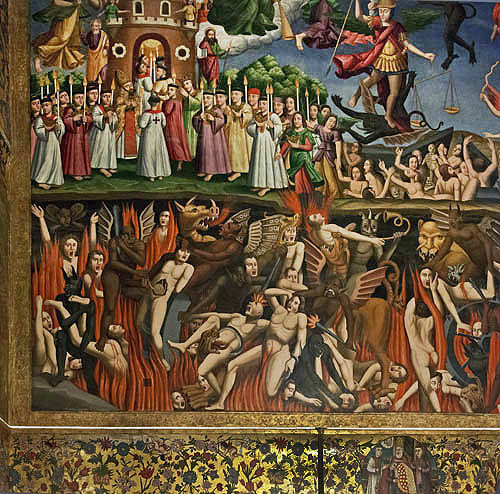
Cutting right to the chase this is what it broke down to: the god-picture, that is the Christian god-picture, could no longer be sustained and maintained. I use a primary 'pillar' of the Christian story to illustrate this: it became no longer possible to 'believe in' a God who dropped Adam & Eve into a primeval garden out of which they 'fell' into the condition Christians say we are now all in (but here is a very important addendum:) and along with the human fall the nature of the world itself was also dragged down into a fallen condition. This is core to both Judaism and Christianity. I assume that most reading here are not fully aware of this.

The Fall of Man produced the conditions of this terrible world. That is to say that *the world* was originally perfect, Man fell, and the world was infected with Man's error. When Man is redeemed, the world will also be redeemed. That is, returned to a perfected state. So when Iambiguous refers to theodicy, and when some anti- or counter-Christians refer to a terrible God's world in which an insect can place larvae in the eye of a child which then eats its way out of that eye (a terrible imago of an aspect of this terrible world), what must be understood is that these conditions came about because of man's own error! He is ultimately responsible. That is what *original sin* means and entails. Original sin is a complex idea. Man's original sin infected the entire world and reduced it from something, say, heavenly, to something tending to hellish. But more properly an intermediate state.
Image

So let me state again that at a certain point in time that this 'picture' became impossible to maintain and sustain. It was seen for what, in fact, it really seems to be: a mythologized description with a preaching function (an apologetic function).

When this story collapsed (when the horizon was erased to use the Nietzschean metaphor) it was, and reasonably so, a culturally and personally shattering event. This 'shattering' is still going on. For some it has not begun, for others it is well advanced, but here is the thing: it is likely inevitable for all.

And on these pages we have often referred to the result of the metaphysical dislocation entailed: nihilism. Loss of sense of 'locality' as well as coherent sense of existential mission.

Now, what you IC want to assert, and indeed you cannot assert any other thing -- this is important: you are locked into one explanatory system and, should you deviate from it, the entire system would shatter and crumble -- and so what this means is that you must do all in your power, even if it involved an irrational or non-rational manoeuvre, to keep your belief system intact. Therefore, you must believe in the realness of Adam & Even in the Garden; you must believe in the Ark and all the rest. This is, of course, where you launch into sheer irrationalism but you could not, and you do not, describe it as such. You could not. Because your System has to be rational through-and-through.

My manoeuvre, in comparison to yours, is odd. I do not dis-believe in God, therefore I would check the box *one God*. But at that point, and with that 'declaration', I would say and I do say that everything about understanding that god and defining that god's theology (so to speak) gets difficult, intricate and complex. And here is another statement: though I can say 'I believe in one god' (in the sense that I do not believe in no-god or multiple-gods) I do not accept, and find I cannot accept, the Standard Version (here I refer to the Christian picture) through which the notion of the one god is revealed and explained. And again I start with the most simple way to illustrate: No original pair dropped in a Garden. No world-destruction events. Et cetera et cetera et cetera.

And additionally, as a Modern, I cannot put to the side the entire, and in its way also shattering, expanded view of the Universe and the way it works (that is to say reality) that impinges so powerfully against mythological religious stories.

Now the ethical questions (the soundness of Christian ethics) remains a separate topic and of course requires a great deal more explanation. The sense of it, or the lack of sense of it, etc.
Post Reply