AJ: No, we can suppose or believe very strongly, and we may even have certain *evidences* that bolster our belief, but we do not ever receive overt, mass-perceived revelations of god's existence.
Immanuel Can wrote: ↑Sun Jun 05, 2022 2:40 amThat's not even the point.
There are only three possible alternatives: no gods, one God, multiple gods. That's it. A rational person has to pick one of those alternatives, because there are no others even possible.
Ironically, it means that whichever alternative one picks, at least two of three must be wrong. There's no escaping that.
To understand your argument (such as it is) one must first understand the nature of and the strategies inherent in your apologetic project. You are here to preach and, at least I cannot imagine that you have a different purpose, your purpose is to attempt to convince your readers to accept what you have accepted in your faith-life.
Your core platform, your essential position, is that what you have chosen must be chosen by all. That is to say that what you have concluded -- rationally you say -- is and should be rationally apparent to all of those persons you describe as 'rational persons'. Those rational persons have the 3 options you outline.
If they choose no gods or multiple gods your argument will become to attempt to point out the logical fallacy in the understanding of a
no-god position, and as well with a
multiple-gods position. The effort will be, and in your case (with your commitments) can only be to accept a one-god conclusion.
Once that is established then the question becomes: of all those religions that propose a supreme being, which one is the better and the truer one? You will break it down into questions of and statements about
realness and
unrealness. So Vishnu-Krishna (the personality of god said to speak through the Bhagavad-Gita) was described by you deprecatingly as a 'piece of work' (because, I gathered when once we spoke of this) that in the Gita the universal form of god is pictured much like a galactic maelstrom is pictured where 'worlds collide' and terrible destructive forces interact, crushing mercilessly the created forms, etc. etc., before they are re-created into other worlds, all this being an aspect of god's larger creation).
This 'picture' turned your stomach so to speak. Thus, when the god Vishnu-Krishna who speaks in the document known as the Bhagavad-Gita reveals, say, ethical admonishment and speaks
as a person to Arjuna (as Jesus may have spoken with any disciple in the Gospels) you dismiss the entire scenario as false and reduce the pictured god to 'a piece of work' and insult as it were the 'picture'. You reduce, then, this god-picture to something diabolic and satanic (and this of course is core Judaism and core Christian belief: all the 'other god' are all false gods and there is only the true God Yahweh -- "You shall have no other gods before me", etc.)
Your concept of divinity, then, is absolutely exclusive. You cannot tolerate, and you will not tolerate, any other god-image or god-description except the one that you have determined is the 'true & real one'.
So let me clarify here that this is the point over which we (philosophically-oriented people) must linger. And this is the point at which and over which
I linger. And it is around this point which many people -- intellectuals, theologians, artists -- did in fact linger in the time-period I've described as fin-de-siècle.
Cutting right to the chase this is what it broke down to: the god-picture, that is the Christian god-picture, could no longer be sustained and maintained. I use a primary 'pillar' of the Christian story to illustrate this: it became no longer possible to 'believe in' a God who dropped Adam & Eve into a primeval garden out of which they 'fell' into the condition Christians say we are now all in (but here is a very important addendum:) and along with the human fall
the nature of the world itself was also dragged down into a fallen condition. This is core to both Judaism and Christianity. I assume that most reading here are not fully aware of this.
The Fall of Man
produced the conditions of this terrible world. That is to say that *the world* was originally perfect, Man fell, and the world was
infected with Man's error. When Man is redeemed, the world will also be redeemed. That is, returned to a perfected state. So when Iambiguous refers to theodicy, and when some anti- or counter-Christians refer to a terrible God's world in which an insect can place larvae in the eye of a child which then eats its way out of that eye (a terrible
imago of
an aspect of this terrible world), what must be understood is that these conditions came about because of man's own error! He is ultimately responsible. That is what *original sin* means and entails. Original sin is a complex idea. Man's original sin infected the entire world and reduced it from something, say, heavenly, to something
tending to hellish. But more properly an intermediate state.
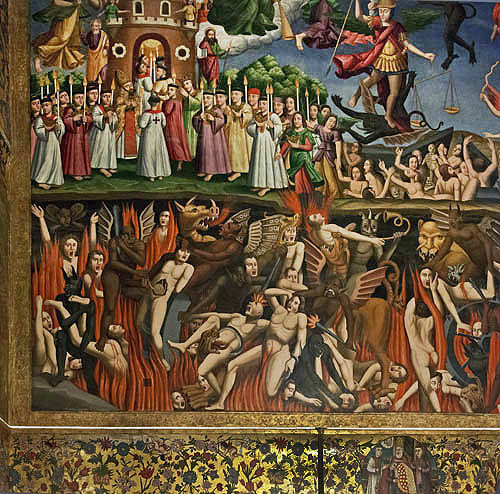
So let me state again that at a certain point in time that this 'picture' became impossible to maintain and sustain. It was seen for what, in fact, it really seems to be: a mythologized description
with a preaching function (an apologetic function).
When this story collapsed (when the horizon was erased to use the Nietzschean metaphor) it was, and reasonably so, a culturally and personally shattering event. This 'shattering' is still going on. For some it has not begun, for others it is well advanced, but here is the thing: it is likely inevitable for all.
And on these pages we have often referred to the result of the metaphysical dislocation entailed: nihilism. Loss of sense of 'locality' as well as coherent sense of existential mission.
Now, what you IC want to assert, and indeed you cannot assert any other thing -- this is important: you are locked into one explanatory system and, should you deviate from it, the entire system would shatter and crumble -- and so what this means is that you must do all in your power, even if it involved an irrational or non-rational
manoeuvre, to keep your belief system intact. Therefore, you must believe in the realness of Adam & Even in the Garden; you must believe in the Ark and all the rest. This is, of course, where you launch into sheer irrationalism but you could not, and you do not, describe it as such. You could not. Because your System has to be rational through-and-through.
My
manoeuvre, in comparison to yours, is odd. I do not dis-believe in God, therefore I would check the box *one God*. But at that point, and with that 'declaration', I would say and I do say that everything about understanding that god and defining that god's theology (so to speak) gets difficult, intricate and complex. And here is another statement: though I can say 'I believe in one god' (in the sense that I do not believe in no-god or multiple-gods) I do not accept, and find I cannot accept, the Standard Version (here I refer to the Christian picture) through which the notion of the one god is revealed and explained. And again I start with the most simple way to illustrate: No original pair dropped in a Garden. No world-destruction events. Et cetera et cetera et cetera.
And additionally, as a Modern, I cannot put to the side the entire, and in its way also shattering, expanded view of the Universe and the way it works (that is to say reality) that impinges so powerfully against mythological religious stories.
Now the ethical questions (the soundness of Christian ethics) remains a separate topic and of course requires a great deal more explanation. The sense of it, or the lack of sense of it, etc.


 Maybe some could stand to be. They're not all great, if you've noticed.