Nor do they ever arrive at such a state.
So knowledge is the absence of anything?
That's also incoherent.
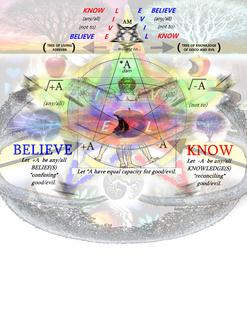
And what would you conclude about your theory if one is approaching -A, but the suffering is not being alleviated?
Similarly: what would you conclude about your theory if one is approaching +A yet the suffering is alleviated?
For some would argue that ignorance is bliss!
It takes a believer to believe that they can define "good" with "evil" correctly.
It takes a believer to believe incorrectness is correct (without the need to define them, which if done so correctly OR incorrectly, immediately renders this argument circular.)
I don't think so... You are calling my beliefs 'beliefs'. Exactly like I am calling your beliefs 'beliefs'
By induction - I can't see why we can't call your beliefs 'beliefs' also.
Sounds like you are special-pleading for an exemption.
Hi pot, my name is kettle.
it's not just mine! You called my beliefs 'beliefs' also! You are tacitly agreeing with me.
If they are universally applicable how come I can't apply your laws?nothing wrote: ↑Wed Nov 20, 2019 5:53 pm The properties (ie. "laws") of the cosmos map as "laws" that act on any/all social fabrics esp. science, language, ethics, logic/physics etc. To know the "laws" of the mundane matters of creation has application to all scales if the laws are, in fact, universally applicable.
Exactly. An *is* is not an *ought*.
It's a definite observation, not a definite assertion.
When a solution believes itself to be a solution, you get things like Christianity.
You've solved nothing.
And who are you in the scenario? A, B or C?
How did you decide on B's correctness?
 ?
?