

Alrighty then - lets get started! (hidden wink of sarcasm here).
Below I will be using the definition from academic biology. "Animal" means anything that is not a bacterium, protozoa, or plant. Basically, if it has multiple cells and it is not fungus or plant, then it is an animal. In particular this very wide "animal" class will also contain insects and earthworms, (as well as humans, horses, and dogs).
The earth we see (that was designed to-order by God) contains about 29% of its surface dedicated to dry land, the rest being covered in ocean. Despite this small percentage, lets concentrate on our first question about this planet on the dry land (...that was designed by God).
Okay then ...
1. What animal on land is the most successful?
One might be seduced into thinking that humans are the most successful. Because well, we can beat any other predator in a fight with our fancy weapons. It turns out, however, that humans are not all that successful on the dry land. But worse than that, not even the apex predators of lions or wolves are at the top of the list. Apparently, God designed this planet so that the most successful land animal is the ant.
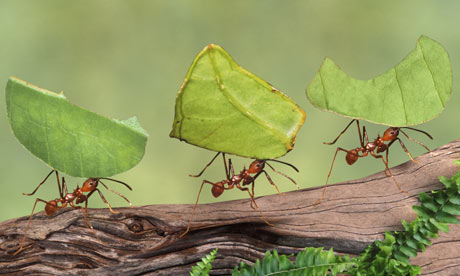
Is that surprising to you? Surprising or not, it is totally true. If you take the aggregate body mass of all humans on earth, and compare it to the aggregate body mass of all ants, humans fall short. Scientists refer to this as the "terrestrial biomass" of a species. Humans not only fall short, but our combined mass is 30 times smaller than that of ants. Even if we cheated by including the mass of all deer, dogs, cattle, horses, and cats in with us, we still would not be even halfway to defeating the wildly successful ant.
We can rest assured that when God designed the earth, he intended to have the dry land to be dominated by ants. Those little guys who sacrifice themselves selflessly for the good of the communist colony, to the chagrin of Conservative Republican voters. Maybe God is telling us that he really likes ants. (I'm not completely sure of His intended Meaning here.)
2. What is the most successful animal on earth, period?
If we include the oceans as well as dry land, (exclude fungus and plants) we can ask which animal God made most of. Or if He did not expressedly create them, we can still ask which ones get by best on His Creation. It turns out the most successul animal on God's planet is something called a Marine Phytoplankton.

Marine phytoplankton are these microscopic little animals who spend their day swimming around in the ocean and absorbing sunlight to make energy. As well as dominating biomass, their species diversity is also staggering. Scientists do not know how many species of phytoplankton exist, but they know it must be larger than 5000 different species. Some people have claimed that God loves us. Well if He does, rest assured He loves phytoplankton a lot more.
3. Is there any special way that God designed animals?
The answer is yes. Within every organism on earth there is a molecule called DNA. This is not theory or scientific conjecture. This is established fact as true as the earth being round. For God so loved DNA, that he put it not only in every animal and beast that scurrieth about, but he also placed it inside of every plant and fungus that groweth.
Jesus Christ had not one, but several chances to mention DNA during his sermons, but chose not to. In my humble opinion, this brings his Divinity into question. The pure universality of DNA in life on earth begs a mention by any Divine messiah. (Humans have DNA too. So don't even take it there.)

The only "entities" on earth that do not contain DNA are viruses. Many contain reduxes of RNA instead. I will discuss those below.
4. DNA is pretty important. So where is most of the DNA located on earth?
So we have established that God has taken a special liking to ants and phytoplankton. It is also obvious that God is obsessed with DNA. He put it in so many things to the point that he is almost being aggresive in His suggestions to us. Given God's DNA obsession, we should perhaps talk a little more about DNA and where we might find it.
There are various ways to calculate biomass in ecology. You can talk about only the dry portions of organisms by excluding the water. But since we are going to be stripping out parts of the body, why not take this logic where it eventually leads. Instead, let's ask where most of the DNA on earth is located. If each organism is a "container" of DNA, where are most of these "containers" located?
A person who abruptly answers "bacteria!" to this question is only technically correct. You would be correct if we were including only living organisms. Ironically, if we include everything and everywhere, the answer is not bacteria.
Most of the DNA on our planet is floating around in the oceans in little packages called bacteriophages. Bacteriophages are (scientifically) classified as viruses. But lets be more explicit here. Viruses are not alive. They are literally little containers that just bump around aimlessly while carrying a sack of DNA on their backs, or in some cases, a package of RNA. Bacteriophages constitute the largest number of DNA packets of anything in the world; far exceeding the number of bacteria by orders of magnitude.
Bacteriophages are these little chemical machines that attach their tube to the outside membranes of bacteria. They then erode the membrane of the bacterium with a needle and squirt some DNA into the inside. The bacterium's chemical machinery then happily goes about creating lots of copies of the bacteriophage. When the bacterium dies, it splits open and an army of bacteriophages emerge to start this process over again.
Nothing in this cycle of bacteriophages is guided. Bacteriophages have no brains and no controllers. They do not turn towards light or swim. The part where they inject DNA into a bacterium is a purely mechanical process that proceeds by chemistry. Their claim to fame is that there is so many of them that they eventually bump into the side of a bacterium by random accident.
If your God created this earth -- if your God designed this earth -- then what your God likes is bacteriophages. He made more of them than anything else and then covered 71% of the earth's surface with oceans, so the little mindless machines could slosh around and make copies of themselves for millions and millions of years.

If God designed organisms, this is what He made and loves.
On this forum, a number of you have loudly proclaimed that your creator God is the designer of DNA. You have openly proposed that DNA must have been designed, and the organisms that form from the blueprints of nucleic acids are hand-designed by your God according to His Plan. Well the facts are in, people. Your God has an inordinate fondness for bacteriophages.


