Philosophy Explorer wrote: ↑Sun Jul 08, 2018 4:26 pm
I've been thinking about with all the talk about global warming, what would constitute a smoking gun? What would make for definite evidence?
It's NOT melting ice and glaciers from Greenland and Antarctica. It's not flooding such as occurred over 100 years ago in China that killed over 900,000 people.
The concern should be rising sea levels. Since 1880 sea levels have risen 8.3 inches
(
https://en.m.wikipedia.org/wiki/Sea_level_rise)
Also the Industrial Age started in 1760 which doesn't coincide with rising sea levels.
That's the record. You should give the Wikipedia article a good read for rising and declining periods of sea level.
As far as predictions go, they're only predictions that are far from a science. I remain unconvinced,
Are you contesting the laws of physics that cover which wavelengths of light are captured by carbon dioxide? Or are you contesting the measurements that show the levels of carbon dioxide in the atmosphere have grown substantially?
Is it your claim that since 1760 the same amount of carbon dioxide has been emitted every year? Of course it wasn't, in the first hundred years of coal power, usage was way below what it would come to be in the second, and petroleum and diesel were unknown outside the laboratory. So naturally all those carbon emitting fuels got used in much greater quantities after all the extra machinery to burn them had been invented than before that point. This should be f****** obvious, but here's a picture to help you out anyway.
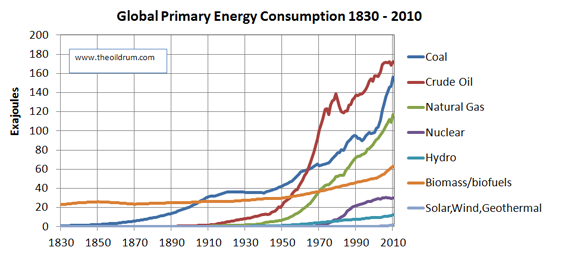
The industrial revolution, as of 1760, was more of an agrarian revolution, and even that only occurred in a few places (Britain,Belgium, some parts of France). There were only a very small number of powered factories in the world in that era, and those were not powered by coal, but by water wheels. Steam engines were used to pump water from mines, and that was about it in the 1760s.
It wasn't until around a century later that steam ships fully replaced sail boats for trade and warfare. The first steam powered train line only got built in 1825, and it took decades for even Britain to be fully covered by rail, let alone all the far flung corners of the Earth (such as America where the golden spike that marked the completion of the first trans-continental train line was driven into the ground in 1869). The observant might notice that the motor car, and the jet engine both came along significantly later still, and those use up quite a lot of fossil fuels too. Same goes for the air conditioning unit, television, the washing machine and the vacuum cleaner which all use electricity that tends more often than not to come from coal, gas or oil.
 PhilX
PhilX

 Of course not as they're melting because it's getting colder. Don't forget the North Pole.
