Christianity

For all things philosophical.

Moderators: AMod, iMod

User avatar
Immanuel Can
Posts: 27604
Joined: Wed Sep 25, 2013 4:42 pm

Re: Christianity

Post by Immanuel Can »

Alexis Jacobi wrote: Tue Mar 29, 2022 3:00 pm My own grasp of Weaver is similar to how you put it.
I was always thinking of Weaver in this light.

Your conjecture about my interpretation being otherwise was simply wrong.
Kali Yuga. A descending cycle that has an unfortunate bottom.

A cycle that has an end is not a cycle: it's a spiral, which is ultimately a linear form, since it has both beginning and end. A cycle that is closed is ultimately a circle, and by definition, can have no "bottom" or "end." So in thinking about time, we have to opt to say that it is either ultimately linear or ultimately circular. There's no third option that does not simply reduce to one of those.
What I find interesting is the resonance in the notion of a descending cycle, Kali Yuga, and the more or less traditional Christian notion of the end of days, the current direction of things where the Antichrist appears.

That's a linear timeline.
Now what interests me, and it should interest us all, is the force and power of these affirmed predictions. As you know (I submitted a video) Pat Roberts comes out of his cave of retirement to make a statement that Russia has no real concern for Ukraine and its *true objective* is to destroy Israel. These ideas are deeply invested in dark prescriptions and, it seems, a sort of mass-thinking which tends to evoke exactly what is seen in their dark visions.
I am not a fan of these modern, pop "visionaries." I find them highly suspect and mostly fraudulent. But the Biblical test of them is simply the question of whether what they predict turns out to come true or not, which is just as good a test for the secular skeptic, too.
It is as if the Old Mode will be held to no matter how intense the progressive opposition to it. It requires a mind-set of *radical rejectionism*.
It seems to me there's another possibility: that both the Progressives and Pius the Antichrist (a fair translation of the prized, papal title "vicar of Christ") are deceivers, and their ostensible conflict is actually no more than an in-house fight between two sorts of folly.
...you, too, are invested in a type of radical traditionalism....
I'm interested in truth, but have no interest in "tradition" if it fails to conform to truth. Papacy, for example, has no charms for me; it is unrelated to truth, traditional though it may be.

But I do think that maintaining that "truth" is objective and is one thing is, today, mistaken for being merely "traditional," because today's "tradition" is contrary to that.

Wrong is still wrong, even if it's shrouded in all the available elegant terms and adorned with the simpering face of postmodern relativist confusion.
User avatar
Alexis Jacobi
Posts: 8301
Joined: Tue Oct 26, 2021 3:00 am

Re: Christianity

Post by Alexis Jacobi »

Immanuel Can wrote: Tue Mar 29, 2022 5:41 pmA cycle that has an end is not a cycle: it's a spiral, which is ultimately a linear form, since it has both beginning and end. A cycle that is closed is ultimately a circle, and by definition, can have no "bottom" or "end." So in thinking about time, we have to opt to say that it is either ultimately linear or ultimately circular. There's no third option that does not simply reduce to one of those.
Again, once again, you misinterpret and misstate what I say. I said ‘bottom’ in the sense of ‘bottom-out’. The Vedic notion of the yugas (ages) is cyclic. In this description, Kali Yuga will eventually give way to an up-cycle. Their time-speculations are fantastic and they conceive of vast stretches of time.
Hindu texts describe four yugas (world ages) in a Yuga Cycle—Krita (Satya) Yuga, Treta Yuga, Dvapara Yuga, and Kali Yuga—where, starting in order from the first age, each yuga's length decreases by one-fourth (25%), giving proportions of 4:3:2:1. Each yuga is described as having a main period (a.k.a. yuga proper) preceded by its yuga-sandhyā (dawn) and followed by its yuga-sandhyāṃśa (dusk), where each twilight (dawn/dusk) lasts for one-tenth (10%) of its main period.
IC: That's a linear timeline.
Certainly the Jewish/Christian time-line is linear but what more interests me is that there is a description, that time-cycles of whatever form are conceived. Since I tend to regard all these ideas as speculative and as a *picture* that is created for purposes of intelligibility and transmission, I do not invest in one or the other. I am interested in both the Christian view and the neo-Vedic view because 1) many Christians hold to the doomsday view and seem to edge it forward with their evocative paranoia, and 2) the neo-Vedic view because recently, as right-radical ideas entered the mainstream many people are *seeing* in terms described by those who muse on the meaning of Kali Yuga (a time of discord, extreme difference, hypocrisy, breakdown of family solidity, corruption of people and especially of woman).

Obviously, these ideas can be and should be examined because they are having sociological effect.
I am not a fan of these modern, pop "visionaries." I find them highly suspect and mostly fraudulent. But the Biblical test of them is simply the question of whether what they predict turns out to come true or not, which is just as good a test for the secular skeptic, too.
Yet the interest fact is that it is the *pop* and *fraudulent* Christians who seem, by and large, to dominate the field. What I continue to find interesting about Nick’s contributions is that an *inner dimension* is proposed and spoken about. And it points to a whole other level of understanding and also *activity* (on an inner plane).
It seems to me there's another possibility: that both the Progressives and Pius the Antichrist (a fair translation of the prized, papal title "vicar of Christ") are deceivers, and their ostensible conflict is actually no more than an in-house fight between two sorts of folly.
Now now! Your Protestantism is popping through. But I do appreciate your assumption, and your assertion, that you know the truth, have the truth (about Christianity) and are ready to provide it. I am interested by *assertive, declarative statements*. On all sides these come at us.

An interesting conversation to be had is one where evil, the nature of it, the manifestation of it, is examined. I say this because floating all around us today, and seeping into people’s minds and their orientation and perception, are ideas derived from the extreme reductionism that is latent in Christian thinking. For example I subscribed to many different email mailing lists from all sorts of different websites. Highly progressive, moderate, conservative, and also more radical-right. So I examine all of it. The Epoch Times is an interesting source. But take a look at what their core program actually is. (I think Epoch Times is ninked to NDP and that they produced the book How the Spectre of Communism Is Ruling The World).
I'm interested in truth, but have no interest in "tradition" if it fails to conform to truth. Papacy, for example, has no charms for me; it is unrelated to truth, traditional though it may be.
Now you are sounding like Rene Guenon! See for example The Crisis of the Modern World. What Guenon says is that often, or in some degree, one can still find the greater percentage of traditionalist metaphysical ideas within the Catholic tradition (Guenon’s whole argument is that there is a defined metaphysic that can be known and which, adhered to, produces ‘the right way to live’), whereas in other more modern and progressive movements there is little preserved.
User avatar
Immanuel Can
Posts: 27604
Joined: Wed Sep 25, 2013 4:42 pm

Re: Christianity

Post by Immanuel Can »

Alexis Jacobi wrote: Tue Mar 29, 2022 7:01 pm
Immanuel Can wrote: Tue Mar 29, 2022 5:41 pmA cycle that has an end is not a cycle: it's a spiral, which is ultimately a linear form, since it has both beginning and end. A cycle that is closed is ultimately a circle, and by definition, can have no "bottom" or "end." So in thinking about time, we have to opt to say that it is either ultimately linear or ultimately circular. There's no third option that does not simply reduce to one of those.
The Vedic notion of the yugas (ages) is cyclic. In this description, Kali Yuga will eventually give way to an up-cycle. Their time-speculations are fantastic and they conceive of vast stretches of time.
"Vast" may conceal the processes invovled somewhat, but does not change linear into cyclical or cyclical into linear. So what I say still is true: it's one or the other. If the top and bottom are immediately connected in some fashion, then it's cyclical. If they are not, it's linear.
I do not invest in one or the other.
And yet, as a matter of truth, you're going to have to; or else live permanently without reference to the truth of the matter. There are no other options even conceivable or coherent.
Obviously, these ideas can be and should be examined because they are having sociological effect.

Yes, and the same is true of any idea that "has sociological effect," be it bad or good.
It seems to me there's another possibility: that both the Progressives and Pius the Antichrist (a fair translation of the prized, papal title "vicar of Christ") are deceivers, and their ostensible conflict is actually no more than an in-house fight between two sorts of folly.
Now now! Your Protestantism is popping through.
No, truth is not "Protestant." It's just truth.
I do appreciate your assumption, and your assertion, that you know the truth, have the truth (about Christianity) and are ready to provide it.
It's available to anyone. All they have to do is listen to Christ.

As for me, my "knowing of the truth" is only good to whatever extent I do that.
The Epoch Times is an interesting source.
It has good points in it, from time to time. But be cautious, because it's a creation of an occult organization called "Falun Gong" or "Falun Dafa." So its antipathy to the Chinese government, while warranted, is still in the interests of their own agenda.
...one can still find the greater percentage of traditionalist metaphysical ideas within the Catholic tradition

If it were true, it would be no stroke in Catholicism's favour; for most "traditionalism" is arbitrary and often self-deceived.

The problem with investigating something like "conservatism" or "fundamentalism" is that they are only relative terms. Neither describes a core doctrine of any kind, but rather they are related to one's epistemological strategy relative to some field of beliefs, regardless of content.

So classical liberals are "liberal" relative to, say feudalism, but "conservative" relative to Postmodern Leftism or CRT. And while rabid Islamists are called "fundamentalists," so are the utterly pacifistic Quakers. Likewise goes "tradtionalism:" it's neither necessarily good or bad by itself...what matters is whether the "tradition" in view is a good or a bad one.
User avatar
RCSaunders
Posts: 4704
Joined: Tue Jul 17, 2018 9:42 pm
Contact:

Re: Christianity

Post by RCSaunders »

Immanuel Can wrote: Tue Mar 29, 2022 5:29 pm
RCSaunders wrote: Tue Mar 29, 2022 1:56 pm
Immanuel Can wrote: Mon Mar 28, 2022 5:25 pm There didn't even have to be such a thing as "nature," in fact. There ought to have been nothing at all, or if there were anything, just disorder. Both of those eventualities are immeasurably more likely than an intelligible, law-governed, coherent universe.
What is cannot not also not be.
Right. And the universe is orderly, intelligible and rule governed...which means it's literally astronomically unlikely that it's an accident.
There is a concept in philosophy called, "logical determinism."
I'm very familiar with that error. It's still an error, and it's not even genuinely "logical."
The future is as certain as the past.
Nobody believes that: even you don't. You're trying to "change" my mind. If the future is already so certain, you wouldn't.
Immanuel Can wrote: Mon Mar 28, 2022 5:25 pm Cosmology is not "absurd." The amazing thing is that it's rational.
Cosmology is only, "rational," in the sense that it uses the method of reason to hypothesize (i.e. conjecture or guess) about the, "origins," of what there is no reason to believe there was any origin of.
Well, a "hypothesis" is considerably more than a guess, but I'll let you have that one. But no, cosmology depends on many things...deduction among them. So there are very good reasons to believe certain postulates, and completely logical reasons to reject some. A good example would be the idea that the universe is past-eternal. We know that that is not merely logically but also mathematically and empirically not the case. And there's no "guessing" about that left at all...it's now beyond any reasonable doubt.
...you refuse to look at the map...
Yes, your "map" is lovely. :D
...you assume existence is contingent...
It is. Observably so.

You, for example, are not self-existent. Neither am I. Nor is anything that exhibits entropy. They're all contingent beings, by definition.
[/quote]
Sure. The universe I actually see, experience and live in is contingent, but I'm supposed to believe some supernatural being that I only have your word for isn't.

I repeat:

"There didn't even have to be such a thing as "god," in fact. There ought to have been no god at all." Why would there be a god? Certainly you don't believe god just is because nothing can be without a cause, right?
User avatar
Immanuel Can
Posts: 27604
Joined: Wed Sep 25, 2013 4:42 pm

Re: Christianity

Post by Immanuel Can »

RCSaunders wrote: Wed Mar 30, 2022 1:25 am Sure. The universe I actually see, experience and live in is contingent, but I'm supposed to believe some supernatural being that I only have your word for isn't.
You don't just have my word. You have other things.

First, you have mathematics. You can be certain that an infinite regressive causal chain never gets started at all. So there had to be something that is an "uncaused cause" of the causal chain we observe all the time.

Secondly, there are only two possibilities for that: a personal Uncaused Cause, or an impersonal uncaused cause of some kind. But you can't doubt that an uncaused origin point has to have existed, or there would be no causal chains now, either.

But what would an impersonal uncaused cause even be? :shock: We don't even have a concept for such things. The only such things we know are things like numbers...which would seem to be uncaused, but have never caused anything.

Thirdly, you have the observable order and complexity of the universe, it's law-like nature, its precision, fine-tuned-for-life balances, and so on. And what is the more likely hypothesis: that all the observable order we see was infused into the universe deliberately at a past point in time, by a super-intelligence that serves as the original cause in the causal chain, or that in spite of their being no intelligent or orderly starting point, the universe just "fell out" that way, with all it's immeasureable complexity and balance? Which makes better sense?

So you've got a lot to go on, even before you get to this: that you don't just have my word for it...you have God's.
User avatar
Alexis Jacobi
Posts: 8301
Joined: Tue Oct 26, 2021 3:00 am

Re: Christianity

Post by Alexis Jacobi »

Image
Immanuel Can wrote: Tue Mar 29, 2022 7:26 pm"Vast" may conceal the processes invovled somewhat, but does not change linear into cyclical or cyclical into linear. So what I say still is true: it's one or the other. If the top and bottom are immediately connected in some fashion, then it's cyclical. If they are not, it's linear.
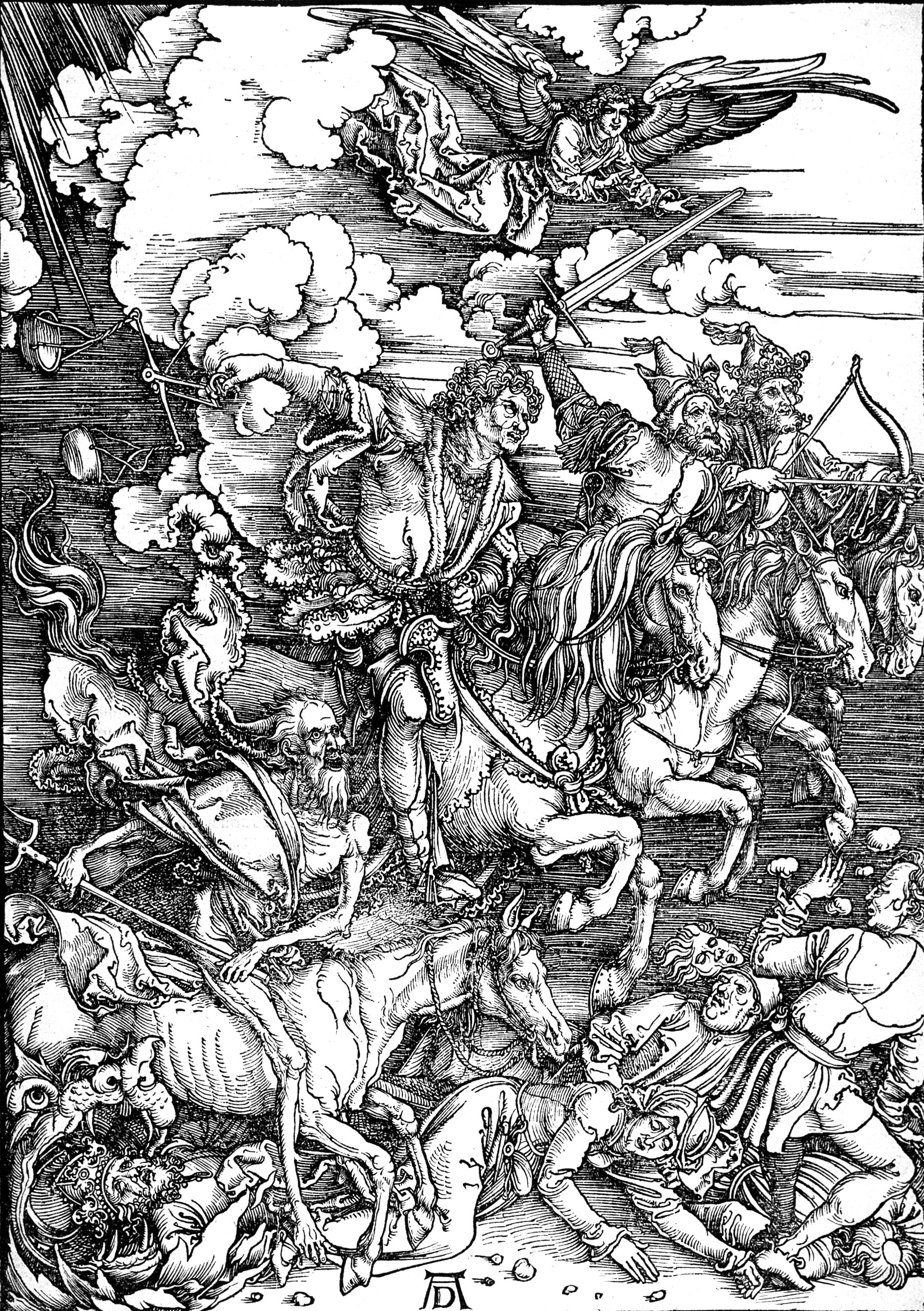
I submit that what is more interesting in all of this is to consider the lines of similarity between the Christian vision of apocalypsis and its ‘end-of-world’ mythology, and that of the Vedists. The Christian vision or prediction has a good deal more power and influence than that of the Vedists. It is not an abstract idea but something that many people envision as upcoming; that we are on the verge of it. And it is tied to an entire view of good and evil in a cosmic play.

The following from the Wiki page on the Yugas:
Kali Yuga is the last yuga in a cycle. There is one quarter virtue and three quarters sinfulness. It is the age of darkness and ignorance. People stop following dharma and lack virtue. They become slaves to their passions and are barely as powerful as their earliest ancestors of Satya Yuga. Society falls into disuse and people become liars and hypocrites. Knowledge is lost and scriptures are diminished. Humans eat forbidden and dirty food. The environment is polluted causing a scarcity in food and water. Wealth is heavily diminished. Families become non-existent. This yuga starts with humans having an average lifespan of 100 years and stature of 3.5 cubits (5 ft, 3 inches or 1.6 meters).
Satya Yuga (Krita Yuga, "the age of truth" or the "Hindu golden age") is the first and best yuga in a cycle. It is the age of truth and perfection. This yuga has no crime and all humans are kind and friendly. The Krita Yuga is so named because humans are long living, powerfully built, honest, youthful, vigorous, erudite and virtuous. The four Vedas are one. All mankind can attain to supreme blessedness. There is no agriculture or mining since the earth yields those riches on its own. Weather is pleasant and everyone is happy. There is no disease, decrepitude, or fear of anything. Virtue reigns supreme. This yuga starts with humans having an average lifespan of 100,000 years and stature of 21 cubits (33 ft, 6 inches or 10.2 meters)
Wiki page: “Apocalypticism is the religious belief that the end of the world is imminent, even within one's own lifetime. This belief is usually accompanied by the idea that civilization will soon come to a tumultuous end due to some sort of catastrophic global event. Apocalypticism is one aspect of eschatology in certain religions—the part of theology concerned with the final events of history, or the ultimate destiny of humanity.
User avatar
Immanuel Can
Posts: 27604
Joined: Wed Sep 25, 2013 4:42 pm

Re: Christianity

Post by Immanuel Can »

Alexis Jacobi wrote: Wed Mar 30, 2022 2:21 am
If the top and bottom are immediately connected in some fashion, then it's cyclical. If they are not, it's linear.
I submit that what is more interesting in all of this is to consider the lines of similarity between the Christian vision of apocalypsis and its ‘end-of-world’ mythology, and that of the Vedists.
Hmmm...on the contrary, I always find that the differences, not the similarities, are the most telling part of any analysis. It's not that I mind the similarities, it's just that they rarely point to much that signifies identity -- just as in the case of describing two people it is less telling to say that both are "humans" and "of an age," than to say that one is male and the other is female, one is tall and the other is short, one is African American and the other is Malay, and so on.

I don't doubt that every culture has in it some realization of the necessity of judgment against evil. I just think that's a lot less telling than the ways in which their narratives depart from each other.
The following from the Wiki page on the Yugas:
Kali Yuga is the last yuga in a cycle. There is one quarter virtue and three quarters sinfulness. It is the age of darkness and ignorance. People stop following dharma and lack virtue. They become slaves to their passions and are barely as powerful as their earliest ancestors of Satya Yuga. Society falls into disuse and people become liars and hypocrites. Knowledge is lost and scriptures are diminished. Humans eat forbidden and dirty food. The environment is polluted causing a scarcity in food and water. Wealth is heavily diminished. Families become non-existent. This yuga starts with humans having an average lifespan of 100 years and stature of 3.5 cubits (5 ft, 3 inches or 1.6 meters).
I have to confess that I'm not seeing a lot of similarities here with the Biblical account. You must be pointing to something I'm missing. Maybe you can tell me, if that's the case.

But at least one obvious difference stands out: that the Kali Yuga is part of an assumed infinite re-cycling process, whereas the Biblical Apocalypse is the end of a linear timeline, with no cyclical nature at all. That's one of the fundamental differences between the "Eastern" and "Western" traditions: a linear universe versus an infinite-cyclical one. Of course, only one of those two options can actually be true, as well.

But I don't want to cut off your chain of thought: I'd like to hear it out.

So may I ask, where are you going with this comparison? Do you see something that makes you think the Kali Yuga is somewhat like the account in Revelation? Or is the elements of both that are comparable to our present world that intrigue you?
User avatar
Alexis Jacobi
Posts: 8301
Joined: Tue Oct 26, 2021 3:00 am

Re: Christianity

Post by Alexis Jacobi »

Immanuel Can wrote: Wed Mar 30, 2022 2:57 amSo may I ask, where are you going with this comparison? Do you see something that makes you think the Kali Yuga is somewhat like the account in Revelation? Or is the elements of both that are comparable to our present world that intrigue you?
Sure. I think that through the lenses of perception men, people, examine the manifest world, the world we live in, and make the necessary effort to *interpret* it. We are called to interpret. I do not believe it possible that we do not interpret. Interpretation has to do with locating oneself, arriving at an *actionable description*.

That action is part-and-parcel of being aware, or having consciousness. I refer often to the Vedic perspective (beginning with the Rishis, the seers) who developed extremely intricate pictures and diagrams of the world and the kosmos that contained the world. I’ve not come across such elaborate descriptions as those of the Indian subcontinent.

I have a feeling that when you (since you are the one I am speaking with) are presented with these visions, these pictures, that you regard them as something like *childishly false* or perhaps whimsical is the word. For example ,your assertion, which expresses a mode of seeing that I share, is that time is lineal, not cyclical. I too cannot see things except in that way. It is necessary that I see in that way. But no matter if this is so or if, somehow, some type of cycle is actually the way things are, what is more interesting is the imposition, the assertion, of the story about it. The Story fits into a larger structure of defining what the world is, why it is, and what to do in it.

The elaborate structure of the Vedic metaphysical dream is of a type with the Christian metaphysical dream. The commonality they share is that they are elaborated, needed, necessary, part of a cosmic vision as it were.

If you were to ask me directly: Do you think either is true? Which one do you accept as truthful? I would answer: 1) I have no way nor means, by myself, to determine the truth of either, and 2) I find it more useful to examine how each assertion functions for the one who believes it, lives in accord with what it portends to them. In this sense they are similar. But I do not assert that they are the same nor equal to each other.

Why should I believe either one of them? That is, why should I believe that the world will be ended and time will cease? Or that the entire kosmos will be wrapped up and then human being ushered in to a Final Judgment? and the world left a polished ball as a monument to the whole cosmic play?

It is an utterly fantastic picture! Fantasy, imagination, dream, allegory, metaphor, all enter into it. In this sense it is similar to, though I would not assert *non-different from*, the elaborated Vedic vision (and I should say *visions* because there are numerous permutations of these grand metaphysical stories).
I have to confess that I'm not seeing a lot of similarities here with the Biblical account.
The religions, these traditions, cannot be compared straight across. They are in fact very different. I am not proposing to compare them in this way and to make them appear equal.
User avatar
Alexis Jacobi
Posts: 8301
Joined: Tue Oct 26, 2021 3:00 am

Re: Christianity

Post by Alexis Jacobi »

A recent NYTs article The Apocalypse as an ‘Unveiling’: What Religion Teaches Us About the End Times:
Shamain Webster, who lives in the suburbs outside of Dallas, has seen the signs of a coming apocalypse for a while now, just as the Bible foretold.

Kingdom would rise against kingdom, Jesus taught his disciples in the Book of Luke. Ms. Webster sees widespread political division in this country. There will be fearful events, and great signs from heaven, he said. She sees biblical values slipping away. A government not acting in the people’s best interest. And now this — a pandemic.

But Ms. Webster, 42 and an evangelical Christian, is unafraid. She has been listening online to one of her favorite preachers, who has called the coronavirus pandemic a “divine reset.”

“These kinds of moments really get you to re-evaluate everything,” she said. As everyone goes through a period of isolation, she added, God is using it for good, “to teach us and train us on how to live life better.”
For people of many faiths, and even none at all, it can feel lately like the end of the world is near. Not only is there a plague, but hundreds of billions of locusts are swarming East Africa. Wildfires have ravaged Australia, killing an untold number of animals. A recent earthquake in Utah even shook the Salt Lake Temple to the top of its iconic spire, causing the golden trumpet to fall from the angel Moroni’s right hand.

But the story of apocalypse is an old one, one of the oldest humans tell. In ancient religious traditions beyond Christianity — including Judaism, Islam and Buddhism — it is a common narrative that arises in moments of social and political crisis, as people try to process unprecedented or shocking events.
About 44 percent of likely voters in the United States see the coronavirus pandemic and economic meltdown as either a wake-up call to faith, a sign of God’s coming judgment or both, according to a poll commissioned by the Joshua Fund, an evangelical group run by Joel C. Rosenberg, who writes about the end of the world, and conducted last week by McLaughlin & Associates, pollsters for President Trump and other Republicans.

David Jeremiah, a pastor who has been one of President Trump’s informal evangelical advisers, asked in a sermon recently if the coronavirus was biblical prophecy, and called the pandemic “the most apocalyptic thing that has ever happened to us.”
Among Christians, one of the most well-known apocalyptic narratives is the Book of Revelation in the New Testament, which tells the story of the defeat of an evil beast, a final divine judgment and the coming of a New Jerusalem.
He wonders if Jesus will return by 2028, 10 years after Mr. Trump moved the U.S. embassy in Israel to Jerusalem, which he saw as a prophetic sign. “I tell my children, I think we are that generation,” said Mr. Johnson, who attends Gateway Church, one of the country’s most prominent evangelical churches.

In the United States, where Christianity is by far the dominant religion, about 40 percent of American adults believe that Jesus is definitely or probably going to return to earth by 2050, including one in five religiously unaffiliated people, according to the Pew Research Center.

Some evangelical Christians are finding hope in a divine promise that God has saved them for eternity, a feeling of security in the midst of so much uncertainty.
Etc. etc. etc.
uwot
Posts: 6092
Joined: Mon Jul 23, 2012 7:21 am

Re: Christianity

Post by uwot »

Sorry for the delayed response, I've been climbing mountains with my daughter. Listen me old mucker, I can't speak for all atheists, atheism is a broad church dontcha know? All I can say for certain is that at least one atheist is not an atheist because they do not find anthropomorphic images compelling.
More interesting, to me at any rate, is what exactly you mean by "an "informationally-based" substance". You don't like the duck pond analogy, how about an old 45? The information on a record is in the groove; when you first drop the needle, there is no sound, because the groove is smooth; it carries no information. And then: Wop bop a loo bop a lop bom bom! The way I see things is that the substance comes first; be that a duck pond, a record or the stuff the universe is made of.
seeds wrote: Thu Mar 24, 2022 8:50 pm...the informationally-based substance from which the stars, planets, bodies, and brains are created, is "up for grabs," so to speak, and can be used to create, again, anything "imaginable" (again, just like the substance from which our thoughts and dreams are created).
Well, there has always been a distinction between empirical and rational information; matter and mind in essence. Some people believe that mathematics and logic somehow 'exist' independently of matter; two oranges plus two oranges is four oranges regardless of whether there are any oranges, and all that. That's yer basic Platonism; I don't buy it, but I gather you are a dualist.
User avatar
RCSaunders
Posts: 4704
Joined: Tue Jul 17, 2018 9:42 pm
Contact:

Re: Christianity

Post by RCSaunders »

attofishpi wrote: Sat Mar 19, 2022 12:52 am Just though I'd make my own 'definition' of what it is to be Christian, what Christianity entails.

Belief in Jesus Christ (what he said and did).

Belief in the 10 commandments.

Living according to the above.
Really? The 10 commandments?

From a 2005 article:
The Ten Commandments

Except for two of the ten commandments, all are prohibitions, that is, "thou shalt nots." Of the two that are not prohibitions, almost no one keeps the first, "remember the sabbath day, to keep it holy," and the second, "honor thy father and thy mother," while loosely observed, is not even possible to many people, whose parents have passed away or who, for various reasons, have no idea in the world who their mother and father are. It is odd that an absolute moral code would include a requirement, that, at least for some people, is not only impossible to keep, but totally without meaning.

Another odd thing about the ten commandments is that there are not ten. In addition to the two "thou shalts," there are seven "thou shalt nots," summarized as follows: thou shalt not (1) kill, (2) steal, (3) lie, (4) make up your own religion, (5) fornicate, (6) covet, or (7) swear. But seven "thou shalt nots," plus, two, "thou shalts," only add up to nine. To get ten, you must either turn the "make up your own religion" commandment into two, "have no other gods," and, "make no graven images," as the Protestants do, or turn the "covet" commandment into two, "do not covet your neighbors house," and, "do not covet your neighbor's wife," as the Catholics do. There really are only nine commandments, but ten seems much more impressive and significant, so why worry about exact truth when we're talking about God and absolute moral principles?

These nine commandments, passed off as ten, are claimed to be the source and foundation of all Western civilization and the moral code that made America what it is today. One would expect anything responsible for so much would be very profound. When we examine these "ten" commandments, however, particularly the prohibitive commandments, (you shouldn't kill, steal, lie, make up your own religion, fornicate, covet, or swear), there is not one profound thought among them.

They might seem profound to some aboriginal tribe in some backwater third-world nation, but to those who have spent their lives wrestling with moral issues in a modern advanced country like the United States, the assertion that murder, theft, and promiscuity are wrong are hardly earthshaking revelations. They are such simple concepts they are assumed everywhere there is civilization and intelligence. Even though they are regularly violated, their violation is always, "justified," by some argument, such as, "it is a political necessity," allowed in the name of some kind of, "rights," or excused as some kind of social or psychological "necessity," (they can't help it). Even in their violation, their validity is admitted, else there would be no attempt to justify their violation. There is really nothing particularly profound about them.

As for the other two prohibitions, do not covet or swear, far from being profound, they are inane. To covet something only means to desire something which belongs to someone else. A desire itself cannot be immoral, even a desire, that if fulfilled, would be immoral. A wrong desire is only a temptation. What virtue is there in not doing wrong if one is never tempted to do wrong in the first place? So long as one only desires what another has, and neither murders them to get it, or steals it in some other way, there is nothing immoral in the desire. There is frequently a perfectly moral way to acquire the desired object anyway.

Coveting is not only moral, it is an absolute necessity to the economy of a free society. If no one ever "coveted" anything, there could be no economy as we know it, or any other kind of economy, for that matter. The local grocery, hardware, or drug store owners are our neighbors. If none of us ever coveted what is their property, we would never go to their stores to purchase anything. It is only because we covet our neighbor's food (in his grocery store) or our neighbor's lawn mower (in his hardware store) or our neighbor's medicine (in his drug store) that we go to their stores and purchase the things we covet.

Nevertheless, those who accept the ten commandments as an absolute moral code will swear that it is wrong to covet. They will also explain to you that the ten commandments do not prohibit what we normally call, "swearing," only taking God's name in vain is prohibited. What they will not explain is what that means, because they are very likely to have a bumper sticker that reads, "God is my co-pilot," and see nothing vain in that use of God's name. We are left wondering, what in God's name they mean by swearing.

Some Commandments More Absolute Than Others

Maybe the most peculiar thing of all about the ten commandments is that those who insist most vehemently they are absolute, do not themselves regard them as absolute. If the commandments are absolute, it would be no more immoral to break one of the commandments than another.

In the United States, this was, at one time, taken quite seriously. It was felt the dictum to observe the Sabbath was just as important as the prohibition against stealing. In most places "blue laws" were passed to prevent Sunday (the Christian substitute for the Sabbath) from being desecrated. Today the blue laws are all but gone, and while some Christians do sincerely believe they ought to be brought back, none of them are seeking laws to put people in jail for working on Saturday or Sunday or whatever the latest change to that absolute unchangeable law is.

Missing From the Ten Commandments

The point of ethics is to tell us how we ought to live in this world. One of the first things one notices about the ten commandments is, except for the two mentioned, they are all negative. It's fine to tell us what we should not do, but, the real question of ethics is, what should we do? To that question, the ten commandments provide no answer.

If you tried to live strictly by the ten commandments, the only thing you would be required to do is honor your parents and spend Saturday doing nothing (to keep it holy). The ten commandments do not require you to do anything else, and so long as you never kill anyone, steal, lie, make up your own religion, fornicate, covet, or swear, you are perfectly moral. Of course, you won't be worth a blessed thing to yourself or anyone else in the world and will starve to death if someone else does not undertake to feed you, but, according to the ten commandments, those, apparently, are not moral issues.

Perhaps the most blatant contradiction of the absoluteness of the Ten Commandments is the way Jews and Christians, especially those who truly understand and practice their religions faithfully, live their lives. I do not mean they "break" the commandments, although they observe some more loosely than others, on the contrary, in their day-to-day lives they exhibit a decency, reasonableness, and moral rectitude that is much higher than simply observing the ten commandments would produce. Most are productive, self-supporting, honest, ambitious, responsible, and reasonable people who seek to excel and achieve the highest levels of virtue and accomplishment they are able. In spite of their outward declaration of a belief in an absolute code, they live by an absolute principle, "to do less than your best is a sin."

This is not to be taken as an endorsement of Christianity or any other religion. With extremely few exceptions, almost all religionists embrace and promote some form of superstition.

Nevertheless, there are degrees of dangerousness in superstition. A Christian of the Reformed branch is much to be preferred to that anti-religious movement called Humanism, for example. The Reformed Christians believe their God predestines the majority of mankind to eternal torment in hell, but that hell, at least, is in the next world. In this world, these same Reformed Christians are great defenders of individual liberty and moral values. The collectivist, statist, altruist, anti-moral pseudo-intellectual ideology of the Humanists, however, if actually put into practice, would make a hell out of this world, here and now.
User avatar
Alexis Jacobi
Posts: 8301
Joined: Tue Oct 26, 2021 3:00 am

Re: Christianity

Post by Alexis Jacobi »

Dubious wrote: Tue Mar 29, 2022 10:05 am As metaphor, I’d describe the language as programmatic in creating a hologram of processes which manifest the cosmos as it seems to us. Language as monologue, invariably and exclusively subject to its own grammar.
I am curious to understand what you’d consider to be the effect, in a person, or in a culture, if this notion you present became common? Would this not imply that someone would feel inclined to *break free of their grammar*? How could that be done? Immersing oneself in another language built very differently? (Should I begin to learn Algonquin? Or perhaps some Malayo-Polynesian tongue?) ;) Or doing away entirely with any language? Some type of direct receptivity of *what is* without the holographic mediator?
Your encounter with logos as applied to the cosmos conforms – as I interpret it – to a universal constant unconditionally saturated with its own creative logic. It is what god would have spoken had there been any such demiurge to start the process. As I said, metaphors can be sublime and completely acceptable to the universe - even if taken literally. All interpretations are allowed and none negated. What is sin in the bible is commensurate to the freedom allowable in an indifferent universe unsupervised by any interventionist overlords.
So, when once some people — for example the Greeks — imagined they were closing in on some bedrock: the idea of a universal Logos (intelligibility running though all levels of creation and manifestation) they were in fact imposing an order that does not, really, exist? And on the basis of this (a frame of mind, perhaps Aristotelean) they *pulled out of their hat* that World that is what ‘logos’ refers to?

And something came along at some point in history and collapsed their false-certainty? So then the *edifice* created through their imposition of certainty collapsed?

Are we not (as I say) *obligated* (forced by necessity) to notice, not so much impose or discover, “ a universal constant unconditionally saturated with its own creative logic”? Isn’t the actual question or problem more like Is the model accurate or is it merely approximate?
The important questions hardly ever get resolved which is the reason they consistently reappear whenever any provisional acceptance once again begins to question itself. The most iconic questions are the looped ones.

Hardly ever? So they do get resolved every once in a while? So some *certainty* can be got about some things?
...but what Nietzsche referred to was certainly not any absolute truth but one millennially accepted as if it were one and its consequent psychological effect in having to renounce it. It was an assumed absolute whose negation has consequences. N was not in the least concerned about any such absolute existing and even questioned whether truth itself, as supervised by us, is more a function of expediency to make it seem favorable when in actuality it often isn’t. Within the human psyche truth, more often than not, colludes with hypocrisy which is seldom mentioned as ingredient in that alliance.
I think I may see *Nietzsche* (here with emphasis to indicate a phenomenon) in a somewhat different light. It is not a fully developed idea but it is the one I am working with. The Roman culture and religion came as an *imposition* on the Germanic tribes. But at some essential level it was ‘non-authentic’ to them. Yet they could not, say, resist it. It came through military power on one side and clerical power on the other.

Though this was true — the imposition was received and integrated — it underwent modifications and adaptions. In relation to the Christianity received, when it was received it was altered. Or I could say ‘reinterpreted’.

(Harold Bloom might have spoken of swerve or clinamen – Bloom defines clinamen as: "poetic misreading or misprision proper". The poet makes a swerve away from the precursor in the form of a "corrective movement". This swerve suggests that the precursor "went accurately up to a certain point", but should have swerved in the direction that the new poem moves).

In any case, the foreign thing was received and modified. This idea I got from reading The Germanization of Early Medieval Christianity. “While historians of Christianity have generally acknowledged some degree of Germanic influence in the development of early medieval Christianity, Russell goes further, arguing for a fundamental Germanic reinterpretation of Christianity.”

Eventually, this led to a cultural necessity of *throwing off the yoke* that was laid on. It is possible to suggest that Protestantism (Martin Luther et al) is that manifestation. Squirming out from under an entire, really a vast and complex, imposition. It had, let’s say, a beginning point but to what did it eventually progress? I would suggest that it culminated in *Nietzsche* — that is in a total and thorough *casting off* the yoke.

One also has to mention, of course, the German and the generally Germanic desire to rid themselves, to excise really, the core influence that came embedded in Christianity, which is, naturally, what Nietzsche rails against. While I do not think Nietzsche was an anti-Semite in a personal sense it is pretty clear that he was indeed an anti-Semite at a — what would I call it? — an idea-level, or perhaps even somatic level. In any case at some thoroughly fundamental level.

It has always seemed to me that Nietzsche the man was ripped apart by psychological forces. He lived and embodied the *torture* of dealing with a vast cultural and sociological and existential battle. I would not say this was the source of his madness, but in any case it is *madness* that becomes the result of the struggle.

I am curious to hear your opinion on any part of this (and anyone else’s as well).
To me the sacred is that which has long been sanctioned as most valuable, most indispensable to an individual or, most importantly, to a society; a traditional inflection which claims some element of its existence as sacrosanct. An over-awe never lasts long enough to fully claim the title.
I guess this would fit into your general picture, right? It could not be an *essence* external to man but moreover a choice or an emphasis of certain men, at certain moments.
That’s what myths, stories and religions are for...to camouflage how things really are being our little anodynes when facing truths too neutral to be favorable. Among humans, truth is most revealing when it renounces itself and all our bright crystal ballroom chandeliers show themselves to be nothing more than 40 watt light-bulbs!
Man, when you write your Symphony I am curious to know in advance what effect it will have on *the people*. ;)

Peripetie
User avatar
Alexis Jacobi
Posts: 8301
Joined: Tue Oct 26, 2021 3:00 am

Re: Christianity

Post by Alexis Jacobi »

uwot wrote: Wed Mar 30, 2022 11:23 am Well, there has always been a distinction between empirical and rational information; matter and mind in essence. Some people believe that mathematics and logic somehow 'exist' independently of matter; two oranges plus two oranges is four oranges regardless of whether there are any oranges, and all that.
All well and good as far as it goes. But how would you have solved the Kasper Hauser problem, hmmmm?
User avatar
Immanuel Can
Posts: 27604
Joined: Wed Sep 25, 2013 4:42 pm

Re: Christianity

Post by Immanuel Can »

Alexis Jacobi wrote: Wed Mar 30, 2022 4:19 am I have a feeling that when you (since you are the one I am speaking with) are presented with these visions, these pictures, that you regard them as something like *childishly false* or perhaps whimsical is the word.
No, I wouldn't say that.

I would agree with the perspective of C.S. Lewis on other cultures, namely, that it would be wrong to think of them as simply totally false or deluded. Rather, they represent genuine attempts by human beings to articulate existential situations, intuitions, movements of conscience, basic human longings, and so forth. Unfortunately, the also contain untruths that distort them as "lenses" and make them somewhat less than fully trustworthy; but there's always work to be done in sorting out the elements they get right from those they don't.

For example, reincarnation is an attempt by the East to explain the manifest injustices of earthly life. Karma is supposed to make "just" what is very ostensibly unjust. Unfortunately, the doctrine of reincarnation also implies that whatever injustices there are in life, they can only be deserved; so it issues in caste and dharma, making progress in equality or human rights seem "irreligious." The same belief also accounts for the lack of development of labour-saving technologies in the subcontinent and the plight of the Dalits, as well.

So a good insight, wrongly resolved, has resulted in incalculable misery and injustice in places like India. That doesn't make India "childish" or stupid, or something like that: it just means they're victims of a flawed explanation for a fact that anybody in the world can recogize, which is the obvious unfairness in earthly existence.
For example ,your assertion, which expresses a mode of seeing that I share, is that time is lineal, not cyclical. I too cannot see things except in that way. It is necessary that I see in that way.
It's not a matter of "seeing," or whether you and I choose to think that way: it's a matter of truth. Either time is cyclical, or it's not: there is no other way it can be, logically. So let's not delude ourselves by pretending that what you and I choose to "see" is determinative of anything.

It's not.
The elaborate structure of the Vedic metaphysical dream is of a type with the Christian metaphysical dream.

No, I still don't see this.

It would be very superficial for us to just say, "Well, both are ways human being try to dream about the end." That tells us absolutely nothing about their relative claims, or about the actual truth value of either. It might well mean both add up to delusions -- but if so, the only really important question returns: what other fact are these "dreams" aspiring to articulate, i.e. what is the actual truth they are both missing?
If you were to ask me directly: Do you think either is true? Which one do you accept as truthful? I would answer: 1) I have no way nor means, by myself, to determine the truth of either,
Oh, I think you do. That is, unless you're willing to dismiss both science and logic. If you take either seriously, you know time is linear, not cyclical. So that immediately rules out the Vedas as a candidate for the truth.
2) I find it more useful to examine how each assertion functions for the one who believes it, lives in accord with what it portends to them.
Yet they "portend" very different things. So again, the question of relative truthfulness returns.
Why should I believe either one of them?

Well, for argument's sake, let's assume neither.

Then there is something else, some truth, you should be believing. For if one or both is "aspiring" to that truth, why not go straight to the complete truth? Is that not obviously better than pretty delusions and half-truths? But if neither aspires to truth, then what is the value of studying two delusions, except to hope to predict what stupid and erroneous things other men are likely to do if they happen to be deluded by them?
That is, why should I believe that the world will be ended and time will cease?
Scientifically and empirically, we can see it will. There's no reasonable doubt.

Some say it will happen in a few years, and some say in many; but no informed person imagines the universe is eternal. Given its present trajectory, if not interrupted somehow, even a pure Materialists knows we will all eventually end up as equally-dispersed particles of random energy, in what's called "Heat Death"; after which the universe will remain silent and dead forever, since not inequality of energy will any longer exist to induce any reaction forever.
Or that the entire kosmos will be wrapped up and then human being ushered in to a Final Judgment?

That depends. If you believe something is "going on here," that the world has meaning and is the deliberate creation of God, you would. In fact, it would seem absolutely natural to you. If you assume it's not like that, then you would think that Heat Death is your end.

But one or the other will turn out to be true. And what we decide to think will not determine what will be true; it will only determine what your and my relative position to that end will be, when it comes.

But come it will...whether Judgment or Heat Death, neither will be stayed by our choice to believe in it or not.
User avatar
RCSaunders
Posts: 4704
Joined: Tue Jul 17, 2018 9:42 pm
Contact:

Re: Christianity

Post by RCSaunders »

Immanuel Can wrote: Wed Mar 30, 2022 1:43 am
RCSaunders wrote: Wed Mar 30, 2022 1:25 am Sure. The universe I actually see, experience and live in is contingent, but I'm supposed to believe some supernatural being that I only have your word for isn't.
You don't just have my word. You have other things.
You have not provided one bit of evidence I can examine by any means, only your own arguments which evidence of nothing but the machinations of your own mind, i.e. just your words.
Immanuel Can wrote: Wed Mar 30, 2022 1:43 am First, you have mathematics.
Mathematics, which is totally the invention of human beings are hardly evidence of a contingent universe.
Immanuel Can wrote: Wed Mar 30, 2022 1:43 am You can be certain that an infinite regressive causal chain never gets started at all. So there had to be something that is an "uncaused cause" of the causal chain we observe all the time.
There is no such thing as a chain of causes. Your sixth-grade understanding of what, "cause," is (Humean "cause and effect") is nonsense. Here's the grown-up understanding of cause: "The Nature Of Cause: Notes On Wrong Views."
Immanuel Can wrote: Wed Mar 30, 2022 1:43 am Thirdly, you have the observable order and complexity of the universe, it's law-like nature, its precision, fine-tuned-for-life balances, and so on.
You have no idea what order is. The only order observed in the universe is that order human rational identification and understanding of it imposes on it. The universe itself is totally chaotic (else it would not exist). There are not two identical entities or events in the entire universe and no two things behave in exactly the same way.

There is absolutely nothing in or about the physical universe that even suggests there is anything other than that universe or anything, "outside," it that in any way determines what it is.
Post Reply