Page 2 of 2

Re: Knowledge can not be knowledge unless it helps humans.

Posted: Fri Mar 20, 2020 3:08 pm
by nothing
Skepdick wrote: Fri Mar 20, 2020 1:24 pm
nothing wrote: Fri Mar 20, 2020 1:11 pm Answers are static, whereas
questions are dynamic, thus
If you have a well-structrued ontology, there is no distinction between expressing a question and expressing an answer. They are isomorphic.

A question can be expressed as a statement using Relational algebra.

The question is static. If your ontology is static, then so is your answer.
Well-structured "ontology" is not only of benefit, but also of detriment.
If/when there is no distinction between a question and/or an answer,
the question is invariably fruitless, thus "structure" presents as a barrier.
Some answers require the transcendence of space and time entirely
thus questions rendering them invariant are needed to be found and asked
for any such fruitfulness to ever bear.

"Seek and ye shall find" implies the answer to any question
is to be found in the right question asked, however only if asked.

Thus the conscience concerns inquiry, (hence 'science') as employed by the self (hence 'con')
whereas consciousness further implies the ongoing state of navigating choice-by-choice
according to the constituency of the being in terms of their rationale. That is why:

v = s/t as velocity being space about time
e = t/s as energy being time about space
____________________________________
space and time are naturally coupled.

s³/t = physical
t³/s = meta-physical
____________________________________
time also has the same 3 dimensions as space.

In terms of the same, no question means no growth,
and some beliefs are never questioned, hence death exists.
Those who do not use the conscience, lose the conscience, hence
all discernment and discretion is forfeit upon death because
this is precisely what the conscience grants: the ability to discern.
As this depletes, time appears to speed up relative to the observer
as time and discretion are one: time and space are discrete units
in v = s/t hence +alpha and -omega are a null universal binary
which serves to satisfy all measure, according to the
sincerity/integrity of the one measuring, circling back to "choice".

There are alternative states to "structure":
liquid, such to assume the form it enters, also
gas, such to expand/contract a form, also
fire, such to destroy/create a form. All of these
are dynamic, as needed for a universe of motion.
Re: Knowledge can not be knowledge unless it helps humans.

Posted: Fri Mar 20, 2020 4:49 pm
by Skepdick
nothing wrote: Fri Mar 20, 2020 3:08 pm Some answers require the transcendence of space and time entirely
thus questions rendering them invariant are needed to be found and asked
for any such fruitfulness to ever bear.
*yawn*.

Any question about any ontology requires transcendence of the ontology.

Whether the ontology is 'variant' or 'invariant' pretty much depends on your ability to sample the ontology faster than its rate of change.
Either you can describe the ontology in its totality (change and all) or you can't.

Nyquist–Shannon sampling theorem
nothing wrote: Fri Mar 20, 2020 3:08 pm "Seek and ye shall find" implies the answer to any question
is to be found in the right question asked, however only if asked.
The set of "any questions" is contains the set of "right questions". None of this bullshit matters.

If your ontology is deterministic then any asked question is answerable.

Re: Knowledge can not be knowledge unless it helps humans.

Posted: Fri Mar 20, 2020 5:37 pm
by nothing
Skepdick wrote: Fri Mar 20, 2020 4:49 pm *yawn*.
Speaking of (low-hanging) fruit...
Skepdick wrote: Fri Mar 20, 2020 4:49 pm Any question about any ontology requires transcendence of the ontology.
Questioning any ontology already fixes the barrier to the ontology:
all distortions begin/end locally with the one observing the ontology,
thus no consideration to ontology is actually "transcendent".

The fruitful question(s) assume no ontology such to import the barrier(s) associated
thus all questions ultimately collapses into, thus explicitly concerns, the inquirer.
It is a matter of conscience (or not).
Skepdick wrote: Fri Mar 20, 2020 4:49 pm Whether the ontology is 'variant' or 'invariant' pretty much depends on your ability to sample the ontology faster than its rate of change.
Either you can describe the ontology in its totality (change and all) or you can't.
Variant/invariant depends on time and space: if neither are concerned, there is no "sampling" involved.
If "sampling" is involved, it is not time/space-invariant because it takes time/space to sample.
Knowledge is immediate: it takes the form of a presence, as in a temperance, thus has the same quality as light.
Ignorance is the same, however is the former of an absence (of knowledge), as in an encumbrance, thus has the same quality as darkness
as in a collapsed body whose gravity is such to consume light, rather than either generate its own or reflect the light of others.

As above, so below: it applies to both stellar evolution/cosmology and just simply being.
Skepdick wrote: Fri Mar 20, 2020 4:49 pm The set of "any questions" is contains (?) the set of "right questions". None of this bullshit matters.

If a question (ANY question) is answerable, it implies a deterministic ontology. No random variables.
I didn't understand your first sentence, thus what you are referencing, however:
what matters is the integrity of the impetus behind the asking/seeking the question.

Unfortunately, contrary to popular "belief"... there is such a thing as a relatively stupid question.
Such as that of Lawrence Krauss asking "how will the universe end?" Understand: that man spent his life
in pursuit of that one question, thus the impetus of his being reflects the same.
There are problems with such questions:
i. they don't know to any degree of certainty how the universe BEGAN (if, even) let alone should END
ii. the question prompts looking up-and-away instead of now-and-here such to ignore:
iii. better questions, such as "how will human suffering end?" which would have relatively immense practical application
so far as using "science" to help/evolve humanity is concerned. Instead, he choose a relatively stupid question.

Therefor he is a good example of "Western" science: asking stupid questions
that have little to no practical meaning/benefit, hence "fruitless"
despite the "ontology" (ie. reality) of so much human suffering.

Re: Knowledge can not be knowledge unless it helps humans.

Posted: Fri Mar 20, 2020 5:45 pm
by Eodnhoj7
nothing wrote: Fri Mar 20, 2020 1:11 pm
Eodnhoj7 wrote: Thu Mar 19, 2020 6:25 pm
nothing wrote: Thu Mar 19, 2020 12:55 pm

(!)

Belief itself is not the same as belief-based ignorance.

It is possible to believe someone/something without knowing the same to be true
with it later turning out to be actually true, however it is not knowledge
until it is acknowledged as no longer containing degrees of uncertainty.

Belief implies presence of one or more degrees of uncertainty.
Knowledge implies the absence of the same.

In thus knowing all: not to believe one indefinitely approaches all-knowing (theist/atheist-invariant).
The potential for the same lies in the conscience of the being
as a reflection of the quality of their own way of inquiry
such to distinguish truth from untruth. This instead of
good and evil, the latter requiring "belief" thus all eaters of the tree
of the knowledge of good and evil are "believers" such
to bring suffering and death into the world.
No, all of being exists through a relative formless unactualized state at one time or another, thus requiring belief for actualization.
It's the other way around: actual begets potential.
The constituency of the potential is based on the consciousness of the being.

False, all actual states results in a potential state which results in another actual state. Actuality and potentiality cycle.

Answers are static, whereas
questions are dynamic, thus
potential and inquiry are related.
Eodnhoj7 wrote: Thu Mar 19, 2020 12:39 am For example, a young athlete is starting a new physical fitness program. He believes if he does x,y,z exercise it will make him a better athlete. He lacks the actualization of being of a superior athlete.
Know him the desired results certainly won't come unless he first tries?

He must first believe in order to try. That beleif is that the program may work.

The same is true with belief:

TRUTH-by-WAY-of-NEGATION
... truth by way of living ...
o. to: ...ad infinitum... consciously acknowledge all BELIEF(s)
i. to TRY both: +to and -not (+alpha and -omega) to BELIEVE
ii. to TEST both: +true and/or -not (necessarily)
iii. to FALSIFY all BELIEF(s) NOT (necessarily) TRUE
...ad infinitum ...

Knowing all: not to believe approaches all-knowing theist/atheist-invariant.
Eodnhoj7 wrote: Thu Mar 19, 2020 12:39 am This belief, one where committing to a program will actualize superior athletic potential, is based upon the seeing of others follow the same work out routine and getting better results.

The same applies for religion, for many it turns life into a better state, thus other people replicate what they see in others.

All belief is the movement towards a state which is yet unactualized. It is the movement of an actual to a potential with the potential being actualized into a state of form derived from formlessness.
You have it upside-down: all belief is static, knowledge is dynamic.

Beliefs are changing. For example one believe one thing about a person's character and in regards to a new action the belief may change.

Answers are static: they are fixed.
Questions are dynamic, they cause movement.

Answers are subject to an infinite regress through analysis, one answer leads to another then another and a continual movement.

You ask a question. You subject it to alpha/omega
generate a movement to/from truth (accordingly)
such to posit new questions, thus new movement.

To ask a question is to make a knowledgeable assertion. To ask "what color is the sky?" is to necessitate an assertion that the sky has color. All questions require what you would call static knowledge.

Those who ask not questions, but merely believe to have all the answers
(such as: as contained in a single book as "revealed" by a single all-knowing god)
are the ones who are both suffering and stagnant: they have no conscious knowledge
of their own belief-based ignorance causing the same, thus turn to blame and abuse.

Re: Knowledge can not be knowledge unless it helps humans.

Posted: Fri Mar 20, 2020 5:51 pm
by Skepdick
nothing wrote: Fri Mar 20, 2020 5:37 pm Questioning any ontology already fixes the barrier to the ontology
It doesn't. Ontologically speaking: What is a questioner?
nothing wrote: Fri Mar 20, 2020 5:37 pm all distortions begin/end locally with the one observing the ontology,
thus no consideration to ontology is actually "transcendent".
Ontologically speaking: What is an observer?
nothing wrote: Fri Mar 20, 2020 5:37 pm The fruitful question(s) assume no ontology such to import the barrier(s) associated
thus all questions ultimately collapses into
So, ontologically speaking, the questioner doesn't exist then?
nothing wrote: Fri Mar 20, 2020 5:37 pm thus explicitly concerns, the inquirer.
It is a matter of conscience (or not).
Indeed. That is the measurement problem in physics. What is an observer?
nothing wrote: Fri Mar 20, 2020 5:37 pm Variant/invariant depends on time and space: if neither are concerned, there is no "sampling" involved.
Sampling means the same thing as "making an observation". Taking a reading. Measuring.
nothing wrote: Fri Mar 20, 2020 5:37 pm If "sampling" is involved, it is not time/space-invariant because it takes time/space to sample.
Hence the problem of the observer transcending the ontology.
nothing wrote: Fri Mar 20, 2020 5:37 pm Knowledge is immediate: it takes the form of a presence, as in a temperance, thus has the same quality as light.
Light is not immediate. Light is time-bound. Causality has a speed limit.

If knowledge is immediate, then it transcends the speed of light.
nothing wrote: Fri Mar 20, 2020 5:37 pm I didn't understand your first sentence, thus what you are referencing, however:
what matters is the integrity of the impetus behind the asking/seeking the question.
Neither the integrity nor the impetus matters, if ANY question raised by whatever impetus/integrity is answerable.
nothing wrote: Fri Mar 20, 2020 5:37 pm Unfortunately, contrary to popular "belief"... there is such a thing as a relatively stupid question.
Naturally. Ask a stupid question and you will get a stupid answer. But you WILL get an answer.

nothing wrote: Fri Mar 20, 2020 5:37 pm i. they don't know to any degree of certainty how the universe BEGAN (if, even) let alone should END
ii. the question prompts looking up-and-away instead of now-and-here such to ignore
Isn't that fundamentally the problem of physics: nobody can define "now".
nothing wrote: Fri Mar 20, 2020 5:37 pm iii. better questions, such as "how will human suffering end?"
Since you seem to care about certainty, then I have an even better question: Will human suffering end? When?
nothing wrote: Fri Mar 20, 2020 5:37 pm Therefor he is a good example of "Western" science: asking stupid questions
that have little to no practical meaning/benefit, hence "fruitless"
despite the "ontology" (ie. reality) of so much human suffering.
You don't even know what an "answerable question is", never mind a "stupid question".

If there was such a thing as a "stupid question", a question that can't be answered - sure meets my bar.
Answerable questions are time variant - some answers take longer than others, but you will get an answer.
Unanswerable questions are time invariant - all such questions take infinite time to answer e.g never.

Philosophy asks way more stupid questions than science.

https://philosophynow.org/issues/46/New ... aser_Sword
The scientist’s perception of philosophy is that all too much of philosophical analysis is a sterile word game played in a state of mental muddle. When you ask of a scientist if we have free will, or only think we have, he would ask in turn: “What measurements or observations would, in your view, settle the matter?” If your reply is “Thinking deeply about it”, he will smile pityingly and pass you by. He would be unwilling to join you in playing what he sees as a rather silly game.

Re: Knowledge can not be knowledge unless it helps humans.

Posted: Fri Mar 20, 2020 6:10 pm
by nothing
Eodnhoj7 wrote: Fri Mar 20, 2020 5:45 pm False, all actual states results in a potential state which results in another actual state. Actuality and potentiality cycle.
This is the same confusion as 'I think, therefor I am'.

Is it because one thinks, one is?
Or because one is, one may think?

It is because one is (actual) one may think (believe).
Belief severed from actual indicates ignorance/suffering.
He must first believe in order to try. That beleif is that the program may work.
That is not the only possibility: hey may try knowing it has worked for others.
If it hasn't, he may believe it will somehow work for him, and suffer it not.
Beliefs are changing. For example one believe one thing about a person's character and in regards to a new action the belief may change.
Beliefs change due to questioning them. Beliefs that are never questioned are static.
If beliefs are constantly changing, there is a dynamic substrate process: consciousness.

People who do not question belief(s) are thus not conscious.
To ask a question is to make a knowledgeable assertion. To ask "what color is the sky?" is to necessitate an assertion that the sky has color. All questions require what you would call static knowledge.
The exampled question is stupid in all contexts.

Re: Knowledge can not be knowledge unless it helps humans.

Posted: Fri Mar 20, 2020 6:21 pm
by Eodnhoj7
nothing wrote: Fri Mar 20, 2020 6:10 pm
Eodnhoj7 wrote: Fri Mar 20, 2020 5:45 pm False, all actual states results in a potential state which results in another actual state. Actuality and potentiality cycle.
This is the same confusion as 'I think, therefor I am'.

Is it because one thinks, one is?
Thinking is a tautology of I, as well as "am". I is an inherently empty terms which manifests through actions.


Or because one is, one may think?

It is because one is (actual) one may think (believe).
Belief severed from actual indicates ignorance/suffering.

Beleif is the evidence of things hoped for and as such is inevitable.
He must first believe in order to try. That beleif is that the program may work.
That is not the only possibility: hey may try knowing it has worked for others.
If it hasn't, he may believe it will somehow work for him, and suffer it not.
Beliefs are changing. For example one believe one thing about a person's character and in regards to a new action the belief may change.
Beliefs change due to questioning them. Beliefs that are never questioned are static.
If beliefs are constantly changing, there is a dynamic substrate process: consciousness.

Yet belief exists.

People who do not question belief(s) are thus not conscious.

Questioning is the manifestation of assertion.
To ask a question is to make a knowledgeable assertion. To ask "what color is the sky?" is to necessitate an assertion that the sky has color. All questions require what you would call static knowledge.
The exampled question is stupid in all contexts.

False, to ask what color "x" is, is to make an assertion color exists. Questions are assertions of facts.

Re: Knowledge can not be knowledge unless it helps humans.

Posted: Fri Mar 20, 2020 6:29 pm
by nothing
Skepdick wrote: Fri Mar 20, 2020 5:51 pm ...line-by-line...
It's easier to dialogue if not breaking up line-by-line,
I don't have the inclining to break into multiple tangents.

I take ontological to be a function of space/time, thus in context
a questioner is one who is subject to/of however may (or may not) transcend,
an observer may be the same, though observation does not necessarily imply inquiry,
a questioner may exist but their existence may not be bound to a spacial/temporal one.

The measurement problem is merely a product of modern-day physics
not understanding what light is (not): it does not "travel", and only has a "speed"
relative to we "observers" who are traveling relative to it.
You don't even know what an "answerable question is", never mind a "stupid question".
The accuser is the accused.
Philosophy asks way more stupid questions than science.
They are not fundamentally different: all inquiry relates/collapses into 'con'science(s)
as necessitated by the constituency of the body(s) comprising the discipline.
If one attempts to sever the two, this is a division locally made, thus distorted,
thus suffered.

Re: Knowledge can not be knowledge unless it helps humans.

Posted: Fri Mar 20, 2020 6:38 pm
by nothing
Eodnhoj7 wrote: Fri Mar 20, 2020 6:21 pm Thinking is a tautology of I, as well as "am". I is an inherently empty terms which manifests through actions.
Thought is not what a person is, it is what a person does: to think (or not).
Beleif (?) is the evidence of things hoped for and as such is inevitable.
(!)

Belief can be of things known possible, and/or as well as hoped for
thus not limited to/by hope.
Yet belief exists.
Thus does human suffering exist viz. unconsciousness
viz. belief-based ignorance.
Questioning is the manifestation of assertion.
...the shaking of...
False, to ask what color "x" is, is to make an assertion color exists. Questions are assertions of facts.
It actually first assumes, then asserts "x" has a color
else the question fails at the level of the questioner
for not knowing the question is relatively stupid anyways.

Re: Knowledge can not be knowledge unless it helps humans.

Posted: Fri Mar 20, 2020 6:42 pm
by Skepdick
nothing wrote: Fri Mar 20, 2020 6:29 pm I take ontological to be a function of space/time, thus in context
a questioner is one who is subject to/of however may (or may not) transcend,
an observer may be the same, though observation does not necessarily imply inquiry,
a questioner may exist but their existence may not be bound to a spacial/temporal one.
Ontology means "existence". To imply that the questioner is not bound by space/time is to imply that the questioner has transcended space/time.

Therefore, the questioner exists in a separate ontology to space time.

So here is a question: How many existences/ontologies are there? One or two?

nothing wrote: Fri Mar 20, 2020 6:29 pm The measurement problem is merely a product of modern-day physics
No. It's really a product of the eternal philosophical conflict between monism and dualism

How many existences/ontologies are there? One or two?
nothing wrote: Fri Mar 20, 2020 6:29 pm not understanding what light is (not): it does not "travel", and only has a "speed"
relative to we "observers" who are traveling relative to it.
Clearly you don't understand that the speed of light is also the speed of causality.

If knowledge is instant, then knowledge is not caused.
nothing wrote: Fri Mar 20, 2020 6:29 pm The accuser is the accused.
No. The accuser is accusing the accused.
nothing wrote: Fri Mar 20, 2020 6:29 pm If one attempts to sever the two, this is a division locally made, thus distorted,
thus suffered.
if one severs being into two, that is a division locally made, thus distorted, thus suffered.

Monism vs dualism. That's what all philosophy boils down to.

Re: Knowledge can not be knowledge unless it helps humans.

Posted: Fri Mar 20, 2020 6:57 pm
by nothing
Skepdick wrote: Fri Mar 20, 2020 6:42 pm Ontology means "existence". To imply that the questioner is not bound by space/time is to imply that the questioner has transcended space/time.

Therefore, the questioner exists in a separate ontology to space time.
In such a case the burden shifts to "existence" begging definition.

It is possible to transcend space/time. It is called mukti/liberation in Hindu tradition.
So here is a question: How many existences/ontologies are there? One or two?
The question is stupid: you don't "count" existence/ontologies anymore than you count yourself.
If you count yourself... that is another issue.
No. It's really a product of the eternal philosophical conflict between monism and dualism

How many existences/ontologies are there? One or two?
There is no conflict unless one is at odds with themselves.
In this case they may believe they are at odds with someone/something else
which would require an understanding of the principle displacement factor(s)
of belief, blame/accusation, and scapegoating. These require a comparison "us vs. them" such
to generate a division experienced locally that, if acted upon, "plays out" cosmically.
Clearly you don't understand that the speed of light is also the speed of causality.
The accuser is the accused.
If knowledge is instant, then knowledge is not caused.
The attaining to knowledge is not instant, but once it is attained to
it is instant. Thus knowledge not being caused does not follow.
No. The accuser is accusing the accused.
Correct: that is precisely what you are doing now.
Your accusation against me makes you the accuser.
Now you are accusing the accused. It is the same
as the 'Mark of Cain': to draw from ones own nature
and accuse/scapegoat in the form of an accusation
against another. Requires "us vs. them" (ie. comparison)
mentality. Cain compared his offerings to Abel.
If not comparison, no conflict. Welcome to "us vs. them".
I recommend looking at "believer vs. unbeliever" to see
where that all leads.
Monism vs dualism. That's what all philosophy boils down to.
Philosophy boils down to a love of wisdom, thus
collapses at the point one either stops loving
or chooses not to be wise, as wisdom is like a woman:
if loved, she loves back many fold over.

Re: Knowledge can not be knowledge unless it helps humans.

Posted: Fri Mar 20, 2020 7:10 pm
by Skepdick
nothing wrote: Fri Mar 20, 2020 6:57 pm In such a case the burden shifts to "existence" begging definition.
No. What lacks definition is "definition" itself.
nothing wrote: Fri Mar 20, 2020 6:57 pm It is possible to transcend space/time. It is called mukti/liberation in Hindu tradition.
It's called just "transcendence" to any Kantian.
nothing wrote: Fri Mar 20, 2020 6:57 pm The question is stupid: you don't "count" existence/ontologies anymore than you count yourself.
If you count yourself... that is another issue.
I am not counting them. YOU are counting them!

By claiming space/time transcendence you are claiming that there is an existence other than space/time.
So how many does that make. Do you want me to help you count?

1. Spacetime
2. transcended spacetime
nothing wrote: Fri Mar 20, 2020 6:57 pm There is no conflict unless one is at odds with themselves.
YOU are at odds with yourself. You can't decide whether you can transcend spacetime or not!

You can't decide whether there is 1 ontology or 2!
nothing wrote: Fri Mar 20, 2020 6:57 pm The attaining to knowledge is not instant, but once it is attained to
it is instant. Thus knowledge not being caused does not follow.
Ohhh, you mean memory recall is instant? No - it isn't! If your own mind/brain is subject to spacetime (causality) there are no such thing as "instant" anything.

"instant" means zero time.
nothing wrote: Fri Mar 20, 2020 6:57 pm Philosophy boils down to a love of wisdom thus
collapses at the point one either stops loving
or chooses not to be wise, as wisdom is like a woman:
if loved, she loves back many fold over.
You can't define wisdom. Or Philosophy. Or Love.

Or definition.

Re: Knowledge can not be knowledge unless it helps humans.

Posted: Fri Mar 20, 2020 7:26 pm
by nothing
Skepdick wrote: Fri Mar 20, 2020 7:10 pm ...more breaking up...
I am not counting them. YOU are counting them!

By claiming space/time transcendence you are claiming that there is an existence other than space/time.
So how many does that make. Do you want me to help you count?

1. Spacetime
2. transcended spacetime
Space and time are discrete units of motion. Any/all physical bodies,
including human bodies, are expressed through these units of motion
but not necessarily as 'units' as discretion is also quality, not only a quantity.

Thus, once again.
...YOU are counting them!
The accuser is the accused.

Very 'You'ish.

There is an existence other than space/time. However it is not quantifiable.
See, space/time as speed implies time/space as energy... which is not quantifiable.
If I asked you to count how many energies there are in the universe, you could
and rightfully so, accuse me of asking a stupid question.

There is only one energy: that is the inverse of all motion.

Thus "division" is strictly a local phenomena, according to the constituency
of the body(s) concerned as displaced. Belief-based ignorance tends to do that:
de-couple beings from the 'one energy' for their own "believing" they are somehow
not in/of that same energy, as present, as ever-present as any "all-knower" must be,
should one exist, thus knowing all that one both: knows truly, and knows truly not.

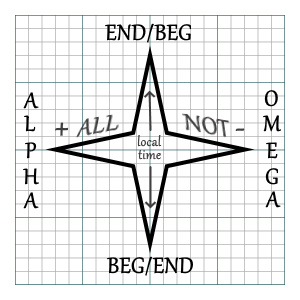
Image

This axes transcends space and time:
beg/end are ever-(non)-local, alpha/omega
capture all possible binaries. However,
'binary' assumes 'not one' hence 'duality'
is a product of ones own making. The axes
is universally bestowed, locally employed
and transcends space/time by them being
invariant.

Therefor which binaries does one "sample"
such to transcend? Well, there is one particular one
warned about in the book of Genesis concerning:
that such a universal binary used as terms to bear fruit
leads to nothing but death over death. And it is true:
those who absolutely believe to absolutely know
good and evil, while in reality they are actually wrong,
the same are thus absolutely dead wrong, the warning hence.

Thus all gravity of ignorance begins and ends at that tree
but those who believe do naught: but believe, believe and believe...
...meanwhile the answer is inside of themselves, as bestowed
as according to their own employment (or not).

Now when we bring Φ into the equation...
(in anticipation of another broken-up response...).

Re: Knowledge can not be knowledge unless it helps humans.

Posted: Fri Mar 20, 2020 7:34 pm
by Eodnhoj7
nothing wrote: Fri Mar 20, 2020 6:38 pm
Eodnhoj7 wrote: Fri Mar 20, 2020 6:21 pm Thinking is a tautology of I, as well as "am". I is an inherently empty terms which manifests through actions.
Thought is not what a person is, it is what a person does: to think (or not).

No, it is a variation of the I, thought is an extension of the "I".
Beleif (?) is the evidence of things hoped for and as such is inevitable.
(!)

Belief can be of things known possible, and/or as well as hoped for
thus not limited to/by hope.

Belief is a manifestation of possibilities thus inherent within the human capacity of reason.
Yet belief exists.
Thus does human suffering exist viz. unconsciousness
viz. belief-based ignorance.
Questioning is the manifestation of assertion.
...the shaking of...

Questions are the synthesis of thetical and antithetical assertions.

viewtopic.php?f=5&t=28816&p=447628#p447628


False, to ask what color "x" is, is to make an assertion color exists. Questions are assertions of facts.
It actually first assumes, then asserts "x" has a color
else the question fails at the level of the questioner
for not knowing the question is relatively stupid anyways.

Actually to ask "what is the y of x?" is the standard format of a question, let alone the question of color.