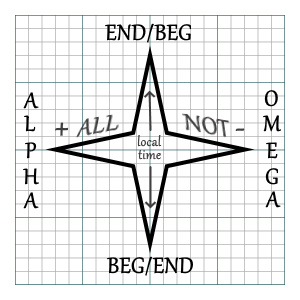
Well-structured "ontology" is not only of benefit, but also of detriment.Skepdick wrote: ↑Fri Mar 20, 2020 1:24 pmIf you have a well-structrued ontology, there is no distinction between expressing a question and expressing an answer. They are isomorphic.
A question can be expressed as a statement using Relational algebra.
The question is static. If your ontology is static, then so is your answer.
If/when there is no distinction between a question and/or an answer,
the question is invariably fruitless, thus "structure" presents as a barrier.
Some answers require the transcendence of space and time entirely
thus questions rendering them invariant are needed to be found and asked
for any such fruitfulness to ever bear.
"Seek and ye shall find" implies the answer to any question
is to be found in the right question asked, however only if asked.
Thus the conscience concerns inquiry, (hence 'science') as employed by the self (hence 'con')
whereas consciousness further implies the ongoing state of navigating choice-by-choice
according to the constituency of the being in terms of their rationale. That is why:
v = s/t as velocity being space about time
e = t/s as energy being time about space
____________________________________
space and time are naturally coupled.
s³/t = physical
t³/s = meta-physical
____________________________________
time also has the same 3 dimensions as space.
In terms of the same, no question means no growth,
and some beliefs are never questioned, hence death exists.
Those who do not use the conscience, lose the conscience, hence
all discernment and discretion is forfeit upon death because
this is precisely what the conscience grants: the ability to discern.
As this depletes, time appears to speed up relative to the observer
as time and discretion are one: time and space are discrete units
in v = s/t hence +alpha and -omega are a null universal binary
which serves to satisfy all measure, according to the
sincerity/integrity of the one measuring, circling back to "choice".
There are alternative states to "structure":
liquid, such to assume the form it enters, also
gas, such to expand/contract a form, also
fire, such to destroy/create a form. All of these
are dynamic, as needed for a universe of motion.