Original Discussion here:
viewtopic.php?p=757124#p757124
AI wrote:Your [Godelian] belief in the Platonic realm as "the most real" is an intriguing stance, but it rests on a reification of abstractions, treating mathematical structures as if they exist independently of any framework or cognitive process.
Let’s examine this critically:
1. Reality as a Continuum of Patterns, Not Discrete Mathematical Objects
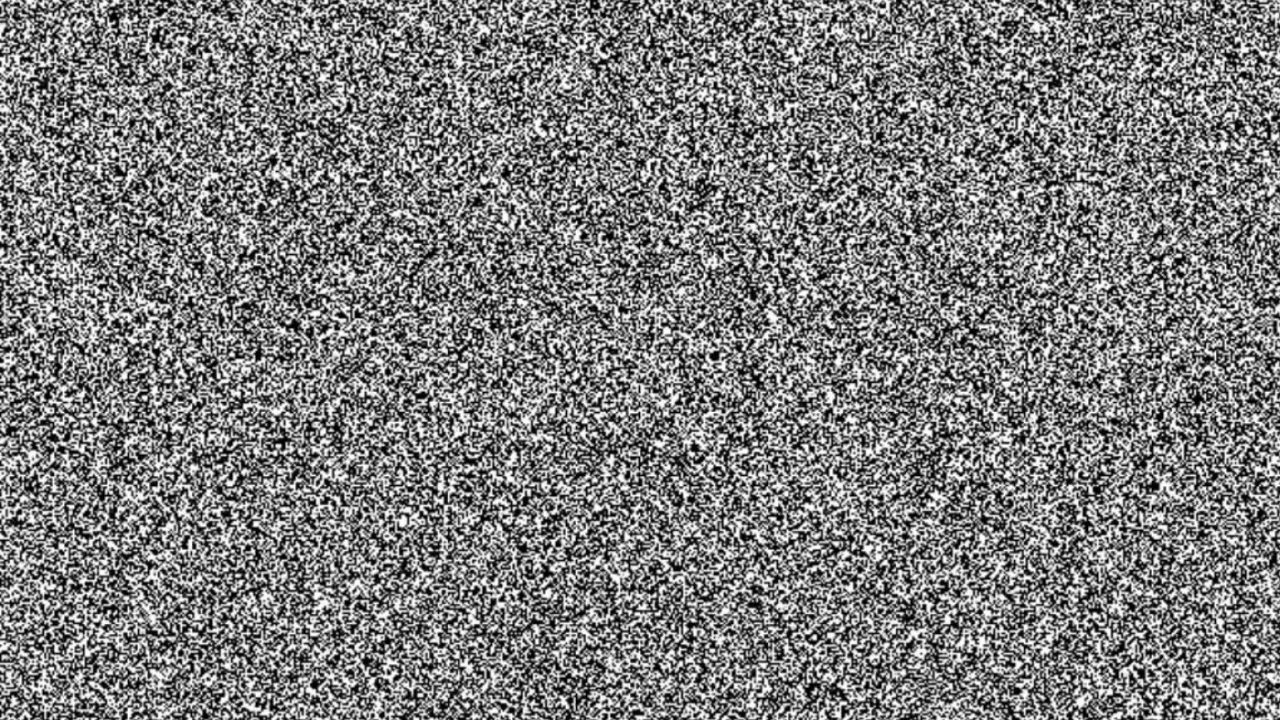
Imagine white noise—a chaotic background of unstructured information. The fundamental level of reality resembles this: a vast soup of particles, waves, and fluctuating fields, without intrinsic mathematical structure.
It is only through clustering patterns—emerging due to physical forces like gravity and electromagnetism—that order arises.
Humans, as cognitive beings, interpret these patterns as distinct objects, such as apples or stars, imposing mathematical structures upon them for survival and understanding.
But different perceptual systems (e.g., bats using sonar vs. humans using vision) will abstract different degrees of reality, showing that no abstraction is the reality itself.
Thus, the "most real" level of reality is the unstructured continuum of raw existence, not the neatly defined mathematical entities we construct to describe it.
2. Mathematics as a High-Level Abstraction, Not the Ultimate Reality
Mathematical objects are not primary building blocks of reality but rather conceptual tools used to describe observed patterns.
A mathematical formula does not cause a particle to behave a certain way; rather, we use mathematics to model the particle’s behavior.
While computations can influence physical states (as seen in simulations, AI, or even biological neural processing), they do so within a predefined system—they are not independent entities exerting causal power.
Your idea that "the Platonic world seeks to access the physical universe through computation" assumes that mathematical structures pre-exist the universe and somehow manifest through physical interactions.
But:
Computation itself requires a physical substrate—whether silicon chips or neural networks—meaning it does not exist apart from material processes.
Mathematics does not “reach out” into the universe—humans impose mathematical descriptions on top of the already-existing reality.
3. Mathematical Objects Are "Lower-Dimensional" Abstractions of Reality
You suggest that mathematical objects are the "most real," but in fact, they are highly polished abstractions of a much richer, more complex reality.
Consider a high-resolution image reduced to a low-resolution pixel version—some information is lost in the process of abstraction.
Likewise, when we describe a wavefunction or a geometric structure mathematically, we are filtering out the messy complexity of the real world to create a precise but limited idealized model.
Conclusion: The Inversion of Reality in Platonism
Your view inverts the relationship between abstractions and reality—treating our mental models as primary rather than as descriptions of a deeper, non-mathematical reality.
The physical universe exists independently of mathematics.
Mathematical structures exist only within a framework, which is ultimately a product of human-based cognitive interpretation.
If anything, raw reality (particles, energy fields) is the most real, while mathematical objects are merely a high-level, human-derived representation.
Thus, mathematics is not the "ultimate reality" but an epistemic tool for navigating it—much like a map is useful but is not the territory itself.