Can the Religious Be Trusted?

How should society be organised, if at all?

Moderators: AMod, iMod

User avatar
attofishpi
Posts: 13319
Joined: Tue Aug 16, 2011 8:10 am
Location: Orion Spur
Contact:

Re: Can the Religious Be Trusted?

Post by attofishpi »

accelafine wrote: Fri Jan 03, 2025 12:39 am
attofishpi wrote: Fri Jan 03, 2025 12:32 am
BigMike wrote: Thu Jan 02, 2025 8:20 pm Can the Religious Be Trusted?
Seriously though. What a ridiculous thread title Mike (yet again), are you some form of bigot?

Can the non-religious be trusted?

..just as daft. Ya can't pigeon hole everyone as the same..FFS.

AND, why are these daft threads of yours in the Politics area?
You're just jealous because he can write (notwithstanding AI) and you can't :mrgreen:
So how the fuck did you just manage to read that then? I write as I feeeeeel..

U want some do ya? ...bring it on woman!!
BigMike
Posts: 2210
Joined: Wed Jul 13, 2022 8:51 pm

Re: Can the Religious Be Trusted?

Post by BigMike »

attofishpi wrote: Fri Jan 03, 2025 12:32 am
BigMike wrote: Thu Jan 02, 2025 8:20 pm Can the Religious Be Trusted?
Seriously though. What a ridiculous thread title Mike (yet again), are you some form of bigot?

Can the non-religious be trusted?

..just as daft. Ya can't pigeon hole everyone as the same..FFS.

AND, why are these daft threads of yours in the Politics area?
The thread title, while provocative, wasn’t meant to pigeonhole or insult—it was an entry point into exploring the complexities of trust in philosophical dialogue, particularly with people whose beliefs are rooted in faith. You’re right to call out the potential for it to come across as dismissive, but the focus wasn’t on labeling anyone, religious or not, as untrustworthy by default. The intention was to dig into whether a commitment to faith-based reasoning might conflict with a shared commitment to intellectual honesty in evidence-based discussions.

As for the "Politics" section, it’s relevant because religion and determinism often intersect with political discourse—whether it’s in debates over education policy, legal frameworks, or even the role of morality in governance. These aren’t abstract musings; they shape how societies operate and how individuals engage with one another in public and private life.

And look, if we’re going to talk about bigotry, let’s be clear: questioning whether certain modes of reasoning conflict with others isn’t the same as dismissing entire groups of people. It’s about understanding where conversations hit a wall and why. If the title came off as too blunt or unfair, that’s worth acknowledging. But the question itself—whether we can fully trust reasoning that prioritizes faith over evidence—is a valid one, even if it makes us uncomfortable.
User avatar
attofishpi
Posts: 13319
Joined: Tue Aug 16, 2011 8:10 am
Location: Orion Spur
Contact:

Re: Can the Religious Be Trusted?

Post by attofishpi »

BigMike wrote: Fri Jan 03, 2025 1:27 am
attofishpi wrote: Fri Jan 03, 2025 12:32 am
BigMike wrote: Thu Jan 02, 2025 8:20 pm Can the Religious Be Trusted?
Seriously though. What a ridiculous thread title Mike (yet again), are you some form of bigot?

Can the non-religious be trusted?

..just as daft. Ya can't pigeon hole everyone as the same..FFS.

AND, why are these daft threads of yours in the Politics area?
The thread title, while provocative, wasn’t meant to pigeonhole or insult—it was an entry point into exploring the complexities of trust in philosophical dialogue, particularly with people whose beliefs are rooted in faith. You’re right to call out the potential for it to come across as dismissive, but the focus wasn’t on labeling anyone, religious or not, as untrustworthy by default. The intention was to dig into whether a commitment to faith-based reasoning might conflict with a shared commitment to intellectual honesty in evidence-based discussions.

As for the "Politics" section, it’s relevant because religion and determinism often intersect with political discourse—whether it’s in debates over education policy, legal frameworks, or even the role of morality in governance. These aren’t abstract musings; they shape how societies operate and how individuals engage with one another in public and private life.

And look, if we’re going to talk about bigotry, let’s be clear: questioning whether certain modes of reasoning conflict with others isn’t the same as dismissing entire groups of people. It’s about understanding where conversations hit a wall and why. If the title came off as too blunt or unfair, that’s worth acknowledging. But the question itself—whether we can fully trust reasoning that prioritizes faith over evidence—is a valid one, even if it makes us uncomfortable.

Have you ever been tea-bagged?
Age
Posts: 27841
Joined: Sun Aug 05, 2018 8:17 am

Re: Can the Religious Be Trusted?

Post by Age »

seeds wrote: Mon Dec 30, 2024 2:19 am
BigMike wrote: Mon Dec 30, 2024 1:30 am So here’s the challenge again, spelled out clearly: Name one human trait or quality you believe cannot be explained deterministically.
Okay, how about the "experiencing" of the qualia involving the unique flavor or "taste" of a banana?

In other words, use determinism to describe what it is within the makeup of a human that not only "experiences" (and "enjoys") the unique flavor of a banana, but is also capable of differentiating it from the unique flavor of a pear,...
'It' is just one of the five senses. The one called 'taste'. Which, obviously along with the others, came about because of 'determinism'.
seeds wrote: Mon Dec 30, 2024 2:19 am ...of which it "enjoys" to an equal degree, but "prefers" the "taste" of the banana on its morning cereal?
_______
'It' does NOT 'enjoy' ANY thing. 'you', human beings, instead do.

And, WHY ALL of 'you', human beings, 'prefer' DIFFERENT things, FROM 'each other', is, AGAIN, because of 'past experiences'. Or, because of 'determinism', if one 'prefers' that phrase, or term.
Age
Posts: 27841
Joined: Sun Aug 05, 2018 8:17 am

Re: Can the Religious Be Trusted?

Post by Age »

henry quirk wrote: Mon Dec 30, 2024 2:23 am Just a reminder: this...
BigMike wrote: Fri Nov 29, 2024 6:06 pmyour brain is a deterministic machine, operating under the same unyielding physical laws as a rock rolling downhill. You don’t control your thoughts, your desires, or your decisions. You are driven by a cascade of external inputs, biological processes, and environmental stimuli—all of which you neither initiated nor directed.
...is what Mike thinks of you.

You are meat.
OBVIOUSLY, "henry quirk" has MISINTERPRETED and MISUNDERSTOOD things, here, ONCE AGAIN.
henry quirk wrote: Mon Dec 30, 2024 2:23 am Now, Mike, almost as refined and filigreed as AJ, dresses up that pig in Sunday, go-to-meetin', duds, makin' it all well-presentable.

Declaratives like the deterministic laws of physics do not eliminate the richness of human experience; they explain it or neural activity, behavior, and decision-making processes adhere to causal patterns that align with conservation laws. These patterns don’t deny the richness of human experience—they provide the framework within which that richness unfolds or determinism doesn’t erase the richness of human experience—it grounds it or determinism doesn’t strip life of its richness—it explains the processes that underpin it all sound nifty but ultimately mean nuthin'.

He declares, but never substantiates, instead relyin' on some bastard chimera, one part science sez, one part promissory materialism, one part everybody who's anybody just knows...

He presses for material explanations of the metaphysical but offers nuthin' beyond catchphrases (neuroplasticity) and willful misinterpretations of research (Libet) to undergird his own barren bio-determinism.

He explains away or dismisses neuroscience that fails to fall within his cat dish-shallow materialism (the unity of mind after corpus callosotomy; the wholeness of mind after hemispherectomy) but cannot explain how the three pounds of dog's breakfast in your skull makes you. He'll lecture about synapses and whatnot (talks machinery) but never gets to the root of how it works, of how you come to be.

The worst of it, of course: Mike believes a better world, and a better you, can be had thru your acceptance of bein' less. Never mind you're nuthin' but a deterministic machine with no control your thoughts, your desires, or your decisions, somehow you're just supposed to accept and adopt (and you're a bad egg if you don't).
Age
Posts: 27841
Joined: Sun Aug 05, 2018 8:17 am

Re: Can the Religious Be Trusted?

Post by Age »

accelafine wrote: Mon Dec 30, 2024 3:59 am Since 'free will' is a religious concept then it's bullshit by default. Glad that's cleared up. Next topic...
Since WHEN has 'free will' been a, so-claimed, 'religious concept'?
Age
Posts: 27841
Joined: Sun Aug 05, 2018 8:17 am

Re: Can the Religious Be Trusted?

Post by Age »

Atla wrote: Mon Dec 30, 2024 5:47 am
Alexis Jacobi wrote: Mon Dec 30, 2024 12:53 am
I do not deny nor negate the physiological facts of the platform you subscribe to. But yes, I definitely hold to true things that depend on another sort of epistemological base. It really is just this, BigMike.

I agree that when I speak of “experience with what is divine” that I rely on subjectivity. And I am acutely aware that I cannot reveal, as in a scientific paper that is published and reviewed, a mechanical path that explains how it worked. And I also know that what cannot be demonstrated and proven must for you be relegated to fantasy, to poetry, and of course to hallucination.
Be honest, doesn't it bother you that there are countless different traditions on this planet that rely on subjective experience with the divine, and you can't objectively show that yours is the correct one, nor that it isn't made up?
Does 'this' apply to EVERY one, to you "atla"?
Age
Posts: 27841
Joined: Sun Aug 05, 2018 8:17 am

Re: Can the Religious Be Trusted?

Post by Age »

seeds wrote: Mon Dec 30, 2024 7:28 am
Dubious wrote: Sun Dec 29, 2024 10:47 pm
seeds wrote: Sun Dec 29, 2024 8:16 pm I cannot disprove causality or determinism, nor would I even attempt to challenge the fundamental principles of the laws of conservation, or the four fundamental forces.

No, the simplest thing I can do in this particular situation is to reinvoke the words of Terence McKenna...
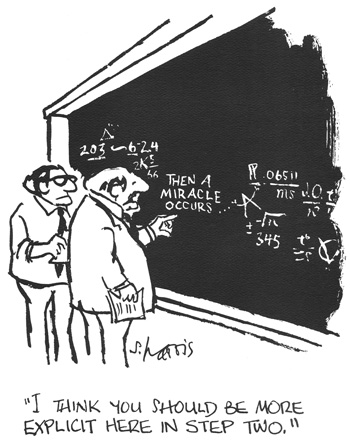
...and then point out to you that your theory of determinism expects us to grant you the "one free miracle" mentioned in the quote.

However, some of us are simply not that generous (or gullible).
No!....

...The quote implodes the moment he says that science is based of the principle of 'give us one free miracle...' since anything naturally occurring is not a miracle whether or not we can explain it at this or any other time.
I'm sorry, Dubious, but despite your proven ability to accurately point out the problems in someone's argument, you've given away the weakness of your hand by using the term "naturally occurring," which, to me, is nothing more than the blind and mindless meanderings of "chance" dressed up in a mother's apron.

As I posed to BigMike, do you, Dubious, actually believe that this,...

Image

...which came "fully stocked" with every possible ingredient and process necessary to awaken untold billions of unique lifeforms into existence,...

...was a "naturally occurring" phenomenon?

Really???
LOL This one ACTUALLY BELIEVES, ABSOLUTELY, that there is some thing outside of 'Nature', Itself.
seeds wrote: Mon Dec 30, 2024 7:28 am
Dubious wrote: Sun Dec 29, 2024 10:47 pm But, for the sake of argument, let's use the word 'miracle' as employed in the quote. Now what? Does it in any way confute the fact that all the laws that govern as ramifications of this so-called miracle are by that very definition deterministic...whether or not you call it a miracle?
Likewise, for the sake of argument, if I were to concede to you and BigMike that determinism was indeed probably involved in most of the material processes that culminated in the manifestation of the human brain,...

...will you guys at least be open to the "possibility" that the human "I Am-ness" of which the brain has metaphorically "given birth" to,...

...could be an epiphenomenal "something" that,...

...in the spirit of what "strong emergence" allegedly entails,...

...represents something that is "wholly other" than that which it emerged from?

I'm talking about a "self-aware something" that, within the autonomous domain of its own personal mind, possesses the absolute "free will" ability to shape its own personal supply of mental imaging energy into absolutely anything it freely chooses?

Again, you guys can have your determinism up to - but not beyond the point - where the human mind, along with its accompanying "I Am-ness," is, again, metaphorically "born" (strongly emerges) from the quantum fabric of the brain.

Now I know it sounds far-fetched, but what I am speculatively suggesting is that the ontological status of the human mind (relative to the material fabric of the brain) is not unlike what is suggested as being the status of the parallel worlds in the "Many Worlds Interpretation of Quantum Mechanics."

In other words, the emergence of the human mind ("I Am-ness"/soul) from the quantum fabric of the brain is like a new parallel universe that "branches" off of this universe in such a way where the inner physics of the mind is no longer connected to (entangled with) the physics of the universe it branched off of.

In which case, our minds thus acquire full autonomy where the inner "agent" has "free will" control over its own inner dimension of reality without effecting or impinging on the physics of other parallel universes.

(Yeah, yeah, I know, poor ol' Hugh Everett and Bryce DeWitt are probably spinning in their graves right now. :lol: But you can't say that I'm not trying to incorporate "science" [albeit "pseudo" science] into my argument. :P)
Dubious wrote: Sun Dec 29, 2024 10:47 pm When an absurd statement is made it usually proves opposite to its intended effect. Mr. Mckenna should have used fewer psychedelics to swarm his neurons in making the wrong connections.
Well, has Mr. Dubious personally experimented with psychedelics and therefore has first-hand knowledge of that which he warns of?

Furthermore, Mr. Mckenna isn't the only person to express the particular sentiment stated in that quote...
Image

I suppose you'll insist that the person who created that cartoon should stick to cartooning and leave the brainy stuff to the math nerds, right?
_______
Age
Posts: 27841
Joined: Sun Aug 05, 2018 8:17 am

Re: Can the Religious Be Trusted?

Post by Age »

Belinda wrote: Mon Dec 30, 2024 12:06 pm
seeds wrote: Mon Dec 30, 2024 7:27 am
Atla wrote: Mon Dec 30, 2024 6:19 am
It's enough for Mike to answer this in Chalmers's "Easy problems" sense. It would be unfair to expect determinism to resolve the Hard problem within the Western philosophical framework, when no other philosophy can do that either.
Well, BigMike is the one who asked us to name "...one human trait or quality..." that we believe cannot be explained deterministically.

Anyway, he'll probably just ignore my post.

He doesn't like dealing with actual challenges.
_______
I prefer the flavour and texture of a pear because I learned to do so as a young child influenced by my mother and no doubt by wartime unavailability of bananas. Please see the word 'because' which indicates the conditional clause and its use in everyday reasoning.
And, there AGAIN is 'determinism', AT WORK.
BigMike
Posts: 2210
Joined: Wed Jul 13, 2022 8:51 pm

Re: Can the Religious Be Trusted?

Post by BigMike »

attofishpi wrote: Fri Jan 03, 2025 1:33 am
BigMike wrote: Fri Jan 03, 2025 1:27 am
attofishpi wrote: Fri Jan 03, 2025 12:32 am

Seriously though. What a ridiculous thread title Mike (yet again), are you some form of bigot?

Can the non-religious be trusted?

..just as daft. Ya can't pigeon hole everyone as the same..FFS.

AND, why are these daft threads of yours in the Politics area?
The thread title, while provocative, wasn’t meant to pigeonhole or insult—it was an entry point into exploring the complexities of trust in philosophical dialogue, particularly with people whose beliefs are rooted in faith. You’re right to call out the potential for it to come across as dismissive, but the focus wasn’t on labeling anyone, religious or not, as untrustworthy by default. The intention was to dig into whether a commitment to faith-based reasoning might conflict with a shared commitment to intellectual honesty in evidence-based discussions.

As for the "Politics" section, it’s relevant because religion and determinism often intersect with political discourse—whether it’s in debates over education policy, legal frameworks, or even the role of morality in governance. These aren’t abstract musings; they shape how societies operate and how individuals engage with one another in public and private life.

And look, if we’re going to talk about bigotry, let’s be clear: questioning whether certain modes of reasoning conflict with others isn’t the same as dismissing entire groups of people. It’s about understanding where conversations hit a wall and why. If the title came off as too blunt or unfair, that’s worth acknowledging. But the question itself—whether we can fully trust reasoning that prioritizes faith over evidence—is a valid one, even if it makes us uncomfortable.

Have you ever been tea-bagged?
Your response is beyond inappropriate and completely irrelevant to the discussion at hand. It’s shocking that you would stoop to such a juvenile and offensive remark, particularly in the context of what was, up until that point, an intellectual exchange. This isn’t just unproductive; it’s downright sickening.

If I had to guess, deterministically speaking, remarks like that may stem from deep-seated issues or formative experiences, perhaps shaped by upbringing in environments where open discussions about sexuality were stigmatized or repressed. Psychological studies have shown correlations between strict, sex-negative environments and higher incidences of unhealthy attitudes toward sex, ranging from shame and guilt to inappropriate or even perverse expressions of it later in life. This isn’t an accusation—it’s an observation grounded in data.

Such environments often set the stage for dysfunction. When sexuality is suppressed, curiosity doesn’t disappear; it often manifests in unhealthy or secretive ways. And while not every individual raised in such circumstances reacts this way, the trend is well-documented. It’s a powerful reminder of how deeply deterministic forces—upbringing, social norms, and cultural narratives—shape even the most personal aspects of human behavior.

If your goal is to engage in serious discussion, then rise to that level. If not, perhaps it’s time to reflect on what compels you to derail conversations with this kind of behavior. This space deserves better, and frankly, so do you.
Belinda
Posts: 10548
Joined: Fri Aug 26, 2016 10:13 am

Re: Can the Religious Be Trusted?

Post by Belinda »

Age wrote: Fri Jan 03, 2025 4:39 am
accelafine wrote: Mon Dec 30, 2024 3:59 am Since 'free will' is a religious concept then it's bullshit by default. Glad that's cleared up. Next topic...
Since WHEN has 'free will' been a, so-claimed, 'religious concept'?
Unique among all of God’s creation is man, given the ability to freely choose how he will behave and thus endowed with the greatest responsibility. Gen. 1:26-31. We can choose how we will respond to God, whether we will serve Him or not. He does not force us to serve Him


The doctrine of Free Will is essential to all forms of theism, as the doctrine of Free Will enables God to punish with justice.The doctrine is as old as the oldest theistic religion which probably is Judaism.
Last edited by Belinda on Fri Jan 03, 2025 11:24 am, edited 1 time in total.
User avatar
attofishpi
Posts: 13319
Joined: Tue Aug 16, 2011 8:10 am
Location: Orion Spur
Contact:

Re: Can the Religious Be Trusted?

Post by attofishpi »

BigMike wrote: Fri Jan 03, 2025 9:03 am
attofishpi wrote: Fri Jan 03, 2025 1:33 am
BigMike wrote: Fri Jan 03, 2025 1:27 am

The thread title, while provocative, wasn’t meant to pigeonhole or insult—it was an entry point into exploring the complexities of trust in philosophical dialogue, particularly with people whose beliefs are rooted in faith. You’re right to call out the potential for it to come across as dismissive, but the focus wasn’t on labeling anyone, religious or not, as untrustworthy by default. The intention was to dig into whether a commitment to faith-based reasoning might conflict with a shared commitment to intellectual honesty in evidence-based discussions.

As for the "Politics" section, it’s relevant because religion and determinism often intersect with political discourse—whether it’s in debates over education policy, legal frameworks, or even the role of morality in governance. These aren’t abstract musings; they shape how societies operate and how individuals engage with one another in public and private life.

And look, if we’re going to talk about bigotry, let’s be clear: questioning whether certain modes of reasoning conflict with others isn’t the same as dismissing entire groups of people. It’s about understanding where conversations hit a wall and why. If the title came off as too blunt or unfair, that’s worth acknowledging. But the question itself—whether we can fully trust reasoning that prioritizes faith over evidence—is a valid one, even if it makes us uncomfortable.

Have you ever been tea-bagged?
Your response is beyond inappropriate and completely irrelevant to the discussion at hand. It’s shocking that you would stoop to such a juvenile and offensive remark, particularly in the context of what was, up until that point, an intellectual exchange. This isn’t just unproductive; it’s downright sickening.

If I had to guess, deterministically speaking, remarks like that may stem from deep-seated issues or formative experiences, perhaps shaped by upbringing in environments where open discussions about sexuality were stigmatized or repressed. Psychological studies have shown correlations between strict, sex-negative environments and higher incidences of unhealthy attitudes toward sex, ranging from shame and guilt to inappropriate or even perverse expressions of it later in life. This isn’t an accusation—it’s an observation grounded in data.

Such environments often set the stage for dysfunction. When sexuality is suppressed, curiosity doesn’t disappear; it often manifests in unhealthy or secretive ways. And while not every individual raised in such circumstances reacts this way, the trend is well-documented. It’s a powerful reminder of how deeply deterministic forces—upbringing, social norms, and cultural narratives—shape even the most personal aspects of human behavior.

If your goal is to engage in serious discussion, then rise to that level. If not, perhaps it’s time to reflect on what compels you to derail conversations with this kind of behavior. This space deserves better, and frankly, so do you.
I can't believe you are so upset with me when since the Big Bang to now I had no choice in the matter. You can't punish me like this BigMike, it truly hurts (ok, that's a lie).

Why you bring sex into the discussion is beyond me.

The fact remains that I don't know whether I have ever been tea-bagged (as a result of The Big Bang). Apparently it usually happens to the victim when one is asleep. Nobody's ever admitted to me that they had tea-bagged me. You are very upset about this, to the extent that perhaps, just maybe you had a bastard of a friend actually admit to doing it to you. If you want to talk about it, we are all here for you Mike. Thank GOD that the Big Bang made me such a considerate, yet extremely immature gentleman.
Belinda
Posts: 10548
Joined: Fri Aug 26, 2016 10:13 am

Re: Can the Religious Be Trusted?

Post by Belinda »

attofishpi wrote: Fri Jan 03, 2025 11:19 am
BigMike wrote: Fri Jan 03, 2025 9:03 am
attofishpi wrote: Fri Jan 03, 2025 1:33 am


Have you ever been tea-bagged?
Your response is beyond inappropriate and completely irrelevant to the discussion at hand. It’s shocking that you would stoop to such a juvenile and offensive remark, particularly in the context of what was, up until that point, an intellectual exchange. This isn’t just unproductive; it’s downright sickening.

If I had to guess, deterministically speaking, remarks like that may stem from deep-seated issues or formative experiences, perhaps shaped by upbringing in environments where open discussions about sexuality were stigmatized or repressed. Psychological studies have shown correlations between strict, sex-negative environments and higher incidences of unhealthy attitudes toward sex, ranging from shame and guilt to inappropriate or even perverse expressions of it later in life. This isn’t an accusation—it’s an observation grounded in data.

Such environments often set the stage for dysfunction. When sexuality is suppressed, curiosity doesn’t disappear; it often manifests in unhealthy or secretive ways. And while not every individual raised in such circumstances reacts this way, the trend is well-documented. It’s a powerful reminder of how deeply deterministic forces—upbringing, social norms, and cultural narratives—shape even the most personal aspects of human behavior.

If your goal is to engage in serious discussion, then rise to that level. If not, perhaps it’s time to reflect on what compels you to derail conversations with this kind of behavior. This space deserves better, and frankly, so do you.
I can't believe you are so upset with me when since the Big Bang to now I had no choice in the matter. You can'unish me like this BigMike, it truly hurts (ok, that's a lie).

Why you bring sex into the discussion is beyond me.

The fact remains that I don't know whether I have ever been tea-bagged (as a result of The Big Bang). Apparently it usually happens to the victim when one is asleep. Nobody's ever admitted to me that they had tea-bagged me. You are very upset about this, to the extent that perhaps, just maybe you had a bastard of a friend actually admit to doing it to you. If you want to talk about it, we are all here for you Mike. Thank GOD that the Big Bang made me such a considerate, yet extremely immature gentleman.
That's a reasoned reply and worth responding to. Indeed every event including what you do, say, and think is a necessary event which necessarily happened , not excepting my being surprised there is such a thing as tea bagging and that the phrase possibly has a rude meaning.

This brings me to the importance of determinism for enhancing your freedom. If you understand why some event happened, then you are more empowered to be the agent of its happening again tomorrow (or not happening as the case may be).
Unlike a stick, a stone, a subject of fates, or a corpse you are an agent. Even my dog is an agent to some little extent as he can and does learn and acts accordingly.
BigMike
Posts: 2210
Joined: Wed Jul 13, 2022 8:51 pm

Re: Can the Religious Be Trusted?

Post by BigMike »

attofishpi wrote: Fri Jan 03, 2025 11:19 am
BigMike wrote: Fri Jan 03, 2025 9:03 am
attofishpi wrote: Fri Jan 03, 2025 1:33 am


Have you ever been tea-bagged?
Your response is beyond inappropriate and completely irrelevant to the discussion at hand. It’s shocking that you would stoop to such a juvenile and offensive remark, particularly in the context of what was, up until that point, an intellectual exchange. This isn’t just unproductive; it’s downright sickening.

If I had to guess, deterministically speaking, remarks like that may stem from deep-seated issues or formative experiences, perhaps shaped by upbringing in environments where open discussions about sexuality were stigmatized or repressed. Psychological studies have shown correlations between strict, sex-negative environments and higher incidences of unhealthy attitudes toward sex, ranging from shame and guilt to inappropriate or even perverse expressions of it later in life. This isn’t an accusation—it’s an observation grounded in data.

Such environments often set the stage for dysfunction. When sexuality is suppressed, curiosity doesn’t disappear; it often manifests in unhealthy or secretive ways. And while not every individual raised in such circumstances reacts this way, the trend is well-documented. It’s a powerful reminder of how deeply deterministic forces—upbringing, social norms, and cultural narratives—shape even the most personal aspects of human behavior.

If your goal is to engage in serious discussion, then rise to that level. If not, perhaps it’s time to reflect on what compels you to derail conversations with this kind of behavior. This space deserves better, and frankly, so do you.
I can't believe you are so upset with me when since the Big Bang to now I had no choice in the matter. You can't punish me like this BigMike, it truly hurts (ok, that's a lie).

Why you bring sex into the discussion is beyond me.

The fact remains that I don't know whether I have ever been tea-bagged (as a result of The Big Bang). Apparently it usually happens to the victim when one is asleep. Nobody's ever admitted to me that they had tea-bagged me. You are very upset about this, to the extent that perhaps, just maybe you had a bastard of a friend actually admit to doing it to you. If you want to talk about it, we are all here for you Mike. Thank GOD that the Big Bang made me such a considerate, yet extremely immature gentleman.
Your response is a complete deflection, and frankly, it's exhausting to see you persist in avoiding accountability for your own words by resorting to childish humor. Let me clarify something: this isn’t about being “upset.” It’s about pointing out behavior that derails meaningful discourse and reduces complex discussions to cheap attempts at humor that do nothing but waste time.

You claim that determinism absolves you of responsibility because, "since the Big Bang," you had no choice in the matter. Let’s address that, too. Determinism explains why people behave as they do based on prior causes—upbringing, environment, experiences—but it doesn’t remove the possibility of introspection, growth, or self-awareness. Even within a deterministic framework, people have the capacity to reflect on their actions and recognize when they’re crossing boundaries.

What’s especially troubling is your repeated insistence on introducing perverse or irrelevant commentary into what was intended to be an intellectual discussion. The fact that this response comes so naturally to you raises serious questions about the forces that shaped your behavior. Are you trying to deflect attention from your inability to engage seriously, or are these responses simply what your mind defaults to under pressure? Either way, it’s a clear sign that something in your past—your environment, your social interactions, or your upbringing—has wired you to seek attention through provocation rather than meaningful contribution.

If you truly want to continue this conversation, then drop the immaturity, stop deflecting, and engage in a way that respects the intellectual effort being put into this exchange. Otherwise, you’re just proving my earlier point: when someone can’t rise to the level of the discussion, they try to bring everyone else down to theirs. Don’t let that be the legacy of your contributions here.
Belinda
Posts: 10548
Joined: Fri Aug 26, 2016 10:13 am

Re: Can the Religious Be Trusted?

Post by Belinda »

BigMike wrote: Fri Jan 03, 2025 12:12 pm
attofishpi wrote: Fri Jan 03, 2025 11:19 am
BigMike wrote: Fri Jan 03, 2025 9:03 am

Your response is beyond inappropriate and completely irrelevant to the discussion at hand. It’s shocking that you would stoop to such a juvenile and offensive remark, particularly in the context of what was, up until that point, an intellectual exchange. This isn’t just unproductive; it’s downright sickening.

If I had to guess, deterministically speaking, remarks like that may stem from deep-seated issues or formative experiences, perhaps shaped by upbringing in environments where open discussions about sexuality were stigmatized or repressed. Psychological studies have shown correlations between strict, sex-negative environments and higher incidences of unhealthy attitudes toward sex, ranging from shame and guilt to inappropriate or even perverse expressions of it later in life. This isn’t an accusation—it’s an observation grounded in data.

Such environments often set the stage for dysfunction. When sexuality is suppressed, curiosity doesn’t disappear; it often manifests in unhealthy or secretive ways. And while not every individual raised in such circumstances reacts this way, the trend is well-documented. It’s a powerful reminder of how deeply deterministic forces—upbringing, social norms, and cultural narratives—shape even the most personal aspects of human behavior.

If your goal is to engage in serious discussion, then rise to that level. If not, perhaps it’s time to reflect on what compels you to derail conversations with this kind of behavior. This space deserves better, and frankly, so do you.
I can't believe you are so upset with me when since the Big Bang to now I had no choice in the matter. You can't punish me like this BigMike, it truly hurts (ok, that's a lie).

Why you bring sex into the discussion is beyond me.

The fact remains that I don't know whether I have ever been tea-bagged (as a result of The Big Bang). Apparently it usually happens to the victim when one is asleep. Nobody's ever admitted to me that they had tea-bagged me. You are very upset about this, to the extent that perhaps, just maybe you had a bastard of a friend actually admit to doing it to you. If you want to talk about it, we are all here for you Mike. Thank GOD that the Big Bang made me such a considerate, yet extremely immature gentleman.
Your response is a complete deflection, and frankly, it's exhausting to see you persist in avoiding accountability for your own words by resorting to childish humor. Let me clarify something: this isn’t about being “upset.” It’s about pointing out behavior that derails meaningful discourse and reduces complex discussions to cheap attempts at humor that do nothing but waste time.

You claim that determinism absolves you of responsibility because, "since the Big Bang," you had no choice in the matter. Let’s address that, too. Determinism explains why people behave as they do based on prior causes—upbringing, environment, experiences—but it doesn’t remove the possibility of introspection, growth, or self-awareness. Even within a deterministic framework, people have the capacity to reflect on their actions and recognize when they’re crossing boundaries.

What’s especially troubling is your repeated insistence on introducing perverse or irrelevant commentary into what was intended to be an intellectual discussion. The fact that this response comes so naturally to you raises serious questions about the forces that shaped your behavior. Are you trying to deflect attention from your inability to engage seriously, or are these responses simply what your mind defaults to under pressure? Either way, it’s a clear sign that something in your past—your environment, your social interactions, or your upbringing—has wired you to seek attention through provocation rather than meaningful contribution.

If you truly want to continue this conversation, then drop the immaturity, stop deflecting, and engage in a way that respects the intellectual effort being put into this exchange. Otherwise, you’re just proving my earlier point: when someone can’t rise to the level of the discussion, they try to bring everyone else down to theirs. Don’t let that be the legacy of your contributions here.
Yes, that too. However besides the defensiveness, there was a genuine seeking .
Post Reply