Moving Beyond the Illusion of Free Will in Governance

How should society be organised, if at all?

Moderators: AMod, iMod

seeds
Posts: 2880
Joined: Tue Aug 02, 2016 9:31 pm

Re: Moving Beyond the Illusion of Free Will in Governance

Post by seeds »

BigMike wrote: Sat Dec 21, 2024 11:34 pm Your proposal for a "truly plausible and logical explanation" of determinism’s "teleological impetus" assumes that such impetus exists....
No, BigMike, my proposal assumes the opposite.

My proposal assumes that determinism is utterly devoid of "teleological impetus."

And that is precisely why I am trying to get you to explain in what way you imagine how the originating (post Big Bang) quantum fabric of the universe,...

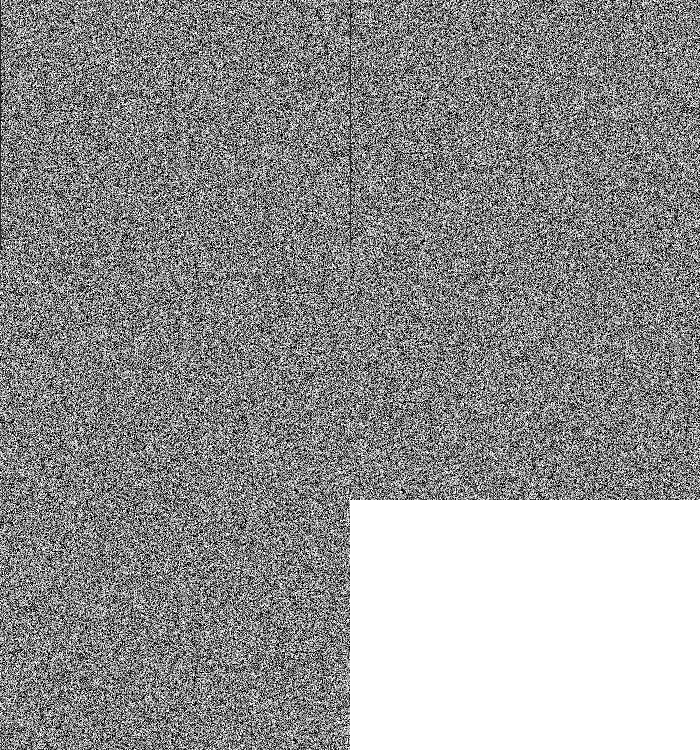
...something of which presumably started out in a state of complete and total chaos of random and disparate quantum phenomena that, metaphorically speaking, resembles something akin to this...
Image

...could have acquired (been imbued with) "fixed laws"?

I mean, your theory of determinism implies the existence of a mysteriously derived set of "fixed laws" that somehow managed to incrementally (yet steadfastly) cause that chaotic foundational substance (pictured above) to end up in this highly organized state...

Image

...that not only happens to be the absolute perfect physiological system and setting for facilitating the awakening of untold trillions of unique lifeforms into existence,...

...but a setting that, again, is equipped with everything it could possibly need to sustain that awakening process - billions of years into the future.

In other words, setting aside the incredible mystery of how this...

Image

...in and of itself initially came into existence, it is absolutely ridiculous of you to assume (take for granted) that that foundational substance just "naturally" came pre-loaded with the propensity to self-organize its random constituents into a state of order that defies our comprehension.
BigMike wrote: Sat Dec 21, 2024 11:34 pm But determinism doesn’t claim a purpose—it describes causality. If you're asking for an explanation of why the universe's laws exist as they do, that’s a deeper metaphysical question, one that lies outside the scope of science and within the domain of philosophical speculation. It’s not something I’ve ignored...
Well, first of all, you do understand that you are posting on a "philosophy" forum, don't you?

And secondly, you most certainly have ignored it.

Indeed, your whole schpiel regarding determinism starts from a point that completely ignores how the causality that determinism describes was set in motion.

Your argument perfectly encapsulates what Terence McKenna was getting at when he made the following statement:
“Modern science is based on the principle ‘Give us one free miracle and we’ll explain the rest.’ The ‘one free miracle’ is the appearance of all the mass and energy in the universe and all the laws that govern it in a single instant from nothing.”
Your failure to factor-in the philosophical questions that lie outside the scope of science,...

(questions whose answers could quite possibly put the kibosh on your theory)

...means that you have absolutely no business being so cocksure in your insistence that determinism not only rules out "free will," but I presume that also includes the ruling out of such things as "souls" and "agents" of mind, right?

I mean, good grief, man, the "Science" you are relying on allegedly can't even explain what approximately 96% of the universe is made of.

Just ask Google AI...
Yes, it is true that according to current scientific understanding, approximately 96% of the universe is made up of substances called "dark matter" and "dark energy," which we cannot directly observe and therefore cannot fully explain what they are, meaning science currently cannot explain what makes up most of the universe.
Yet, here you are, all gung-ho about a theory based on the minimal knowledge humans have derived from the study of a mere 4% of the universe's total makeup.

I'm sorry, BigMike, but you really let me catch a glimpse of just how weak your poker hand is when you used this...
BigMike wrote: Sat Dec 21, 2024 11:34 pm
  • Gravitation organizes matter on cosmic scales, giving rise to stars, planets, and galaxies.
...as a defense for your argument

And that's because anyone who thinks that the blind and mindless processes of gravity and thermodynamics could somehow cause, again, this...

Image

...to coalesce into that which is implied in just this one simple scene alone...

Image

...demonstrates a sort of religious-like "faith" in the creative powers of chance and serendipity that is not dissimilar to the faith that the most devout Christian, Muslim, or Jew has in the creative powers of whatever God they worship.

Until you at least accept the "possibility" that the universe could be the result of a level of consciousness and intelligence that is as far above humans as humans are above amoebas,...

...then you will forever be relegated to membership in the Dunning-Kruger club which consists of all the humans who are simply not awake enough to realize that they are not awake enough to understand that the universe could quite possibly be a perfectly designed "illusion" whose main purpose is to function as a "cosmic womb," so to speak, in which new eternal souls (like ours) can be awakened into existence.

(Yeah, yeah, I know what you're thinking, you're thinking that none of that supernatural "mumbo-jumbo" is evident or verifiable in the 4% of reality that human "Science" can access and measure. Therefore, from the perspective of materialism, it is nothing more than delusional "wishful thinking."

But, you see, that's the problem implicit in the "effect" part of the "Dunning-Kruger Effect" :wink:)

_______
BigMike
Posts: 2210
Joined: Wed Jul 13, 2022 8:51 pm

Re: Moving Beyond the Illusion of Free Will in Governance

Post by BigMike »

seeds wrote: Sun Dec 22, 2024 8:02 pm
Seeds, the topic at hand is the role of determinism in governance, particularly in moving beyond the illusion of free will. Your philosophical detour into the origins of the universe and the metaphysical underpinnings of determinism, while intriguing, isn't directly relevant to the practical applications we're discussing.

Determinism, as applied to governance, doesn't rely on speculations about the ultimate origins of causality or the nature of dark matter. Instead, it functions as a framework to understand human behavior, decision-making, and societal systems through the lens of cause and effect. The question isn't about the first cause but about how deterministic principles, observable and testable in the domains of neuroscience, psychology, and sociology, can inform and improve governance.

For instance:
  • In governance, deterministic insights challenge the traditional punitive approaches that assume moral blameworthiness based on free will. Instead, they advocate for systems that address root causes—be it economic conditions, educational disparities, or systemic biases—to mitigate harmful behavior.
  • Deterministic frameworks emphasize evidence-based policy-making, recognizing that human choices, far from being free, are shaped by prior causes and external influences. This supports the development of governance models that prioritize data, expertise, and predictable outcomes over ideological or moralistic approaches.
You point to the "mystery" of the universe's origins as a critique of determinism's validity. However, determinism, in its practical applications, doesn't need to resolve the metaphysical question of "why laws exist" to function effectively in governance. The utility of determinism lies in its explanatory and predictive power, not in its ability to address philosophical speculation about the cosmos.

Returning to governance: deterministic principles shift the focus from moral retribution to systemic accountability. Whether or not we fully comprehend the ultimate origins of physical laws doesn't change the fact that deterministic insights have the power to reshape systems in ways that are fairer, more effective, and aligned with evidence.

The real question isn't about the "creative powers of chance," as you put it, but about how deterministic understanding can create better systems for human flourishing. That is the practical, grounded issue worth addressing here.
seeds
Posts: 2880
Joined: Tue Aug 02, 2016 9:31 pm

Re: Moving Beyond the Illusion of Free Will in Governance

Post by seeds »

BigMike wrote: Sun Dec 22, 2024 8:24 pm
seeds wrote: Sun Dec 22, 2024 8:02 pm
Seeds, the topic at hand is the role of determinism in governance, particularly in moving beyond the illusion of free will. Your philosophical detour into the origins of the universe and the metaphysical underpinnings of determinism, while intriguing, isn't directly relevant to the practical applications we're discussing.
Come on now, BigMike, that was an "intriguing" sidestep to avoid addressing my arguments.

However, I was simply responding to what you, yourself, wrote just yesterday in this present thread...
BigMike wrote: Sat Dec 21, 2024 10:40 am The universe operates under unchanging conservation laws—principles like the conservation of energy and momentum—and the four fundamental forces of physics: gravity, electromagnetism, and the strong and weak nuclear forces. These laws and interactions govern all matter and energy, ensuring that every event arises as a direct consequence of preceding states. Because nothing in a closed system can occur without a cause grounded in these principles, the universe unfolds in a fully deterministic manner. Every interaction, whether at the cosmic or microscopic level, is governed by these immutable laws.
This deterministic framework extends seamlessly into the biological realm. Life itself is the result of physical processes: chemical reactions that led to the first replicating molecules, driven by specific environmental conditions and interactions. Evolution by natural selection is an inherently deterministic process, where traits that increase an organism's chances of survival and reproduction persist and proliferate over generations. Random mutations introduce variation, but even these arise from deterministic biochemical processes. The environment, in turn, deterministically selects for or against these variations, shaping the path of evolution...
Now, with your own quoted words above in mind (again, words taken from this very thread), you need to reread my post at the top of this page and stop avoiding the hard questions regarding your fundamental stance on determinism.
_______
Post Reply