Woodstock, an early phase:
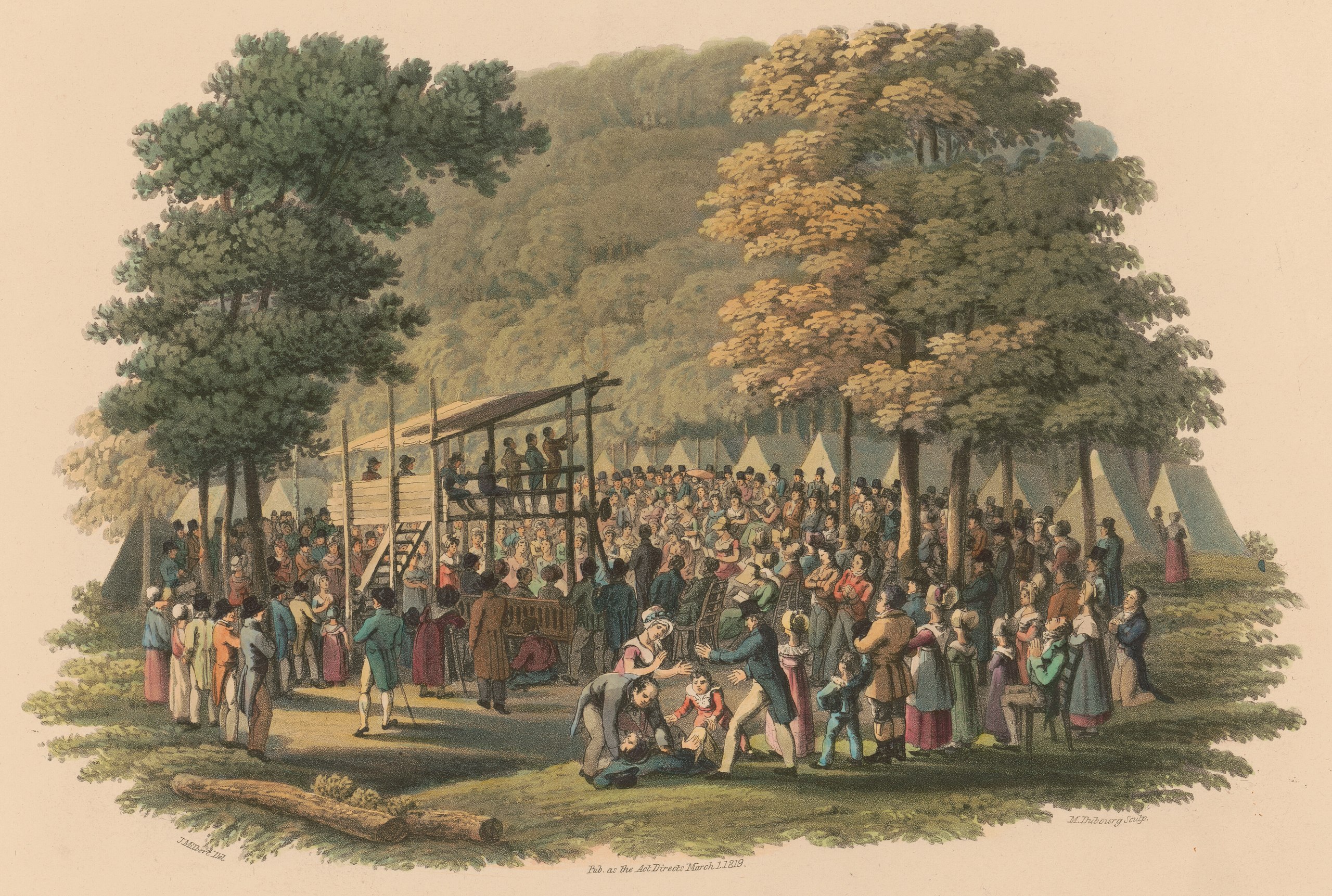
IC wrote: It wasn't about a new society. Or personal health. Or new freedom for women. Or about most of the things it was promoted as being about.
Harbal wrote: And what was it promoted as being about? It seems to me that it actually was about a new society, and about freedom, and I wouldn't even call it a sexual revolution; I think it was just part of a more general questioning of societal constraints. I would also like to think it was a kick up the arse for religious authority, and its stifling, outdated attitudes.
My view, based on what Harbal has written, is that he does not sufficiently understand the revolution of the Sixties. So he seems not to grasp that though the entire movement sold itself as utopian and as a sort of New Dawn for man, it had, at the least,
dual functions and results.
No one can deny, it seems to me, the emotionalized enthusiasm* expressed in the lyrics of the Sixties songs
Get Together and, for another example,
Woodstock. So in a sense that is easily discerned, these songs express Christian Universalism through emotional and ideological terms that make it seem natural, necessary, inevitable. The stance taken by those who were deeply influenced by these messages is one of absolute certainty that their values, their plans for society and for the planet, were good & proper and beyond any critical doubt or counter-argument. In this sense, in my view at least, these songs demonstrate the power of enthusiastic religion and a whole set of premises that extend from Christian Universalism.
Let me state it in another way: It is not possible to find the root of these moods, these messages, this longing if you will, outside of Christian Universalism.
However right there alongside this motivation, this deep emotional longing, this metaphysical certainly that the aspiration was right & good and literally blessed by God, there was another tendency: the destruction of established hierarchies. The attack on institutions of long standing. I know my references here are brief, and the fuller picture is expertly described in Robert Bork's Slouching Toward Gomorrah, but my view is that one has to see and understand the
duality of the results of the movement in order to understand what Immanuel refers to -- decadence, degeneration -- and why it is that conservative Protestant Evangelical (semi-Calvinist) ideologues long for a return to a former world that both existed and also did not really exist. Longing and nostalgia are powerful warpers of memory, and when one is captured by these longings -- a sense of loss, of something one once had that has left and may never return -- it warps one's historical perspective as well. When histories are written by people with this understanding, one ends up with views similar to Patrick Buchanan
et al.
It may sound as if I am critiquing the longing but that is not quite so.
What I would wish to point out is that any proposition to alternatives to the progressiveness that we all have been deeply influenced by, and indeed we cannot see any alternative to it, is met with something that rises up inside of ourselves: that certainty that the ideals we hold to are the right & proper ones. This ideological mood is noticed strongly on this forum by Sculptor, Flash, Lacewing, Gary and many others.
What Immanuel proposes is a cartoon version or as I recently said the Family Bible version of metaphysical conservatism. To get where he wants to go you have to re-amalgamate yourself with an Evangelical cult with a certain sense of cultural and social regulations. It is very true though that the roots of Christianity, and Christian doctrine itself, contains so many vestiges of conservative social doctrine which had been infused into it. But it also seems more true that Christianity is
far less a friend of genuine metaphysical conservatism than is supposed. Why? Because it is tyrannically universalist and uniformist. This impetus derives from its Judaic roots: an absolutely intolerant, tyrannical god-concept that actively and violently invalidates any concept except its own. It mind-fucks people at a central, metaphysical level.
In order to see through it, in order to oppose it, one has to confront it. And as we all clearly see here by example we deal here with a man whose unity of self would crash and fall into bits if he ever abandoned his ideological position.
The core questions though: personal health and wellbeing; the role of woman; sane social organization; respect for regional differences and autonomy; and a wide set of metaphysical predicates that challenge so many of those in our hyper-liberal realities that are so powerful such that we cannot oppose them without provoking in internal crisis -- these things are largely unknown to us because those who think in these terms are suppressed.
I think it was just part of a more general questioning of societal constraints. I would also like to think it was a kick up the arse for religious authority, and its stifling, outdated attitudes.
When understood from a Nietzschean perspective, and that conceptual platform where a child's picture of divine and metaphysical truth was imploded from within, becoming impossible to believe, and leading to a state of bereavement and loss of the ground under our feet (or the *horizon* if you wish), we arrived at an understanding that an entire
World must be reconstructed. But modernity, and liberal culture, and liberal universalism, and universal nihilism, and a world-level business-model which subsumes us all, becomes for us the core ground on which we live.
It was more than just *questioning* since it had to do with both toppling and reconstruction. This was definitely so when the family was thought on. The family, in Leninist terms, is an oppressive institution that needed to be abandoned. In regard to sexuality, the Christian prudish view was targeted, and any alternative to it was seen as good & necessary. But there are certainly schools of thought that would necessarily resist unbridled hedonism and non-restaint in sexual practice. But the rebellious mood -- a child's rebellion against parents and authority -- will always tear down all barriers. Because there is no longer a sound, believable, metaphysical undergirding.
Around us now, but always seem to manifest with a certain inflicted debility, or is it uncertainty, or ideological unclarity, there are numerous challenges to the established Liberal models. The so-called Right-tending resistance movements. They are always described as *fascistic* and therefore *evil*. But they all seem to desire to re-imbue social ideology with more traditionalist metaphysical ideas.
__________________________
*
Enthusiasm
[Pejorative use]
During the years that immediately followed the Glorious Revolution, "enthusiasm" was a British pejorative term for advocacy of any political or religious cause in public, i.e. fanaticism. Such "enthusiasm" was seen in the time around 1700 as the cause of the previous century's English Civil War and its attendant atrocities, and thus it was an absolute social sin to remind others of the war by engaging in enthusiasm. The Royal Society bylaws stipulated that any person discussing religion or politics at a Society meeting was to be summarily ejected for being an "enthusiast."
During the 18th century, popular Methodists such as John Wesley or George Whitefield were accused of blind enthusiasm, a charge against which they defended themselves by distinguishing fanaticism from "religion of the heart." Methodists who enthusiastically preach about and experience the new birth (first work of grace) and entire sanctification (second work of grace) often have emotional experiences.
"Methodist preachers have been known for their enthusiasm in promulgating the doctrines of the new birth and entire sanctification to the public at events such as tent revivals and camp meetings, which they believe is the reason that God raised them up into existence."


