Christianity

For all things philosophical.

Moderators: AMod, iMod

User avatar
iambiguous
Posts: 11317
Joined: Mon Nov 22, 2010 10:23 pm

Re: Christianity

Post by iambiguous »

The Ontological Argument Revisited
Peter Mullen explores the argument that by definition, God exists.
R.G. Collingwood:

“Metaphysical statements are not propositions. They are presuppositions. When I say, ‘God exists’ what I mean is that I presuppose or believe that God exists. This is the metaphysical rubric. The presupposition that God exists is logically identical to the presupposition, ‘Every event has a cause.’
Proposition: "a statement or assertion that expresses a judgment or opinion."

I'm well aware of course that there are those who actually take arguments of this sort seriously. Technical distinctions made between metaphysics, propositions and presuppositions.

But from my frame of mind, given free will, they are still only words...words thought up in order to tell us something about other words that some then conflate into the existence of God. A God, the God, their God.

And then those like Kant propose or presuppose the existence of this God in order to propose or to presuppose the intellectual/philosophical contraption that becomes deontology.

Absolutely nothing beyond the arguments themselves is there to actually demonstrate the empirical, material, phenomenological existence of a God, the God.

It's like Platonic forms. Little more than a metaphysical theory. And from this philosophical concoction comes, what, the "timeless, absolute, unchangeable idea" of God?

That is "proof" that God exists? And merely believing it need be as far as one goes?

Then straight back up "spiritually" into the clouds of abstraction...
"What Anselm’s argument proves is not that because our idea of God is an idea of id quo maius cogitari nequit [‘of which nothing can be thought greater’], therefore God exists, but that because our idea of God is an idea of id quo maius cogitate nequit [‘that which you can’t think of as being more’], we stand [in relation] to a belief in God’s existence.”
"Here and now" I just find it hard to believe that with so much at stake on both sides of the grave, anyone could take this seriously. I can only presume that they do because if it were true how extraordinary that would be for mere mortals given our utter lack of significance given the staggering vastness of "all the there is".

I recall how enormously comforting and consoling my own Christian faith once was. So, sure, if only I could get it back again. But with "evidence" as thin as the ontological argument? An argument that merely defines and deduces God into existence?

And the Christian God to boot?!
Most philosophers think Anselm was trying to prove the existence of God. In a sense he was, but his belief in God did not, for him, depend on the validity of his proof. His Proslogion was a prayer asking God, in whom he firmly believed, to enable him to devise an argument to prove it.
Okay, so what actual proof did he have that the Christian God did in fact exist? Given that back in the eleventh century he didn't have access to YouTube videos.
User avatar
attofishpi
Posts: 13319
Joined: Tue Aug 16, 2011 8:10 am
Location: Orion Spur
Contact:

Re: Christianity

Post by attofishpi »

Show us Christians Y we should provide evidence to chumps without the intelligence to comprehend such a being..oo go on. :twisted:
User avatar
Alexis Jacobi
Posts: 8301
Joined: Tue Oct 26, 2021 3:00 am

Re: Christianity

Post by Alexis Jacobi »

Iambiguous writes: It's like Platonic forms. Little more than a metaphysical theory. And from this philosophical concoction comes, what, the "timeless, absolute, unchangeable idea" of God?

That is "proof" that God exists? And merely believing it need be as far as one goes?

Then straight back up "spiritually" into the clouds of abstraction...
Quoting Peter Mullen:
"What Anselm’s argument proves is not that because our idea of God is an idea of id quo maius cogitari nequit [‘of which nothing can be thought greater’], therefore God exists, but that because our idea of God is an idea of id quo maius cogitate nequit [‘that which you can’t think of as being more’], we stand [in relation] to a belief in God’s existence.”
Iambiguous continues: "Here and now" I just find it hard to believe that with so much at stake on both sides of the grave, anyone could take this seriously. I can only presume that they do because if it were true how extraordinary that would be for mere mortals given our utter lack of significance given the staggering vastness of "all the there is".

I recall how enormously comforting and consoling my own Christian faith once was. So, sure, if only I could get it back again. But with "evidence" as thin as the ontological argument? An argument that merely defines and deduces God into existence?
First, I think your base position is less than honest, in the sense that for you, presently, there are no consequences either on this side of the grave or on the other side of it. Yet you continually refer to that idea, as if you believed it. But it is only those who have certainty of the existence of the soul, be they Christian or for example those who accept the metaphysics of the Bhagavad-Gita, who consider what follows this impermanent existence and take a future existence as *real* and inevitable. It is only someone who is grounded in metaphysics who would even bother to be concerned. So, the metaphysical perspective must come first. And then worry or preoccupation about the consequences of what we do here (or don't do).

Then there is your continual insinuation about those who think, or perceive and reason, in what you negatively describe as *abstractions*. But here again it requires a priori a metaphysical position in order to *abstract* about the possibility, or the reality, of consequences to what we do here and then what might manifest there. In order to think about any of this one must think in abstract terms.
[Middle English, from Latin abstractus, past participle of abstrahere, to draw away : abs-, ab-, away; see ab-1 + trahere, to draw.]
ab•stract (adj. æbˈstrækt, ˈæb strækt; n. ˈæb strækt; v. æbˈstrækt for 11-14, ˈæb strækt for 15 )

adj.
1. thought apart from concrete realities, specific objects, or actual instances: an abstract idea.
2. expressing a quality or characteristic apart from any specific object or instance: an abstract word like justice.
3. theoretical; not applied or practical.
4. difficult to understand; abstruse.
5. emphasizing line, color, and nonrepresentational form: abstract art.
n.
6. a summary of a text, technical article, speech, etc.
7. an abstract idea or term.
8. an abstract work of art.
9. something that concentrates in itself the essential qualities of anything more extensive or more general.
v.t.
10. to draw or take away; remove.
11. to divert or draw away the attention of.
12. to steal.
13. to consider as a general quality or characteristic apart from specific objects or instances.
14. to make an abstract of; summarize.
Clearly, thought apart from concrete realities, specific objects, or actual instances: an abstract idea is the basis of your criticism in regard to what you refer to as being in the clouds and reasoning or theorizing from an unreal plane, but I suggest that you seem stuck in a strange semi-distorted reasoning-loop.

You imply that one can and should come down from these abstract heights to 'reality' and, arriving there, conclude something which you never can state nor define nor name. Yet it is obvious that to even think about the higher consequences of actions and doing here in this plane requires an abstract form of reasoning or speculation.

So I would return to this:
It's like Platonic forms. Little more than a metaphysical theory. And from this philosophical concoction comes, what, the "timeless, absolute, unchangeable idea" of God?
Obviously, Plato's ideas depend on 'abstraction'. But in the absence of such abstraction, if you think about it, there is really no, say, dimensional thought at all. What sort of human being could think or does think in such a manner? Perhaps some proto-human at the very dawn of the sort of consciousness we understand to be human.

So, I think that you indirectly advocate for some way of thinking about things which I cannot for the life of me understand. You label that *the intellectual clouds* without seeming to realize that if you negate that sort of thinking you negate the human.
IAMs writes: "Here and now" I just find it hard to believe that with so much at stake on both sides of the grave, anyone could take this seriously.
What I do not get is your emphasis on 'here and now' placed in contrast to abstract or intellectual thought. Well, to say *I don't get it* is not quite right. In fact I think I do get it.

So again I have to repeat: you advocate for and are committed to a type of non-thinking and a way of being in life that does not involve intellectual or abstract thinking about those matters touching on consequences and also on the soul's existence. You seem to negate both or in any case the two of them together. Because it is only if there is a soul that there could be, might be, or will be consequences for that soul.

But your ideational world is that of an acute moral nihilist. That is how you describe yourself. Why all the bother then about issues pertaining to abstractions, to the existence of the soul and to consequences?

How could anyone propose any solution to your *problem* when, or so it seems, you'd need to reconfigure the way you have established as the *correct way to think* which is to say not to think (abstractly and intellectually)?
I recall how enormously comforting and consoling my own Christian faith once was. So, sure, if only I could get it back again. But with "evidence" as thin as the ontological argument? An argument that merely defines and deduces God into existence?
You also said that your former faith was a faith of a child. But I do not think that the faith of a child is the sort of thing that holds a man's philosophical and existential position together. A man requires a faith based on principles that have been struggled for. In the best of circumstances a man requires something more than mere *faith*. But that is where what is intellectually conceived becomes acutely relevant!

A child cannot reason at this level. A child can only focus on what is *visible* and what impinges directly on him. But can you really ask a child to think in terms that are intellectual, abstract and consequential? My experience is that it is there that children are very weak. Who then thinks in such abstract and consequential terms? I think you'd have to go to the other end of the age-scale. Traditionally, it is *old serious men* (the 'wise men') who, at the end of a life of experience, encourage people to see things more dimensionally.

This should not be taken as an effort at Christian apologetics necessarily. My view is that what we understand to be Christian apologetics is a strange amalgamation of Hebrew and Greek modes-of-thinking. The blending of the two is strange indeed. And the *picture* that has been concocted is indeed just that: a picture. But the picture is not the essence that the picture, or the symbol, seeks to convey.

The essence within the picture can only be perceived at the abstract and intellectual level. Children require pictures. But a mature and intellectual adult (technically!) should become capable of reasoning on those 'higher levels'.

So the child who really is not interested in an *answer* that does not conform to his stubborn and headstrong sense of what an answer is and how it should be presented stomps his feet, gets frustrated and irritated, and digs himself deeper into the position he determines he will resolutely hold.

It is not that I do not understand and can't relate to the child's position and stance, indeed I do and I can, because it is the position we are all in. We cannot any longer *believe in God* because our own *mental contraptions* (to borrow your phrase Iambiguous) stand so much in our way. They appear to us so real, so insurmountable, that we are effectively locked out of a position of 'belief'.

Personally, I think that the whole Picture has actually to be allowed to collapse, and then we have to start over again. The horizon (picture) was erased according to Nietzsche's metaphor. But we have no sufficient means to reconstruct it.

[And this is why I am now working on the 15th Chapter of the (now) Fifteen Week *Total Reconstruction* Email Course!]
Gary Childress
Posts: 11755
Joined: Sun Sep 25, 2011 3:08 pm
Location: It's my fault

Re: Christianity

Post by Gary Childress »

Alexis Jacobi wrote: Mon Jul 03, 2023 3:09 pm It is only someone who is grounded in metaphysics who would even bother to be concerned. So, the metaphysical perspective must come first. And then worry or preoccupation about the consequences of what we do here (or don't do).
Does one have to have a "first philosophy" in order to be concerned with the consequences of what they do or don't do? It seems to me that one could equally make the case that one can become aware of consequences to ones actions even before one has any formalized "first philosophy". At the very least it sounds to me like a chicken or egg kind of argument.
User avatar
iambiguous
Posts: 11317
Joined: Mon Nov 22, 2010 10:23 pm

Re: Christianity

Post by iambiguous »

Chaz Bufe
Reasons to Abandon Christianity
Christianity is cruel.

Throughout its history, cruelty—both to self and others—has been one of the most prominent features of Christianity. From its very start, Christianity, with its bleak view of life, its emphasis upon sexual sin, and its almost impossible-to-meet demands for sexual "purity," encouraged guilt, penance, and self-torture. Today, this self-torture is primarily psychological, in the form of guilt arising from following (or denying, and thus obsessing over) one's natural sexual desires.
Yes, Christianity can be cruel. Though, again, given my own experiences, I never came upon any actual cruelty at all. On the contrary, it was mostly about doing good deeds in the community and being rewarded with immortality and salvation. Yes, I'd ponder from time to time those tortured in Hell for all of eternity, but that simply wasn't something that Reverend Deerdorf and the other church leaders focused on. Very little of the old "fire and brimstone" stuff at the Protestant Community Church. As for sex, nope, it never much came up.

Though I'm sure for other Christian communities, things are different. Especially "historically".
In earlier centuries, it was often physical. W.E.H. Lecky relates:

"For about two centuries, the hideous maceration of the body was regarded as the highest proof of excellence. . . . The cleanliness of the body was regarded as a pollution of the soul, and the saints who were most admired had become one hideous mass of clotted filth. . . . But of all the evidences of the loathsome excesses to which this spirit was carried, the life of St. Simeon Stylites is probably the most remarkable. . . . He had bound a rope around him so that it became embedded in his flesh, which putrefied around it. A horrible stench, intolerable to the bystanders, exhaled from his body, and worms dropped from him whenever he moved, and they filled his bed. . . . For a whole year, we are told, St. Simeon stood upon one leg, the other being covered with hideous ulcers, while his biographer [St. Anthony] was commissioned to stand by his side, to pick up the worms that fell from his body, and to replace them in the sores, the saint saying to the worms, "Eat what God has given you." From every quarter pilgrims of every degree thronged to do him homage. A crowd of prelates followed him to the grave. A brilliant star is said to have shone miraculously over his pillar; the general voice of mankind pronounced him to be the highest model of a Christian saint; and several other anchorites [Christian hermits] imitated or emulated his penances."
Is that still around much these days, however?
Given that the Bible nowhere condemns torture and sometimes prescribes shockingly cruel penalties (such as burning alive), and that Christians so wholeheartedly approved of self-torture, it's not surprising that they thought little of inflicting appallingly cruel treatment upon others. At the height of Christianity's power and influence, hundreds of thousands of "witches" were brutally tortured and burned alive under the auspices of ecclesiastical witch finders, and the Inquisition visited similarly cruel treatment upon those accused of heresy.
Here, of course, many Christians will no doubt make the distinction between the Old Testament God and the New Testament God/Christ. Perhaps in his 30 odd years down here among us, we civilized Him a bit.

On the other hand...
https://www.google.com/search?q=violenc ... s-wiz-serp

It will probably come down to how a particular Christian makes his or her own distinction between Christianity "back then" and Christianity "today".
User avatar
iambiguous
Posts: 11317
Joined: Mon Nov 22, 2010 10:23 pm

Re: Christianity

Post by iambiguous »

attofishpi wrote: Mon Jul 03, 2023 5:54 am Show us Christians Y we should provide evidence to chumps without the intelligence to comprehend such a being..oo go on. :twisted:
Your avatar...is that photoshopped? Or, perhaps, a caricature of you?

:wink:

Seriously, though, for those not construed by you to be chumps, what evidence might that be?
User avatar
attofishpi
Posts: 13319
Joined: Tue Aug 16, 2011 8:10 am
Location: Orion Spur
Contact:

Re: Christianity

Post by attofishpi »

iambiguous wrote: Mon Jul 03, 2023 10:36 pm
attofishpi wrote: Mon Jul 03, 2023 5:54 am Show us Christians Y we should provide evidence to chumps without the intelligence to comprehend such a being..oo go on. :twisted:
Your avatar...is that photoshopped? Or, perhaps, a caricature of you?

:wink:

Seriously, though, for those not construed by you to be chumps, what evidence might that be?
There's plenty of evidence that an intelligence (God) has formed certain things into their present state, indeed there are anomalies all around us. Even the letter Christ formed on the crucifix Y should be considered - WHY? Crew See Fiction?

The English language is riddled with anomalies that could only have been brought about by this intelligence, not naturally via typical language etymology. In saying that, I only started examining the homophones, word reversals etc..once God had made itself evident to me, and set me to task on delving into the construct of certain key words within the language.

AN_ARCH_Y?
LIVE/EVIL
HELL_o
JE_SUS
Tree of KNOW_LEDGE
PARANOID - PA ANNOYED......God is v annoyed when you return to the tree of knowledge
PARANOYA - PA ANNOYA........God will annoy you in the most EVIL way.

Etc etc..(yes clearly schizo talk - but have a deeper think about it)

The moon dimensions are a bloody strange anomaly..
Places on the planet as per within my thread:- Simulation or Divine Reality?:- viewtopic.php?t=33214

So when I state 'anomalies' I mean things in their present state could not have come about naturally - this God must have construed such things.

I think for you iambiguous, you should be considering God from a hypothetical point of view. The first question you should consider IF there is a God, is why does it demand FAITH without providing clear evidence to all such that there is no DO_U_BT?
User avatar
iambiguous
Posts: 11317
Joined: Mon Nov 22, 2010 10:23 pm

Re: Christianity

Post by iambiguous »

attofishpi wrote: Tue Jul 04, 2023 1:41 am
iambiguous wrote: Mon Jul 03, 2023 10:36 pm
attofishpi wrote: Mon Jul 03, 2023 5:54 am Show us Christians Y we should provide evidence to chumps without the intelligence to comprehend such a being..oo go on. :twisted:
Your avatar...is that photoshopped? Or, perhaps, a caricature of you?

:wink:

Seriously, though, for those not construed by you to be chumps, what evidence might that be?
There's plenty of evidence that an intelligence (God) has formed certain things into their present state, indeed there are anomalies all around us. Even the letter Christ formed on the crucifix Y should be considered - WHY? Crew See Fiction?

The English language is riddled with anomalies that could only have been brought about by this intelligence, not naturally via typical language etymology. In saying that, I only started examining the homophones, word reversals etc..once God had made itself evident to me, and set me to task on delving into the construct of certain key words within the language.

AN_ARCH_Y?
LIVE/EVIL
HELL_o
JE_SUS
Tree of KNOW_LEDGE
PARANOID - PA ANNOYED......God is v annoyed when you return to the tree of knowledge
PARANOYA - PA ANNOYA........God will annoy you in the most EVIL way.

Etc etc..(yes clearly schizo talk - but have a deeper think about it)

The moon dimensions are a bloody strange anomaly..
Places on the planet as per within my thread:- Simulation or Divine Reality?:- viewtopic.php?t=33214

So when I state 'anomalies' I mean things in their present state could not have come about naturally - this God must have construed such things.

I think for you iambiguous, you should be considering God from a hypothetical point of view. The first question you should consider IF there is a God, is why does it demand FAITH without providing clear evidence to all such that there is no DO_U_BT?
No, seriously, what evidence?
User avatar
attofishpi
Posts: 13319
Joined: Tue Aug 16, 2011 8:10 am
Location: Orion Spur
Contact:

Re: Christianity

Post by attofishpi »

B_lame

U R Blind.
Gary Childress
Posts: 11755
Joined: Sun Sep 25, 2011 3:08 pm
Location: It's my fault

Re: Christianity

Post by Gary Childress »

I saw a license plate the other day. The second symbol on it was the #7. I submit that as irrefutable proof that God exists. :roll:
User avatar
iambiguous
Posts: 11317
Joined: Mon Nov 22, 2010 10:23 pm

Re: Christianity

Post by iambiguous »

Note to myself:

Him again. So, should I continue to take him seriously -- if only up in the ponderous "wall of words" clouds -- or as with those like IC and...alas of late...henry quirk, is it now just entertainment?


Edit: still too close to call...

Alexis Jacobi wrote: Mon Jul 03, 2023 3:09 pm
Iambiguous writes: It's like Platonic forms. Little more than a metaphysical theory. And from this philosophical concoction comes, what, the "timeless, absolute, unchangeable idea" of God?

That is "proof" that God exists? And merely believing it need be as far as one goes?

Then straight back up "spiritually" into the clouds of abstraction...
Quoting Peter Mullen:
"What Anselm’s argument proves is not that because our idea of God is an idea of id quo maius cogitari nequit [‘of which nothing can be thought greater’], therefore God exists, but that because our idea of God is an idea of id quo maius cogitate nequit [‘that which you can’t think of as being more’], we stand [in relation] to a belief in God’s existence.”
Iambiguous continues: "Here and now" I just find it hard to believe that with so much at stake on both sides of the grave, anyone could take this seriously. I can only presume that they do because if it were true how extraordinary that would be for mere mortals given our utter lack of significance given the staggering vastness of "all the there is".

I recall how enormously comforting and consoling my own Christian faith once was. So, sure, if only I could get it back again. But with "evidence" as thin as the ontological argument? An argument that merely defines and deduces God into existence?
First, I think your base position is less than honest, in the sense that for you, presently, there are no consequences either on this side of the grave or on the other side of it. Yet you continually refer to that idea, as if you believed it.
Obviously: for those who believe in a God, the God, their Christian God, the consequences are very, very real "in their head". And on both sides of the grave. And what I believe here and now is that given the complete lack of substantive evidence from the Christians I have come upon of late, I don't believe "in my head" that the Christian God does exist. But in no way, shape or form would I argue that in fact He does not exist. And, so, if in fact He does exist that makes the consequences exist too.

But then all these folks -- https://en.wikipedia.org/wiki/List_of_r ... traditions -- insist that, on the contrary, the consequences revolve around their own One True Path instead.

Then straight back up into the spiritual/metaphysical/Platonic clouds!
Alexis Jacobi wrote: Mon Jul 03, 2023 3:09 pmBut it is only those who have certainty of the existence of the soul, be they Christian or for example those who accept the metaphysics of the Bhagavad-Gita, who consider what follows this impermanent existence and take a future existence as *real* and inevitable. It is only someone who is grounded in metaphysics who would even bother to be concerned. So, the metaphysical perspective must come first. And then worry or preoccupation about the consequences of what we do here (or don't do).

Then there is your continual insinuation about those who think, or perceive and reason, in what you negatively describe as *abstractions*. But here again it requires a priori a metaphysical position in order to *abstract* about the possibility, or the reality, of consequences to what we do here and then what might manifest there. In order to think about any of this one must think in abstract terms.
Now that's entertainment!! :wink:

Note to Harry Baird and IC:

Please translate this particular intellectual concoction into anything that is relevant to connecting the dots between Sin on this side of the grave, Judgment Day and immortality and salvation on the other side of it.
[Middle English, from Latin abstractus, past participle of abstrahere, to draw away : abs-, ab-, away; see ab-1 + trahere, to draw.]
ab•stract (adj. æbˈstrækt, ˈæb strækt; n. ˈæb strækt; v. æbˈstrækt for 11-14, ˈæb strækt for 15 )

adj.
1. thought apart from concrete realities, specific objects, or actual instances: an abstract idea.
2. expressing a quality or characteristic apart from any specific object or instance: an abstract word like justice.
3. theoretical; not applied or practical.
4. difficult to understand; abstruse.
5. emphasizing line, color, and nonrepresentational form: abstract art.
n.
6. a summary of a text, technical article, speech, etc.
7. an abstract idea or term.
8. an abstract work of art.
9. something that concentrates in itself the essential qualities of anything more extensive or more general.
v.t.
10. to draw or take away; remove.
11. to divert or draw away the attention of.
12. to steal.
13. to consider as a general quality or characteristic apart from specific objects or instances.
14. to make an abstract of; summarize.
Alexis Jacobi wrote: Mon Jul 03, 2023 3:09 pmClearly, thought apart from concrete realities, specific objects, or actual instances: an abstract idea is the basis of your criticism in regard to what you refer to as being in the clouds and reasoning or theorizing from an unreal plane, but I suggest that you seem stuck in a strange semi-distorted reasoning-loop.

You imply that one can and should come down from these abstract heights to 'reality' and, arriving there, conclude something which you never can state nor define nor name. Yet it is obvious that to even think about the higher consequences of actions and doing here in this plane requires an abstract form of reasoning or speculation.
Note to Ralph Dumain:

Did you put him up to this?!

Again and again and again: Why on Earth are Gods and religious paths "thought up" by mere mortals? Because there is no getting around death. What then? Well, with no evidence whatsoever on this side of the grave that "I" continues on after death, what is to be done?

Of course: God!

Or the Gods!!

But wait...

He or them is/are not just going to let anyone into Paradise. No, instead, the behaviors of mere mortals on this side of the grave must be Judged. With or without an actual Scripture, some behaviors will be deemed righteous and other behaviors sins.

That is religion -- existentially -- in a nutshell. And not, in my view, the philosophical gibberish that you promote -- your walls of words -- in order to keep you as far removed from the consequences of actual human interaction as you possibly can.
Alexis Jacobi wrote: Mon Jul 03, 2023 3:09 pmSo I would return to this:
It's like Platonic forms. Little more than a metaphysical theory. And from this philosophical concoction comes, what, the "timeless, absolute, unchangeable idea" of God?
Alexis Jacobi wrote: Mon Jul 03, 2023 3:09 pmObviously, Plato's ideas depend on 'abstraction'. But in the absence of such abstraction, if you think about it, there is really no, say, dimensional thought at all. What sort of human being could think or does think in such a manner? Perhaps some proto-human at the very dawn of the sort of consciousness we understand to be human.

So, I think that you indirectly advocate for some way of thinking about things which I cannot for the life of me understand. You label that *the intellectual clouds* without seeming to realize that if you negate that sort of thinking you negate the human.
I'm sorry, you might actually be convinced this is of vital importance in regard to taking philosophy or religion seriously. And, sure, technically maybe it is. But what on Earth does it have to do with the lives that we actually live? Let alone the part where we choose particular behaviors here and now because we really do connect the dots between them and immortality and salvation there and then.

Look, this is only my own "rooted existentially in dasein" personal opinion but above all else, first and foremost, you really do strike me as insufferable pedant. From my frame of mind, you seek to "communicate" only as you imagine others being impressed with your "intellectual depth". Or, uh, maybe to impress the "philosophy chicks" among us?

And then you will really go off the deep end...
Alexis Jacobi wrote: Mon Jul 03, 2023 3:09 pmWhat I do not get is your emphasis on 'here and now' placed in contrast to abstract or intellectual thought. Well, to say *I don't get it* is not quite right. In fact I think I do get it.

So again I have to repeat: you advocate for and are committed to a type of non-thinking and a way of being in life that does not involve intellectual or abstract thinking about those matters touching on consequences and also on the soul's existence. You seem to negate both or in any case the two of them together. Because it is only if there is a soul that there could be, might be, or will be consequences for that soul.

But your ideational world is that of an acute moral nihilist. That is how you describe yourself. Why all the bother then about issues pertaining to abstractions, to the existence of the soul and to consequences?

How could anyone propose any solution to your *problem* when, or so it seems, you'd need to reconfigure the way you have established as the *correct way to think* which is to say not to think (abstractly and intellectually)?
This is so utterly irrelevant to anything that matters to me [and most Christians] in regard to God and religion, it almost reminds me of the sort of stuff that gets posted by Meno over at ILP. As though you are really only imitating Alan Sokal...exposing and/or mocking those who post intellectual gibberish of this sort.

And, no, what I said was that I was "a kid" when I embraced Christianity. Just out of high school but before I got drafted into the Army.

And then I yanked God all the way over to a place called Vietnam.

Where I lost Him.
User avatar
attofishpi
Posts: 13319
Joined: Tue Aug 16, 2011 8:10 am
Location: Orion Spur
Contact:

Re: Christianity

Post by attofishpi »

Gary Childress wrote: Tue Jul 04, 2023 5:32 pm I saw a license plate the other day. The second symbol on it was the #7. I submit that as irrefutable proof that God exists. :roll:
Get back to us when you see "GAZZA_IN_HELL" on a numer plate and then also on a couple of billboards!!


Yeah, no evidence here:

Chile is a long thin backbone to South America - CHILL UP YOUR SPINE? - BRA_zil - on the NIPPLE has a town called NATAL - which means:- Of or relating to childbirth.
ANOTHER RANDOM COIN_CIDENCE?

NATAL (South America to scale)
Image


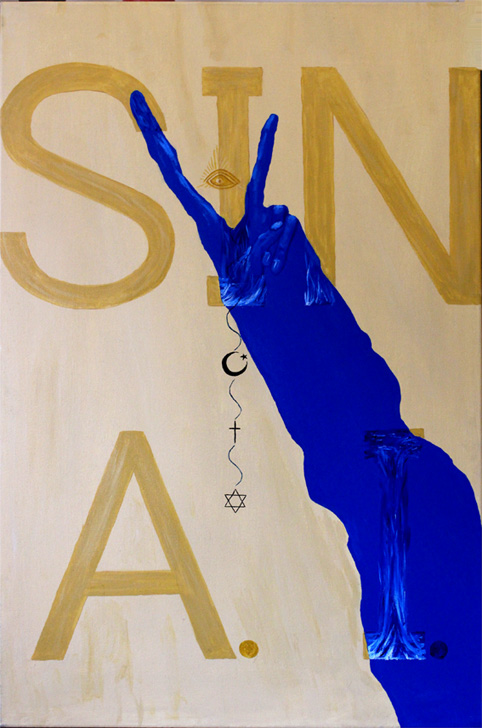
Mount SINAI is where Moses received the conditions for which wo/man should abide - The Commandments. We now know with technology, that it is PLAUSIBLE for an entity to be ALL knowing of our lives. SINAI breaks down to SIN_AI. Is God DIVINE or AI or BOTH?
It just happens that Mount Sinai is placed between what I have painted as two fingers as a peace sign - from the Red Sea.

ANOTHER RANDOM COIN_CIDENCE?

MOUNT SINAI (Red Sea to scale)
Image


Christ stated "I am the light" - interesting the light enters our consciousness via qualia through our PUPILS
ANOTHER RANDOM COIN_CIDENCE?

WISE PUPILS OF THE LIGHT
Image


Again, Christ stated "I am the light" - our life sustenance, the SUN just happens to be a homophone.
ANOTHER RANDOM COIN_CIDENCE?

SUN OF GOD
Image


Faith No More – Evidence
https://www.youtube.com/watch?v=7lvMNLh ... p&index=37
Gary Childress
Posts: 11755
Joined: Sun Sep 25, 2011 3:08 pm
Location: It's my fault

Re: Christianity

Post by Gary Childress »

attofishpi wrote: Wed Jul 05, 2023 2:19 am
Gary Childress wrote: Tue Jul 04, 2023 5:32 pm I saw a license plate the other day. The second symbol on it was the #7. I submit that as irrefutable proof that God exists. :roll:
Get back to us when you see "GAZZA_IN_HELL" on a numer plate and then also on a couple of billboards!!
Oh, yes. "Hell". If you have no proof, just threaten eternal damnation at one's critics. How civil and "Christian".
User avatar
attofishpi
Posts: 13319
Joined: Tue Aug 16, 2011 8:10 am
Location: Orion Spur
Contact:

Re: Christianity

Post by attofishpi »

Gary Childress wrote: Wed Jul 05, 2023 4:47 am
attofishpi wrote: Wed Jul 05, 2023 2:19 am
Gary Childress wrote: Tue Jul 04, 2023 5:32 pm I saw a license plate the other day. The second symbol on it was the #7. I submit that as irrefutable proof that God exists. :roll:
Get back to us when you see "GAZZA_IN_HELL" on a numer plate and then also on a couple of billboards!!
Oh, yes. "Hell". If you have no proof, just threaten eternal damnation at one's critics. How civil and "Christian".
Oh I apologise Gazza, but it didn't seem appropriate to post Gazza in heaven since by your own descriptions your life seems more on the Hellish side!
User avatar
Dontaskme
Posts: 16929
Joined: Sat Mar 12, 2016 2:07 pm
Location: Nowhere

Re: Christianity

Post by Dontaskme »

attofishpi wrote: Tue Jul 04, 2023 1:41 am
iambiguous wrote: Mon Jul 03, 2023 10:36 pm
attofishpi wrote: Mon Jul 03, 2023 5:54 am Show us Christians Y we should provide evidence to chumps without the intelligence to comprehend such a being..oo go on. :twisted:
Your avatar...is that photoshopped? Or, perhaps, a caricature of you?

:wink:

Seriously, though, for those not construed by you to be chumps, what evidence might that be?
There's plenty of evidence that an intelligence (God) has formed certain things into their present state, indeed there are anomalies all around us. Even the letter Christ formed on the crucifix Y should be considered - WHY? Crew See Fiction?

The English language is riddled with anomalies that could only have been brought about by this intelligence, not naturally via typical language etymology. In saying that, I only started examining the homophones, word reversals etc..once God had made itself evident to me, and set me to task on delving into the construct of certain key words within the language.

AN_ARCH_Y?
LIVE/EVIL
HELL_o
JE_SUS
Tree of KNOW_LEDGE
PARANOID - PA ANNOYED......God is v annoyed when you return to the tree of knowledge
PARANOYA - PA ANNOYA........God will annoy you in the most EVIL way.

Etc etc..(yes clearly schizo talk - but have a deeper think about it)

The moon dimensions are a bloody strange anomaly..
Places on the planet as per within my thread:- Simulation or Divine Reality?:- viewtopic.php?t=33214

So when I state 'anomalies' I mean things in their present state could not have come about naturally - this God must have construed such things.

I think for you iambiguous, you should be considering God from a hypothetical point of view. The first question you should consider IF there is a God, is why does it demand FAITH without providing clear evidence to all such that there is no DO_U_BT?
Pattern forming. Like calling white clouds ''mickey mouse''.

That's all that's going on.

Nothing to do with ''mickey mouse'' though, aka God. Just simple basic pattern forming.
Post Reply