Christianity

For all things philosophical.

Moderators: AMod, iMod

User avatar
Immanuel Can
Posts: 27604
Joined: Wed Sep 25, 2013 4:42 pm

Re: Christianity

Post by Immanuel Can »

Alexis Jacobi wrote: Fri Apr 22, 2022 1:05 am
Immanuel Can wrote: Fri Apr 22, 2022 12:28 am Well, our one of our basic disagreements if over whether or not there's ever been anything like a truly "Christian" culture.
That's not a right assessment.
And yet, it is.

Like I say, and as the old song says,

"There ain't no good guy,
There ain't no bad guy;
There's only you and me, and we just disagree."
User avatar
Dontaskme
Posts: 16929
Joined: Sat Mar 12, 2016 2:07 pm
Location: Nowhere

Re: Christianity

Post by Dontaskme »

Immanuel Can wrote: Fri Apr 22, 2022 2:33 am
Alexis Jacobi wrote: Fri Apr 22, 2022 1:05 am
Immanuel Can wrote: Fri Apr 22, 2022 12:28 am Well, our one of our basic disagreements if over whether or not there's ever been anything like a truly "Christian" culture.
That's not a right assessment.
And yet, it is.

Like I say, and as the old song says,

"There ain't no good guy,
There ain't no bad guy;
There's only you and me, and we just disagree."
There is no right assessment - there is no wrong assessment.

To be wrong is to make other right - to be right is to make other wrong.

We can only agree to disagree. Beliefs are not reality. Beliefs are fantasy. I am a poet and I did not know it.


.
Belinda
Posts: 10548
Joined: Fri Aug 26, 2016 10:13 am

Re: Christianity

Post by Belinda »

Immanuel Can wrote: Fri Apr 22, 2022 2:33 am
Alexis Jacobi wrote: Fri Apr 22, 2022 1:05 am
Immanuel Can wrote: Fri Apr 22, 2022 12:28 am Well, our one of our basic disagreements if over whether or not there's ever been anything like a truly "Christian" culture.
That's not a right assessment.
And yet, it is.

Like I say, and as the old song says,

"There ain't no good guy,
There ain't no bad guy;
There's only you and me, and we just disagree."
There is however a method by which RCs and Prots can arbitrate.
User avatar
RCSaunders
Posts: 4704
Joined: Tue Jul 17, 2018 9:42 pm
Contact:

Re: Christianity

Post by RCSaunders »

Alexis Jacobi wrote: Thu Apr 21, 2022 10:20 pm
RCSaunders wrote: Thu Apr 21, 2022 9:06 pm So you aren't talking about cooperation, you're talking about supporting and promoting some particular social/political agenda and calling anyone who does not agree with it or support it, "uncooperative."
Well, all civilizations, all cultures and communities, are built around social/political agendas are they not? Do you see that as something wrong or bad?
Unfortunately that is true and it is what is wrong with all of them. But it's not, "civilizations," and cultures, it's societies and cultures. Civilization refers to something else, to every advance in knowledge and improvement in human life, which always occurred in rebellion against organized societies and cultures, and has always been the work of individuals in defiance of social systems.
Alexis Jacobi wrote: Thu Apr 21, 2022 10:20 pm What do you think should be done? What is right/wrong good/bad?? How would you settle it? What would you say?
Done about what by whom? No society is anyone's society to make what they think it ought to be. If you really want to know what I think ought to be done, everyone ought to mind their own business. Anything else is destructive meddling.
User avatar
Alexis Jacobi
Posts: 8301
Joined: Tue Oct 26, 2021 3:00 am

Re: Christianity

Post by Alexis Jacobi »

::: yawn :::
User avatar
iambiguous
Posts: 11317
Joined: Mon Nov 22, 2010 10:23 pm

Re: Christianity

Post by iambiguous »

iambiguous wrote: Tue Apr 19, 2022 8:09 pmDoes anyone else here have any other evidence beyond a leap of faith that might persuade me that, of all the many, many, many, many, many claims for this or that God, the Christian God is in fact the "real deal"?
Alexis Jacobi wrote: Tue Apr 19, 2022 8:23 pmThere is no evidence of the sort you ask for. The notion of the Christian God is one developed and defined through somewhat elaborate reasoning processes. These predicates are accepted by those inclined to belief. But those who are not inclined do not accept them.
Of course, the beauty of all this for Christians is that those like me have absolutely no capacity to provide evidence that their God does not exist. Or any other God for that matter. The whole point of belief here for Christians revolves around a leap of faith. More or less blind and more or less as a result of being indoctrinated as a child.

After all, a God, the God is one possible explanation for the "human condition", right? So why not their God?

Besides, once you come around to recognizing that a belief in God revolves psychologically around the need to be -- to feel -- comforted and consoled in the face of just how ghastly the "human condition" can be [and not just in Ukraine] you can just nestle down into your faith. Hopefully all the way to the grave.

I know I would if I could.

It's just how frustrating it can be for those like me to come into philosophy venue like PN hoping to encounter some truly sophisticated arguments and instead having to endure more or less substance-less arguments like IC.

If I do say so myself. And I'm the first to admit that my own reaction here is no less rooted subjectively in dasein.
Alexis Jacobi wrote: Tue Apr 19, 2022 8:23 pmThe Christian concept of God is, in my view, much more coherent than that of many other peoples (say the East Indians). But its coherency is, it must be said, a kind of construct. You have to be instructed in it. You have to study it. And in this sense you have to agree to the terms.
Yes, but the concept of anything relating to God can be more coherent because as a concept it is predicated largely on defining and deducing God into existence. That's why over and again I prefer that we take the concepts themselves down out of the spiritual clouds and explore them experientially out in the world of actual human interactions. In particular, interactions that come into conflict given particular contexts.

God and abortion. God and guns. God and theodicy. God and dasein.
Alexis Jacobi wrote: Tue Apr 19, 2022 8:23 pmEthically and socially, I would say, Catholicism and Christianity have done their best work. The Catholic Social Doctrine for example is sound and also noble in many ways. But even that is something that has to be studied, and through a theological method, in order to agree with it.
Tell that to those who insist that religion itself is just a distraction [like extreme knitting] interfering with the need to organize socially, politically and economically to make this what they construe to me a more just world. God as dope to keep you focused solely on salvation and Heaven.

The stuff on the "other side" for "I".
User avatar
Alexis Jacobi
Posts: 8301
Joined: Tue Oct 26, 2021 3:00 am

Re: Christianity

Post by Alexis Jacobi »

iambiguous wrote: Fri Apr 22, 2022 6:23 pm Of course, the beauty of all this for Christians is that those like me have absolutely no capacity to provide evidence that their God does not exist. Or any other God for that matter. The whole point of belief here for Christians revolves around a leap of faith. More or less blind and more or less as a result of being indoctrinated as a child.
Yes in fact, you do. The entire world, the Earth and its systems, the galaxy, the Kosmos, the Universe -- all of these things, if you accept Infinite Regress, seem to indicate an originating idea (for want of a better description). But nothing about any aspect of this World actually gives any direct knowledge of God. If that God created all this, that God is weird indeed, and not Christ or God the Father.

But examine the Greek gods. They are far more linked to natural processes; to the ways that natural forces act and interact with each other. Then examine the gods of the African religions -- say Yoruba. These are gods of mountains, or rivers, of elements. Oshun for example corresponds to Aphrodite. In Africa Oshun rules *rivers* and fresh water. But in practical application Oshun rules 1) women of certain characteristics. Usually alarmingly pretty. Not very intellectual but very sensual. 2) everything that has to do with love, sex, the sexual act, love-affairs, and also money, gold and successful business.

There are other feminine prototype gods as well -- Yemaja for example seems to embody another type that is easily distinguishable. Usually darker, a bit more reserved than boyant Oshun. Very feminine but more motherly. Yemaja is associated with the sea (salt water).

Now I could also mention Eleggua. Ellegua corresponds to Mercury and is masculine. But being corresponded with Mercury this also means with Hermes. And Hermes rules communication and the passageway of communication. He also therefore rules the mind and the sort of intelligence of one who *sees*. In the Yoruba tradition they recognize that people's heads can get all messed up. They get unclear. Their thinking processes and their choices are bad. They wind up with legal troubles, relationship troubles, familily troubles, spiritual troubles essentially. The object of the Yoruba curandero is to *lift* that unclarity from that head. This is done through various sorts of purification -- literally cool balms applied to the head. The head has to be *purified* of bad energies and sort of reset.

And then that person, with a refreshed guidance-system, can plot new and better life-courses. It is very practical spirituality. The things that are important are the things that are closest to the individual and his well-being.

So these are 'the gods of the earth' and in former times, among the Greeks, and in all primitive European cultures. these were the gods who were understood and evoked.

But the Christian God is something else. True, Yahweh began as a god of the dark storm cloud in the desert. Yahwey was a tribal god and possessed a people just as the people possessed the god. Everyone knows how the *concept of god* evolved to become a Universal Deity. There is so much written about how local gods develop into Universal Gods that it need not be repeated.

So what I would propose to you is to stop trying to see Jesus Christ or God The Father in the terms you always seem to. They are not *earth gods*. They are more like Celestial Gods. And as such they come from a space or a place that is *outside the web of the world*. And, importantly, they are encountered, if you will except this language route, on an internal plane: inside of your own consciousness.

IC actually believes that Jesus Christ and God the Father *exist* in some sort of *place* or locality. But what this means is, essentially, outside of himself. What he describes is the not-him and the Absolute Other. And that terrible God will eventually return, in a ball of fire or something similar, and literally, and physically, remodel the whole place and the entire cosmos.

But this is all absurd and *false* -- from one perspective. The God that is discerned (intuited, as well as felt) is only known through an intellectual processes (intellectus). The earth-bound brute, the one completely invested in earth-processes, cannot perceive this God that can only be encountered on the inner plane. This is why all spiritual paths involve some type of purification (and separation from earth-fields).

Essentially what I have outlined here is, I think, a sensible way to think about Christianity.

But if you say *There is no evidence that the Christian God exists!" you are totally mistaken and in so many ways! You have to think of this God as something that manifests itself through our psyche. And what Christianity has done through the psyche is all around you! Thus, you have to consider secondary effects.

The *inner turning* is only something you would experience on an inner plane.
After all, a God, the God is one possible explanation for the "human condition", right? So why not their God?
Christians employ a myth (The Fall) to explain our condition within a chaotic, cruel and also meaningless world. They say, essentially, you are in this world because of some fault of your own which you have to address. That is just Story though, right? Or what was this *other place*?

But none of this really touches what I said about *encountering God on in inner plane*. For some reason -- what reason? -- you do not want to do this (or you can't). Why?
Besides, once you come around to recognizing that a belief in God revolves psychologically around the need to be -- to feel -- comforted and consoled in the face of just how ghastly the "human condition" can be [and not just in Ukraine] you can just nestle down into your faith. Hopefully all the way to the grave.
This is not good seeing. I could say Once you resolve to genuinely encounter God on an inner plane your relationship to yourself as well as to other people and the outer world will change. As a result of encountering another dimension (interiorly) other dimensions of possibilities open up (exteriorly). Your sense of the *terribleness* of the surrounding mechanical world will likely increase, not abate. And "comfort" will not necessarily be the result.

I think it fair to say that *what Christianity is* should be changed to *what Christianity can be*.
I know I would if I could.
Except you actually won't. And you have a series of reasons. You build obstacles and when someone tries to unbuild what you built you are there, quick as a flash, to repair the breach.
It's just how frustrating it can be for those like me to come into philosophy venue like PN hoping to encounter some truly sophisticated arguments and instead having to endure more or less substance-less arguments like IC.
But they came with patterns of frustration already established. Wherever they go they'll find the same thing. Their "frustrated state' is what needs to be examined.

Perhaps a Yoruban head-cleansing! 😂
Tell that to those who insist that religion itself is just a distraction [like extreme knitting] interfering with the need to organize socially, politically and economically to make this what they construe to me a more just world. God as dope to keep you focused solely on salvation and Heaven.
Now hold on! Extreme Knitting is not a distraction. It is a High Art. Oh we'll have to go into this on another thread . . .
The stuff on the "other side" for "I".
I am an eye

A place to start.
Die Art verruchter Sünden
Ist zwar von außen wunderschön;
Allein man muss
Hernach mit Kummer und Verdruss
Viel Ungemach empfinden.
Von außen ist sie Gold;
Doch, will man weiter gehn,
So zeigt sich nur ein leerer Schatten
Und übertünchtes Grab.
Sie ist den Sodomsäpfeln gleich,
Und die sich mit derselben gatten,
Gelangen nicht in Gottes Reich.
Sie ist als wie ein scharfes Schwert,
Das uns durch Leib und Seele fährt.
Nick_A
Posts: 6208
Joined: Sat Jul 07, 2012 1:23 am

Re: Christianity

Post by Nick_A »

iambiguous wrote:
Does anyone else here have any other evidence beyond a leap of faith that might persuade me that, of all the many, many, many, many, many claims for this or that God, the Christian God is in fact the "real deal"?
Maybe if you solved Meno's Paradox it would indicate the inner psychological direction leading to our Source.
In Plato’s Meno, Socrates holds a dialogue with Meno, a young wealthy man who will become a general. The topic of discussion is how to obtain virtue. Virtue in ancient Greece refers not to morality but rather to skills and traits necessary to satisfy a particular role in society. For example, a farmer would have virtues of knowledge about the crops he grows and marketing skills in order to be successful in farming. The dialogue begins as Meno asks Socrates about whether virtue can taught. Socrates then claims that he does not know what virtue is or how it is obtained (71b). Meno is confused by his answer and claims that Gorgias has taught him virtue. Socrates rebukes him and repeats that he cannot learn what virtue is. This leads up to Meno’s famous paradox, in which he asks Socrates how he can learn anything if he does not know what he is searching for. If he already knew what he is searching for, then he wouldn’t need to search for it because he already knows about it
Whether contemplating virtue or our Source, the problem is the same: how he can learn anything if he does not know what he is searching for. If he already knew what he is searching for, then he wouldn’t need to search for it because he already knows about it

If you can solve Meno's paradox, our source would become evident.
Belinda
Posts: 10548
Joined: Fri Aug 26, 2016 10:13 am

Re: Christianity

Post by Belinda »

Alexis Jacobi wrote: Fri Apr 22, 2022 7:44 pm
iambiguous wrote: Fri Apr 22, 2022 6:23 pm Of course, the beauty of all this for Christians is that those like me have absolutely no capacity to provide evidence that their God does not exist. Or any other God for that matter. The whole point of belief here for Christians revolves around a leap of faith. More or less blind and more or less as a result of being indoctrinated as a child.
Yes in fact, you do. The entire world, the Earth and its systems, the galaxy, the Kosmos, the Universe -- all of these things, if you accept Infinite Regress, seem to indicate an originating idea (for want of a better description). But nothing about any aspect of this World actually gives any direct knowledge of God. If that God created all this, that God is weird indeed, and not Christ or God the Father.

But examine the Greek gods. They are far more linked to natural processes; to the ways that natural forces act and interact with each other. Then examine the gods of the African religions -- say Yoruba. These are gods of mountains, or rivers, of elements. Oshun for example corresponds to Aphrodite. In Africa Oshun rules *rivers* and fresh water. But in practical application Oshun rules 1) women of certain characteristics. Usually alarmingly pretty. Not very intellectual but very sensual. 2) everything that has to do with love, sex, the sexual act, love-affairs, and also money, gold and successful business.

There are other feminine prototype gods as well -- Yemaja for example seems to embody another type that is easily distinguishable. Usually darker, a bit more reserved than boyant Oshun. Very feminine but more motherly. Yemaja is associated with the sea (salt water).

Now I could also mention Eleggua. Ellegua corresponds to Mercury and is masculine. But being corresponded with Mercury this also means with Hermes. And Hermes rules communication and the passageway of communication. He also therefore rules the mind and the sort of intelligence of one who *sees*. In the Yoruba tradition they recognize that people's heads can get all messed up. They get unclear. Their thinking processes and their choices are bad. They wind up with legal troubles, relationship troubles, familily troubles, spiritual troubles essentially. The object of the Yoruba curandero is to *lift* that unclarity from that head. This is done through various sorts of purification -- literally cool balms applied to the head. The head has to be *purified* of bad energies and sort of reset.

And then that person, with a refreshed guidance-system, can plot new and better life-courses. It is very practical spirituality. The things that are important are the things that are closest to the individual and his well-being.

So these are 'the gods of the earth' and in former times, among the Greeks, and in all primitive European cultures. these were the gods who were understood and evoked.

But the Christian God is something else. True, Yahweh began as a god of the dark storm cloud in the desert. Yahwey was a tribal god and possessed a people just as the people possessed the god. Everyone knows how the *concept of god* evolved to become a Universal Deity. There is so much written about how local gods develop into Universal Gods that it need not be repeated.

So what I would propose to you is to stop trying to see Jesus Christ or God The Father in the terms you always seem to. They are not *earth gods*. They are more like Celestial Gods. And as such they come from a space or a place that is *outside the web of the world*. And, importantly, they are encountered, if you will except this language route, on an internal plane: inside of your own consciousness.

IC actually believes that Jesus Christ and God the Father *exist* in some sort of *place* or locality. But what this means is, essentially, outside of himself. What he describes is the not-him and the Absolute Other. And that terrible God will eventually return, in a ball of fire or something similar, and literally, and physically, remodel the whole place and the entire cosmos.

But this is all absurd and *false* -- from one perspective. The God that is discerned (intuited, as well as felt) is only known through an intellectual processes (intellectus). The earth-bound brute, the one completely invested in earth-processes, cannot perceive this God that can only be encountered on the inner plane. This is why all spiritual paths involve some type of purification (and separation from earth-fields).

Essentially what I have outlined here is, I think, a sensible way to think about Christianity.

But if you say *There is no evidence that the Christian God exists!" you are totally mistaken and in so many ways! You have to think of this God as something that manifests itself through our psyche. And what Christianity has done through the psyche is all around you! Thus, you have to consider secondary effects.

The *inner turning* is only something you would experience on an inner plane.
After all, a God, the God is one possible explanation for the "human condition", right? So why not their God?
Christians employ a myth (The Fall) to explain our condition within a chaotic, cruel and also meaningless world. They say, essentially, you are in this world because of some fault of your own which you have to address. That is just Story though, right? Or what was this *other place*?

But none of this really touches what I said about *encountering God on in inner plane*. For some reason -- what reason? -- you do not want to do this (or you can't). Why?
Besides, once you come around to recognizing that a belief in God revolves psychologically around the need to be -- to feel -- comforted and consoled in the face of just how ghastly the "human condition" can be [and not just in Ukraine] you can just nestle down into your faith. Hopefully all the way to the grave.
This is not good seeing. I could say Once you resolve to genuinely encounter God on an inner plane your relationship to yourself as well as to other people and the outer world will change. As a result of encountering another dimension (interiorly) other dimensions of possibilities open up (exteriorly). Your sense of the *terribleness* of the surrounding mechanical world will likely increase, not abate. And "comfort" will not necessarily be the result.

I think it fair to say that *what Christianity is* should be changed to *what Christianity can be*.
I know I would if I could.
Except you actually won't. And you have a series of reasons. You build obstacles and when someone tries to unbuild what you built you are there, quick as a flash, to repair the breach.
It's just how frustrating it can be for those like me to come into philosophy venue like PN hoping to encounter some truly sophisticated arguments and instead having to endure more or less substance-less arguments like IC.
But they came with patterns of frustration already established. Wherever they go they'll find the same thing. Their "frustrated state' is what needs to be examined.

Perhaps a Yoruban head-cleansing! 😂
Tell that to those who insist that religion itself is just a distraction [like extreme knitting] interfering with the need to organize socially, politically and economically to make this what they construe to me a more just world. God as dope to keep you focused solely on salvation and Heaven.
Now hold on! Extreme Knitting is not a distraction. It is a High Art. Oh we'll have to go into this on another thread . . .
The stuff on the "other side" for "I".
I am an eye

A place to start.
Die Art verruchter Sünden
Ist zwar von außen wunderschön;
Allein man muss
Hernach mit Kummer und Verdruss
Viel Ungemach empfinden.
Von außen ist sie Gold;
Doch, will man weiter gehn,
So zeigt sich nur ein leerer Schatten
Und übertünchtes Grab.
Sie ist den Sodomsäpfeln gleich,
Und die sich mit derselben gatten,
Gelangen nicht in Gottes Reich.
Sie ist als wie ein scharfes Schwert,
Das uns durch Leib und Seele fährt.
God and nature have in common that nature and God are systematic, patterned, broadly deterministic.

The basic difference between God as Origin and Nature as Origin is that God is a personification of Nature and has also assumed the three classical (Greek) transcendental virtues of goodness, truth, and beauty. Abrahamic religions also claim this transcendent Deity can and does deliberately intervene in history. St Teresa of Avila is notable among Xians for her claim that we men are the hands and voices of God in respect of God's interventions.

BTW I don't know about the Yoruba people but among the traditional Mende , besides ancestors and spirits of place, there is also a sky God , Ngewo, who made it all and then went "far far away".

That we men need to feel comforted and consoled may not be a permanent state among men. There are known individuals who die while proclaiming unbelief in life after death or transcendent order: post modernism no longer makes people angry: there is Christian existentialism.

Alexis Jacobi claims if we approach God intuitively without prejudice (apologies for any distortion, AJ ! ) we can appreciate that God is. I claim that it's more effective for modern men to approach God more cognitively via the transcendent virtues of good, truth, and beauty.
User avatar
Alexis Jacobi
Posts: 8301
Joined: Tue Oct 26, 2021 3:00 am

Re: Christianity

Post by Alexis Jacobi »

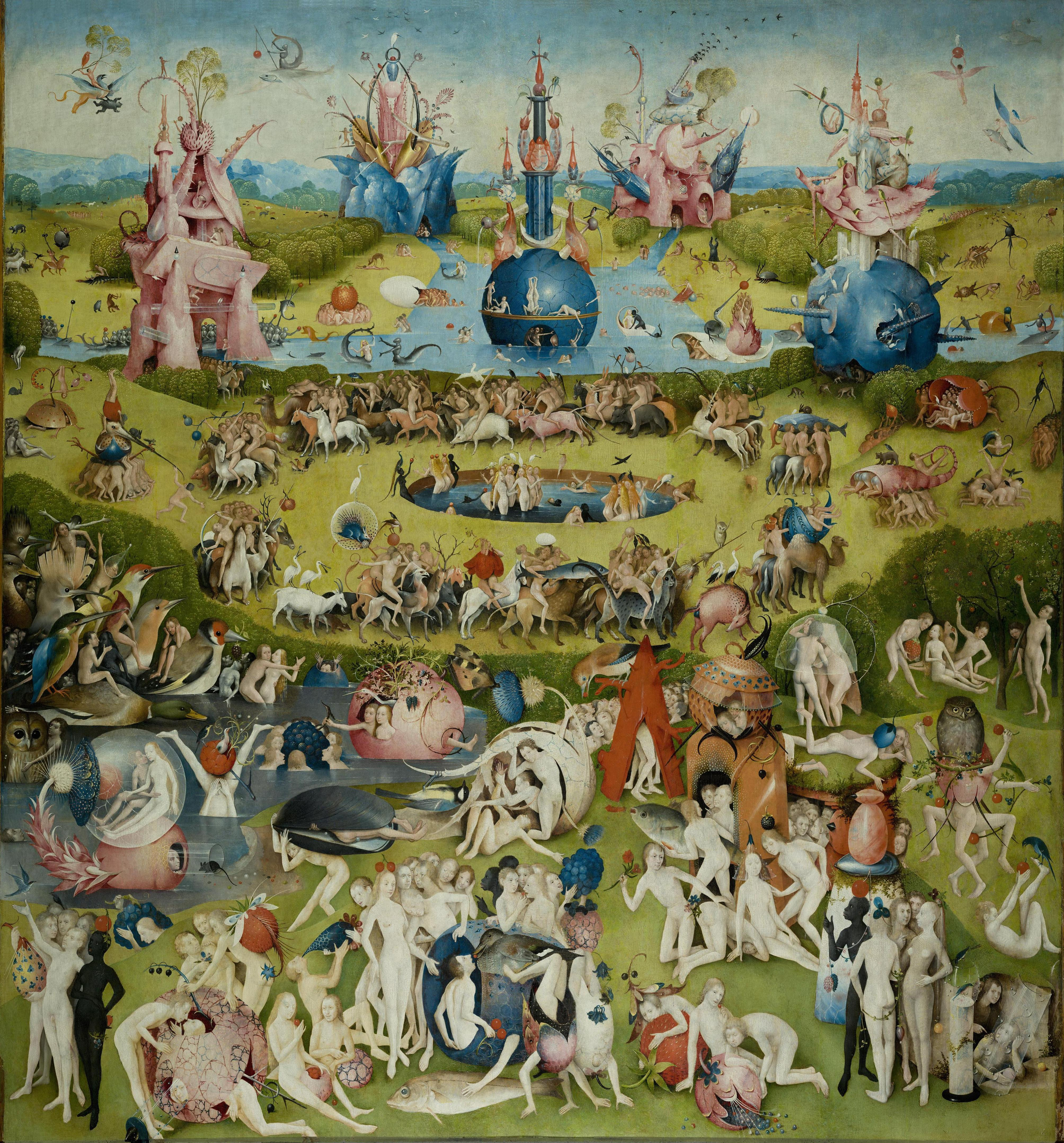
Image
Belinda wrote: Sat Apr 23, 2022 10:40 am God and nature have in common that nature and God are systematic, patterned, broadly deterministic.
I am forced to draw a distinction between the God that *stands behind everything* in the sense of Nature for a rather simple reason. That when natural, biological, and ecological systems are examined they are seen to be *utterly cruel* and completely unconcerned for anything we might recognize as 'ethical'. The world of nature is one where life feeds mercilessly and constantly on life. It is not possible to examine this world and not to see clearly that it is determined by laws and patterns that had been set in motion but in which God does not 'intervene'.

The Christian God establishes a set of rules (take the Sermon on the Mount as an example) whereby the ethical principle, the most important thing that is established, is to act completely contrarily to the way the world is at a fundamental level. It sets up a contrary pattern. It vilifies those who act in ways similar to the way that Nature acts. This for me is basic Nietzscheanism. It is just this realization really taken to heart, really internalized. But I would also say that this realization is *dreadful* and, certainly in Nietzsche's case, pulled him into pieces. And in this sense Nietzsche is 'emblematic' of our condition.

So when Nietzsche, along with a mass of intellectuals, and also people generally, realize that with modern advances in medicine and hygiene that life in the body could really be lived -- and here I am aware that for nearly all of our long history life was ‘solitary, poor, nasty, brutish, and short’ -- the focus of life, and the focus of man's ethics, turned back, necessarily, to actually living out a productive and fulfilling life in this plane of existence. If it is true that Christian hope involved the sense that "now everything is terrible and painful but if I do thus-and-such I will thereafter be rewarded with a beautiful, pain-free life", I think it plain as day that we in the modern world do not live in such a terrible world. We actually can and many people do live fulfilling, healthy lives. But note that when physical suffering is relieved that psychological suffering is also relieved.

Now if what I say here is true then we can examine the modern creation of our modern societies: the consumer culture where life and the living of it has *opened up* for many, if not most, people. Take for example the advertising phrase Where do you want to go today?

What I noticed is that this process of 'return to the possibilities' open to one who lives in the body and in life's immediacy (you could say in mutability) is quite evident when one examines literature. I do not have great experience with André Gide but when I read some of his works I realized that he exemplified a man who was taken with the possibilities of 'living immediately and in the body'. And I am certainly referencing all the physical and sensual and sexual delights of a life free from *imposed restraint* and restriction within this area. So it is no surprise, is it? that modernity moves in the direction of total sexual liberation and getting out from under the former restraint placed on sex-expression. Some may say this is a *good* and yet the essence of an opposing stance runs like this: You cannot simultaneously masturbate and pray to God. You cannot 'dive' into the body and the entrapping mutability of bodily existence and still hold to realizations of a (so-called) Higher Order. So the notion of *sublimation* is alluded to here.

My own view is that Consumer Culture and the opening up of (if you will) The Garden of Earthly Delights results in a decay of the intellectual (in the Christian sense of intellectus). I would say because it seemed to me very plain when I read the Breviary and the Missal as well as the Ordinary of the Catholic Mass that the entire object of the Rite had to do with removing the eyes from the temporal, the transitory and the mutable, and shifting the focus to the eternal, the constant and the immutable. Where is that 'world'? What 'reality' is this? It is not 'of the Earth' because the Earth is absolute mutability and absolutely mutable. The sense of 'anchor' therefore is in ideas and in the idea-realm (intellectus) which is a Vision of the transcendent. And here I simply accentuate what must be evident: You cannot live as *a beast of the field* within a Garden of Earthly Delights, and merely do what you want because it is pleasurable, and at the same time hold to and receive from *the transcendent realm*. That is to say *the angelic realm* as it is conceived by those who turn these ideas into palpable visualizations.

Now why do we live in such a world as this? Why are we products of the brutal Earth and all its determined processes and yet we 'live through' our sense of and our connection to the Transcendental? Who has set this all up? What intelligence stands behind it? And what, knowing what we can know if we do realize our situation, conceive it accurately and clearly, what are we to do? what are we to choose?

When looked at in this way, when understood in this way, the Earth-world resumes the former picture (meaning) assigned to it: Don't be fooled by 'earthly desires'. And that is why I made a reference to (Bach's) "Die Art verruchter Sünden / Ist zwar von außen wunderschön"
The nature of loathsome sins
is indeed from outside very beautiful;
but you must
afterwards with sorrow and frustration
experience much hardship.
From outside it is gold
but if you want to look more closely
it is shown to be only an empty shadow
and whitewashed tomb.
It is like the apples of Sodom
and those who join with it
do not reach God's kingdom.
It is like a sharp sword
that goes through our body and soul.
Who can even read this and recite it without feeling a certain sense of repressiveness? That is, for it to be presented that there is such a thing as 'sin'? Who today actually understands what the idea is that stands behind this admonishing sermon put to (wundershön) music? Well the answer is "Not many"!

So it has seemed to me that we have *fallen away* from and dropped down from and even descended from a sort of intellectual relationship where we have and live out of certain realizations. And those realizations are those I describe as of a Higher Order. Our World (of Europe) was built through this! And this is despite the fact that Immanuel Can says that no Christian culture has really existed!

The entire issue though stems out of this notion, and I see it as a fact, that the Christian God as meaning & sense & conscience comes from outside this world in which we are ensconced and in this sense trapped (or fallen into).

Nevertheless, I fully admit that even the sense of what the Christian God is supposed to advocate for is, to a degree, up in the air. I have certainly presented a contemplative view of the Christian and Catholic path through liturgy's idealism. But we are now very very concerned about *matters on the ground* and I certainly do not have to point this out. Equality, equity, the spread of the possibility of living well and completely in the body and in this life, indeed of modifying your physical structure and visualizing all manner of different identity-postures -- all of these issues and problems have also taken precedence. So none of this can be excluded (from the wider social and cultural conversation).
Nick_A
Posts: 6208
Joined: Sat Jul 07, 2012 1:23 am

Re: Christianity

Post by Nick_A »

Alexis
Who can even read this and recite it without feeling a certain sense of repressiveness? That is, for it to be presented that there is such a thing as 'sin'? Who today actually understands what the idea is that stands behind this admonishing sermon put to (wundershön) music? Well the answer is "Not many"!

So it has seemed to me that we have *fallen away* from and dropped down from and even descended from a sort of intellectual relationship where we have and live out of certain realizations. And those realizations are those I describe as of a Higher Order. Our World (of Europe) was built through this! And this is despite the fact that Immanuel Can says that no Christian culture has really existed!

The entire issue though stems out of this notion, and I see it as a fact, that the Christian God as meaning & sense & conscience comes from outside this world in which we are ensconced and in this sense trapped (or fallen into).

Nevertheless, I fully admit that even the sense of what the Christian God is supposed to advocate for is, to a degree, up in the air. I have certainly presented a contemplative view of the Christian and Catholic path through liturgy's idealism. But we are now very very concerned about *matters on the ground* and I certainly do not have to point this out. Equality, equity, the spread of the possibility of living well and completely in the body and in this life, indeed of modifying your physical structure and visualizing all manner of different identity-postures -- all of these issues and problems have also taken precedence. So none of this can be excluded (from the wider social and cultural conversation).
You seem to be touching on the essence of the human condition. Man is dual natured. His lower parts ascended from below and has become corrupted through negative emotions leading to egoistic fragmentation. Man's higher parts descended from above and attracts our species to our source.. Man is captured by the ground yet attracted to our source. What to do?

This dual nature can be reconciled at the depth of the heart of Man allowing the lower to serve the higher. But as we are, the higher now serves the lower and Man is ruled by appetites leading to the chaos which defines the darkness of our world.
“some might say: ‘Fragmentation of cities, religions, political systems, conflict in the form of wars, general violence, fratricide, etc., are the reality. Wholeness is only an ideal, toward which we should perhaps strive.’ But this is not what is being said here. Rather, what should be said is that wholeness is what is real, and that fragmentation is the response of this whole to man’s action, guided by illusory perception, which is shaped by fragmentary thought.”
― David Bohm, Wholeness and the Implicate Order
After reading Nicolescu's Manifesto of Transdisciplinarity, it is hard to imagine how any thinking person could retreat to the old, safe, comfortable conceptual framework. Taking a series of ideas that would be extremely thought-provoking even when considered one by one, the Romanian quantum physicist Basarab Nicolescu weaves them together in a stunning vision, this manifesto of the twenty-first century, so that they emerge as a shimmering, profoundly radical whole.

Nicolescu’s raison d’être is to help develop people’s consciousness by means of showing them how to approach things in terms of what he calls “transdisciplinarity.” He seeks to address head on the problem of fragmentation that plagues contemporary life. Nicolescu maintains that binary logic, the logic underlying most all of our social, economic, and political institutions, is not sufficient to encompass or address all human situations. His thinking aids in the unification of the scientific culture and the sacred, something which increasing numbers of persons, will find to be an enormous help, among them wholistic health practitioners seeking to promote the understanding of illness as something arising from the interwoven fabric—body, plus mind, plus spirit—that constitutes the whole human being, and academics frustrated by the increasing pressure to produce only so-called “value-free” material...............
There does seem to be a rare few who understand our inner war between wholeness and fragmentation and how to reconcile it. I've mentioned it a few times and it has bombed. But at the same time it is the essence and purpose of Christianity and the meaning of the Crucifixion.
Dubious
Posts: 4637
Joined: Tue May 19, 2015 7:40 am

Re: Christianity

Post by Dubious »

Alexis Jacobi wrote: Sat Apr 23, 2022 2:07 pmNow why do we live in such a world as this? Why are we products of the brutal Earth and all its determined processes and yet we 'live through' our sense of and our connection to the Transcendental? Who has set this all up? What intelligence stands behind it? And what, knowing what we can know if we do realize our situation, conceive it accurately and clearly, what are we to do? what are we to choose?
...our own.

It's one in which the transcendental becomes a personal abstraction, indigenous to the species which conceives and requires it. It is a subjective emanation of intelligence, though not all intelligences may require it.

It is not something which exists outwardly to which we may ascend, but rather that which blends alchemically with the mind to transmute the rust and iron of reality with the conceptualized gold of a higher existence.

It is this which imagination coerces into the foreground as real or hyperreal with the power to thrust life itself into a separate state of temporary illusion boosting the palpability of an after-life to become more intense.

At the end one defaults to nature's reality nevertheless; visions of transcendence survive only as long as one is alive being the mind's way of surmounting the perceived hideous indifference of nature through the imagination's vast arsenal of forcing it into a more friendly countenance.

In spite of science and its stringent methods, humans have always been at war with reality in as many ways as possible.
Belinda
Posts: 10548
Joined: Fri Aug 26, 2016 10:13 am

Re: Christianity

Post by Belinda »

Alexis Jacobi wrote:
You cannot simultaneously masturbate and pray to God.
One wonders what you mean by "prayer".

People can be Dionysian and still love goodness, truth, and beauty.
Nick_A
Posts: 6208
Joined: Sat Jul 07, 2012 1:23 am

Re: Christianity

Post by Nick_A »

Belinda wrote: Sun Apr 24, 2022 12:50 pm Alexis Jacobi wrote:
You cannot simultaneously masturbate and pray to God.
One wonders what you mean by "prayer".

People can be Dionysian and still love goodness, truth, and beauty.
Masturbation is a high form of imagination while prayer requires attentive sincerity. They are mutually exclusive. A person must decide what they want: sincerity or imagination if their aim is truth.

Since I celebrate the Orthodox Easter today, it seems appropriate to post why western Christendom seems somewhat naive to me and caught up in imagination. This is an excerpt from Jacob Needleman's book "Lost Christianity". It is a conversation between Prof Needleman and Metropolitan Anthony of Sourozh. Does the distinction between emotion and feelings as well as prayer defined as vulnerability make sense to you if a person is trying to experience objective meaning?
Metropolitan Anthony," I began, "five years ago when I visited you I attended services which you yourself conducted and I remarked to you how struck I was by the absence of emotion in your voice. Today, in the same way where it was not you but the choir, I was struck by the same thing, the almost complete lack of emotion in the voices of the singers."

Yes he said, "this is quite true, it has taken years for that, but they are finally beginning to understand...."

"What do you mean?" I asked. I knew what he meant but I wanted to hear him speak about this - this most unexpected aspect of the Christianity I never knew, and perhaps very few modern people ever knew. I put the question further: "The average person hearing this service - and of course the average Westerner having to stand up for several hours it took - might not be able to distinguish it from the mechanical routine that has become so predominant in the performance of the Christian liturgy in the West. He might come wanting to be lifted, inspired,moved to joy or sadness - and this the churches in the West are trying to produce because many leaders of the Church are turning away from the mechanical, the routine.."

He gently waved aside what I was saying and I stopped in mid sentence. "There was a pause, then he said: "No. Emotion must be destroyed."

He stopped, reflected, and started again, speaking in his husky Russian accent: "We have to get rid of emotions....in order to reach.....feeling."

Again he paused, looking at me, weighing the effect his words were having. I said nothing. but inside I was alive with expectancy. I waited.

Very tentatively, I nodded my head.

He continued: "You ask about the liturgy in the West and in the East. it is precisely the same issue. the sermons, the Holy Days - you don't why one comes after the other. or why this one now and the other one later. Even if you read everything about it you still wouldn't know, believe me.

"And yet . . . there is a profound logic in them, in the sequence of the Holy Days. And this sequence leads people somewhere - without their knowing it intellectually. Actually, it is impossible for anyone to understand the sequence of rituals and Holy Days intellectually. it is not meant for that. It is meant for something else, something higher.

For this you have to be in a state of prayer, otherwise it passes you by-"

"What is prayer?" I asked.

He did not seem to mind my interrupting with this question. Quite the contrary. "In a state of prayer one is vulnerable." He emphasized the last word and then waited until he was sure I had not taken it in an ordinary way.

"In prayer one is vulnerable, not enthusiastic. and then these rituals have such force. they hit you like a locomotive. You must be not enthusiastic, nor rejecting - but only open. This is the whole idea of asceticism: to become open."
Belinda
Posts: 10548
Joined: Fri Aug 26, 2016 10:13 am

Re: Christianity

Post by Belinda »

NickA quoted:
"In prayer one is vulnerable, not enthusiastic. and then these rituals have such force. they hit you like a locomotive. You must be not enthusiastic, nor rejecting - but only open. This is the whole idea of asceticism: to become open."
That rules out superstition, magical thinking, and idolatry, so I like it. But hold on! There must be an object for prayer or else one may deceive oneself and become prey to all sorts of nonsense.

Trinitarianism is particularly good for providing the teaching and life of Jesus who brings the Deity down to Earth for us. Muhammad the Holy Prophet did the same service for Muslims by recording in human language (Koran) and a life (Hadith) the word of God.
Post Reply