Christianity

For all things philosophical.

Moderators: AMod, iMod

User avatar
attofishpi
Posts: 13319
Joined: Tue Aug 16, 2011 8:10 am
Location: Orion Spur
Contact:

Re: Christianity

Post by attofishpi »

Immanuel Can wrote: Tue Mar 22, 2022 1:52 am
attofishpi wrote: Tue Mar 22, 2022 1:19 am
Immanuel Can wrote: Tue Mar 22, 2022 12:53 am
According to anybody who has the book, which would, yes, be me.
You do take the bible literally as fact though, don't you - deleting the point that Dubious made.
If you mean, "You do take all the statements the Bible itself treats as literal to be literal," then the answer is "Yes."
I wonder how you would discern the difference?

I guess we need an example:- 1 In the beginning God created the heavens and the earth. (New Intl Version)

Should we take that to be literally true to what God did?
User avatar
Immanuel Can
Posts: 27608
Joined: Wed Sep 25, 2013 4:42 pm

Re: Christianity

Post by Immanuel Can »

attofishpi wrote: Tue Mar 22, 2022 1:59 am
Immanuel Can wrote: Tue Mar 22, 2022 1:52 am
attofishpi wrote: Tue Mar 22, 2022 1:19 am

You do take the bible literally as fact though, don't you - deleting the point that Dubious made.
If you mean, "You do take all the statements the Bible itself treats as literal to be literal," then the answer is "Yes."
I wonder how you would discern the difference?
Context.
I guess we need an example:- 1 In the beginning God created the heavens and the earth. (New Intl Version)
Literally true.

But when it says, "Jesus spoke this parable," then you know it's a parable. And when somebody says, "the Sun rises," you know it's a metaphor, from the perspective of the Earth...because the Sun does not literally rise, even though common usage treats it as if it does.
User avatar
attofishpi
Posts: 13319
Joined: Tue Aug 16, 2011 8:10 am
Location: Orion Spur
Contact:

Re: Christianity

Post by attofishpi »

Immanuel Can wrote: Tue Mar 22, 2022 3:26 am
attofishpi wrote: Tue Mar 22, 2022 1:59 am
Immanuel Can wrote: Tue Mar 22, 2022 1:52 am
If you mean, "You do take all the statements the Bible itself treats as literal to be literal," then the answer is "Yes."
I wonder how you would discern the difference?
Context.
I guess we need an example:- 1 In the beginning God created the heavens and the earth. (New Intl Version)
Literally true.

But when it says, "Jesus spoke this parable," then you know it's a parable. And when somebody says, "the Sun rises," you know it's a metaphor, from the perspective of the Earth...because the Sun does not literally rise, even though common usage treats it as if it does.
3 And God said, “Let there be light,” and there was light.

Of whom was God commanding or asking to permit light?
User avatar
Immanuel Can
Posts: 27608
Joined: Wed Sep 25, 2013 4:42 pm

Re: Christianity

Post by Immanuel Can »

attofishpi wrote: Tue Mar 22, 2022 3:50 am
Immanuel Can wrote: Tue Mar 22, 2022 3:26 am
attofishpi wrote: Tue Mar 22, 2022 1:59 am

I wonder how you would discern the difference?
Context.
I guess we need an example:- 1 In the beginning God created the heavens and the earth. (New Intl Version)
Literally true.

But when it says, "Jesus spoke this parable," then you know it's a parable. And when somebody says, "the Sun rises," you know it's a metaphor, from the perspective of the Earth...because the Sun does not literally rise, even though common usage treats it as if it does.
3 And God said, “Let there be light,” and there was light.

Of whom was God commanding or asking to permit light?
What makes you think his locutionary act was that of "asking to permit" or "commanding another"? Why not just "declaring to be"?
User avatar
attofishpi
Posts: 13319
Joined: Tue Aug 16, 2011 8:10 am
Location: Orion Spur
Contact:

Re: Christianity

Post by attofishpi »

Immanuel Can wrote: Tue Mar 22, 2022 4:18 am
attofishpi wrote: Tue Mar 22, 2022 3:50 am
Immanuel Can wrote: Tue Mar 22, 2022 3:26 am
Context.


Literally true.

But when it says, "Jesus spoke this parable," then you know it's a parable. And when somebody says, "the Sun rises," you know it's a metaphor, from the perspective of the Earth...because the Sun does not literally rise, even though common usage treats it as if it does.
3 And God said, “Let there be light,” and there was light.

Of whom was God commanding or asking to permit light?
What makes you think his locutionary act was that of "asking to permit" or "commanding another"? Why not just "declaring to be"?
Because, "declaring to be" is a far cry from what was stated.
God is clearly asking or commanding another entity, not declaring. A declaration would be as such "I declare there is light."
User avatar
Alexis Jacobi
Posts: 8301
Joined: Tue Oct 26, 2021 3:00 am

Re: Christianity

Post by Alexis Jacobi »

Immanuel Can wrote: Mon Mar 21, 2022 11:53 pm Hmmm...don't let the bias against apologetics make you miss something you should see, I would say.

Check it out: the arguments in those books are secular. You do not need to believe anything in order to assess historical evidence, and that's what they summon.
Oh no, there are lots of things I read that are apologetic. It is the material of that sort in the first two that I avoid. For the reasons stated.

(A secular Christian argument. What a notion! :!: )

The other is on a different level.

Quote passages here that you feel are important from either. That is more proper to forum argument and conversation. Or summarize.
uwot
Posts: 6092
Joined: Mon Jul 23, 2012 7:21 am

Re: Christianity

Post by uwot »

seeds wrote: Mon Mar 21, 2022 7:02 pm
seeds wrote: Mon Mar 21, 2022 5:46 am There's nothing wrong with a good ol' whataboutism once in a while, especially if it's valid.
uwot wrote: Mon Mar 21, 2022 10:17 am seeds me old mucker, most 6 year olds could tell you that two wrongs don't make a right.
Look, it was you who stated the following,...
uwot wrote: Tue Mar 15, 2022 8:44 am I still don't understand why anthropomorphism, when discussing the creation of the universe, is contradictory and paradoxical.
...to which I simply suggested what I feel is a valid reason for why anthropomorphism is problematic...
seeds wrote: Tue Mar 15, 2022 4:31 pm It's because anthropomorphic representations of the source of the intelligence that is responsible for the creation of the universe are precisely what makes the existence of such a source so implausible and unbelievable to atheists and materialists.
...To which you then proceeded to ignore or disavow the point being made and accuse me of some kind of debating "no-no" called "whataboutism."
I don't really want to argue about this. I think this is an example of how the same facts can support different narratives. In my version "contradictory and paradoxical" was introduced by Dubious:
Dubious wrote: Mon Mar 14, 2022 5:51 amAny non-abstract god entity, biblical or not has zero relationship when reflecting on a universe as the creation of an abstract intelligence. Anthropomorphism simply no-longer applies in that kind of debate and actually turns out to be a contradiction and paradox when considering it in those terms.
Dubious has since clarified and I'm fairly confident what he means is not "problematic" in the sense you find it; neither Dubious nor myself are bothered by anthropomorphic gods preventing others from sharing our vision.
seeds wrote: Mon Mar 21, 2022 7:02 pmIn which case, if we're going to play by some sort of nit-picking equivalent of the "Marquess of Queensberry Rules" applied to a philosophical debate, then I accuse you of the "no-no" of using a "non sequitur" to sidetrack my argument.
The charge of whataboutism was specifically in response to this:
seeds wrote: Fri Mar 18, 2022 4:24 pm
uwot wrote: Fri Mar 18, 2022 2:53 amseeds, you are trivialising atheists. It is not anthropomorphism we are not persuaded by; it is the hypothetical "intelligence that is responsible for the creation of the universe".
And you don't think that atheists trivialize theists?
Let's accept that atheists trivialise theists. How does that advance your argument?
seeds wrote: Mon Mar 21, 2022 5:46 amNo matter what interpretation [of quantum mechanics] you look at, they all imply that the underlying fabric of reality is composed of an infinitely malleable, informationally-based substance that is capable of becoming absolutely anything "imaginable",...
That is you interpreting them all in that way.
seeds wrote: Mon Mar 21, 2022 7:02 pmImage
...just like the substance from which our thoughts and dreams are created.
Right. So what I understand you to mean is the universe is made of a substance, and information is any deformation in that substance. If so, I think that is probably true. Where we differ is that for you the cosmos is so perfectly created for human life, there must be an intelligence orchestrating it. Granted there is a thin layer on a small planet that does sustain human life, but in a universe reckoned to be 90 odd billion light years in diameter, I don't see 'chance' as being so unlikely as you do.
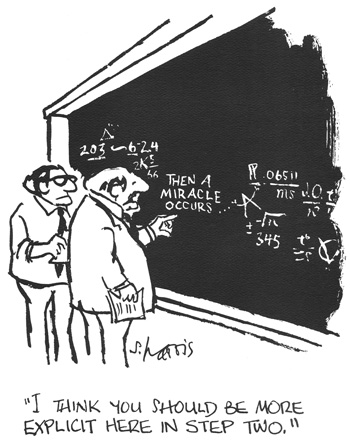
seeds wrote: Mon Mar 21, 2022 7:02 pm...I expect you to follow-thru with some speculative suggestions as to what you mean when using the term "miraculous." Otherwise, all you are doing is echoing the sentiment expressed in this amusing cartoon...
Image
Not quite. In my version, the miracle is step 1. Why is there either a universe, or a god that created one?
Belinda
Posts: 10548
Joined: Fri Aug 26, 2016 10:13 am

Re: Christianity

Post by Belinda »

seeds wrote regarding the acorn:
epitomizes the very meaning of teleological impetus, for its DNA is absolutely pregnant with an intended goal of not only producing a tree, but also maintaining its existence throughout its life cycle of shedding and growing leaves and subsequent seeds of itself.
I agree about acorns and subsequent oaks being teleological creatures, however their impetus is unpremeditated. Beautiful but unpremeditated. An acorn shell full of salt is not a teleological creature even when the salt is in process of dissolving in the rain.

I imagine God intends salt to be as salt does despite salt's lack of teleological impetus.
User avatar
Immanuel Can
Posts: 27608
Joined: Wed Sep 25, 2013 4:42 pm

Re: Christianity

Post by Immanuel Can »

attofishpi wrote: Tue Mar 22, 2022 4:27 am God is clearly asking or commanding another entity, not declaring. A declaration would be as such "I declare there is light."
No, I don't think that's "clear" at all.

If I parallel your objection, a "commanding another entity" would be, "I command you to make light."

It seems obvious to me that, considered by itself and without context, the locutionary act in question could be taken to be either a command or a declaration; but we have a strong consideration against the first, namely that there is no other apparent entity to whom the words could be addressed. So it doesn't seem reasonable to say that God is commanding some other being to jump to the task...no other such is even suggested in the context of the subsequent verses.
User avatar
Immanuel Can
Posts: 27608
Joined: Wed Sep 25, 2013 4:42 pm

Re: Christianity

Post by Immanuel Can »

Alexis Jacobi wrote: Tue Mar 22, 2022 5:17 am A secular Christian argument. What a notion!
It's actually not a strange idea at all. All it means is that the Christian agrees to play by the "secular rules." It doesn't mean he has to give up being a Christian to do it.

Peter Berger, the sociologist, calls his own strategy "methodological atheism," even though Berger himself declares he is a liberal Christian. What he means is that, for "methodological" purposes, his writings will adopt the same episteme as "atheism," i.e. no reference to metaphysics in the proofs or evidence, but that Berger reserves his own right to remain a Christian when doing so.

It's an act of charity to condescend to use the episteme preferred or demanded by one's opponent; and act of charity that I have never seen returned by the Atheist, I might also say.
Quote passages here that you feel are important from either. That is more proper to forum argument and conversation. Or summarize.
The problem that method runs is that unless you see the statements in context, it's possible to mistake the argument itself. These are not simplistic arguments: they're scholarly, substantial and carefully developed. So grabbing snippets runs the risk of encouraging misunderstanding.

For example, when I say something like, "Atheism has no rational access to morality." An interlocutor is prone to receive that as if I'm saying, "Atheists are immoral people." (That's was the instantaneous reaction I got when I floated that idea in another thread, years ago). Of course, that's a total distortion of the point, but the mistake is (humanly) understandable, and the knee-jerk defensiveness it all too human a reaction. We can avoid a lot of pointless wrangling if we avoid that sort of misapprehension, by keeping statements in their proper context.

What's better is for a person to have actually read the essay, and then, afterward, to discuss the individual points, since then, both interlocutors are able to put every remark in its proper context, as well.
User avatar
Alexis Jacobi
Posts: 8301
Joined: Tue Oct 26, 2021 3:00 am

Re: Christianity

Post by Alexis Jacobi »

Immanuel Can wrote: Tue Mar 22, 2022 3:21 pm What's better is for a person to have actually read the essay, and then, afterward, to discuss the individual points, since then, both interlocutors are able to put every remark in its proper context, as well.
Perhaps you can link to an article or essay that you feel meets the evidenciary requirements.
All it means is that the Christian agrees to play by the "secular rules."
Again, this entire idea is bizarre. A Christian cannot 'agree to play' by any rules except those defined by the Christian metaphysical system. Nor can someone who is not a Christian agree to play by Christian rules. What you are suggesting as possible makes no sense at all.

However, I think that this is where you *reside* (my notion about locality and position). You actually and sincerely believe this is possible. Because for you if the Christian interpretive system is true, and the entire world of science, its methods, etc., is also true, that there can be and there is no conflict between them. And if there seems to be conflict or dissonance the will (your will in this case) enters in to bend the truths of the different system so that they accord.

The problem is that non-believers and skeptics -- or in my case a person who can transcend 'story' as I say that I can -- they look at you and shake their heads. You twist yourself into the most bizarre sophistical knots but remain cool, calm, collected as if it is the most natural thing.

What I have learned here and it has been helpful in my case, is that because I have examined the former metaphysical system in some depth, and most people have not (I began this through Shakespeare studies and the study of the 17th century -- a bridge-point between two very different epistemological systems) I feel that I can *transcend* the constraints of each.

The former metaphysical system get so much right except that it does when it misperceives and in a way mis-interprets data. And if we (any of us, all of us) begin to have discussions about meaning and refer to meanings we will inevitably refer to the former system. But most have not thought about this and they assume that 'meanings', defined through a former metaphysics, all still automatically apply in the print dispensation. Except they don't. In light of the New Metaphysics, which is an anti-metaphysics (and yet a metaphysics despite) the fact is that meaning and also value (values defined through meaning and developed in the former system) actually disintegrate.

This is why we can say, and with truth, that we all are becoming aware that the operative system of the World today is showing itself as being involved in and concerned about just one thing: POWER. And this is where 'will to power' becomes a necessary topic of examination.

The Old System of metaphysics could and did conceive of 'higher reason' and of course of the ethics in the fading shadow of which we now live. But the New System of metaphysics, an anti-metaphysics, cannot conceive of any of that. Because none of this exists in the natural world, the world of the Earth and its processes. And the more that they define this new metaphysic in their mood of absolute certainty, the more they anchor themselves in the sole issue which is relevant: that of POWER.

So for this reason -- it seems to me -- no part of what we discuss here is at all irrelevant. Because every topic that we discuss has bearing on existential issues. And these existential issues and the conflicts they produce are now becoming crucially visible.

The other issue which is interesting but also weird as heck is *the problem of interpretation*. No matter where one looks today, and in respect to all questions, all issues, sociological, cultural, religious, political, there are 10 different interpretations of what is actually going on. So, it seems that one cannot get *certainty* because, as it appears, some one or some entity or some power-structure is battling other such structures in order to control what is seen, what it means -- thus interpretation.

This is why I find your arguments strange and problematic. Not because I do not grasp (and I think I do grasp) what Christianity means, but because Christianity in so many ways spans two epistemological interpretive systems and in different degrees tries to reconcile them. You for example battle furiously to *preserve* the possibility of actually believing in a primeval couple, in a deathless realm, under the aegis of a protective God. You visualize this scene and it is *reality* for you. It had to have existed on the face of the planet. It is not a metaphor for you though you will, whenever the "meaning" of the story is necessary to talk about revert instantaneously to allegory -- which is of course where the 'meaning' is found.

So the fact is that there are millions and millions -- possibly billions -- of people who exist in this shadow-land or flicker-land where in varying degrees one episteme is accentuated into a 'perceptual lens' that dominates as *truth* and thus as what is *important* and what worth fighting for, or the other one is accented into another. And there are so many shades of commitment. And this is a real problem.

And so we may sit down to talk and associate with another person and suddenly realize "We do not operate with the same perceptual lens!" We do not share the same metaphysical base nor commitment. But most do not realize and can't think about the nuts & bolts of this issue: it is profound disagreement and profound discord. It leads to no other thing but war (and this assertion applies on so many levels).

The curious thing is that in this situation (again *locality* in my lexicon) what is seen is determined by what is understood, but understanding is in a terrible mess. Because as I say no one can really understand anything. Just listen to them talk. All their ideas, and possibly all our ideas, are borrowed. We cobble together perceptual edifices on the basis of what we receive through auditory and visual discourses. And it is fair to say that for most people this is a "swamp" of perception. It is a mishmash. It is a 'three-ring circus of the mind'.

One thing that can contradict that is to have a literary life or, on the other hand, to disassociate with all media and recover oneself through contemplative method. A literary life: reading older material of course. Real value and meaning and what is important has already been expressed in old literary material. It is a source one can drink from.

So where is the 'real anchor' in the self to be found? What is it that anchors a person -- spiritually let's say, authentically, sanely -- in 'reality'? That is the question. It must be internal. And if that is so it must resist the external. But in order to become *seated* in the internal space even that has to be defined through conception of it. I mean, what does one do in that inner, conceptual space?

So here the proposition is *to get to the essence*. And in my own view the essence can be discovered when one studies the older and original sources of Christian belief. In any case that is what I have found. It offers a diagram (not the right word), a sense of the issues at stake. It is all laid out quite plainly.
User avatar
Immanuel Can
Posts: 27608
Joined: Wed Sep 25, 2013 4:42 pm

Re: Christianity

Post by Immanuel Can »

Alexis Jacobi wrote: Tue Mar 22, 2022 6:07 pm
Immanuel Can wrote: Tue Mar 22, 2022 3:21 pm What's better is for a person to have actually read the essay, and then, afterward, to discuss the individual points, since then, both interlocutors are able to put every remark in its proper context, as well.
Perhaps you can link to an article or essay that you feel meets the evidenciary requirements.
Well, the essays in the book are the ones you're going to want. The represent some of the best scholarship available. But if you have something else you want to talk about, I'm game.

Is it just that you don't want to invest in such an expensive tome? The other two books are much less expensive, and should be available quite cheap by download...
All it means is that the Christian agrees to play by the "secular rules."
Again, this entire idea is bizarre. A Christian cannot 'agree to play' by any rules except those defined by the Christian metaphysical system.
Peter Berger made a career of doing it. And no, it's not at all bizarre. All it involves is agreeing to use the other person's rules of evidence, not your own.

Nothing hard in that. Nothing's even strange.
User avatar
Alexis Jacobi
Posts: 8301
Joined: Tue Oct 26, 2021 3:00 am

Re: Christianity

Post by Alexis Jacobi »

Immanuel Can wrote: Tue Mar 22, 2022 7:44 pm Is it just that you don't want to invest in such an expensive tome? The other two books are much less expensive, and should be available quite cheap by download…
Very well. I will find an essay by one of those authors, read it, post a link here, and discuss it.

So laborious. 🥳
User avatar
Immanuel Can
Posts: 27608
Joined: Wed Sep 25, 2013 4:42 pm

Re: Christianity

Post by Immanuel Can »

Alexis Jacobi wrote: Tue Mar 22, 2022 9:24 pm
Immanuel Can wrote: Tue Mar 22, 2022 7:44 pm Is it just that you don't want to invest in such an expensive tome? The other two books are much less expensive, and should be available quite cheap by download…
Very well. I will find an essay by one of those authors, read it, post a link here, and discuss it.

So laborious. 🥳
Well, it would be nice for the skeptics' sake if the arguments in favour of Theism were light and easy. But if they were, there'd be little reason to bother anyway. On the other hand, handling a meaty argument is bound to take some effort. And I commend you if, unlike others, you're prepared to grapple with something substantial, rather than the mere pop-level stuff.
User avatar
attofishpi
Posts: 13319
Joined: Tue Aug 16, 2011 8:10 am
Location: Orion Spur
Contact:

Re: Christianity

Post by attofishpi »

Immanuel Can wrote: Tue Mar 22, 2022 3:10 pm
attofishpi wrote: Tue Mar 22, 2022 4:27 am God is clearly asking or commanding another entity, not declaring. A declaration would be as such "I declare there is light."
No, I don't think that's "clear" at all.

If I parallel your objection, a "commanding another entity" would be, "I command you to make light."

It seems obvious to me that, considered by itself and without context, the locutionary act in question could be taken to be either a command or a declaration; but we have a strong consideration against the first, namely that there is no other apparent entity to whom the words could be addressed. So it doesn't seem reasonable to say that God is commanding some other being to jump to the task...no other such is even suggested in the context of the subsequent verses.
Reasonable!!?

What is reasonable about thinking a man is talking the planet and stars into existence?
Post Reply