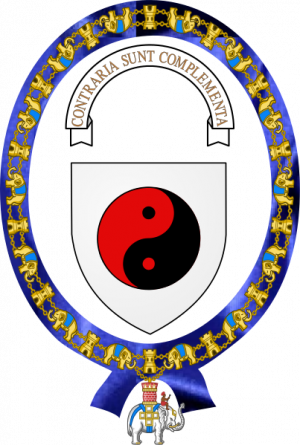
At the professional level from Physicists.
The author is attempting a 'put down' in the claim of Bohr's interaction with the Principles of the Yin-Yang, but then he stated;(A biographer, Abraham Pais, tells us that Bohr was never interested in religion, or philosophy for that matter.)
Pais tells us more of Bohr’s coat of arms:
"the belief that Bohr’s view on physics were influenced by oriental philosophy is unfounded. These speculations have an amusing origin"1.
Then he goes on to tell us that Bohr could find no satisfactory coat of arms until the wife of a co-worker of his, Hanna Kobylinski who was a Chinese historian, suggested that he use the Yin and Yang symbol.
So it is not as if Bohr was drawing on any deep acquaintance he had with eastern systems of belief!
Point is the author should not sound too skeptical if he had not exhausted the evidences [Bohr's library of papers] available to him.Does Bohr use some Taoist and/or Buddhist thought in his scientific publications?
Well, it is said that he did mention these in his lectures.
But did they appear in his papers?
I have not read them all (too many!) but of the few I have read nothing of that sort appears in them.
So I leave it to Bohr scholars to tell us whether or not Bohr puts into his scientific work the Yin-Yang doctrine.
It is hard to get any evidence for this.
I shall not pursue looking for hard evidence that Bohr officially applied the Principles of Yin-Yang into his papers.
However we can infer that the Yin-Yang Principles did have a significant influence on him based on the following;
1. That Bohr agreed for the Yin-Yang Symbol to be included in his Coat of Arms [something that is representing one's reputation] implied he understood the principles of the Yin-Yang which complementariness is significant to his project.
He would have been very stupid just to put the Yin-Yang symbol in his coat of arms merely because his colleague's wife mentioned it.
2. I read Bohr's biography by Pai, and Pai stated,
- As Favrholdt put it to me: 'He never studied philosophy: I mean sitting at his desk reading Kant or some other.'
Bohr did refer with great respect to Buddha and Lao Tse, however.24
Abraham Pais (1991) Niels Bohr’s Times in Physics, Philosophy and Polity, Clarendon Press, p. 424
In addition, Buddhism also has its concept of complementarity in its Two-truths Theory.
Therefore Bohr would have been familiar with the Yin-Yang Philosophy.
3. Neils Bohr is a serious student of Philosophy and thus would have easily grasp and understood the the Yin-Yang principles and the Two-truths Theory of Buddhism.
4. I have not read anywhere that Bohr mentioned the Yin-Yang principle of complementarity in his papers.
I believe there is no necessity to mention the Ying-Yang Principles even though it might have assisted him in his dilemma of struggling with mutually exclusive dualism.
The Yin-Yang Principles merely claim that opposites interact with each other complementarily instead of being exclusive distinct and independent.
So this is merely a different perspective of looking at duality and Bohr would then have explained this different perspective in his own principles and quantum elements.
5. The ignoramus would claim the Ying-Yang Principles belong to some religious doctrines.
NO!
- In Ancient Chinese philosophy, yin and yang is a concept of dualism, describing how seemingly opposite or contrary forces may actually be complementary, interconnected, and interdependent in the natural world, and how they may give rise to each other as they interrelate to one another.
https://en.wikipedia.org/wiki/Yin_and_yang
To insist the Yin-Yang complementary is a religious doctrine is pure ignorance of reality.
The above points are thus to clear ignorance and doubts regarding Neils Bohr, Complementary & Yin-Yang.