What could make morality objective?

Should you think about your duty, or about the consequences of your actions? Or should you concentrate on becoming a good person?

Moderators: AMod, iMod

Peter Holmes
Posts: 4134
Joined: Tue Jul 18, 2017 3:53 pm

Re: What could make morality objective?

Post by Peter Holmes »

Immanuel Can wrote: Mon May 04, 2020 4:37 pm
Peter Holmes wrote: Mon May 04, 2020 6:45 am
Immanuel Can wrote: Mon May 04, 2020 4:05 am

Done.

https://www.wiley.com/en-ca/The+Blackwe ... 1405176576

I've read it, cover to cover. If anyone else has a serious intention of knowing what the best current "natural"-type arguments for the existence of God are, here they are, and they can grapple with them too. The book is academic, documented, and precisely argued, in an edited, peer-reviewed source, published by one of the top philosophy publishers in the world, Blackwell.

I doubt you'll find a better source anywhere. If you do, let me know...I'll want to read it too.
I'm happy to go with surreptitious57's definition of 'natural' for now. And I endorse the request for your take, rather than a link to a book.

I think you'll find the book better than any synopsis anyone could possibly supply in these spaces. And I sense your skepticism will require significant proof, which this provides, rather than one individual's gloss on somebody else's best version of the argument.

I find the arguments therein very winsome; and they're presented by some of the world's leading experts, as well. Some of them involve things like String Theory, at which I have to confess myself a relative novice, so there are arguments in there that others are better to judge. But those that fall within my competencies, I find excellent.

The point would be this: you said that "there is no evidence." Very clearly, there is. And that evidence exists at the highest academic level. Now, one can say, "I don't accept that evidence," or "I don't like that argument," or even "I'm afraid to look at the evidence," and one can also decide to say why, or just avoid the evidence -- but what one can no longer rationally do, in view of texts like this one, is say "there is no evidence." That boat just doesn't float anymore.

And we might have known. An issue that has occupied some of the best scholarship for some two thousand years plus is highly unlikely to be a trivial issue, the sort of easy thing dismissed with the wave of a hand and a claim that "there is no evidence." Very clearly, some very smart people found some very compelling reasons to think the question was deserving of consideration.
To save time: what do you think is the strongest natural evidence for the existence of a god?
I think that "natural" evidences don't really convince anybody who's determined not to accept evidence from nature. People like Francis Bacon, the father of science, liked natural arguments. So did people like Newton, or Pascal...not foolish men, to be sure. But not everybody does; and for those who do not, there is always an alternate explanation for everything, that is "good enough" to allow them to continue not to consider.

At most, natural arguments can take an obdurate man where his excuses for NOT believing lack warrant, and he is, to quote Romans "without excuse." But Jesus Himself said, "He who has ears, let him hear." That implies that some people will listen, and some are determined not to listen. I can think of no argument at all that can force a person to accept anything as evidence, if he is determined not to. As the old saying goes,

"A man convinced against his will / Remains an unbeliever still."

No argument is persuasive if we're speaking to one who will not hear. Fortunately, we do not have to be like that. It's always a choice: "I will consider," or "I will not."
(And to repeat, this has nothing to do with the the objectivity or subjectivity of morality.)
That's clearly incorrect, as you can see if you understand the Moral Argument, for example as presented in the Blackwell Guide. Whether or not a Creator of the cosmos exists is absolutely essential to the question of whether anything can every be "right" or "wrong."
But ... what do you think is the strongest natural evidence for the existence of a god? (No worries if you don't want to answer.)

(Just to say: cosmological and teleological arguments that assume a non-natural explanation is possible merely beg the question. In other words, the premise 'a non-natural explanation for a natural event is possible' has to be justified.)

And no formulation of the moral argument that I've seen even remotely establishes moral objectivity, because that's not its purpose. If you care to set one out here that you think does succeed, please do, and we'll assess it.
Last edited by Peter Holmes on Mon May 04, 2020 10:19 pm, edited 1 time in total.
User avatar
RCSaunders
Posts: 4704
Joined: Tue Jul 17, 2018 9:42 pm
Contact:

Re: What could make morality objective?

Post by RCSaunders »

Immanuel Can wrote: Mon May 04, 2020 7:03 pm
RCSaunders wrote: Mon May 04, 2020 6:05 pm
Immanuel Can wrote: Mon May 04, 2020 5:05 pm
Because they deal with different kinds of explanation.

Textbooks on such matters generally do not draw metaphysical conclusions.
Evidence based knowledge does not have to be defended by endless mental gymnastics, just clear reason.
But what's "evidence," RC?

Does it mean just things you can see, touch, taste, smell, put in a beaker, roll down an inclined plane, mix in a test tube, put under a microscope, and so on? If it does, then the only "evidence" for anything is physical evidence.
The fact that I can see, hear, touch, taste, and smell those things are also evidence, as well as the fact that I can identify them consciously, identify their relationships and their nature are all evidence.

There is no evidence apart from material existents, non-living physical, living organism, conscious organism, and those conscious organisms with the unique volitional, intellectual, rational consciousness, human beings. None of those things, life, consciousness, or minds, exist independently of the physical organisms they are the attributes of, but life, consciousness, and minds are not physical attributes, just very rare ones.

So all that I am directly conscious, my life, my consciousness, and my my mind are all the evidence there is.
Immanuel Can wrote: Mon May 04, 2020 7:03 pm Rational arguments then can't be included; for ironically, rationality is an operation that does not depend for its outputs on any specific kind of physical content to the exclusion of another. It's a handle-that-fits-various-pots, and is employed just as well in purely mathematical abstractions as with anything concrete.
That's just nonsense. The only thing there is to reason about is what is known and the only thing there is to know is what one can be conscious of and the fact that they are conscious (the ontological) and whatever one uses their conscious mind to learn and create (epistemological). There is no such thing as "pure mathematical abstraction." There is only the human invented method of mathematics which has no other purpose than identifying those aspects of reality that can be counted or measured. All the rest is a variation of the Pythagorean fallacy that makes mathematics metaphysical. There is no mathematics sans human minds.
Immanuel Can wrote: Mon May 04, 2020 7:03 pm But without rational arguments, how does the scientist know what his experiment is "telling" him?
That's only a problem for you and your absurd Kantian view of reason. No scientist has any such problem.
Immanuel Can wrote: Mon May 04, 2020 7:03 pm But what about our present topic, morality?
So long as you insist that there are intrinsic values, that what you mean by moral are some kind of obligation imposed on human beings, we have nothing to discuss. I've come to believe the problem is the word,"moral."

I do not believe there are any such things as, "morals," as you and most others on this thread mean. I believe there are principles human beings must live by if they are going to live successfully as human beings, but I would call them, "life principles," which have a real purpose and objective and are determined by the nature of reality and the requirements of human nature and are therefore objective.
Immanuel Can wrote: Mon May 04, 2020 7:03 pm
I see you use, "metaphysical," as H.L. Mencken understood it:
Not at all. I use it very broadly. For example, I would say that moral ideas are metaphysical. So are abstractions and concepts. Mathematical operations surely are. So are valuations, intentions, relationships, purposes and meanings. So is the human mind -- though not the physical brain, which is not itself the mind.
That's what Mencken meant. You believe things made up in human minds (like ideals) have independent metaphysical existence. The attributes of the human mind are not physical, but do not exist independently of the physical organism they are the minds of, and none of the things human minds produce, including all concepts, knowledge, and ideas do exist at all, except in human minds. They have no metaphysical existence.
uwot
Posts: 6092
Joined: Mon Jul 23, 2012 7:21 am

Re: What could make morality objective?

Post by uwot »

Immanuel Can wrote: Mon May 04, 2020 4:37 pmThe point would be this: you said that "there is no evidence." Very clearly, there is.
Yes Mr Can, there is lots of evidence for god. We all understand that if your argument is that creation demands a creator, then the fact that there is creation is evidence for a creator. We also understand that if you insist that people can only think some action is moral because some higher being says so, then the fact that people agree that some actions are immoral is evidence that a higher being exists. The thing is that you have to demonstrate the soundness of your premises. No one has succeeded in doing so; anyone who accepts the premises does so for for aesthetic or emotional reasons, not for rational reasons.
Immanuel Can wrote: Mon May 04, 2020 4:37 pmAnd that evidence exists at the highest academic level.
Mr Can, if ever you get near the highest academic level, you will discover that the highest academic level does not equate with 'truth', it just doesn't work that way. If everyone agreed, there would be no academy.
Belinda
Posts: 10548
Joined: Fri Aug 26, 2016 10:13 am

Re: What could make morality objective?

Post by Belinda »

Immanuel, when you talk of evidence for God do you mean evidence of God's existence, or do you mean evidence for the wisdom of trusting God's providence ?
User avatar
Immanuel Can
Posts: 27612
Joined: Wed Sep 25, 2013 4:42 pm

Re: What could make morality objective?

Post by Immanuel Can »

Peter Holmes wrote: Mon May 04, 2020 8:46 pmBut ... what do you think is the strongest natural evidence for the existence of a god? (No worries if you don't want to answer.)
No, no...I'm happy to answer.

Well, it works this way: Atheists often look at something like the Argument For a First Cause, and say, "Well, even if it's right, it doesn't tell us enough to know what kind of 'God' we're talking about, so it doesn't help much." Or they look at the Moral Argument and say, "Well, it doesn't prove there IS a God in the first place, only that He's necessary for morality, so it doesn't do enough, and begs the existence question." And actually, all of that would be fair enough, if one only considered a single one of the arguments in isolation. But the Atheist critics are rejoicing too soon: they've overlooked that no argument all by itself was every intended to prove the case for God: rather, each one addresses one aspect of the necessary set-of-arguments to establish not only the existence of God, but a fair bit about His nature and about His moral identity as well.

The Atheist critic wants the Theistic case to be a table standing on one leg: it's not. It rests on several pillars, each of which addresses a substantial concern Atheists have raised about Theism. So they need to be regarded as a cumulative composite, not simply a disparate collocation of unrelated arguments. Each builds upon the last.

The Blackwell Guide does an excellent job of reflection this. I highly recommend the introduction, which places all the subsequent arguments in their right relation to each other.

So, for example, if you want an argument for the existence of God conceptually, then the Kalaam is a very compelling one, when rightly articulated. But it's function starts and stops with establishing the rational necessity of the concept of some kind of God, without specifying further. The evidence from Design, I also think is overwhelming to any fair-minded observer; but its function is to supplement the Kalaam and similar arguments, by filling out the picture of what kind of God we're talking about. The Moral Argument does even more, in that regard; and I think it might well be the hardest for secularism to answer -- because secularism has no explication of evil at all. But all these do not fill in all the details we need.

However, as I said earlier (perhaps to someone else in this thread), "natural" arguments of this type, I think, generally do not turn out to convince people who decide they simply want an opportunity to justify their unbelief, rather than considering the arguments dispassionately. You can't convince a man who doesn't want to be convinced under any circumstances. It would take a miracle to do that.

However, of all the arguments the Guide lists, I think the one that's key to actually knowing something about God is not, per se, a "natural" argument at all: it's the Argument from Revelation, the specific fact that God has spoken.

So again, we get back to the question, "Has God spoken?" If He has, it changes everything: but if He had not, we'd all -- Theists and Atheists alike -- be thrashing around in the dark, speculating on insufficient evidence and not knowing WHAT to conclude, except that if there is a God he doesn't care enough about us to tell us anything.

The upshot: unless God speaks, no set of natural-style arguments is going to give up more than a sort of argument-to-the-best-explanation type of confidence about God even existing, let alone about His nature and purposes.
User avatar
Immanuel Can
Posts: 27612
Joined: Wed Sep 25, 2013 4:42 pm

Re: What could make morality objective?

Post by Immanuel Can »

Belinda wrote: Mon May 04, 2020 10:22 pm Immanuel, when you talk of evidence for God do you mean evidence of God's existence, or do you mean evidence for the wisdom of trusting God's providence ?
Check my answer to Peter, just below your question, and I think you'll have your answer. "Does God exist?" is one question. "Is God good?" is another. Another would be, "Does God have any purposes for you and me, or (if He exists) does He exist as a sort of indifferent Deistic deity?" Another would be, "What are the implications for humanity of life without God?" Another would be "Has God spoken?"

As you can see, you need to answer all these different questions with reference to somewhat different information. Naturally, all of the information must fit together in some way, but one cannot prove God's goodness by only proving God's existence, or prove God's existence only by proving the concept "God" is humanly necessary.

In your question, you've got two different issues: "God's existence" is one; "The wisdom of trusting God's providence" is another, because the second already takes for granted that the questioner is satisfied about the first -- one can't ask, "Is it wise for us to trust the providence of a god who doesn't exist," obviously. So unless you're happy with the supposition that God exists, you can't really pose the second at all.
Belinda
Posts: 10548
Joined: Fri Aug 26, 2016 10:13 am

Re: What could make morality objective?

Post by Belinda »

Immanuel Can wrote: Mon May 04, 2020 10:31 pm
Belinda wrote: Mon May 04, 2020 10:22 pm Immanuel, when you talk of evidence for God do you mean evidence of God's existence, or do you mean evidence for the wisdom of trusting God's providence ?
Check my answer to Peter, just below your question, and I think you'll have your answer. "Does God exist?" is one question. "Is God good?" is another. Another would be, "Does God have any purposes for you and me, or (if He exists) does He exist as a sort of indifferent Deistic deity?" Another would be, "What are the implications for humanity of life without God?" Another would be "Has God spoken?"

As you can see, you need to answer all these different questions with reference to somewhat different information. Naturally, all of the information must fit together in some way, but one cannot prove God's goodness by only proving God's existence, or prove God's existence only by proving the concept "God" is humanly necessary.

In your question, you've got two different issues: "God's existence" is one; "The wisdom of trusting God's providence" is another, because the second already takes for granted that the questioner is satisfied about the first -- one can't ask, "Is it wise for us to trust the providence of a god who doesn't exist," obviously. So unless you're happy with the supposition that God exists, you can't really pose the second at all.
But there are people who are not at all interested in ontological questions, who have never questioned the existence or non existence of God, and who trust the providence of God.
User avatar
Immanuel Can
Posts: 27612
Joined: Wed Sep 25, 2013 4:42 pm

Re: What could make morality objective?

Post by Immanuel Can »

RCSaunders wrote: Mon May 04, 2020 9:35 pm
Immanuel Can wrote: Mon May 04, 2020 7:03 pmBut without rational arguments, how does the scientist know what his experiment is "telling" him?
That's only a problem for you and your absurd Kantian view of reason. No scientist has any such problem.
That isn't true, RC.

Just because a scientist is sufficiently epistemologically naive to imagine that the Scientific Method does not require reason, so that he can go on and do his work without it, does not mean he actually can, anymore than a man who is asleep in an airplane is actually flying without one, or a mammal that is not capable of understanding oxygen is living without it. His ignorance changes nothing about what he's actually doing. His choice is to realize it or to be oblivious...but his obliviousness will change nothing.

If any scientist genuinely tried to operate for one day without actually using reason, he'd be non-scientific immediately...maybe running on his instinct or intuition, but deprived of any scientific basis either for hypothesizing or concluding.
Immanuel Can wrote: Mon May 04, 2020 7:03 pm But what about our present topic, morality?
So long as you insist that there are intrinsic values, that what you mean by moral are some kind of obligation imposed on human beings, we have nothing to discuss.
Why's that?
I've come to believe the problem is the word,"moral."

I do not believe there are any such things as, "morals," as you and most others on this thread mean. I believe there are principles human beings must live by if they are going to live successfully as human beings, but I would call them, "life principles," which have a real purpose and objective and are determined by the nature of reality and the requirements of human nature and are therefore objective.

Well, let's start with that, then.

What's "successful" for a human being?
Immanuel Can wrote: Mon May 04, 2020 7:03 pm
I see you use, "metaphysical," as H.L. Mencken understood it:
Not at all. I use it very broadly. For example, I would say that moral ideas are metaphysical. So are abstractions and concepts. Mathematical operations surely are. So are valuations, intentions, relationships, purposes and meanings. So is the human mind -- though not the physical brain, which is not itself the mind.
That's what Mencken meant. You believe things made up in human minds (like ideals) have independent metaphysical existence.
Not quite. You make it sound like I believe in something like "a realm of ideal forms," or something...which obviously, I do not.

Rather, I would argue that the physical stuff we see around us takes on metaphysical significance by way of how we use it, and what it is legitimately used for. So the metaphysical is always present with the physical -- we do not live in a realm of indifferent matter, in other words.

Maybe I can try to illustrate. Physically, we have an object...say, a rock. Now, that rock has legitimate and illegitimate uses; I can make it into a tool to grind corn, a block for my house wall, a crude hammer with which to pound nails. All legit. But I can also make it into a weapon to harm you, or a projectile to knock your house down...or I can pulverize it, and use the elements of it to poison. In other words, the metaphysics is in the relations instantiated by my use of it. And over all that, there is the question, "Why did God make this particular kind of rock, and what are the uses for which He intended them to exist?" So the whole of reality is suffused with moral issues: there's no "just physical" stuff in the universe; it all has potential relevance to moral relations.

So to speak of "metaphysical existence" one is speaking of real existence...just a different aspect, but one no less objective and real than the physical existence of the object, and present-with the object.
Last edited by Immanuel Can on Mon May 04, 2020 11:02 pm, edited 1 time in total.
User avatar
Immanuel Can
Posts: 27612
Joined: Wed Sep 25, 2013 4:42 pm

Re: What could make morality objective?

Post by Immanuel Can »

Belinda wrote: Mon May 04, 2020 10:36 pm But there are people who are not at all interested in ontological questions, who have never questioned the existence or non existence of God, and who trust the providence of God.
Well, there are certainly many people who are not interested, or not capable of understanding Ontological arguments, and some are on the Atheist and some on the Theistic sides. Fair enough. But nobody who "trusts in the providence of God" also thinks that God does not exist.

You might as well speak of them "Trusting in the providence of unicorns"...and I've never met a single person who did that.
Belinda
Posts: 10548
Joined: Fri Aug 26, 2016 10:13 am

Re: What could make morality objective?

Post by Belinda »

Immanuel Can wrote: Mon May 04, 2020 11:01 pm
Belinda wrote: Mon May 04, 2020 10:36 pm But there are people who are not at all interested in ontological questions, who have never questioned the existence or non existence of God, and who trust the providence of God.
Well, there are certainly many people who are not interested, or not capable of understanding Ontological arguments, and some are on the Atheist and some on the Theistic sides. Fair enough. But nobody who "trusts in the providence of God" also thinks that God does not exist.

You might as well speak of them "Trusting in the providence of unicorns"...and I've never met a single person who did that.
No, unicorns never had the authority of God to provide.


"Praise to the Lord, who o'er all things
so wondrously reigneth,
Shieldeth thee gently from harm,
or when fainting sustaineth:
Hast thou not seen
How thy heart's wishes have been
Granted in what He ordaineth?

Praise to the Lord, who doth prosper
thy work and defend thee,
Surely His goodness and mercy
shall daily attend thee;
Ponder anew
What the Almighty can do,
If with His love He befriend thee."

Unicorns don't offer amazing rewards .Unicorns are not supported by beautiful tunes and posh buildings.
User avatar
Immanuel Can
Posts: 27612
Joined: Wed Sep 25, 2013 4:42 pm

Re: What could make morality objective?

Post by Immanuel Can »

Belinda wrote: Mon May 04, 2020 11:12 pmUnicorns don't offer amazing rewards .Unicorns are not supported by beautiful tunes and posh buildings.
Well, Atheists think they are.

But I think it must be pretty sad to be an Atheist, and look around at the wonders of nature or the miracle of new life, and think, "I'm feeling thankful...but there's no one to be thankful to."

But this much we should grant them: that the presence of a beautiful building or a lovely tune is not proof of God. Rather, those things, when rightly employed, are supposed to be responses to God. They're not for Atheists, really. But then, nothing is...for an Atheist, the world's just an accident, and nothing's "for" anybody.
User avatar
RCSaunders
Posts: 4704
Joined: Tue Jul 17, 2018 9:42 pm
Contact:

Re: What could make morality objective?

Post by RCSaunders »

Immanuel Can wrote: Mon May 04, 2020 10:58 pm Just because a scientist is sufficiently epistemologically naive to imagine that the Scientific Method does not require reason, ...."
It is only you that believes that Kantian empiricism vs idealism nonsense. No scientist believes evidence alone provides knowledge without the rational identification of that evidence and its nature.
Immanuel Can wrote: Mon May 04, 2020 7:03 pm But what about our present topic, morality?
So long as you insist that there are intrinsic values, that what you mean by moral are some kind of obligation imposed on human beings, we have nothing to discuss.
Why's that?
I've come to believe the problem is the word,"moral."

I do not believe there are any such things as, "morals," as you and most others on this thread mean. I believe there are principles human beings must live by if they are going to live successfully as human beings, but I would call them, "life principles," which have a real purpose and objective and are determined by the nature of reality and the requirements of human nature and are therefore objective.

Well, let's start with that, then.

What's "successful" for a human being?
If I thought the question was honest, I'd answer it, but I know it's not.

Were you ever a boy scout? To earn merit badges there were certain tasks one had to accomplish to earn them. If one tried to earn a merit badge but failed to accomplish the task they failed. If one tried to earn a merit badge and accomplished the task, they succeeded.

That's what I mean by success, and nothing more. If you want to know what it means to be successful as a human being, we would first have to agree on what a human being is. Since you have a mystic view of what a human being is, such agreement is not possible. I know what it means to be successful as a human being, but you cannot, because you don't know what a human being is.
Immanuel Can wrote: Mon May 04, 2020 7:03 pm Not at all. I use it very broadly. For example, I would say that moral ideas are metaphysical. So are abstractions and concepts. Mathematical operations surely are. So are valuations, intentions, relationships, purposes and meanings. So is the human mind -- though not the physical brain, which is not itself the mind.
That's what Mencken meant. You believe things made up in human minds (like ideals) have independent metaphysical existence.
Not quite. You make it sound like I believe in something like "a realm of ideal forms," or something...which obviously, I do not.

Rather, I would argue that the physical stuff we see around us takes on metaphysical significance ...
How does it do that? Does it have volition?

But you actually missed the point. The physical is metaphysical. It doesn't need to take on metaphysical significance. It is those other things, moral ideas, abstractions, concepts, mathematical operations, valuations, intentions, relationships, purposes and meanings, you mentioned that have no metaphysical existence, and only exist as creations of the human mind. If there were no human beings there would be no moral ideas, abstractions, concepts, mathematical operations, valuations, intentions, relationships, purposes and meanings.
User avatar
Immanuel Can
Posts: 27612
Joined: Wed Sep 25, 2013 4:42 pm

Re: What could make morality objective?

Post by Immanuel Can »

RCSaunders wrote: Tue May 05, 2020 1:33 am No scientist believes evidence alone provides knowledge without the rational identification of that evidence and its nature.
That's my point. There's no such thing as a scientist who can do his work without reason. But reason is not a feature of the physical world.
Immanuel Can wrote: Mon May 04, 2020 7:03 pm What's "successful" for a human being?
If I thought the question was honest, I'd answer it, but I know it's not.[/quote]
It's honest. However, you can't reasonably expect your answer to stand, if it turns out to be something arbitrary.

Go ahead.
Were you ever a boy scout? To earn merit badges there were certain tasks one had to accomplish to earn them. If one tried to earn a merit badge but failed to accomplish the task they failed. If one tried to earn a merit badge and accomplished the task, they succeeded.

That's what I mean by success, and nothing more.
Well, I have to assume you don't mean "success for a human is obtaining merit badges." But if you mean "success for a human is getting what he wants," then that's nearly as bad an answer, obviously. Because human being can...and often do want...bad things, things neither you nor I would want them to have, and which they, if they knew their own best interests, might not even want to have. But they don't. Think of heroin, for example.
If you want to know what it means to be successful as a human being, we would first have to agree on what a human being is.

Absolutely.
Since you have a mystic view of what a human being is, such agreement is not possible. I know what it means to be successful as a human being, but you cannot, because you don't know what a human being is.
Interesting. I think you have no way at all of saying what a human being "is." I don't think you have a way of knowing. I think all you've said so far is a human being is something that wants stuff...and you seem to think "success" is when he gets it.
Immanuel Can wrote: Mon May 04, 2020 7:03 pm Not at all. I use it very broadly. For example, I would say that moral ideas are metaphysical. So are abstractions and concepts. Mathematical operations surely are. So are valuations, intentions, relationships, purposes and meanings. So is the human mind -- though not the physical brain, which is not itself the mind.
That's what Mencken meant. You believe things made up in human minds (like ideals) have independent metaphysical existence.
Not quite. You make it sound like I believe in something like "a realm of ideal forms," or something...which obviously, I do not.

Rather, I would argue that the physical stuff we see around us takes on metaphysical significance ...
How does it do that? Does it have volition?
No. As I explained...it has metaphysical significance by way of the role it plays, or is induced to play.
But you actually missed the point. The physical is metaphysical. It doesn't need to take on metaphysical significance. It is those other things, moral ideas, abstractions, concepts, mathematical operations, valuations, intentions, relationships, purposes and meanings, you mentioned that have no metaphysical existence, and only exist as creations of the human mind.
This is not so much incorrect as simply incomplete. For while it is true to say that things like mathematical operations, abstractions, ideas, etc. can be actuated in the human mind, it is not the same as saying that they refer ONLY TO things that exist in the human mind. Take mathematics: while it's a purely formal operation to do maths, maths has huge significance for engineering and other fields. Or concepts like"time" and "space": are you going to say that they are simply things that exist in the human mind? No, they are ways of speaking of real-world phenomena.

So while it is true that, as you say...
"If there were no human beings there would be no moral ideas, abstractions, concepts, mathematical operations, valuations, intentions, relationships, purposes and meanings"
(One should say, "if there were no conscious entities," perhaps)...it is also true that there would be no moral ideas, valuations, relationships that have any significance at all without the fact that they refer to reality.

So you've mistaken half the formula for the whole, there. That's what's incomplete. There is also a real world in which the relationships are among real things, the valuations are correct or incorrect, the intentions are noble or base, the purposes are correct or misguided, and the meanings are true or false. Moreover, I suggest, the moral ideas are about objective good and evil, even when they err.
Veritas Aequitas
Posts: 15722
Joined: Wed Jul 11, 2012 4:41 am

Re: What could make morality objective?

Post by Veritas Aequitas »

Peter Holmes wrote: Mon May 04, 2020 11:23 am
Veritas Aequitas wrote: Mon May 04, 2020 10:43 am
My argument is we can approach Morality like what we do with Science which generate relative objective scientific truths and facts on a reality which is "co-created"* inevitably by humans collectively.

To be more precise "Co-created" is emergence of reality as it is where such an emergence imperatively must be intertwined with the human conditions.

Note I can understand all your points and perspectives, but they are limited, narrow and shallow.
Note: I understand your argument, and it is unsound, because your premises are false or at least unjustified.
I don't see you've understood [not necessary agree] my arguments.

Note I requested you to respond to the following;
  • viewtopic.php?p=453754#p453754
    Do you agree you and all humans as subjects [past and present] are intricately part and parcel of reality?
    or you deny the above?
But you seem to be running away from it.
We don't create the reality that we - including scientists - describe by means of factual assertions produced, no doubt, through intersubjective consensus.
To describe a thing is not to create it - unless you're equivocating mystically on the meanings of 'describe' and 'create' - which I think you are.
What we call reality does not 'emerge' when we describe it. That is hippy-woo claptrap.
You misunderstood my point.

I am equivocating but I am approaching the point from different [higher philosophical] perspectives on the same thing.
  • 1. At the common sense and conventional perspective, yes, we are not the creators of things* we perceived and are describing.
    * except if the thing is made personally by the individual. E.g. I am the creator of the table I made - then I am the creator of that table I perceived and describe.
    In this common sense perspective things that are naturally and artificially created by others are independent of the individual's perception, description, proposition and beliefs.

    2. However at a higher philosophical meta- perspective, the things [natural and mad-made] we perceived and described by means of factual assertions and propositions, are CO-CREATED by us.
    We humans are in fact the co-creator of all these things of reality on the basis that we humans are intricately part and parcel of reality.
How can that be "hippy-woo claptrap" when what I proposed above is based on empirical evidence and philosophical reasoning?

You have to respond to the above question [repeat below], then we can proceed from there.
  • viewtopic.php?p=453754#p453754
    Do you agree you and all humans as subjects [past and present] are intricately part and parcel of reality - all there is?
    or you deny the above?
Your problem is your view is too rigid, narrow and shallow, thus you are unable to shift perspective to view reality from another angle.
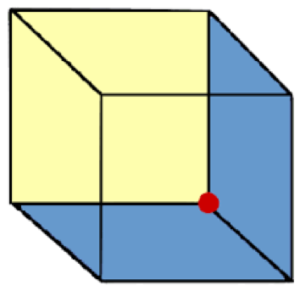
The analogy is when presented the image below [Necker Cube], you can only see one cube but not the other no matter how hard you try to do it.
When another mentioned there is another cube therein, you cursed them as engaging in hippy-woo claptrap and all sorts of derogatory terms.

Image

Wonder when you will realize you have a philosophical handicap here.
Peter Holmes
Posts: 4134
Joined: Tue Jul 18, 2017 3:53 pm

Re: What could make morality objective?

Post by Peter Holmes »

Immanuel Can wrote: Mon May 04, 2020 10:25 pm
Peter Holmes wrote: Mon May 04, 2020 8:46 pmBut ... what do you think is the strongest natural evidence for the existence of a god? (No worries if you don't want to answer.)
No, no...I'm happy to answer.

Well, it works this way: Atheists often look at something like the Argument For a First Cause, and say, "Well, even if it's right, it doesn't tell us enough to know what kind of 'God' we're talking about, so it doesn't help much." Or they look at the Moral Argument and say, "Well, it doesn't prove there IS a God in the first place, only that He's necessary for morality, so it doesn't do enough, and begs the existence question." And actually, all of that would be fair enough, if one only considered a single one of the arguments in isolation. But the Atheist critics are rejoicing too soon: they've overlooked that no argument all by itself was every intended to prove the case for God: rather, each one addresses one aspect of the necessary set-of-arguments to establish not only the existence of God, but a fair bit about His nature and about His moral identity as well.

The Atheist critic wants the Theistic case to be a table standing on one leg: it's not. It rests on several pillars, each of which addresses a substantial concern Atheists have raised about Theism. So they need to be regarded as a cumulative composite, not simply a disparate collocation of unrelated arguments. Each builds upon the last.

The Blackwell Guide does an excellent job of reflection this. I highly recommend the introduction, which places all the subsequent arguments in their right relation to each other.

So, for example, if you want an argument for the existence of God conceptually, then the Kalaam is a very compelling one, when rightly articulated. But it's function starts and stops with establishing the rational necessity of the concept of some kind of God, without specifying further. The evidence from Design, I also think is overwhelming to any fair-minded observer; but its function is to supplement the Kalaam and similar arguments, by filling out the picture of what kind of God we're talking about. The Moral Argument does even more, in that regard; and I think it might well be the hardest for secularism to answer -- because secularism has no explication of evil at all. But all these do not fill in all the details we need.

However, as I said earlier (perhaps to someone else in this thread), "natural" arguments of this type, I think, generally do not turn out to convince people who decide they simply want an opportunity to justify their unbelief, rather than considering the arguments dispassionately. You can't convince a man who doesn't want to be convinced under any circumstances. It would take a miracle to do that.

However, of all the arguments the Guide lists, I think the one that's key to actually knowing something about God is not, per se, a "natural" argument at all: it's the Argument from Revelation, the specific fact that God has spoken.

So again, we get back to the question, "Has God spoken?" If He has, it changes everything: but if He had not, we'd all -- Theists and Atheists alike -- be thrashing around in the dark, speculating on insufficient evidence and not knowing WHAT to conclude, except that if there is a God he doesn't care enough about us to tell us anything.

The upshot: unless God speaks, no set of natural-style arguments is going to give up more than a sort of argument-to-the-best-explanation type of confidence about God even existing, let alone about His nature and purposes.
Okay. You offer no natural evidence for the existence of your god. All you can say is that it has spoken - a claim for which you offer no evidence. Tant pis. This is why atheism is the rational position.

And you think a number of unsound and repeatedly refuted abductive arguments (not, in themselevs, evidence, of course) add up to a rational case. Oh well. Nothing to see here.

There's no mind more determinedly closed than that of a true believer.
Post Reply