√5 and Phi

What is the basis for reason? And mathematics?

Moderators: AMod, iMod

Post Reply
wtf
Posts: 1232
Joined: Tue Sep 08, 2015 11:36 pm

Re: √5 and Phi

Post by wtf »

Skepdick wrote: Fri Feb 14, 2020 7:42 am I agree with pretty much everything you said before this so I am not going to respond on any of it. For every Mathematical denotation there is a clear philosophical interpretation. I much prefer science/engineering to philosophy so I want to elaborate on WHY I think lazy evaluation matters to Mathematics (and so I must do Philosophy).
Good. Yes. That's the question and I appreciate your proposing to answer.

Let me emphasize something I forgot to mention the other day about lazy evaluation. Lazy evaluation is an optimization technique. It's a clever way to reduce the use of resources in a given computation. We don't evaluate an expression till we need to. There's a complementary technique called memoization, which is that once we evaluate an expression we save the result so that we don't have to calculate it again. Computer science is full of these kinds of optimizations for the purpose of using real world resources (time, space, energy) more efficiently.

However, no optimization can have the slightest effect on computability. You could implement lazy evaluation on a Turing machine. After all, we do that every day! Conventional computers are physical implementations of Turing machines. They have a certain level of computational power. We can optimize the algorithms to run more efficiently; but we can never make a noncomputable problem computable by way of an algorithmic optimization.

What you are talking about is complexity: how efficiently a computation runs as a function of the input length. As the inputs get longer, does the resource consumption go up as a polynomial or an exponential of the input length? That's a huge deal in computer science these days.

But that is the subject of complexity and not computability.

It's possible for an optimization to improve the complexity of a given computation; but never the computability. I hope you understand that. Again, using these words with their conventional meaning.

Skepdick wrote: Fri Feb 14, 2020 7:42 am You say that the Mathematical universe is idealised.
Mathematics only cares about pure functions. Referential transparency (e.g referencing/dereferencing are isomorphic)
Time doesn't matter - everything is static and unchanging.
I'll take you on your word and I will even aspire to that narrative in spirit.
Math itself, yes. 2 + 3 = 5. But if it's 2pm and I wait 3 hours, it's 5pm. So we can use math to model time. But as to pure math itself, there's no time in it. Time is a question of physics, not math.

Although even then we could invent time-dependent math if we wanted. We could define a set that at time t has elements S(t). So you'd have time-varying sets. You can use math to model anything you want.

But in general the objects described by math are unchanging; even though we can use math to model changing objects. So when we say f(x) = x^2, mathematically the function exists all at once; all the input/output pairs exist right now. We could also say a point is moving with that equation of motion, so that the function describes a motion.

Hope we're all agreed on this. Essentially math is static. I'll agree to that.
Skepdick wrote: Fri Feb 14, 2020 7:42 am Wittgenstein's rule-following problem (and Kripke's response to it) is about whether, either of us knows what "purity" really means,
and how, despite our best efforts at practicing 'purity' we all might be practicing 'furity' rather than 'purity'.
It's an abstract concept with no formal metric. Like justice, beauty and an infinite list of virtues that I need not enumerate.
I'll stipulate that I know little of Wittgenstein or Kripke. I'll take Wittgy's advice and whereof I cannot speak, thereof I'll put a sock in it.

I don't know what you mean by furity. Do you mean practicality? As in Turing machines versus actual running programs? Abstract versus concrete? Not sure what you mean and "furity" did not have any Google links when I looked it up. They asked me if I meant fruity or futurity.
Skepdick wrote: Fri Feb 14, 2020 7:42 am Both of us aspire to purity. Neither of us can define it or measure it, so it's difficult to say anything meaningful about it.
You'll have to speak for yourself on that. I long ago gave up that quest, if I ever had it. We are not monks. I'm not, anyway. I live in the world.

But now a point of confusion. I'm not trying to say anything meaningful about purity. Saying meaningful things about purity? When did that become a topic of conversation? I have no interest in it. Besides, purity died in the culture ever since the "99.44% pure" Ivory Snow girl became a porn star.

https://en.wikipedia.org/wiki/Marilyn_Chambers

Saying anything meaningful about purity? Man where ARE you coming from? The other guy, @nothing, he wants to talk about the golden ratio but it turns out he really wants to talk about the Garden of Eden. What is it with this place? LOL
Skepdick wrote: Fri Feb 14, 2020 7:42 am So when you are doing math - are you being 'pure' or 'fure'? You don't know.
I'm just doing math. Like when I was eating breakfast a while ago. I wasn't thinking about the act of eating breakfast. I was just eating breakfast. And again, I don't exactly know what connotation "fure" means to you. Unless it means abstract versus concrete. Breakfast as an Aristotelian category or Platonic idea, versus the "executing process" of my cooking breakfast for myself in my kitchen.A recipe is a program; making breakfast is a process. Is that what you are talking about?

What are you talking about? When I have to solve an equation or learn a theorem or read a Wiki page about some advanced math concept, that's what I'm doing. I'm not pure or fure. I'm just doing math.
Skepdick wrote: Fri Feb 14, 2020 7:42 am When I am doing math - am I being 'pure' or 'fure'? I don't know!
Is my 'pure' your 'fure' or vice versa?!? We don't know.
You're off on your own here. You lost me entirely.
Skepdick wrote: Fri Feb 14, 2020 7:42 am What is purity? Deep question. A more shallow one is: can we measure it?
It's not a thread subject I'd jump into. I had no idea we were talking about it here. I have no opinion on the subject. I recall there's a dramatic comedy movie State and Main, where Philip Seymour Hoffman is writing a movie script based on the idea of Purity, and that becomes a theme of the movie. Poor guy. Brilliant actor, died with a needle in his arm. Is that Purity or Furity? What do you think?

What is purity? What the eff? The subject was why you think lazy evaluation tells us something about the philosophy of math, and what exactly that might be.


Skepdick wrote: Fri Feb 14, 2020 7:42 am Because that's the only kinds of questions Math can answer - quantitative ones.
Math answers qualitative questions too. Confidence intervals, probabilities. And math isn't just about quantity. It's about shape, structure, symmetry. It's about how some qualities of things stay the same as you change other qualities, as in stretching and shrinking without tearing or bending.

Math is all of that. Math is about everything mathematical. What of it? Lazy evaluation, remember? You were going to tell me how you think that an algorithmic optimization can affect computability, WHICH IT CAN'T POSSIBLY.

Skepdick wrote: Fri Feb 14, 2020 7:42 am So here is my metric: Purity is strictness. And lazyness-strictness is the sliding scale by which I measure it.
Model it as you wish. strict maps to 0, lazy to inf - or the inverse. It doesn't matter.
That doesn't make a bit of effing sense. Lazy evaluation is an optimization that makes a computation run more efficiently. You've utterly failed to make your point.
Skepdick wrote: Fri Feb 14, 2020 7:42 am In an impure universe (the actual one), where time, memory or representation does matter functions must be as strict as possible, otherwise they leak implementation details. They leak time, which is what allows for side-channel attacks etc. So back to the pure universe....
Now YOU are the one believing in a pure universe. Last post you were mocking the idea. Make up your mind.

The world is what it is, it's the only one we've got. And lazy evaluation is a computational optimization that can not affect computability. My God if I'm writing a program and I use a shortcut operator like x += 5 instead of writing x = x + 5, do you think this is an effiing philosophically significant act? It's a notational optimization. What the hell of it?

To the extent that I understand what you're saying, I think you're making a major mountain of the most trivial idea. Program optimization? Man they've been doing that since they invented programming in the 1940's.
Skepdick wrote: Fri Feb 14, 2020 7:42 am Given the identity f(x) = g(x) there must be no other, differentiating function that you can find. No function d(x) where

d(g(x)) != d(f(x))
Ok now we're back to math. New subject. Ok. Yes, by definition, equality between functions means that the functions given exactly the same output for every input. That f(x) = g(x) for every x in their common domain. That's the definition of what it means for two functions to be equal.

Let me emphasize that this isn't right or wrong, it's just the way we define equality of functions.

Skepdick wrote: Fri Feb 14, 2020 7:42 am Now. Up to here, all of this is my own reasoning. From 1st principles + engineering experience.
Where my brain makes a leap is that - to me that seems exactly like the conclusion in the "Sometimes all functions are continuous" article.
No, it's very different. One's a definition, the other's a theorem that follows from some premises.

Saying f and g are the same function as long as f(x) = g(x) is the DEFINITION of function equality.

Regarding the article, they pointed out that if you make the particular definition of computable continuity, then all functions on the natural numbers are computably continuous (if I recall correctly). That's a theorem that follows from the definition they made of computable continuity.

Two totally different things. No connection.
Skepdick wrote: Fri Feb 14, 2020 7:42 am Even though I don't understand a significant portion of the topology/homotopy jargon in it (or whether it's even important to do that in order to understand the implications), it seem to me that I am concluding roughly the same things the author is concluding.
Interestingly, I understood the topology part. I should go back to the article and finish getting through their conclusion to see if I can put it into context. It was actually very interesting. When they talked about the product topology I knew all about that and was able to make sense out of what they were saying. I'll get back to that article and see if I can say anything interesting about it.
Skepdick wrote: Fri Feb 14, 2020 7:42 am f(x) = g(x) does not imply d(f(x)) = d(g(x))
Doesn't follow at all. Your 'd' notation's a little confusing, the 'd' of a function is usually its derivative. Can you choose a better notation to say what you mean? I don't actually know what you mean here.

You're making up a connection between things that aren't related. I hope you'll take my words to heart on this matter.
Skepdick wrote: Fri Feb 14, 2020 7:42 am It seems to me that what mathematicians call "discontinuities", software engineers call "leaky abstractions".
My friend, I know what a leaky abstraction is. I read Joel on Software just like you do.

I also know some math. Let me tell you from the bottom of my heart, that discontinuities in math have nothing at all to do with leaky abstractions. You're reaching for connections when you'd be better off trying to understand the details of what you're talking about, so that you'll understand more.
Skepdick wrote: Fri Feb 14, 2020 7:42 am The details which we attempted to abstract away - surfacing at higher layers of abstraction. An edge case. An unhandled exception
A discontinuity as an unhandled exception. Ok. I will grant you this: As a metaphor, or as geek poetry, it's not bad. Kind of good in a spacey way. But it's not right technically. There's no technical connection. But poetically? Yeah maybe.

But not really An unhandled exception is a programming error. Two bad things happened: One, the program did something abnormal; and two, the programmer forgot to check for it. Bad programmer!

But with discontinuous functions, some phenomena are really discontinuous. When you go to the post office you pay 55 cents to send a letter weighing up to 3.5 ounces. If your letter weighs 3.6 ounces, you pay $1.10. You need another whole stamp. You can't pay proportionally.

In fact as you may recall, it's the "post office function" that's always taught to students when they learn about discontinuous functions.

So again: An uncaught exception is a programming error; something that ideally, should not happen. A discontinuous function simply models a discontinuous phenomenon in the world.
Skepdick wrote: Fri Feb 14, 2020 7:42 am It signals new information. It signals a false assumption somewhere underneath.
No. An uncaught exception is a mistake by a programmer A discontinuous function models something in the world that happens to be discontinuous. Like getting married. One instant you aren't then you are. That's discontinuity. The "singlehood" function has a discontinuity at the moment of your marriage. Right? Right.

You are seriously misinterpreting that article. It's a good explainer about a certain aspect of constructive math. I found it useful. But it does not mean what you think it does. And it has nothing to do with discontinuous functions.

Skepdick wrote: Fri Feb 14, 2020 7:42 am And I won't bore you with the details of why that looks a lot like the measurement problem in Physics to me, or why I think Mathematics is an attempt to model reality. The number line represents time.
Of course the number line represents time in physics. And there is a point to be made about that, which is that there is no evidence that actual time in the universe works anything like the real numbers! The real numbers are an abstraction and very unlikely to end up being "true" about time, if we ever do figure out what's true about time.
Skepdick wrote: Fri Feb 14, 2020 7:42 am When you ask me "Do you think the numbers exist" I am hearing "Do you think time exists?"
Numbers are abstract. Time is an actual reality in our lives.
Skepdick wrote: Fri Feb 14, 2020 7:42 am How cranky do I sound now? Or am I "stating the obvious" again?
Much of your post was shockingly lucid. We're at the point where I disagree with you on some issues but at least I can understand what you're saying.

But the part about the meaning of purity, man that went way over my head. And what's furity?

And the bit about mathematical discontinuity, you're just misunderstanding the article, or rather wildly extrapolating it to areas where it doesn't apply.

Also, you did not IMO make your point about lazy evaluation. Lazy evaluation is an optimization technique no different in principle from all other optimization techniques, none of which can affect the computability of a given task. I simply don't see the relevance of that example to anything else you're trying to say.
Impenitent
Posts: 5775
Joined: Wed Feb 10, 2010 2:04 pm

Re: √5 and Phi

Post by Impenitent »

Skepdick wrote: Fri Feb 14, 2020 8:48 am
Impenitent wrote: Fri Feb 14, 2020 12:40 am and the abstractions of the "abstract universe" which are beyond empirical impression...
Well, somebody is abstracting the abstraction - somebody is experiencing it.

So there is clearly an abstract() procedure of some sort.
And if there is an abstract() procedure, then there is also a deabstract() procedure.

So what does deabstract(abstract universe) give us? Real universe?
I have yet to meet anyone who has empirically experienced the square root of -1

I would say the "deabstract" procedure gives us the Tractatus…

-Imp
wtf
Posts: 1232
Joined: Tue Sep 08, 2015 11:36 pm

Re: √5 and Phi

Post by wtf »

Impenitent wrote: Sat Feb 15, 2020 1:05 am I have yet to meet anyone who has empirically experienced the square root of -1
I have. You have too. The complex number i is just a gadget that keeps track of how many times you made a counterclockwise quarter turn in the plane. If you're facing east that's 1 on the real line if you are in the usual x-y plane. If you turn to the north, that's i. If you turn to the west, that's two quarter turns, or i x i. And which way are you facing? Exactly the opposite of where you started. You're at the point -1 on the real line. i^2 = -1.

One more turn and you face south, and one more turn after that and you're back where you started. i^4 = 1.

If you ever drove your car and made a left turn at an intersection, you rotated yourself through an angle of 90 degrees. In the complex plane this is represented by multiplying your original direction by the number i.

If you took linear algebra, a complex number is just a 2x2 matrix of a particular form. This is all much simpler than the way they confused you in school.

In any event, you have now met someone with a direct experience of the complex number i.
Impenitent
Posts: 5775
Joined: Wed Feb 10, 2010 2:04 pm

Re: √5 and Phi

Post by Impenitent »

I understand walking the circumference of a radius 1 circle about the origin counterclockwise, and making mental notes about theoretical position on a 2 dimensional plane in relation to all other points; but no, I don't equate spinning in empirical circles with imaginary mathematics...

-Imp
wtf
Posts: 1232
Joined: Tue Sep 08, 2015 11:36 pm

Re: √5 and Phi

Post by wtf »

Impenitent wrote: Sat Feb 15, 2020 2:50 am I understand walking the circumference of a radius 1 circle about the origin counterclockwise, and making mental notes about theoretical position on a 2 dimensional plane in relation to all other points; but no, I don't equate spinning in empirical circles with imaginary mathematics...
Have you seen the numbers 1, i, -1, and -i as the points on the x-y plane? To get from one to the next you turn 90 degrees counterclockwise. This is what the number i is. It's ok if you don't equate it yourself. You said you've never met anyone who has a direct experience of the square root of -1. I studied math. I have a very clear experience of it. You've met me. Also there are a lot weirder things in math than the number i, which in fact does have a very down-to-earth geometric nature.

ps ... Here is another bit of philosophy or a point of view about the square root of -1.

Do you know the integers mod 5? These are the numbers {0, 1, 2, 3, 4} with addition and multiplication mod 5; that is, you do the operation normally then throw away everything but the remainder after the result is divided by 5.

For example 2 + 4 = 6 = 1 (mod 5), and 3 * 3 = 9 = 4 (mod 5).

What is 4 + 1? It's 0 (mod 5). And what's another name for a number that when you add 1 to it, it becomes 0? Well, -1 is such a number. In fact 4 = -1 (mod 5).

What is 2 * 2? It's 4, as usual. So in the integers mod 5, we have 2 * 2 = -1. In other words in the integers mod 5, the number 2 is a square root of -1.

What does this mean? It means that a "square root of -1" might or might not exist, depending on the nature of the number system we're working with. There is no square root of -1 in the real numbers; but there is in the integers mod 5; and there is in the complex numbers.

It's just a question of what number system you live in. When you take math through high school and two years of calculus -- which is still a lot of math for most people! -- you only live in the real number system. So you never see a square root of -1 except in passing, where it's generally taught badly and doesn't convince anyone.

Math majors spend a lot of time living in the complex numbers, and the integers mod 5, and lots of other strange and wonderful number systems. Numbers other than the reals become familiar. Experiencing -1 is not a matter of cosmic mystery so much as simply a matter of mathematical familiarity. You go to number theory class where 2 x 2 = -1 (mod 5), and you go to complex variables class where i x i = -1, and after a while you just internalize that some number systems have a square root of -1 and others don't, but that it's no big deal either way.
nothing
Posts: 621
Joined: Mon Oct 14, 2019 9:32 pm

Re: √5 and Phi

Post by nothing »

wtf wrote: Fri Feb 14, 2020 10:19 pm
nothing wrote: Fri Feb 14, 2020 3:38 pm
π + π√5
‾‾2π‾‾ = Φ
But this is just a restatement of the defining property of Φ. You could plug in any real number whatsoever and it would still be true.

You have (pi + pi sqrt(5) / 2pi = (pi(1 + sqrt(5))) / 2pi = (1 + sqrt(5)) / 2 = Φ.

Just as the pi cancelled in the numerator and denominator; you could put any real number you like in there and it would still be true. So you've said nothing here.
The point made was you can generate the +1 without arbitrarily using it before-hand in phi.
This binds the derived +1 to the π used to derive it.

I am not confident a general mathematician would implicitly understand the nuance of this, as it relates to number theory itself than anything else. To me it is clear that 1+√5/2 is not qualitatively equivalent to π+π√5/2π, as the latter implies a circle, whereas the former does not.

I suppose it is a matter of perception - like all things real and/or transcendental.
wtf wrote: Fri Feb 14, 2020 10:19 pm I looked up Edenic and found, "Of or suggesting Eden, the paradise of the Bible."

Is that what you mean?
Yes - tree of knowledge of good and evil, and tree of living.
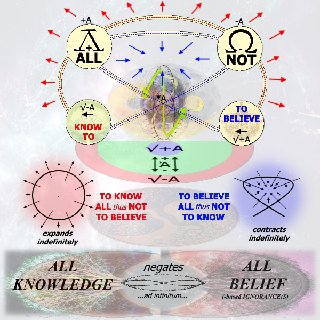
The two trees are the two legs of the pentagram,
the arms are the universal operators: all and not (alpha and omega).

I intuit this is how one must be "grounded" into the source of creation as it functions from within.
Clarifying what these two trees are would wake up the "believers" for their eating of the tree
which certainly leads to suffering/death, as written according to their own "source".

Image
{to know all thus: not to believe} expands indefinitely outward, whereas
{to believe all thus: not to know} contracts indefinitely inward.
Impenitent
Posts: 5775
Joined: Wed Feb 10, 2010 2:04 pm

Re: √5 and Phi

Post by Impenitent »

wtf wrote: Sat Feb 15, 2020 3:38 am
Impenitent wrote: Sat Feb 15, 2020 2:50 am I understand walking the circumference of a radius 1 circle about the origin counterclockwise, and making mental notes about theoretical position on a 2 dimensional plane in relation to all other points; but no, I don't equate spinning in empirical circles with imaginary mathematics...
Have you seen the numbers 1, i, -1, and -i as the points on the x-y plane? To get from one to the next you turn 90 degrees counterclockwise. This is what the number i is. It's ok if you don't equate it yourself. You said you've never met anyone who has a direct experience of the square root of -1. I studied math. I have a very clear experience of it. You've met me. Also there are a lot weirder things in math than the number i, which in fact does have a very down-to-earth geometric nature.

ps ... Here is another bit of philosophy or a point of view about the square root of -1.

Do you know the integers mod 5? These are the numbers {0, 1, 2, 3, 4} with addition and multiplication mod 5; that is, you do the operation normally then throw away everything but the remainder after the result is divided by 5.

For example 2 + 4 = 6 = 1 (mod 5), and 3 * 3 = 9 = 4 (mod 5).

What is 4 + 1? It's 0 (mod 5). And what's another name for a number that when you add 1 to it, it becomes 0? Well, -1 is such a number. In fact 4 = -1 (mod 5).

What is 2 * 2? It's 4, as usual. So in the integers mod 5, we have 2 * 2 = -1. In other words in the integers mod 5, the number 2 is a square root of -1.

What does this mean? It means that a "square root of -1" might or might not exist, depending on the nature of the number system we're working with. There is no square root of -1 in the real numbers; but there is in the integers mod 5; and there is in the complex numbers.

It's just a question of what number system you live in. When you take math through high school and two years of calculus -- which is still a lot of math for most people! -- you only live in the real number system. So you never see a square root of -1 except in passing, where it's generally taught badly and doesn't convince anyone.

Math majors spend a lot of time living in the complex numbers, and the integers mod 5, and lots of other strange and wonderful number systems. Numbers other than the reals become familiar. Experiencing -1 is not a matter of cosmic mystery so much as simply a matter of mathematical familiarity. You go to number theory class where 2 x 2 = -1 (mod 5), and you go to complex variables class where i x i = -1, and after a while you just internalize that some number systems have a square root of -1 and others don't, but that it's no big deal either way.
I'll admit that I have not taken the level of math classes that you have, but as far as I understand, mathematics (like any language system) is a mental event. Interpretations of symbols is also a mental event. I do not doubt that you have direct mental experience of these numerical concepts... I'll maintain that empirical experience is different...

-Imp
Skepdick
Posts: 16022
Joined: Fri Jun 14, 2019 11:16 am

Re: √5 and Phi

Post by Skepdick »

Impenitent wrote: Sat Feb 15, 2020 1:05 am I have yet to meet anyone who has empirically experienced the square root of -1

I would say the "deabstract" procedure gives us the Tractatus…
And I am yet to meet anybody who has empirically experienced the number 1.

No wait. That's not true.

I just experienced the number 1. Right before I uttered it.

Much like you experienced square root of -1. Right before you uttered it.
Impenitent
Posts: 5775
Joined: Wed Feb 10, 2010 2:04 pm

Re: √5 and Phi

Post by Impenitent »

Skepdick wrote: Sat Feb 15, 2020 8:35 pm
Impenitent wrote: Sat Feb 15, 2020 1:05 am I have yet to meet anyone who has empirically experienced the square root of -1

I would say the "deabstract" procedure gives us the Tractatus…
And I am yet to meet anybody who has empirically experienced the number 1.

No wait. That's not true.

I just experienced the number 1. Right before I uttered it.

Much like you experienced square root of -1. Right before you uttered it.
no, your numerical definition is still not empirically experienced

-Imp

https://www.merriam-webster.com/dictionary/empirical

#2
wtf
Posts: 1232
Joined: Tue Sep 08, 2015 11:36 pm

Re: √5 and Phi

Post by wtf »

Impenitent wrote: Sat Feb 15, 2020 3:20 pm I'll admit that I have not taken the level of math classes that you have, but as far as I understand, mathematics (like any language system) is a mental event. Interpretations of symbols is also a mental event. I do not doubt that you have direct mental experience of these numerical concepts... I'll maintain that empirical experience is different...
I'm not sure what you mean. As I say, when you understand the number 'i' sufficiently then it is perfectly clear to you on an intuitive, experiential basis that turning left 90 degrees is multiplication by i.

Analogy: Suppose you hear about the physics of electromagnetism and you say, Oh, that is a complicated mathematical theory, and I have no experience of that. Then someone would point out that it's just a fancy word for light! You have an everyday experience of it. You just haven't learned the fancy scientific language yet.

Turning left is just like that. You haven't learned the fancy mathematical vocabulary of complex numbers; but of course you have an experiential understanding of turning left.

Can you explain more why you think it's experientially different? Other than lack of mathematical familiarity with the jargon?
wtf
Posts: 1232
Joined: Tue Sep 08, 2015 11:36 pm

Re: √5 and Phi

Post by wtf »

nothing wrote: Sat Feb 15, 2020 3:05 pm I am not confident a general mathematician would implicitly understand the nuance of this, as it relates to number theory itself than anything else. To me it is clear that 1+√5/2 is not qualitatively equivalent to π+π√5/2π, as the latter implies a circle, whereas the former does not.
I already pointed out that you could use 47 instead of pi and you'd still have a valid equation. You're just taking the definition of phi and multiplying the numerator and denominator by a constant.
nothing wrote: Sat Feb 15, 2020 3:05 pm I intuit this is how one must be "grounded" into the source of creation as it functions from within.
Clarifying what these two trees are would wake up the "believers" for their eating of the tree
which certainly leads to suffering/death, as written according to their own "source".

You've got me there.
nothing
Posts: 621
Joined: Mon Oct 14, 2019 9:32 pm

Re: √5 and Phi

Post by nothing »

wtf wrote: Sun Feb 16, 2020 5:30 am I already pointed out that you could use 47 instead of pi and you'd still have a valid equation. You're just taking the definition of phi and multiplying the numerator and denominator by a constant.
Yes I am aware, however π is not an ordinary constant like 47: coupling π to Φ generates
the equivalent of a variable rotating base (π per half-rotation) coupled to
the creative Φ ratio, along with all geometries intrinsic to it.
Whereas the former is dynamic (ie. variable) as one can divide/multiply a circle as many times as needed,
Φ is both static and a solution to a quadratic whose ratio inside of a circle never repeats itself (ie. infinite)

Using π thus couples a pentagram (Φ) to the unit circle r = 1 described by 2π.

I already tried to indicate general mathematicians may not see the importance of the coupling
because of their strictly quantitative way of seeing/calculating, rather than qualitative.
The closest I see to the latter is imaginary numbers, but '1' is not imaginary: it is both the radius of a unit circle
and the length of each side of a Φ pentagram/pentagon.
wtf wrote: Sun Feb 16, 2020 5:30 am You've got me there.
If the apex of a pentagram splits in two bases, these bases capture the two Edenic trees
'to Know' and 'to Believe' (as the legs) given static 'all' and 'not' operators (as the hands).

Apex: will {equal capacity for good/evil}
base: to Know {beg/end}
arm: All {alpha}
arm: Not {omega}
base: to Believe {end/beg}

This mapping establishes the bi-rotation model that "points" in the direction of both trees, thus
towards both all-knowing and all-belief-based-ignorance causing/perpetuating suffering/death
and applies to both a theist and atheist context (irrelevant).
Impenitent
Posts: 5775
Joined: Wed Feb 10, 2010 2:04 pm

Re: √5 and Phi

Post by Impenitent »

wtf wrote: Sun Feb 16, 2020 3:51 am
Impenitent wrote: Sat Feb 15, 2020 3:20 pm I'll admit that I have not taken the level of math classes that you have, but as far as I understand, mathematics (like any language system) is a mental event. Interpretations of symbols is also a mental event. I do not doubt that you have direct mental experience of these numerical concepts... I'll maintain that empirical experience is different...
I'm not sure what you mean. As I say, when you understand the number 'i' sufficiently then it is perfectly clear to you on an intuitive, experiential basis that turning left 90 degrees is multiplication by i.

Analogy: Suppose you hear about the physics of electromagnetism and you say, Oh, that is a complicated mathematical theory, and I have no experience of that. Then someone would point out that it's just a fancy word for light! You have an everyday experience of it. You just haven't learned the fancy scientific language yet.

Turning left is just like that. You haven't learned the fancy mathematical vocabulary of complex numbers; but of course you have an experiential understanding of turning left.

Can you explain more why you think it's experientially different? Other than lack of mathematical familiarity with the jargon?
there is a package of eggs on the counter

I observe they are whitish in color, semi spherical in shape, they make no hearable sound and emit no perceptible odor.

all these labeled properties are mental descriptions of that which is immediately perceived

another package of eggs on the counter

these are more brown in color, more spherical, noticeably smaller in overall size, again silent and scent free...

different packages with different contents, yet both are named eggs

the "ideal" egg appears no place other than in the labels presented in the language of the observer

remove the eggs from the packages and put them in a disorganized pile in a bowl

at a glance, you see different colored semi spherical objects piled in a bowl, you can't see what is beneath the top observable layer

how many complete eggs can you see? 17? 20?

how many eggs are there?

the mental description of 24 (if the initial packages were indeed dozens) is not what is currently observed...

to say nothing of the discovery of those eggs in which the chicken embryo was further developed than simple unfertilized eggs

-Imp
Skepdick
Posts: 16022
Joined: Fri Jun 14, 2019 11:16 am

Re: √5 and Phi

Post by Skepdick »

Impenitent wrote: Sun Feb 16, 2020 2:18 pm I observe they are whitish in color
So, would you say that you've empirically experienced, and therefore - intuitively understand the concept of "color"?
Impenitent wrote: Sun Feb 16, 2020 2:18 pm there is a package of eggs on the counter
So would you say that you empirically experienced, and therefore - intuitively understand the concept of a "set" e.g a "collection of things"?
wtf
Posts: 1232
Joined: Tue Sep 08, 2015 11:36 pm

Re: √5 and Phi

Post by wtf »

Impenitent wrote: Sun Feb 16, 2020 2:18 pm to say nothing of the discovery of those eggs in which the chicken embryo was further developed than simple unfertilized eggs
I did not understand this at all. But it's ok. I myself have a perfectly clear experience of the number i, and you've met me online. So you've met at least one person with such an experience.
Post Reply