The Logic of Information: A Theory of Philosophy as Conceptual Design

For all things philosophical.

Moderators: AMod, iMod

nothing
Posts: 621
Joined: Mon Oct 14, 2019 9:32 pm

Re: The Logic of Information: A Theory of Philosophy as Conceptual Design

Post by nothing »

Skepdick wrote: Fri Jan 10, 2020 2:05 pm That's an oxymoron. If there was a "how it universally operates" there would be no need for "local" adjustments.
Of course there would, because of how it universally operates.
"local" adjustments to a "universal" rule are called exceptions. And in programming the act of dealing with "local adjustments" is called exception handling.
Relativity is an exception that is intrinsically local, thus the need to build into the identity locally (!)
This is where you are getting confused. Lambda calculus is universally expressive. The logic exists.
Has it then derived the primordial {alpha/omega}{beginning/end} operators/roots?
A universal expression (using the universal logic) ABOUT the phenomena in question doesn't. Once you've figured out what universal thing you want to say about such phenomena - go ahead and say it. Logic is fundamentally constructive/generative in nature.
Well the only relevant phenomena concerned here begins and ends with the observer themselves: the seat of one's own experience of all creation is from within the observer. Therefor, any variable body, such as A, must intrinsically have the capacity to orient themselves according to observation. To "what"? "That" is the universal phenomena to which any valid universal logic must be rooted: "that" being whatever orients towards being universally 'true' and/or 'false' with the least number of exceptions and/or special cases.

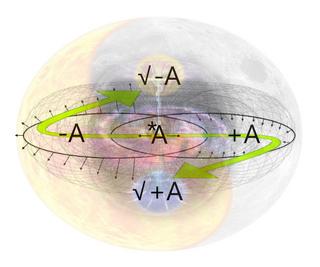
Again: A must have an intrinsic root system √A such to allow +A and -A, or simply *A as intrinsically *(+/-). Now A can move.
The absence of a language/logic isn't holding you back - the absence of a universal idea about the phenomena in question is.
It's the other way around: what language/logic has already derived universal roots/operators?

Let *A be any suffering being with the *capacity to "move" to/from *(+/-) suffering.
Let s be space, and let t be time.
Let c be unity as 1/1, and let c be the cessation(s) of all causation(s) of the suffering *A.
Let *A exist by way of space/time, thus *A = s/t.

*A = s/t
*A → c
*A = s/1, 1/t
√*A = s/√1, √1/t
√*A = (s/+1, s/-1), (+1/t, -1/t)
*A = √(s/+1, s/-1), √(+1/t, -1/t)
*A = √space(+all-not), √time(+all-not)
*A = √spacetime, √+all-not
________________________________
√+all-not are universal operators intrinsic to *A
√spacetime is universal to all motion(s) caused/ceased, including human beings, thus:

*A = {+all, -not}, {+causation, -cessation}
*A = {+alpha, -omega}, {+√beginning, -√end}
______________________________________
both √root(s) are immediate in time

Thus *A is intrinsically endowed with a quaternion modus operandi which allows for variable impetus/impedance:
Image
As I pointed out before - if you treat A as a computational object - a type, A can respond (or not) to whatever operations you want. This is the crux of type theory.

https://en.wikipedia.org/wiki/Type_theory : In type theory, every "term" has a "type" and operations are restricted to terms of a certain type.
Now *A can be captured in terms of position and direction.
Not only: it is possible to know the real/imaginary roots of *A,
which translates into any being being rooted in both
√knowledge (real) and √belief (imaginary)
reflecting the two Edenic trees, one of which yields suffering/death.

Thus, such a logic can be used to discern between one-of-two "orientations":
to know all, thus: not to believe
or
to believe all, thus: not to know
which lends itself to the derived quaternion being valid 180-degree inversions
producing opposite results: one tends towards all-knowing, the other all-belief-based ignorance(s)
causing suffering/death. It thus allows to find the root(s) of any/all suffering/death.
OK, but that's the very point. The description of the sun's behaviour is with respect to the observer's reference frame. From location (view-point) A - it behaves one way. From location (view-point) B - it behaves another way. This is the crux of Einstein's Relativity.
Thus build relativity into the variable (!)

Einstein's GTOR is absurd: space doesn't bend. The mathematics of it is fine, but the interpretation of it has lead to absolute absurdities like infinitely dense, infinitely hot, infinitely warped black holes. There is no such thing.

There is already an existing system of theory that is a 'theory of everything' which correctly derives the reciprocally related relationship between space and time:

3d space / 1d time <-real, physical sector
2d space / 2d time <-speed of light c, unity
1d space / 3d time <-ethereal, cosmic sector
There is no universal observer reference frame, so there's no universal description of the sun's behaviour.
According to the logic provided, there is a universal reference frame: c. I have already used the logic and let *A be Adam in a garden of Eden, then solved for the original sin(s), thus mark of Cain etc. which are real conditions that can be tested for, and return 'true' values if/when true. The logic is immensely powerful because if/when variables obstructing what would otherwise be c are removed, the yields compound until there is no distortion(s) left, only a clear view. The logic is designed to accompany a theorem which takes √+A→*A→√-A as belief-based ignorance is negated by knowledge ad infinitum, which leads to any possible all-knowing 'state' theist/atheist-invariant: if a god exists, and is all-knowing, all-knowing approaches the same. If a god exists not, all-knowing approaches knowing the same.
Your pespective is not universal because it's context-dependent.
No it's not - only if I insist only mine is correct, rather acknowledging it is context-dependent.
Sure. Reject it - nothing will happen. Logic works just fine without A = A. In fact. Logic works just fine with A = A being false.
It is one-dimensional: A needs both location and motion-based orientation. *A resolves this by allowing two valid √roots: -one a real one (ie. knowledge) and +one an imaginary one (ie. belief) thus allowing *A to both: be of the constituency of both space/time as motion in/of, according to *A's own -impetus/+impedance, thus reflecting an expression(s) of the 'will' of that being(s), be it individual or state.

Place any belief-based ignorance in +A... there exists a -A counter-part that alleviates the suffering(s) associated.
Skepdick
Posts: 16022
Joined: Fri Jun 14, 2019 11:16 am

Re: The Logic of Information: A Theory of Philosophy as Conceptual Design

Post by Skepdick »

nothing wrote: Fri Jan 10, 2020 4:28 pm Of course there would, because of how it universally operates.
Most people understand "universality" to mean "context-free application". A rule that applies always (anywhere, anywhen ) and without exceptions.

If it's context-dependent - it's not universal.

Ironically, the contextual limits of rules are the contextual limits of language.

https://en.wikipedia.org/wiki/Chomsky_h ... _hierarchy
nothing wrote: Fri Jan 10, 2020 4:28 pm Relativity is an exception that is intrinsically local, thus the need to build into the identity locally (!)
Gibberish.

Relativity is context-dependent. It's the physics of large-scale interactions.
Quantum Theory is context-dependent too. It's the physics of small-scale interactions.

Universally - the two are incompatible.
nothing wrote: Fri Jan 10, 2020 4:28 pm Has it then derived the primordial {alpha/omega}{beginning/end} operators/roots?
You are confused. What would Lambda calculus derive the "primordial" operators/roots FROM? You seem to be a prisoner of the foundationalist delusion - there are no principles, no truths, no axioms to "start with". ALL axioms are chosen.Calling them "primordial" doesn't change that fact.

Lambda calculus tells you how to APPLY the operators AFTER you define them. It doesn't absolve you from the responsibility of defining them.

Using the language of "primordial operators" you could say that Lambda calculus has two of them: α-conversion and β-reduction.
nothing wrote: Fri Jan 10, 2020 4:28 pm Well the only relevant phenomena concerned here begins and ends with the observer themselves: the seat of one's own experience of all creation is from within the observer
And so you might want to go ahead and define "the observer", or what it means "to observe". In physics this is called The Measurement problem.
nothing wrote: Fri Jan 10, 2020 4:28 pm Therefor, any variable body, such as A, must intrinsically have the capacity to orient themselves according to observation.
A must have the intrinsic capacity to observe. The English sentence "A observes B" can be expressed in the notation "A -> B"

Define "observation". e.g define the arrow.
nothing wrote: Fri Jan 10, 2020 4:28 pm To "what"? "That" is the universal phenomena to which any valid universal logic must be rooted: "that" being whatever orients towards being universally 'true' and/or 'false' with the least number of exceptions and/or special cases.
That which is "true" and "false" is determined by the observer. How does the observer determine what is "true" and "false"?

Defining the "HOW" is tantamount to defining the process which took place in your head - it's an algorithm.
nothing wrote: Fri Jan 10, 2020 4:28 pm Again: A must have an intrinsic root system √A such to allow +A and -A, or simply *A as intrinsically *(+/-). Now A can move.
Move towards what and why?
nothing wrote: Fri Jan 10, 2020 4:28 pm It's the other way around: what language/logic has already derived universal roots/operators?
You are still confused. Derived "universal roots/operators?" from what?

If such things could be derived, then surely the things they are derived FROM is "more universal" than the derived universals?
nothing wrote: Fri Jan 10, 2020 4:28 pm Now *A can be captured in terms of position and direction.
OK, how would you represent "position" in Logic? I figure you are going to use some geometry and some coordinate system?
How are you going to express direction? I figure you are going to use a vector of sorts?

You haven't arrived at anything new yet.
nothing wrote: Fri Jan 10, 2020 4:28 pm Thus build relativity into the variable (!)
Sure. How many reference frames (e.g perspectives!) would the variable need to capture?
nothing wrote: Fri Jan 10, 2020 4:28 pm Einstein's GTOR is absurd: space doesn't bend. The mathematics of it is fine, but the interpretation of it has lead to absolute absurdities like infinitely dense, infinitely hot, infinitely warped black holes. There is no such thing.
But it's precisely the mathematics of it which tells you about "infinite densities", "infinite hotness" and "infinitely warped black holes".

And yet - the theory works within its context of applicability. Outside of its context of applicability - it has exceptions.
nothing wrote: Fri Jan 10, 2020 4:28 pm There is already an existing system of theory that is a 'theory of everything' which correctly derives the reciprocally related relationship between space and time:

3d space / 1d time <-real, physical sector
2d space / 2d time <-speed of light c, unity
1d space / 3d time <-ethereal, cosmic sector
Sure it does. I bet all those those idiot-physicists who are trying to solve the problem of time/quantum gravity haven't heard about it yet.
nothing wrote: Fri Jan 10, 2020 4:28 pm According to the logic provided, there is a universal reference frame: c
You know of any observers who are moving at the speed of light? What are they "observing" exactly?
nothing wrote: Fri Jan 10, 2020 4:28 pm No it's not - only if I insist only mine is correct, rather acknowledging it is context-dependent.
OK, but that's the very problem with "universality". There is (ontologically speaking) only one context. That context is called reality.

It's precisely because of context is why we can't resolve General Relativity and Quantum Mechanics. One works in the context of "very large scale". The other works in the context of "Very small scale".

There's no way (currently) to unify those two perspectives into a single, universal perspective.
nothing wrote: Fri Jan 10, 2020 4:28 pm It is one-dimensional: A needs both location and motion-based orientation.
No - I've made no claims or mentions of "dimensionality". A exists. Whatever "existence" means and however many dimensions "existence" has.

The need for a notation expressing A's location, motion and orientation in an N-dimensional existence still remains.
nothing
Posts: 621
Joined: Mon Oct 14, 2019 9:32 pm

Re: The Logic of Information: A Theory of Philosophy as Conceptual Design

Post by nothing »

Skepdick wrote: Sat Jan 11, 2020 2:20 pm Most people understand "universality" to mean "context-free application". A rule that applies always (anywhere, anywhen ) and without exceptions.

If it's context-dependent - it's not universal.

Ironically, the contextual limits of rules are the contextual limits of language.
Context-dependent is a universal phenomena:
depending on geometrical location whence to perceive phenomena,
phenomena appears relative to the same.

It is context-invariant.
Gibberish.

Relativity is context-dependent. It's the physics of large-scale interactions.
Quantum Theory is context-dependent too. It's the physics of small-scale interactions.

Universally - the two are incompatible.
GToRelativity is rooted in a false assumption(s),
Quantum Theory the same.

Universally - both are incompatible because they are both wrong.
You are confused. What would Lambda calculus derive the "primordial" operators/roots FROM? You seem to be a prisoner of the foundationalist delusion - there are no principles, no truths, no axioms to "start with". ALL axioms are chosen.Calling them "primordial" doesn't change that fact.
Neither does it change the fact if they exist or not. I don't know what Lambda would derive it from: I don't know who designed the language. There are principles/truths/axioms that are already "starting with..." chosen axioms are not axioms: acknowledged ones are.
And so you might want to go ahead and define "the observer", or what it means "to observe". In physics this is called The Measurement problem.
The measurement problem is rooted in false assumption(s) like GToR - it any event, the problem is of choice.
If/when choosing to measure, 'state' collapses relative to the observer according to choice.
A must have the intrinsic capacity to observe. The English sentence "A observes B" can be expressed in the notation "A -> B"

Define "observation". e.g define the arrow.
*in/out
*A observes inner/outer nature(s)
*A observes
That which is "true" and "false" is determined by the observer. How does the observer determine what is "true" and "false"?

Defining the "HOW" is tantamount to defining the process which took place in your head - it's an algorithm.
"True" and "false" is chosen by the observer, but regardless has a definite right/wrong return/result.
Knowing the right/wrong result is a matter of observation: either one pays attention (or not).
Regarding observation, there are two "directions": in/out.
How the observer determines true/false is according to the discipline (or not) of their own conscience.
The "how" is a reflection of the discipline (or lack therefor).
Move towards what and why?
According to will.
You are still confused. Derived "universal roots/operators?" from what?

If such things could be derived, then surely the things they are derived FROM is "more universal" than the derived universals?
Yes: the reciprocal relationship between space and time, therefor time having 3 valid dimensions which all occupy one dimension of space.
This reciprocal relationship {3/1 ↔ 2/c/2 ↔ 1/3} mandates reciprocity as a universal property, hence the need for *A to contain it. Now, *A can move in/out from 3/1 to unity c (the speed of light) unimpeded less their own local impedance(s).
OK, how would you represent "position" in Logic? I figure you are going to use some geometry and some coordinate system?
How are you going to express direction? I figure you are going to use a vector of sorts?

You haven't arrived at anything new yet.
Are you asking in terms of universality?

"Position" would be 1D orientation: the local relationship knowledge has to belief.
"Direction" would be "position" with an resulting 2D impetus behind it:
-A knows {+all (alpha) -not (omega)} to believe,
thus tends towards all-knowing, or
+A believes {+all (alpha) -not (omega)} to know,
thus tends towards belief-based ignorance(s) up-to a 180-degree inversion(s).
3D is it all playing out over time - the "believers" are upside-down relative to knowledge of +all (alpha)
who/what/where/why/when/how and/or if: -not (omega) to believe.

One tends towards all-knowing, the other all-belief-based-ignorance(s)
the only difference being a matter of perspective.
Sure. How many reference frames (e.g perspectives!) would the variable need to capture?
One, but bi-directional: in/out.
But it's precisely the mathematics of it which tells you about "infinite densities", "infinite hotness" and "infinitely warped black holes".

And yet - the theory works within its context of applicability. Outside of its context of applicability - it has exceptions.
It's not the mathematics, it's the interpretation of the mathematics and the conceptualizations resulting therefrom.
Sure it does. I bet all those those idiot-physicists who are trying to solve the problem of time/quantum gravity haven't heard about it yet.
It's not about that - it's about the Western institution of science. The cult of Einstein and accessory cult of Quantum would sooner suppress real science if it meant their ousting than concede to admitting the theories upon which their funding relies are fundamentally wrong. It is thus such institutions are literally religions, thus "idiocy" fits nicely as inventing problems such as time/quantum gravity is idiocy.
You know of any observers who are moving at the speed of light? What are they "observing" exactly?
No, but theoretically only 2 dimensions are relevant at the speed of light.
It is thus only a matter of orientation as to how one could know for themselves.
OK, but that's the very problem with "universality". There is (ontologically speaking) only one context. That context is called reality.

It's precisely because of context is why we can't resolve General Relativity and Quantum Mechanics. One works in the context of "very large scale". The other works in the context of "Very small scale".

There's no way (currently) to unify those two perspectives into a single, universal perspective.
There is - by never separating them in the first place. Relativity and QM do not agree because neither agree with the universe.
No - I've made no claims or mentions of "dimensionality". A exists. Whatever "existence" means and however many dimensions "existence" has.

The need for a notation expressing A's location, motion and orientation in an N-dimensional existence still remains.
A is intrinsically motionless, thus unreal.
*A is two-dimensional and can orient/move.
√*A is three-dimensional if under unity.
Eodnhoj7
Posts: 10708
Joined: Mon Mar 13, 2017 3:18 am

Re: The Logic of Information: A Theory of Philosophy as Conceptual Design

Post by Eodnhoj7 »

nothing wrote: Sun Jan 12, 2020 9:01 pm
Skepdick wrote: Sat Jan 11, 2020 2:20 pm Most people understand "universality" to mean "context-free application". A rule that applies always (anywhere, anywhen ) and without exceptions.

If it's context-dependent - it's not universal.

Ironically, the contextual limits of rules are the contextual limits of language.
Context-dependent is a universal phenomena:
depending on geometrical location whence to perceive phenomena,
phenomena appears relative to the same.

It is context-invariant.
Gibberish.

Relativity is context-dependent. It's the physics of large-scale interactions.
Quantum Theory is context-dependent too. It's the physics of small-scale interactions.

Universally - the two are incompatible.
GToRelativity is rooted in a false assumption(s),
Quantum Theory the same.

Universally - both are incompatible because they are both wrong.
You are confused. What would Lambda calculus derive the "primordial" operators/roots FROM? You seem to be a prisoner of the foundationalist delusion - there are no principles, no truths, no axioms to "start with". ALL axioms are chosen.Calling them "primordial" doesn't change that fact.
Neither does it change the fact if they exist or not. I don't know what Lambda would derive it from: I don't know who designed the language. There are principles/truths/axioms that are already "starting with..." chosen axioms are not axioms: acknowledged ones are.

Chosen axioms are axioms as the axiom of choice acknowledges this. The universal "primordial axiom" is form itself as it is taken "as is". The most universal axiom is space by default as it is both a priori and a posteriori, as such it is both assumed as is and subject to choice.

One can acknowledge space for what it is, and "choose" to measure phenomena according to its dictates (charts, graphs, etc.).

Choice, as acknowledged, is the means in which one axiom is inverted into another with this inversion of continuums (all choice being subject to the divergence of continuums) from one into another setting the foundation for choice as both a point of awareness and a point in and of itself considering all choice replicate through a branching form.


And so you might want to go ahead and define "the observer", or what it means "to observe". In physics this is called The Measurement problem.
The measurement problem is rooted in false assumption(s) like GToR - it any event, the problem is of choice.

There are no false assumptions, only assumptions which are disconnected.
If/when choosing to measure, 'state' collapses relative to the observer according to choice.
A must have the intrinsic capacity to observe. The English sentence "A observes B" can be expressed in the notation "A -> B"

Define "observation". e.g define the arrow.
*in/out
*A observes inner/outer nature(s)
*A observes
That which is "true" and "false" is determined by the observer. How does the observer determine what is "true" and "false"?

Defining the "HOW" is tantamount to defining the process which took place in your head - it's an algorithm.
"True" and "false" is chosen by the observer, but regardless has a definite right/wrong return/result.
Knowing the right/wrong result is a matter of observation: either one pays attention (or not).
Regarding observation, there are two "directions": in/out.
How the observer determines true/false is according to the discipline (or not) of their own conscience.
The "how" is a reflection of the discipline (or lack therefor).
Move towards what and why?
According to will.
You are still confused. Derived "universal roots/operators?" from what?

If such things could be derived, then surely the things they are derived FROM is "more universal" than the derived universals?
Yes: the reciprocal relationship between space and time, therefor time having 3 valid dimensions which all occupy one dimension of space.
This reciprocal relationship {3/1 ↔ 2/c/2 ↔ 1/3} mandates reciprocity as a universal property, hence the need for *A to contain it. Now, *A can move in/out from 3/1 to unity c (the speed of light) unimpeded less their own local impedance(s).
OK, how would you represent "position" in Logic? I figure you are going to use some geometry and some coordinate system?
How are you going to express direction? I figure you are going to use a vector of sorts?

You haven't arrived at anything new yet.
Are you asking in terms of universality?

"Position" would be 1D orientation: the local relationship knowledge has to belief.
"Direction" would be "position" with an resulting 2D impetus behind it:
-A knows {+all (alpha) -not (omega)} to believe,
thus tends towards all-knowing, or
+A believes {+all (alpha) -not (omega)} to know,
thus tends towards belief-based ignorance(s) up-to a 180-degree inversion(s).
3D is it all playing out over time - the "believers" are upside-down relative to knowledge of +all (alpha)
who/what/where/why/when/how and/or if: -not (omega) to believe.

One tends towards all-knowing, the other all-belief-based-ignorance(s)
the only difference being a matter of perspective.
Sure. How many reference frames (e.g perspectives!) would the variable need to capture?
One, but bi-directional: in/out.
But it's precisely the mathematics of it which tells you about "infinite densities", "infinite hotness" and "infinitely warped black holes".

And yet - the theory works within its context of applicability. Outside of its context of applicability - it has exceptions.
It's not the mathematics, it's the interpretation of the mathematics and the conceptualizations resulting therefrom.
Sure it does. I bet all those those idiot-physicists who are trying to solve the problem of time/quantum gravity haven't heard about it yet.
It's not about that - it's about the Western institution of science. The cult of Einstein and accessory cult of Quantum would sooner suppress real science if it meant their ousting than concede to admitting the theories upon which their funding relies are fundamentally wrong. It is thus such institutions are literally religions, thus "idiocy" fits nicely as inventing problems such as time/quantum gravity is idiocy.
You know of any observers who are moving at the speed of light? What are they "observing" exactly?
No, but theoretically only 2 dimensions are relevant at the speed of light.
It is thus only a matter of orientation as to how one could know for themselves.
OK, but that's the very problem with "universality". There is (ontologically speaking) only one context. That context is called reality.

It's precisely because of context is why we can't resolve General Relativity and Quantum Mechanics. One works in the context of "very large scale". The other works in the context of "Very small scale".

There's no way (currently) to unify those two perspectives into a single, universal perspective.
There is - by never separating them in the first place. Relativity and QM do not agree because neither agree with the universe.
No - I've made no claims or mentions of "dimensionality". A exists. Whatever "existence" means and however many dimensions "existence" has.

The need for a notation expressing A's location, motion and orientation in an N-dimensional existence still remains.
A is intrinsically motionless, thus unreal.
*A is two-dimensional and can orient/move.
√*A is three-dimensional if under unity.
nothing
Posts: 621
Joined: Mon Oct 14, 2019 9:32 pm

Re: The Logic of Information: A Theory of Philosophy as Conceptual Design

Post by nothing »

Eodnhoj7 wrote: Mon Jan 13, 2020 3:01 am Chosen axioms are axioms as the axiom of choice acknowledges this. The universal "primordial axiom" is form itself as it is taken "as is". The most universal axiom is space by default as it is both a priori and a posteriori, as such it is both assumed as is and subject to choice.

One can acknowledge space for what it is, and "choose" to measure phenomena according to its dictates (charts, graphs, etc.).
True axioms are acknowledged, not chosen. One chooses to pursue knowledge of axioms, thus attains to, or not. Space is not an axiom, it requires the counter-part time which allows for motion, thus the axiom involves the reciprocal nature of both being aspects of motion.
Choice, as acknowledged, is the means in which one axiom is inverted into another with this inversion of continuums (all choice being subject to the divergence of continuums) from one into another setting the foundation for choice as both a point of awareness and a point in and of itself considering all choice replicate through a branching form.
Not all choices are acknowledged and/or even conscious.
There are no false assumptions, only assumptions which are disconnected.
Disconnected assumptions are false assumptions if/when advanced as being "connected".
Eodnhoj7
Posts: 10708
Joined: Mon Mar 13, 2017 3:18 am

Re: The Logic of Information: A Theory of Philosophy as Conceptual Design

Post by Eodnhoj7 »

nothing wrote: Mon Jan 13, 2020 12:55 pm
Eodnhoj7 wrote: Mon Jan 13, 2020 3:01 am Chosen axioms are axioms as the axiom of choice acknowledges this. The universal "primordial axiom" is form itself as it is taken "as is". The most universal axiom is space by default as it is both a priori and a posteriori, as such it is both assumed as is and subject to choice.

Choice is acknowledged as an axiom, thus axioms are chosen.

One can acknowledge space for what it is, and "choose" to measure phenomena according to its dictates (charts, graphs, etc.).
True axioms are acknowledged, not chosen. One chooses to pursue knowledge of axioms, thus attains to, or not. Space is not an axiom, it requires the counter-part time which allows for motion, thus the axiom involves the reciprocal nature of both being aspects of motion.
Choice, as acknowledged, is the means in which one axiom is inverted into another with this inversion of continuums (all choice being subject to the divergence of continuums) from one into another setting the foundation for choice as both a point of awareness and a point in and of itself considering all choice replicate through a branching form.
Not all choices are acknowledged and/or even conscious.


There are no false assumptions, only assumptions which are disconnected.
Disconnected assumptions are false assumptions if/when advanced as being "connected".
nothing
Posts: 621
Joined: Mon Oct 14, 2019 9:32 pm

Re: The Logic of Information: A Theory of Philosophy as Conceptual Design

Post by nothing »

Eodnhoj7 wrote: Mon Jan 13, 2020 9:31 pm Choice is acknowledged as an axiom, thus axioms are chosen.
Choice is not necessarily acknowledged as an axiom, as
not all beings are conscious of their own ability to choose.

Axioms are not chosen - they exist irrespective of choice
(ie. the capacity of).
Eodnhoj7
Posts: 10708
Joined: Mon Mar 13, 2017 3:18 am

Re: The Logic of Information: A Theory of Philosophy as Conceptual Design

Post by Eodnhoj7 »

nothing wrote: Wed Jan 15, 2020 1:09 am
Eodnhoj7 wrote: Mon Jan 13, 2020 9:31 pm Choice is acknowledged as an axiom, thus axioms are chosen.
Choice is not necessarily acknowledged as an axiom, as
not all beings are conscious of their own ability to choose.

Axioms are not chosen - they exist irrespective of choice
(ie. the capacity of).
False you can choose one axiom by ignoring another, any act of ignoring (ie ignorance) is a failure by choice to assume something.
nothing
Posts: 621
Joined: Mon Oct 14, 2019 9:32 pm

Re: The Logic of Information: A Theory of Philosophy as Conceptual Design

Post by nothing »

Eodnhoj7 wrote: Wed Jan 15, 2020 3:24 am
nothing wrote: Wed Jan 15, 2020 1:09 am
Eodnhoj7 wrote: Mon Jan 13, 2020 9:31 pm Choice is acknowledged as an axiom, thus axioms are chosen.
Choice is not necessarily acknowledged as an axiom, as
not all beings are conscious of their own ability to choose.

Axioms are not chosen - they exist irrespective of choice
(ie. the capacity of).
False you can choose one axiom by ignoring another, any act of ignoring (ie ignorance) is a failure by choice to assume something.
Ignorance can be a conscious choice not to (any longer) assume something
as axiomatic, as it axiomatically pertains to consciously knowing not to assume the same.
Eodnhoj7
Posts: 10708
Joined: Mon Mar 13, 2017 3:18 am

Re: The Logic of Information: A Theory of Philosophy as Conceptual Design

Post by Eodnhoj7 »

nothing wrote: Fri Jan 17, 2020 8:06 pm
Eodnhoj7 wrote: Wed Jan 15, 2020 3:24 am
nothing wrote: Wed Jan 15, 2020 1:09 am

Choice is not necessarily acknowledged as an axiom, as
not all beings are conscious of their own ability to choose.

Axioms are not chosen - they exist irrespective of choice
(ie. the capacity of).
False you can choose one axiom by ignoring another, any act of ignoring (ie ignorance) is a failure by choice to assume something.
Ignorance can be a conscious choice not to (any longer) assume something
as axiomatic, as it axiomatically pertains to consciously knowing not to assume the same.
Ignorance as the absence of assuming knowledge necessitates ignorance as a negative limit to what is already assumed. By ignoring something, failing to assume it, that ignorance acts as a negative definition to what you already assume by defining what it is not.
nothing
Posts: 621
Joined: Mon Oct 14, 2019 9:32 pm

Re: The Logic of Information: A Theory of Philosophy as Conceptual Design

Post by nothing »

Eodnhoj7 wrote: Sat Jan 18, 2020 1:06 am
nothing wrote: Fri Jan 17, 2020 8:06 pm
Eodnhoj7 wrote: Wed Jan 15, 2020 3:24 am

False you can choose one axiom by ignoring another, any act of ignoring (ie ignorance) is a failure by choice to assume something.
Ignorance can be a conscious choice not to (any longer) assume something
as axiomatic, as it axiomatically pertains to consciously knowing not to assume the same.
Ignorance as the absence of assuming knowledge necessitates ignorance as a negative limit to what is already assumed. By ignoring something, failing to assume it, that ignorance acts as a negative definition to what you already assume by defining what it is not.
Ignorance is not only the absence of assuming (something that leads to) knowledge. On can ignore something for having already assumed it was possibly true, but was subsequently found certainly not. Being conscious of what to/not to ignore not only has a need for knowledge, but a need for a discipline of conscience.
Eodnhoj7
Posts: 10708
Joined: Mon Mar 13, 2017 3:18 am

Re: The Logic of Information: A Theory of Philosophy as Conceptual Design

Post by Eodnhoj7 »

nothing wrote: Sun Jan 19, 2020 4:29 pm
Eodnhoj7 wrote: Sat Jan 18, 2020 1:06 am
nothing wrote: Fri Jan 17, 2020 8:06 pm

Ignorance can be a conscious choice not to (any longer) assume something
as axiomatic, as it axiomatically pertains to consciously knowing not to assume the same.
Ignorance as the absence of assuming knowledge necessitates ignorance as a negative limit to what is already assumed. By ignoring something, failing to assume it, that ignorance acts as a negative definition to what you already assume by defining what it is not.
Ignorance is not only the absence of assuming (something that leads to) knowledge. On can ignore something for having already assumed it was possibly true, but was subsequently found certainly not. Being conscious of what to/not to ignore not only has a need for knowledge, but a need for a discipline of conscience.
If one assumes something as true, finds out is wasn't then by default one misaligned assumptions . A misalignment of connections is a disconnect. The disconnect between assumptions is due to an assumption not made, rather than a wrong one made. Information was missing.
nothing
Posts: 621
Joined: Mon Oct 14, 2019 9:32 pm

Re: The Logic of Information: A Theory of Philosophy as Conceptual Design

Post by nothing »

Eodnhoj7 wrote: Sun Jan 19, 2020 5:34 pm If one assumes something as true, finds out is wasn't then by default one misaligned assumptions . A misalignment of connections is a disconnect. The disconnect between assumptions is due to an assumption not made, rather than a wrong one made. Information was missing.
The first problem exists if/when a person assuming something as 'true' instead of 'possibly true'.
The misalignment is (as always) thus local to the being, and not any particular assumption itself.

If all misalignment can be summed into a displacement(s) from unity,
the spontaneous reconciliation to unity means all displacements temporarily
exist in a suspended state concerning unity.

This suspended state serves as the root for a need of discipline,
regardless of where it is aligned to at any given time as
even misalignment becomes the corpus of a reconciliation.
Eodnhoj7
Posts: 10708
Joined: Mon Mar 13, 2017 3:18 am

Re: The Logic of Information: A Theory of Philosophy as Conceptual Design

Post by Eodnhoj7 »

nothing wrote: Sun Jan 19, 2020 7:25 pm
Eodnhoj7 wrote: Sun Jan 19, 2020 5:34 pm If one assumes something as true, finds out is wasn't then by default one misaligned assumptions . A misalignment of connections is a disconnect. The disconnect between assumptions is due to an assumption not made, rather than a wrong one made. Information was missing.
The first problem exists if/when a person assuming something as 'true' instead of 'possibly true'.
The misalignment is (as always) thus local to the being, and not any particular assumption itself.

False, one can assume something as true and missalign it with some other assumption. I can assume the sky will be blue tomorrow and fail to assume a prediction that it will be stormy weather. I can also fail to assume that it is just a prediction as well. The failure of assuming a possible true lies in failing to assume it is only possible.

If all misalignment can be summed into a displacement(s) from unity,
the spontaneous reconciliation to unity means all displacements temporarily
exist in a suspended state concerning unity.

Not from a larger timeline. From my space/time position I may assume one thing, but from a larger position a different timezone appears with different elements within it.

This suspended state serves as the root for a need of discipline,
regardless of where it is aligned to at any given time as
even misalignment becomes the corpus of a reconciliation.

The suspended state opens up the possibility for belief.
nothing
Posts: 621
Joined: Mon Oct 14, 2019 9:32 pm

Re: The Logic of Information: A Theory of Philosophy as Conceptual Design

Post by nothing »

Eodnhoj7 wrote: Sun Jan 19, 2020 8:49 pm False, one can assume something as true and missalign it with some other assumption. I can assume the sky will be blue tomorrow and fail to assume a prediction that it will be stormy weather. I can also fail to assume that it is just a prediction as well. The failure of assuming a possible true lies in failing to assume it is only possible.
If you fail to assume what lends itself to being true, it is ignorance either way.
It is the same as religious people being given evidence which lends itself
to their belief being not necessarily true, but they still ignore it anyways.
Not from a larger timeline. From my space/time position I may assume one thing, but from a larger position a different timezone appears with different elements within it.
Space and time are reciprocally related, thus "larger timeline" becomes meaningless
if/when the one assuming knows to factor in the same. Things appearing differently
in a different timezone are a local constraint that can be transcended. Further,
metaphysical truths transcend space/time such that their wielding renders invariance
concerning the same.
The suspended state opens up the possibility for belief.
It exists because of it.
Post Reply