If the knowledge which negated your belief was itself negated was it ever really 'knowledge'?
People are not born into a state of all-knowing.
Is that which you call 'knowledge' immune to negation? That sounds like a religious dogma to me...
Knowledge being immune to negation is incoherent: knowledge is not the presence of anything, it is the absence of it.
Let *A = any theoretical being
Let +A = any body of belief-based ignorance
Let -A = the body of knowledge negating any/all belief-based ignorance associated with +A
Let the root of +A be all-believing evil is good (ie. satan)
Let the root of -A be all-knowing-negating-belief (ie. god)
As one approaches -A, they simultaneously depart from +A such that any/all suffering/death associated with the belief-based ignorance is alleviated.
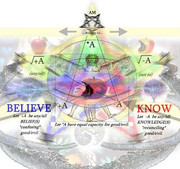
It takes a believer to believe evil is good (without the need to define them, which, if done so incorrectly, immediately collapses a being into A/B instead of C).
And I call everything that's in your head "beliefs".
i. It is your own belief, thus the belief problem is local to you
ii. My knowledge is not in my "head" - mind is not being, thus not knowledge
That is precisely what I said!
You draw a distinction - I don't.
*edit* I'm circling-back from the end to highlight 'the accuser is the accused' is actually your own projection/accusation throughout.
It's the other way around: I draw a distinction, you do not.
You call some of your beliefs 'knowledge' - I don't call any of your beliefs 'knowledge'.
I call all of your beliefs 'beliefs'.
This is all
your own belief. It is an impasse either way.
D sees a problem with A,B and C.
E sees a problem with A, B, C and D.
F sees a problem with A,B,C,D and E.
G sees a problem with A,B,C,D,E and F.
Ad infinitum.
It's the same as +A approaches -A. In either case, "sees a problem" is a form of (ac)knowledge(ment) that is distinct from mere belief: to acknowledge ones own belief may not be true. This is a valid knowledge: to know one knows not to any degree of certainty.
It is possible to know that if satan exists, satan would certainly require belief, and an all-knowing god (if one exists) must necessarily know that. If god and satan exist, and are antithetical, an all-knowing god would be the negation of belief/satan. Belief and idol worship are actually one-and-the-same, but it goes too deep for the idol worshipers.
You seem to believe very many things. What do you use all those beliefs for?
The properties (ie. "laws") of the cosmos map as "laws" that act on any/all social fabrics esp. science, language, ethics, logic/physics etc. To know the "laws" of the mundane matters of creation has application to all scales if the laws are, in fact, universally applicable.
Thus, once again, they are markedly distinct from "belief".
It "allows" for (nor "prohibits") nothing.
I am not using language prescriptively - you are.
You used a definite *is* - I respect language because it points back into the fabric of creation itself. If you are going to state the above, while omitting:
I am merely describing the fact that whether any particular thing is a "problem" or a "solution" is contingent on one's perspective.
This is the same as the Edenic warning - do not believe to know good/evil, otherwise it becomes a matter of perspective and there is no more universal ground. This has a practical application to Judaism/Christianity/Islam. The being becomes grounded in their own idolatrous beliefs, and they develop the "us vs. them" mentality which leads to suffering/death. The point being made is: entanglements of A/B nature are ignorant of C, which is to *not* eat from the tree of the knowledge of good and evil in
the first place, which requires
knowing the problem-in-and-of-itself. In this way, A and B are lacking something C definitely has: knowledge of the problem of
belief-in-and-of-itself.
When a problem believes itself to be a solution, you get things such as Islam. They militarily enforce their belief-based state killing "unbelievers" for not "believing" something that is not true, thus invariably violating the very law they themselves claim was/is inspired by their own god. The whole House is upside-down in perpetually believing evil-is-good. They do not even respect the Edenic state of 1x1=1 ad infinitum viz. 'honor mother and father', which is an equilateral triangle - a form of perfect fidelity. Islam is just about as far away as one can possibly get from such a 'state' for their own being based on an infidel model of a (dead) man.
You have a group of people belonging to an infidel 'state' calling other people infidels. I do not have to "believe" the text indicates that from Adam's own rib was derived one Eve - it would take a believer to believe themselves entitled to more than one woman.
Whether you approve or disapprove of any particular perspective is but a matter of opinion. I don't care about your opinion - and you shouldn't care about mine either.
I don't care about opinions or beliefs - I care about whatever is true / not true, and especially don't care for people who try to justify that such can not be known to a certainty. I know not to "believe" that.
According to C Genocide is genocide.
According to A it's a solution.
According to B it's a problem.
In this argument you aren't C. You are B.
In this example B is correct - C is stating the obvious.
One need not "believe" genocide is a problem - it would take a believer to believe it is not one.
I am not justifying anything. I am pointing out what happened.
You are the one who keeps ending up on the wrong side of the is-ought gap.
You can not derive an ought from an is.
You
can derive an
ought not from an is.
One can know genocide is a problem because it exists.
It isn't - because I explicitly stated that I will not signal virtue. It is not my intention, and it my best effort to make statements devoid of personal value-judgments. If you are reading any into it - be certain that you are projecting.
You are interpreting the absence of virtue-singling as absence of virtue. By another name it's a fallacy: absence of evidence is not evidence of absence.
You are reading into my meaning of 'it is invariably implicit'. Notwithstanding, such a fallacy can only exist if there is, in fact, an absence of evidence.
To the believer that is indeed the case - they are absolutely certain of their 'knowledge'.
It's another way of saying 'dogmatic'.
Hence, belief is the condition required for such a state: it re-enforces itself. It is a problem because people identify
as their own belief such that if/when the belief is undermined as being
false, they invariably take it personally and start whining and squealing. Truth can never succumb to this problem: what is true, is acknowledged and there is simply no attachment. Again: this relates to what real (real) idol worship is: people who identify by way of their own thought/belief patterns and systems. It is obvious to me that Muhammad suffered the same: he believed himself into a certainty that he was a messenger of god such that if/when faced with evidences he was certainly not one (by the Jews) he started cutting their heads off. This is Islam, and the root of the global conflict - the whiners and squealers incessantly whine and squeal over such ridicule of such a swine man, because that is their nature that proves itself true day after day after day: whining and squealing. It is the same pathology as the geopolitical Left because Islam has infected it with their divisiveness while blaming any/all others for the same (ie. accuser is the accused is always true in/of Islam).
Indeed - I am accusing you of doing exactly that.
You're accusing me of the crimes of Muhammad?
The pathology is your own as indicated above - it is your own accusation against me. Mine is against belief-based ideologies such as Judaism/Christianity/Islam who ignore the most basic precepts established by their own "god". That is hypocrisy - to kill unbelievers for not believing something that is not true.
You accuse me of genocide against "unbelievers"?
I have it in my nature to be a hypocrite (and I do not deny it) - it takes one to know one indeed.
Admitting to being a hypocrite does not in any way alleviate the burden of it.
What I deny is that I am being a hypocrite in this particular instance.
One who is themselves in denial would.
