It's a descriptor.Belinda wrote: ↑Sat Aug 26, 2017 10:57 am Reflex wrote:
No . I am saying that panentheism is a cop -out from the rigorous reason and humanity of pantheism.You are conflating pantheism and panentheism. Or, perhaps, advocating strong panentheism as opposed to weak panentheism. God, or the One, is ontologically distinct from the many. It is not a member of the set of many; it is that "in whom we live, move and have our being."
Panentheism
Re: Panentheism
Re: Panentheism
F4
I introduced Plotinus into the thread on Panenthisms since in order for Panentheism to serve as the logical basis for uniting science with the essence of religion, It must begin with a god concept that is not insulting to the mind of science. The ONE is such a concept
I introduced Plotinus into the thread on Panenthisms since in order for Panentheism to serve as the logical basis for uniting science with the essence of religion, It must begin with a god concept that is not insulting to the mind of science. The ONE is such a concept
Is the idea of a living universe necessary for the ONE to be both outside of and within the unierse opposed to science which measures the results of laws? Is the concept of the emanations of the ONE manifesting as creation existing as a process without beginning or end so offensive that science must deny it? No. Consequently if scientific proofs of the future verify through the deductive process connecting above and below that Creation requires a source for the process to be possible then those like Simone will be proven right raising new necessary questions concerning Man’s purpose for conscious evolution within the conscious universe.On the question of whether this is metaphysics, from the site that NIck recommended:
Plotinus is not a metaphysical thinker in the strict sense of the term. He is often referred to as a 'mystical' thinker, but even this designation fails to express the philosophical rigor of his thought. Jacques Derrida has remarked that the system of Plotinus represents the "closure of metaphysics" as well as the "transgression" of metaphysical thought itself (1973: p. 128 note). The cause for such a remark is that, in order to maintain the strict unity of his cosmology (which must be understood in the 'spiritual' or noetic sense, in addition to the traditional physical sense of 'cosmos') Plotinus emphasizes the displacement or deferral of presence, refusing to locate either the beginning (arkhe) or the end (telos) of existents at any determinate point in the 'chain of emanations' -- theOne, the Intelligence, and the Soul -- that is the expression of his cosmological theory; for to predicate presence of his highest principle would imply, for Plotinus, that this principle is but another being among beings, even if it is superior to all beings by virtue of its status as their 'begetter'. Plotinus demands that the highest principle or existent be supremely self-sufficient, disinterested, impassive, etc. However, this highest principle must still, somehow, have a part in the generation of the Cosmos. (http://www.iep.utm.edu/plotinus/)
I believe that one identical thought is to be found—expressed very precisely and with only slight differences of modality—in. . .Pythagoras, Plato, and the Greek Stoics. . .in the Upanishads, and the Bhagavad Gita; in the Chinese Taoist writings and. . .Buddhism. . .in the dogmas of the Christian faith and in the writings of the greatest Christian mystics. . .I believe that this thought is the truth, and that it today requires a modern and Western form of expression. That is to say, it should be expressed through the only approximately good thing we can call our own, namely science. This is all the less difficult because it is itself the origin of science. Simone Weil….Simone Pétrement, Simone Weil: A Life, Random House, 1976, p. 488
Re: Panentheism
I had to laugh at the panentheism is "cop -out" comment. It's a descriptor, but then, so is everything else.
Re: Panentheism
seeds wrote: Anyway, and not to speak for Nick, but it’s not so much that the God of Panentheism exists above and beyond time in the ultimate sense of the word, it’s just that his central consciousness (his “I Am-ness”) is not encapsulated in physical matter, and is thus not bound to the constraints of that which dictates time within the universe.
Nonsense.
However, even if it is anthropomorphic to attribute consciousness to God, so what?
Furthermore (and yes, to cherry-pick something from religious doctrine to support my argument), allegedly, humans are created in the image of God. In which case, some of our own features (such as consciousness) can thus be turned around and applied to God in certain limited ways.
The idea of God having “infinite” attributes is “old paradigm” thinking that needs to be discarded.
God does not have infinite attributes; he has just the right amount of attributes that allowed him to create our universe which, in turn, has allowed him to replicate himself through us.
in other words, through us, God has “conceived” his own offspring “within” himself out of the living fabric of his own personal being - as is depicted in the illustration I uploaded earlier:
How much more “NATURAL” can Panentheism and the truth of our existence be than in the idea that as we stand on the earth and look out into the universe, we are viewing God from a “fetal” perspective?
I suggest that mind (life/consciousness) and the infinitely malleable substance through-which life expresses itself (matter), is basically all there is to existence.
What do you mean by Berkeley’s scepticism?
In my opinion, mind and matter (like the “particle/wave” duality) are two complementary aspects of the same fundamental (Spinozan-like) “oneness” substance, beyond which there is only nothingness.
_______
Re: Panentheism
Reflex wrote:
Being itself is a concept not something that exists.
If God is ontologically distinct from the many, then God may be said to be a different substance from the many. That's the ontological basis of theism.God, or the One, is ontologically distinct from the many. It is not a member of the set of many; it is that "in whom we live, move and have our being."
Being itself is a concept not something that exists.
Re: Panentheism
What makes you think any of this is true? Do you have any evidence for it?seeds wrote: ↑Sat Aug 26, 2017 7:48 pm The idea of God having “infinite” attributes is “old paradigm” thinking that needs to be discarded.
God does not have infinite attributes; he has just the right amount of attributes that allowed him to create our universe which, in turn, has allowed him to replicate himself through us.
in other words, through us, God has “conceived” his own offspring “within” himself out of the living fabric of his own personal being - as is depicted in the illustration I uploaded earlier:
How much more “NATURAL” can Panentheism and the truth of our existence be than in the idea that as we stand on the earth and look out into the universe, we are viewing God from a “fetal” perspective?
Re: Panentheism
Nick:
Weil:
I will leave aside the question of whether it is or is not insulting to “the mind of science”, but it seems to me that if you are going to introduce the concept of the One and relate it to science then you cannot ignore what he says about matter and how this relates on the one hand to creation and on the other to the scientific concept of matter. Otherwise it is just name dropping.I introduced Plotinus into the thread on Panenthisms since in order for Panentheism to serve as the logical basis for uniting science with the essence of religion, It must begin with a god concept that is not insulting to the mind of science. The ONE is such a concept
Science does not impose the notion of a God on the universe. The notion of a living universe is problematic. Science does much more that measure the result of laws.Is the idea of a living universe necessary for the ONE to be both outside of and within the unierse opposed to science which measures the results of laws?
The concept of creation is foreign to Plotinus’ concept of the One. The One according to Plotinus does not create matter. Matter is the passive substratum or ground of existence. It is not that it is offensive to science. Science does not deny it, it simply does not affirm it because there is no evidence either physical or theoretical for it.Is the concept of the emanations of the ONE manifesting as creation existing as a process without beginning or end so offensive that science must deny it?
Scientific proofs are not deductive proofs based on valid argument. Valid arguments tell us nothing about the world. If it can be shown scientifically that there was a creation and that creation requires a source then science will eventually accept it and most human beings will accept what follows from it. as was the case with the Copernican revolution and evolution. Only this time religious individuals might not be so resistant. But this is arbitrary and really means nothing since there is nothing to indicate that this will happen and nothing that in principle distinguishes it from whatever anyone might imagine however unlikely if it is proven to be right.Consequently if scientific proofs of the future verify through the deductive process connecting above and below that Creation requires a source for the process to be possible then those like Simone will be proven right raising new necessary questions concerning Man’s purpose for conscious evolution within the conscious universe.
Weil:
There are many careful scholars who do not ignore differences in order to make everything seem to be the same. Many see a significant difference between Jesus’ Judaism, Paul’s Christianity, and John’s Christianity. Here we are discussing such differences as between pantheism and panentheism. You introduced Plotinus' concept of God because it “serves as a plausible premise for the relationship of God to the universe”. Wouldn’t this be true of all concepts of God? If it is all the same then why not the God of Genesis? It cannot even be agreed whether the God of Genesis created ex nihilo or simply brought order to chaos. The later is in this sense closer to Plotinus then the God who creates ex nihilo, but the God of Genesis is not, one in three and existence is not a process taking place in God. Why not the God of Daoism? Is it because there is in Daoism no omnipotent being beyond the cosmos, who created and controls the universe? But of course some Christian deny that God is a being or that he created or controls the universe, while others strongly deny that a God who is not the supreme being is their God.I believe that one identical thought is to be found—expressed very precisely and with only slight differences of modality—in. . .Pythagoras, Plato, and the Greek Stoics. . .in the Upanishads, and the Bhagavad Gita; in the Chinese Taoist writings and. . .Buddhism. . .in the dogmas of the Christian faith and in the writings of the greatest Christian mystics. . .

Re: Panentheism
seeds wrote: ↑Sat Aug 26, 2017 7:48 pm The idea of God having “infinite” attributes is “old paradigm” thinking that needs to be discarded.
God does not have infinite attributes; he has just the right amount of attributes that allowed him to create our universe which, in turn, has allowed him to replicate himself through us.
in other words, through us, God has “conceived” his own offspring “within” himself out of the living fabric of his own personal being - as is depicted in the illustration I uploaded earlier:
How much more “NATURAL” can Panentheism and the truth of our existence be than in the idea that as we stand on the earth and look out into the universe, we are viewing God from a “fetal” perspective?
I experienced a profound spiritual epiphany in the summer of 1970, something of which I am not prepared to talk about in this forum.
However, everything I have written in the decades since that moment (which includes hours of video presentations for public access television, along with two self-published books), has been based on that epiphany.
Furthermore (and to answer your second question), part of the understanding that came with the epiphany is that humans can never be allowed to have irrefutable “evidence” for the claims I am making.
To understand why that is so, read this post here: viewtopic.php?f=11&t=3561&start=1845#p297277
The things to keep in mind about this unique version of Panentheism is:
One – It is extremely “natural” in that it suggests that the Creator of this universe is literally “pregnant” with us, and that we await a second and final “birth” into a higher context of existence where only the highest lifeforms in all of reality reside...
...lifeforms that can replicate themselves by conceiving their offspring “within” themselves (thus affirming the old Hermetic adage - “as above, so below”).
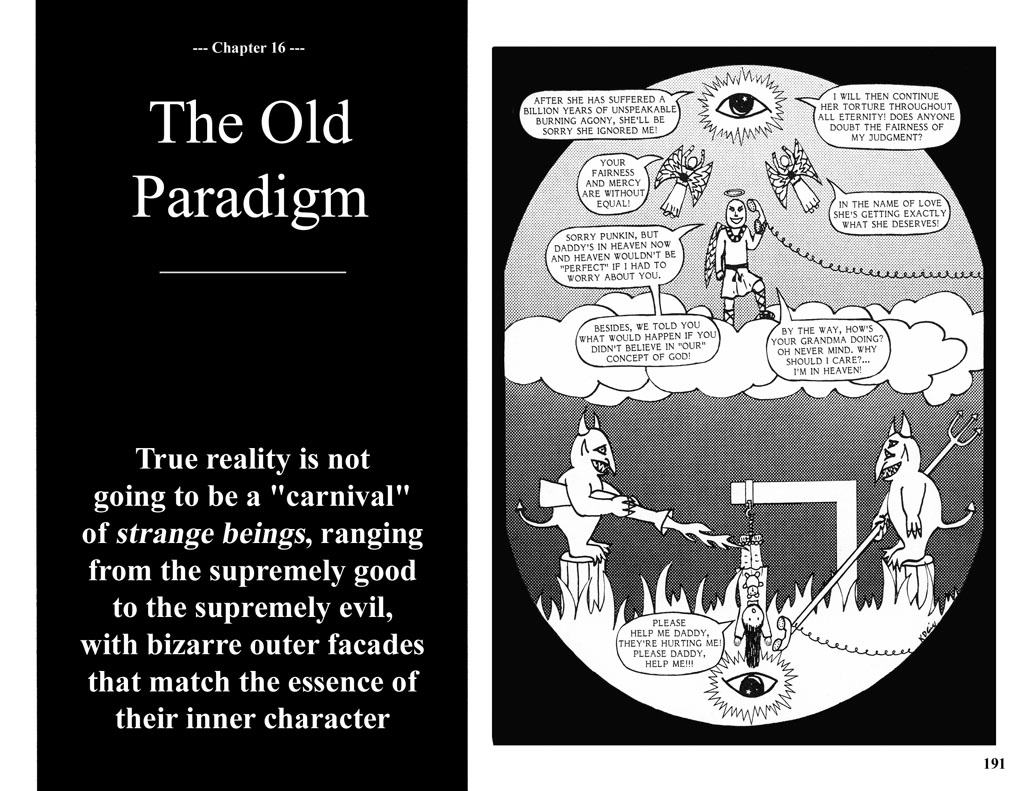
Two – As per item one, in what I call “true reality,” there are no strange and bizarre subdivisions of life, such as angels, or demons, or Satan, or hell, or any other such “old paradigm” nonsense as depicted below:
(For a clearer view of the dialogue, click the following link and expand the image - http://www.theultimateseeds.com/Images/ ... 20hell.jpg)
Three – We will all share the exact same eternal destiny together, regardless of the divergent and contrary assertions of any religion, creed, or ideology.
Four – Everything pertaining to astronomy, physics, biology, chemistry, evolution, etc., etc., still holds true in precisely the way material science is slowly determining it to be, with the one exception that none of it has come into existence by “accident.”
As I have suggested several times before in alternate threads and forums:
In other words, we need a new “mythology” - one that can exist in harmony with our advanced understanding of the universe.seeds wrote: I have often portrayed the ascension of modern science (i.e., quantum physics, astrophysics, etc.) in the metaphorical terms of being like a frantically flapping butterfly wing that is in desperate need of the symmetry of its other wing (spirituality), which is still stuck in the chrysalis of archaic beliefs.
Now I’m pretty sure I know what the atheists are probably thinking:
They are thinking - why replace the old mythology? Why not just be done with any form of religious and supernatural thought altogether?
Well firstly, such a myopic vision of the universe suggests that they are sleep-walking through life, and that the “illusion” of objective reality has them completely under its thrall.
And secondly, for anyone to expect billions of humans to summarily relinquish the “hope” that there may be more to life than the few fleeting moments we spend on earth, is absurd and will never happen.
_______
Re: Panentheism
F4
First things first. If the idea of the ONE is unacceptable, then so is its relationship to matter. The question remains is if the ONE in any way contradicts science.I will leave aside the question of whether it is or is not insulting to “the mind of science”, but it seems to me that if you are going to introduce the concept of the One and relate it to science then you cannot ignore what he says about matter and how this relates on the one hand to creation and on the other to the scientific concept of matter. Otherwise it is just name dropping.
Science relies on discursive reasoning but the ONE is known through contemplation revealing what is already known. Can more people science be brought to to the point of accepting its limitations like Basarab Nicolescu? If so, that is the beginning for appreciating what spirit in matter means, the Law of Vibration, why all matter vibrates, and how it explains human involution and conscious evolution.a. The One
The 'concept' of the One is not, properly speaking, a concept at all, since it is never explicitly defined by Plotinus, yet it is nevertheless the foundation and grandest expression of his philosophy. Plotinus does make it clear that no words can do justice to the power of the One; even the name, 'the One,' is inadequate, for naming already implies discursive knowledge, and since discursive knowledge divides or separates its objects in order to make them intelligible, the One cannot be known through the process of discursive reasoning (Ennead VI.9.4). Knowledge of the One is achieved through the experience of its 'power' (dunamis) and its nature, which is to provide a 'foundation' (arkhe) and location (topos) for all existents (VI.9.6). The 'power' of the One is not a power in the sense of physical or even mental action; the power of the One, as Plotinus speaks of it, is to be understood as the only adequate description of the 'manifestation' of a supreme principle that, by its very nature, transcends all predication and discursive understanding. This 'power,' then, is capable of being experienced, or known, only through contemplation (theoria), or the purely intellectual 'vision' of the source of all things. The One transcends all beings, and is not itself a being, precisely because all beings owe their existence and subsistence to their eternal contemplation of the dynamic manifestation(s) of the One. The One can be said to be the 'source' of all existents only insofar as every existent naturally and (therefore) imperfectly contemplates the various aspects of the One, as they are extended throughout the cosmos, in the form of either sensible or intelligible objects or existents. The perfect contemplation of the One, however, must not be understood as a return to a primal source; for the One is not, strictly speaking, a source or a cause, but rather the eternally present possibility -- or active making-possible -- of all existence, of Being (V.2.1). According to Plotinus, the unmediated vision of the 'generative power' of the One, to which existents are led by the Intelligence (V.9.2), results in an ecstatic dance of inspiration, not in a satiated torpor (VI.9.; for it is the nature of the One to impart fecundity to existents -- that is to say: the One, in its regal, indifferent capacity as undiminishable potentiality of Being, permits both rapt contemplation and ecstatic, creative extension. These twin poles, this 'stanchion,' is the manifested framework of existence which the One produces, effortlessly (V.1.6). The One, itself, is best understood as the center about which the 'stanchion,' the framework of the cosmos, is erected (VI.9.
The scientific method is basic inductive reason. Contemplation leads to deductive reason verifying what was experienced during the deeper states of conscious contemplation. When they compliment each other it produces “understanding.”Scientific proofs are not deductive proofs based on valid argument. Valid arguments tell us nothing about the world. If it can be shown scientifically that there was a creation and that creation requires a source then science will eventually accept it and most human beings will accept what follows from it. as was the case with the Copernican revolution and evolution. Only this time religious individuals might not be so resistant. But this is arbitrary and really means nothing since there is nothing to indicate that this will happen and nothing that in principle distinguishes it from whatever anyone might imagine however unlikely if it is proven to be right.
But this is the idea. The ONE doesn’t create. The ONE IS. Creation begins with Nous. Unless people agree on this conception, there cannot be a structure for universal existence within Isness. Without this structure there is nothing for science to contemplate; nothing for the scientific method to fit within – nothing to “remember.” We are left with the usual arguments and circular reasoning.There are many careful scholars who do not ignore differences in order to make everything seem to be the same. Many see a significant difference between Jesus’ Judaism, Paul’s Christianity, and John’s Christianity. Here we are discussing such differences as between pantheism and panentheism. You introduced Plotinus' concept of God because it “serves as a plausible premise for the relationship of God to the universe”. Wouldn’t this be true of all concepts of God? If it is all the same then why not the God of Genesis? It cannot even be agreed whether the God of Genesis created ex nihilo or simply brought order to chaos. The later is in this sense closer to Plotinus then the God who creates ex nihilo, but the God of Genesis is not, one in three and existence is not a process taking place in God. Why not the God of Daoism? Is it because there is in Daoism no omnipotent being beyond the cosmos, who created and controls the universe? But of course some Christian deny that God is a being or that he created or controls the universe, while others strongly deny that a God who is not the supreme being is their God.
Re: Panentheism
But our "advanced understanding" of the universe incorporates nothing of what you have written -- quite the opposite.
Here I agree. Humans will always concoct fantasies like yours to avoid facing the hard reality of our cosmic insignificance and our fleeting mortality.And secondly, for anyone to expect billions of humans to summarily relinquish the “hope” that there may be more to life than the few fleeting moments we spend on earth, is absurd and will never happen.
-
Arising_uk

- Posts: 12255
- Joined: Wed Oct 17, 2007 2:31 am
Re: Panentheism
You think this would be the case if their lives were not in the main lived in poverty and misery with no end in sight?seeds wrote:...
And secondly, for anyone to expect billions of humans to summarily relinquish the “hope” that there may be more to life than the few fleeting moments we spend on earth, is absurd and will never happen.
If they had access to healthcare, education and economic opportunity?
As such things seem to have led to a decline in such beliefs where they have occurred.
Re: Panentheism
Seeds
http://www.esotericonline.net/profiles/ ... n-of-being
Do you believe in the Great Chain of Being? If so, where does it begin and end? Without getting into details do you sense any truth in this ancient idea?Two – As per item one, in what I call “true reality,” there are no strange and bizarre subdivisions of life, such as angels, or demons, or Satan, or hell, or any other such “old paradigm” nonsense as depicted below:
http://www.esotericonline.net/profiles/ ... n-of-being
The great chain of being (Latin: scala naturae, literally "ladder/stair-way of nature"), is a concept derived from Plato, Aristotle, and Proclus. It details a strict, religious hierarchical structure of all matter and life, believed to have been decreed by God. The chain starts from God and progresses downward to angels, demons (fallen/renegade angels), stars, moon, kings, princes, nobles, men, wild animals, domesticated animals, trees, other plants, precious stones, precious metals, and other minerals………………………….

Re: Panentheism
I'm posting this for reference sake. It is only useful for those with a sincere interest. It does indicate that there is a lot of speculation taking place of which we know nothing about. As Arising suggests we are more concerned with education, healthcare, economic opportunity etc. But for those seeking "understanding" as to what the universe is and what we are. there are those making efforts to do so. I am copying from the Final Conclusion
http://www.metanexus.net/essay/neurosci ... anentheism
http://www.metanexus.net/essay/neurosci ... anentheism
I find it exciting to know that there is this undercurrent of highly intelligent people who are providing inroads towards the eventual unification of facts and meaning - science and the essence of religion. I do believe that the Panentheistic conception of God will be an essential beginning.Neuroscientific research also suggests that the complex nested hierarchical subjective self correlates with a complex nested neural hierarchy. Hence, there is causation from the mental properties towards the physical as well as from the physical towards the mental faculties, giving rise to new and irreducible properties by way of a process of emergence.
The model of the emergent self thus implies that (1) there is only one closed emergent self, which includes both the brain and the mental processes, in which through the mutual causations of hierarchies new distinct mental and neural properties emerge. (2) The mental activity supervenes on the neural and corresponds to different correlating altered neural activity. This concerns both specific and complex pathways between the mental and the physical. (3) The mental properties are real in the same sense as the non-mental are, i.e. they follow the same temporal and special order.
The model of the emergent self in turn suggests a panentheistic model of the relationship between God (Ultimate Reality) and the world. This panentheistic model comprises the following: (1) there is only one closed universe comprising both the natural and Ultimate worlds forming a complex nested hierarchy in which parts are contained within wholes, which themselves become parts within greater wholes, etc. Again there are multiple causations of hierarchies by way of which new distinct mental and physical properties emerge. (2) Mental properties supervene on physical properties, which means that for every difference at the mental state level, there must be some corresponding difference of physical state, on which the difference of the mental state in some sense depends. (3) Ultimate Reality (God) is seen as the ultimate ground of all necessities and possibilities and is in the natural world but is not reducible to it; also note that mental states are real in the same sense as non-mental states are. (4) The world is God’s similitude but human beings, besides being God’s similitudes, are also God’s images; the world is the mediating authority where God and humans meet.
The present paper has not, of course, given any proof that God or Ultimate Reality exists, but at least it makes it harder to ignore or explain away the special feature of human beings in the way, for example, that evolutionary theorists attempt to do.