Bill Wiltrack wrote:.
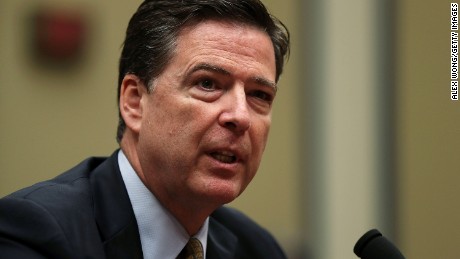
James Comey
From Wikipedia, the free encyclopedia
James Comey
James Brien Comey, Jr. (born December 14, 1960) is an American lawyer. He is the seventh and current Director of the Federal Bureau of Investigation.
He was the United States Deputy Attorney General, serving in President George W. Bush's administration. As Deputy Attorney General, Comey was the second-highest-ranking official in the United States Department of Justice (DOJ) and ran the day-to-day operations of the Department, serving in that office from December 2003 through August 2005. He was U.S. Attorney for the Southern District of New York prior to becoming Deputy Attorney General.
In December 2003, as Deputy Attorney General, Comey appointed the U.S. Attorney in Chicago, close friend and former colleague Patrick Fitzgerald, as Special Counsel to head the CIA leak grand jury investigation after Attorney General John Ashcroft recused himself. In August 2005, Comey left the DOJ and he became General Counsel and Senior Vice President of Lockheed Martin.
In 2010, he became General Counsel at Bridgewater Associates. In early 2013, he left Bridgewater to become Senior Research Scholar and Hertog Fellow on National Security Law at Columbia Law School.
He also joined the London-based board of directors of HSBC Holdings. In 2013, Comey was appointed as the director of the FBI by President Barack Obama.
.
So he has the gift of the gab then.
J. Edgar Hoover was born on New Year's Day 1895 in Washington, D.C., to Anna Marie (née Scheitlin; 1860–1938), who was of German Swiss descent, and Dickerson Naylor Hoover, Sr. (1856–1921), who was of English and German ancestry. Hoover's maternal great-uncle, John Hitz was a Swiss honorary consul general to the United States. [8] Hoover did not have a birth certificate filed upon his birth, although it was required in 1895 Washington. Two of his siblings had certificates, but Hoover's was not filed until 1938, when he was 43.[9]
Hoover grew up near the Eastern Market, in Washington's Capitol Hill neighborhood and attended Central High School, where he sang in the school choir, participated in the Reserve Officers' Training Corps program, and competed on the debate team,[10] where he argued against women getting the right to vote and against the abolition of the death penalty.[11] The school newspaper applauded his "cool, relentless logic".[12]
Hoover was a stutterer as a boy, which he overcame by teaching himself to talk fast—a style that he carried through his adult career. He eventually spoke with such ferocious speed that stenographers had a hard time following him.[13]
He obtained a Bachelor of Laws[14] from The George Washington University Law School in 1916, where he was a member of the Alpha Nu Chapter of the Kappa Alpha Order, and an LL.M., a Master of Laws degree, in 1917 from the same university.[15][16] While a law student, Hoover became interested in the career of Anthony Comstock, the New York City United States Postal Inspector, who waged prolonged campaigns against fraud, vice, pornography, and birth control. Hoover lived in Washington, D.C. for his entire life.[12]
Hoover was 18 years old when he accepted his first job, an entry-level position as messenger in the orders department, at the Library of Congress. The library was a half mile from his house. The experience shaped both Hoover and the creation of the FBI profiles; as Hoover noted in a 1951 letter, "This job […] trained me in the value of collating material. It gave me an excellent foundation for my work in the FBI where it has been necessary to collate information and evidence."[17]
Department of Justice[edit]
Hoover in 1932
Immediately after getting his LL.M degree, Hoover was hired by the Justice Department to work in the War Emergency Division. He soon became the head of the Division's Alien Enemy Bureau, authorized by President Wilson at the beginning of World War I to arrest and jail disloyal foreigners without trial.[12] He received additional authority from the 1917 Espionage Act. Out of a list of 1,400 suspicious Germans living in the U.S., the Bureau arrested 98 and designated 1,172 as arrestable.[18]
In August 1919, Hoover became head of the Bureau of Investigation's new General Intelligence Division—also known as the Radical Division because its goal was to monitor and disrupt the work of domestic radicals.[18] America's First Red Scare was beginning, and one of Hoover's first assignments was to carry out the Palmer Raids.[19]
Hoover and his chosen assistant, George Ruch[20] monitored a variety of U.S. radicals with the intent to punish, arrest, or deport those whose politics they decided were dangerous. Targets during this period included Marcus Garvey;[21] Rose Pastor Stokes and Cyril Briggs;[22] Emma Goldman and Alexander Berkman;[23] and future Supreme Court justice Felix Frankfurter who, Hoover maintained, was "the most dangerous man in the United States".[24]
In 1921, Hoover rose in the Bureau of Investigation to deputy head and, in 1924, the Attorney General made him the acting director. On May 10, 1924, President Calvin Coolidge appointed Hoover as the sixth Director of the Bureau of Investigation, partly in response to allegations that the prior director, William J. Burns, was involved in the Teapot Dome scandal.[citation needed] When Hoover took over the Bureau of Investigation, it had approximately 650 employees, including 441 Special Agents.[citation needed]
Hoover was sometimes unpredictable in his leadership. He frequently fired FBI agents, singling out those he thought "looked stupid like truck drivers," or whom he considered "pinheads."[25][page needed] He also relocated agents who had displeased him to career-ending assignments and locations; Melvin Purvis was a prime example. Purvis was one of the most effective agents in capturing and breaking up 1930s gangs, and it is alleged that Hoover maneuvered him out of the FBI because Hoover was jealous of the substantial public recognition Purvis received.[26]
Hoover often hailed local law-enforcement officers around the country, and built up a national network of supporters and admirers in the process. One whom he often commended for particular effectiveness was the conservative sheriff of Caddo Parish, Louisiana, J. Howell Flournoy.[27]
Apparently Hoover had a 'no blacks, no women, no jews, and no unattractive people' policy. One of the first female recruits ended up in a mental asylum, saying she was going to kill Hoover when she got out.