uwot wrote:JSS wrote:I don't see how SR changes anything Leo has said (which all appears to be correct). SR is actually a limited truth. It is provably not ontologically valid (especially considering spinning disks).
I'm not sure what you think ontology has to do with it, as time dilation is not a 'thing', nor is time in my opinion. From an epistemic view, time dilation due to velocity has been confirmed by every experiment from Hafele-Keating onwards, but tell me about these spinning discs.
Time is a measure of relative change. Distance is a measure of amount of changes. Both are measures. Both are ontological elements. Distance becomes "space". And time becomes "duration".
SR proposes not only that time dilates, but also that distance contracts.
If you try to apply SR to the rim of a disk spinning at near light speed and look at the radius, you get absurd results. The circumference ends up being shorter than the radius = Ontontologically broken. Perhaps think of the extreme asymptote wherein the time dilation of the traveler around the disk has become 1 (100% = zero time). The distance measured around any disk would also be zero regardless of the radius.
uwot wrote:JSS wrote:Because all movement slows and time is just a measure of RELATIVE change/movement, all clocks that measure time also slow in denser mass fields.
How then do you explain the 'Twins paradox'?
GR has nothing to do with SR. The twins paradox has nothing to do with GR (other than to add confusion). The acceleration element in the paradox is the substitute for gravity, but is actually irrelevant to the issue. The issue is resolved merely by who accelerated more from the origin.
In the paradox, it is presumed that neither party knows which is actually moving. But in any real system, one of them accelerated, if not both. The one who accelerated more, in total, is the one who will have had the slower clock. Thus the ship that left Earth and returned, being the one what accelerated more, will be the one that did not age as much.
And you really don't need mystical theories for that, despite what it might seem like. Time dilation is a relatively simple issue, although I believe in the following improvement in time dilation equations.


The confusion was that Einstein and cohorts, presumed (and proclaimed) that one could not by any means know who is the reference, "it is ALL relative". And that was a fantastic thought to promote very anti-God, anti-moral, anti-religion notions, thus it was promoted very quickly. The problem is that he, and they, were actually wrong. It is not ALL relative. It is only partially relative.
uwot wrote:JSS wrote:The universe is certainly "made of something", but there was no Big Bang. The universe was never smaller.
Then what of red shift?
That is a bit of a longer story, but basically the "red-shift" presumed was actually a "blue shifting" unseen.
Everyone is aware of the prism effect separating the color spectrum. Empty space is not empty and has affect upon light passing through it. The light actually shifts; right, left, up, down, and all back around and around as it squirms through "empty" space (filled with affectance causing this). And with each tiny shift of the light, the blue gets shifted slightly more than the red. Through 1000 light years of travel, much of the blue has actually been shifted out of line entirely and dispersed into adjacent light such as to blend into the background. Only the red light remains visible as cogent photons.
The formerly presumed "empty space", if you could actually see ultra-minuscule EMR pulses ("Affectance") would look something like this:
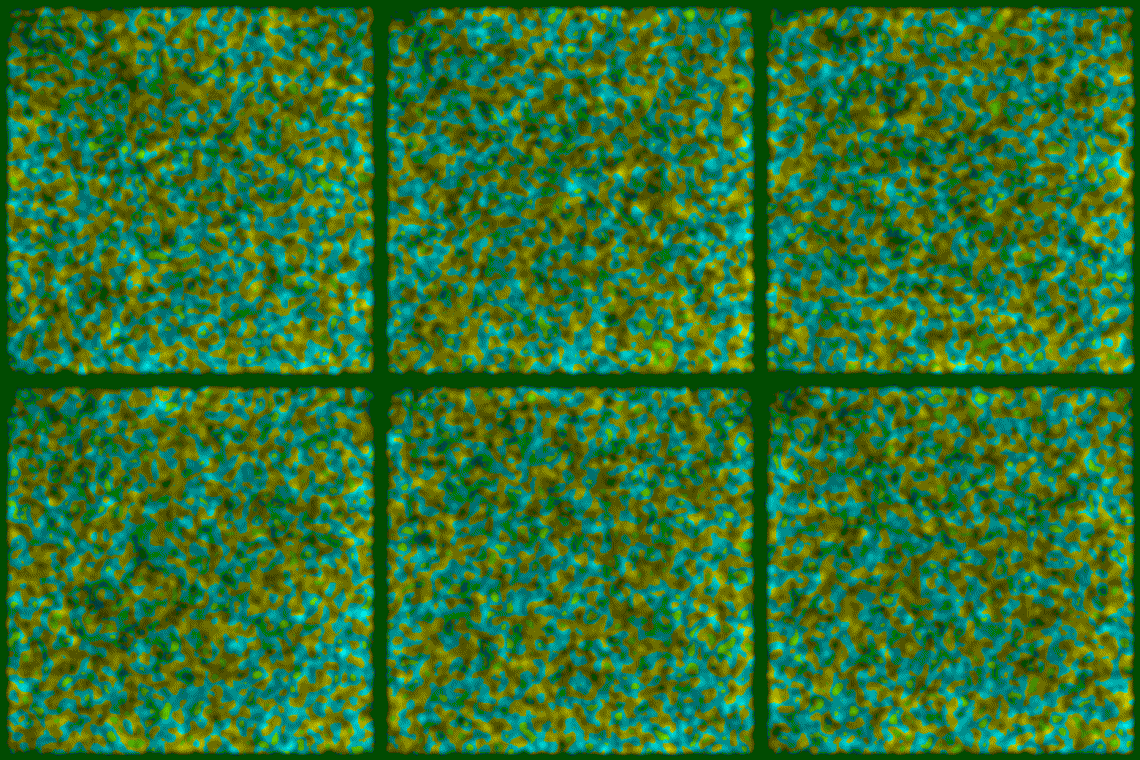
As light propagates through that, the red and blue spectrums gradually drift apart.
The presumption that a moving source, the Doppler effect, was the ONLY potential cause for red-shifting was their error. But by the time someone explained it to them, they had already promoted the religious preference that the universe had a beginning and the red-shift was proof. They did the same (and still do) with the "Second Law of Thermo-dynamics", which was proven wrong more than 130 years ago by James Maxwell and probably empirically 20 times since. Today, Science is merely a mask for a new dogmatic religion and although a little, not all that much different from how the other religions got going.