uwot wrote:JSS wrote:Well a photon cannot experience, period.
You don't say. How about 'be subject to'?
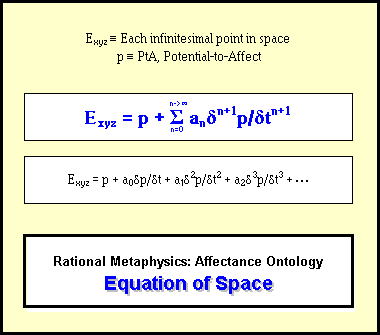
JSS wrote:A photon is a "puff" of ultra-minuscule EMR, "affectance".
Force carrying virtual particle? Causal agent? Blob of energy? The Holy Ghost? Leibniz used a term that is usually translated as appetition. I quite like the term, but how is affectance different from any or all of the above?
Affectance is provable/undeniable. It has independent meaning, not an arbitrary word or a theorized substance.
uwot wrote:Which to my mind suggests that a phenomenon that is indistinguishable from refraction, is in fact refraction.
True, that is what causes refraction, although when dealing with materials, photons are larger than the bits of mass within so the dynamic is a little different, yet still the same basic thing - slowing one side of the little puff more than the other side, causing a bend in propagation. What causes it to stay a little puff and not dissipate is a more complicated version of the same principle. A photon is mildly anentropic.
In the following an "afflate" merely means an "affectance oblate", a roughly spherical portion of affectance, much like a light photon, but of no particular size.
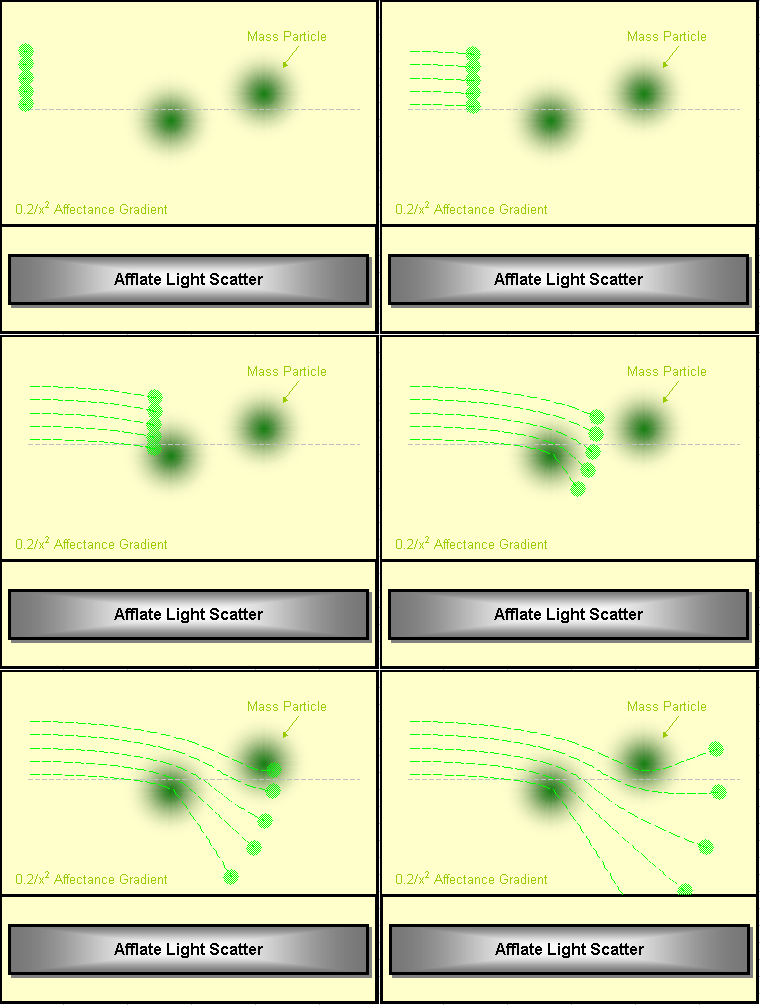
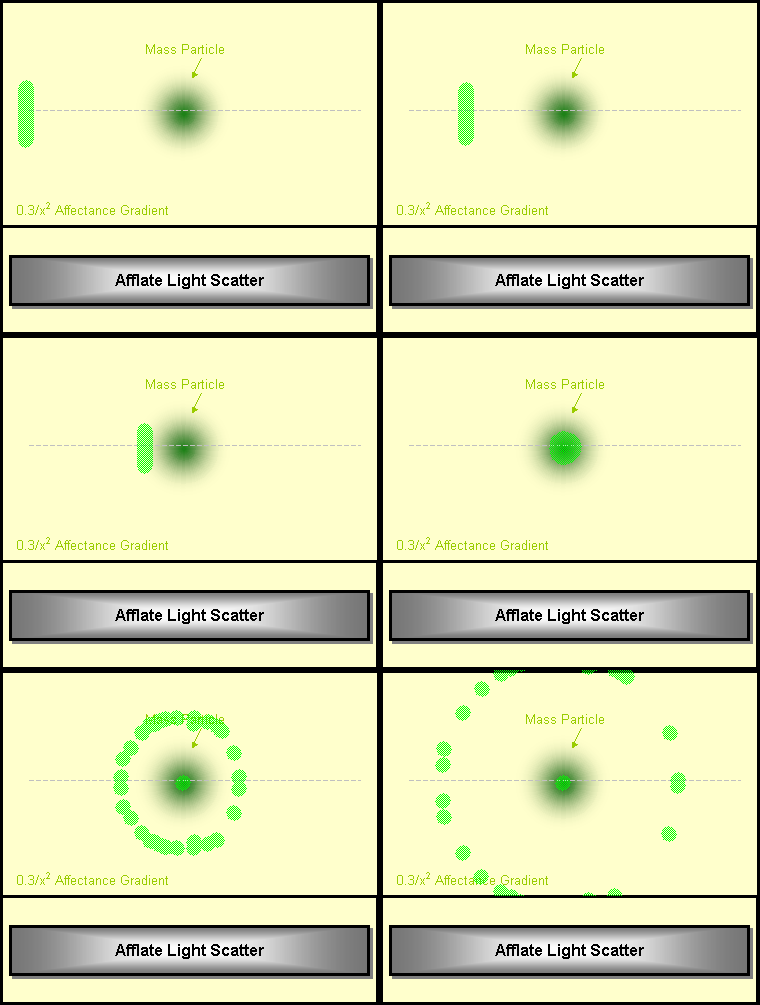
uwot wrote: matter is composed of bits of affectance (if you would go so far) tumbling over each other, they are refracted as they pass one way through a field, and again as they pass the opposite way and any other component velocity which perpendicular to the source of the field. The net result being a small force towards that source.
Affectance comes in portions. The word "bits" gets taken as being particulate. Affectance is not formed of particulates of any kind. It forms the particulates/particles.
And you are exactly right, as sufficient portions of affectance (or photons) come together, they cause even more to spiral in to cause a particulate of noise that has inertia, a "mass particle". That particle is merely a traffic jam of affectance that is spread a little thinner the further away from the center of the traffic jam, very much the same as automobile traffic jams or a crowd of people at the train station, coming and going, yet leaving the jam behind. The noisy clump has inertia due to the increased amount of changing-of-potential going on. Something that is already changing as fast as anything can change, can't be changed any further, thus is frozen in place. There is more to that story.
The following, although poorly made, is from an actual metaspace emulation. Those tiny portions of affectance floating around (roughly from 40,000 to 100,000 of them in a 3D metaspace) independently begin gathering at the center due to the aggregation causing that spiraling into a more and more dense concentration until a maximum density is reached.

uwot wrote:
So, your gif tells us that magnetic potential increases in the presence of mass. Should we draw anything from that?
I don't know of anything particularly significant to use that information for at the moment. The magnetic field increases as the pulse
enters the mass/gravity field. If there is no change in affectance density/mass field density, the magnetic field doesn't change either.
The clump of noise or "traffic jam" known as a subatomic (mono)particle eventually forms a cloud of affectance noise surrounding the particle, known as a mass or gravity field with the following density distribution (which is slightly dependent upon the ambient density as shown):
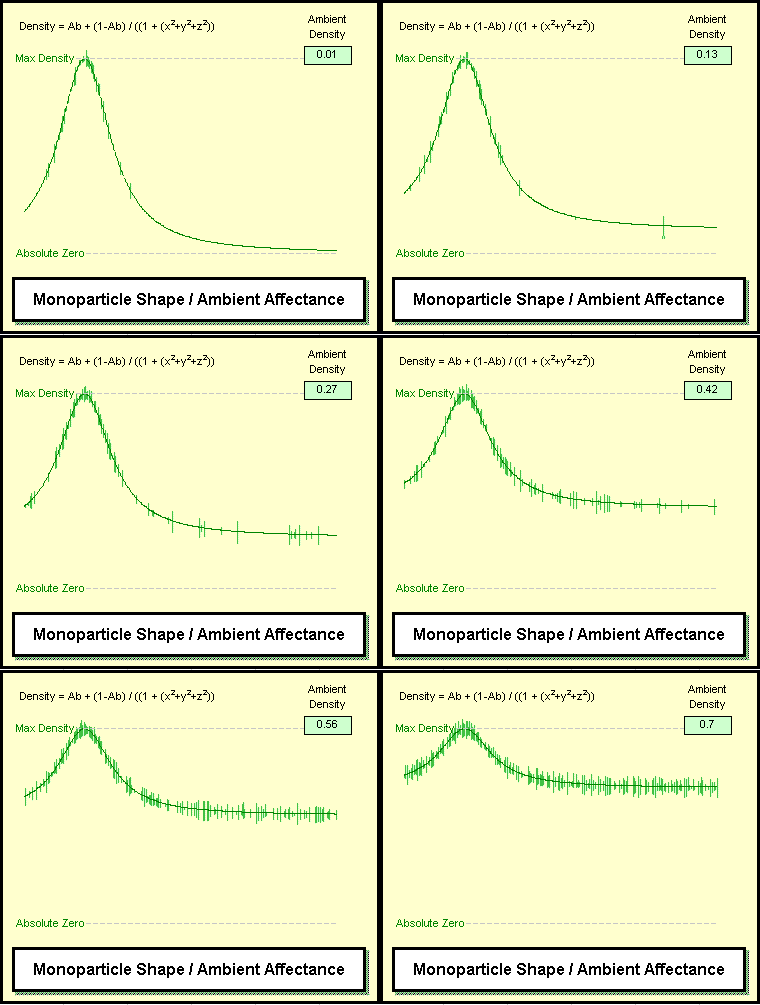
The significance of that thought is that subatomic particles do not actually maintain the exact same size as they change from a strong gravity field to a weaker one. The subatomic particles of a space shuttle leaving Earth actually reduce in diameter and in mass. Fortunately the atomic structure remains relatively the same. If that shuttle were to fall into a black hole, the subatomic particles would grow huge and the atomic structure would not be able to be maintained. The atoms would become much smaller and a nuclear explosion should be expected.