What accounts for the fact that some students are super-devoted and therefore wholesome and some are not?
-
Jaded Sage
- Posts: 1100
- Joined: Mon Aug 24, 2015 2:00 pm
Re: What accounts for the fact that some students are super-devoted and therefore wholesome and some are not?
This is the first time I've ever seen you not know what you're talking about.
-
Hobbes' Choice

- Posts: 8360
- Joined: Fri Oct 25, 2013 11:45 am
Re: What accounts for the fact that some students are super-devoted and therefore wholesome and some are not?
\Jaded Sage wrote:This is the first time I've ever seen you not know what you're talking about.
Seriously you need to read more carefully. As you have either misread what I said, or you simply do not have the mental capacity to understand.
So tell me what you think is wrong, or keep your insults to yourself.
`Because what you said was false.
-
Jaded Sage
- Posts: 1100
- Joined: Mon Aug 24, 2015 2:00 pm
Re: What accounts for the fact that some students are super-devoted and therefore wholesome and some are not?
It's been a long time since I've reviewed logic. Let's use the original so we don't get lost.
“If philosophy is synonymous with God,
(and some atheists love philosophy,)
then some atheists love God.”
We have to distinguish between whether we are discussing the general form or the particular example. I was talking about the former, but everyone else seems to be focusing on the latter.
When it is correctly applied, it is impossible for it to be incorrect. "If all men are mortal, and Socrates is a man, then Socrates is mortal." Supposing the first two are true, the third cannot fail to be true. There is no situation in which the first two could be true and the third could be untrue. "If all unmarried human males of age are bachelors, and Paul is an unmarried human male of age, then Paul is a bachelor." It is unavoidable. It is definite. That is the certainty I am talking about.
The part that is uncertain is the conditional part, the first part. In the first example, we haven't proven either way whether philosophy is synonymous with God. In fact, we are not making any statement about that at all. None. We are jumping ahead to make a statement about a possible future. We are saying of the first two parts, the two conditions: it is possible that is true, and if it is, then X will be the outcome (X being that some atheists love God): the outcome is all we are talking about. So all we are talking about is THE RELATIONSHIP BETWEEN THE FIRST TWO PARTS AND THE THIRD PART, between the two conditions (1: "if phil is God," 2: "and if some atheists love phil") and the certainty (3: "then some atheists love God"); NOT THE RELATIONSHIP BETWEEN THE FIRST TWO PARTS AND REALITY: we are discussing the implications of the conditions (the effect they will cause, should they be true), not the truth value of the conditions (whether or not they actually are true). That is where the certainty is.
The problem with the sunshine stroll example is that it leaves a few things unstated. When we make such a statement, we usually leave out as understood many things that would become second and third conditions. "If tomorrow the sun shines, and if I'm in the right mood, and if my legs continue to work, and if I don't slip on a banana peal and die, and if space aliens haven't invaded earth and enslaved the human race, and if I don't accidentally travel back in time to the moment of the Big Bang and spontaneously combust, then I will go for a walk." Most of these "and if" statements are understood and so go without saying. I think the reason is that the number of them would often approach infinity.
I just realized what you meant by "honesty." That's my mistake. That's actually similar to what I'm saying. You are discussing the trueness of the statement. We can assume the first condition, that the sun will shine, but then it is up to all those other conditions (mentioned above), and the meeting of all those conditions (like, "and if I'm in the right mood, and if I don't change my mind,") because they all seem within his power, you call "honesty." I am focussing on what happens when all the conditions are met, when we see that he is indeed an honest man. If tomorrow, as we expect, everything happens that would cause a walk to be both possible and enjoyable, and nothing happens that would cause him to opt out of the walk unexpectedly, then his walk is certain.
The only place to attack this legotimately is the first part: "If philosophy is God."
“If philosophy is synonymous with God,
(and some atheists love philosophy,)
then some atheists love God.”
We have to distinguish between whether we are discussing the general form or the particular example. I was talking about the former, but everyone else seems to be focusing on the latter.
When it is correctly applied, it is impossible for it to be incorrect. "If all men are mortal, and Socrates is a man, then Socrates is mortal." Supposing the first two are true, the third cannot fail to be true. There is no situation in which the first two could be true and the third could be untrue. "If all unmarried human males of age are bachelors, and Paul is an unmarried human male of age, then Paul is a bachelor." It is unavoidable. It is definite. That is the certainty I am talking about.
The part that is uncertain is the conditional part, the first part. In the first example, we haven't proven either way whether philosophy is synonymous with God. In fact, we are not making any statement about that at all. None. We are jumping ahead to make a statement about a possible future. We are saying of the first two parts, the two conditions: it is possible that is true, and if it is, then X will be the outcome (X being that some atheists love God): the outcome is all we are talking about. So all we are talking about is THE RELATIONSHIP BETWEEN THE FIRST TWO PARTS AND THE THIRD PART, between the two conditions (1: "if phil is God," 2: "and if some atheists love phil") and the certainty (3: "then some atheists love God"); NOT THE RELATIONSHIP BETWEEN THE FIRST TWO PARTS AND REALITY: we are discussing the implications of the conditions (the effect they will cause, should they be true), not the truth value of the conditions (whether or not they actually are true). That is where the certainty is.
The problem with the sunshine stroll example is that it leaves a few things unstated. When we make such a statement, we usually leave out as understood many things that would become second and third conditions. "If tomorrow the sun shines, and if I'm in the right mood, and if my legs continue to work, and if I don't slip on a banana peal and die, and if space aliens haven't invaded earth and enslaved the human race, and if I don't accidentally travel back in time to the moment of the Big Bang and spontaneously combust, then I will go for a walk." Most of these "and if" statements are understood and so go without saying. I think the reason is that the number of them would often approach infinity.
I just realized what you meant by "honesty." That's my mistake. That's actually similar to what I'm saying. You are discussing the trueness of the statement. We can assume the first condition, that the sun will shine, but then it is up to all those other conditions (mentioned above), and the meeting of all those conditions (like, "and if I'm in the right mood, and if I don't change my mind,") because they all seem within his power, you call "honesty." I am focussing on what happens when all the conditions are met, when we see that he is indeed an honest man. If tomorrow, as we expect, everything happens that would cause a walk to be both possible and enjoyable, and nothing happens that would cause him to opt out of the walk unexpectedly, then his walk is certain.
The only place to attack this legotimately is the first part: "If philosophy is God."
Last edited by Jaded Sage on Thu Jan 14, 2016 8:59 pm, edited 3 times in total.
-
Hobbes' Choice
- Posts: 8360
- Joined: Fri Oct 25, 2013 11:45 am
Re: What accounts for the fact that some students are super-devoted and therefore wholesome and some are not?
Do you realise that a deductive syllogism renders NO information?
The conclusion is contained in the premises, and the truth of the conclusion relies on the accuracy of the premises.
Thus, we already know that Socrates is mortal because he is a man, but only because it is understood that men are mortal.
If your premise is that philosophy is god; it is not the same as saying that god is philosophy. The former is defining Philosophy as the highest thing, the later is suggesting that god's greatness is based on philosophy.
A statement such as Philosophy is God denies the existence of the commonly understood meaning of god.
So back to your last post.
NOW..
Back to the post you said I'd shown a lack of understanding to.
If the sun shines tomorrow (a condition) I will go for a walk.
How certain is this conditional certainty ? How certain is it that I will go for a walk ?
YOU SAID: If the equation is true then it is 100% certain that you will go for a walk if the sun shines tomorrow.
I replied: No it is not.
The "equation" suggests an intention, not a certainty, so it cannot be "right."
If the sun explodes or he falls out of bed and breaks his legs then what he is saying is not the case.
Not only is the premise conditional, but the intention is also conditional on his capability to fulfill the intention.
Another way to look at it is that the statement is 100% correct in the sense that it only really is a test of his honesty. In that case it does not matter if the sun does rise, or having risen he is forced against his intention and cannot walk. The honesty of the statement is true or false regardless of the outcome.
What, exactly do you think is wrong with my statement?
The conclusion is contained in the premises, and the truth of the conclusion relies on the accuracy of the premises.
Thus, we already know that Socrates is mortal because he is a man, but only because it is understood that men are mortal.
If your premise is that philosophy is god; it is not the same as saying that god is philosophy. The former is defining Philosophy as the highest thing, the later is suggesting that god's greatness is based on philosophy.
A statement such as Philosophy is God denies the existence of the commonly understood meaning of god.
So back to your last post.
Simply enough the premise is false in every way possible. Therefore atheists do not love god, even if they say philosophy is god, they still love philosophy.If philosophy is synonymous with God,
(and some atheists love philosophy,)
then some atheists love God
NOW..
Back to the post you said I'd shown a lack of understanding to.
If the sun shines tomorrow (a condition) I will go for a walk.
How certain is this conditional certainty ? How certain is it that I will go for a walk ?
YOU SAID: If the equation is true then it is 100% certain that you will go for a walk if the sun shines tomorrow.
I replied: No it is not.
The "equation" suggests an intention, not a certainty, so it cannot be "right."
If the sun explodes or he falls out of bed and breaks his legs then what he is saying is not the case.
Not only is the premise conditional, but the intention is also conditional on his capability to fulfill the intention.
Another way to look at it is that the statement is 100% correct in the sense that it only really is a test of his honesty. In that case it does not matter if the sun does rise, or having risen he is forced against his intention and cannot walk. The honesty of the statement is true or false regardless of the outcome.
What, exactly do you think is wrong with my statement?
-
Jaded Sage
- Posts: 1100
- Joined: Mon Aug 24, 2015 2:00 pm
Re: What accounts for the fact that some students are super-devoted and therefore wholesome and some are not?
Dude, I wrote that whole thing and it's like you didn't even read it. We are saying the same thing. Also, I think it is inductive.
In university, they teach that if the truth of one of the premises can be changed by observation, then it is induction. Here, we see that both conditions might be changed by observation. We could observe that phil is not God, or that somehow, it just so happens to be the case that, by nature, all atheists hate philosophy, for some reason.
Regardless, it doesn't matter whether deductive or inductive. What matters is whether phil is God, because the two parts after that are obvious: some atheists do indeed love philosophy, and if God actually is phil, then some atheists, namely the philosophical ones, do indeed love God.
When I say "is" I mean "equals." So both statements are expressed either way you word it (P = G or G = P).
Seeing as it is a synonym, it is fair to bring up that someone has defined "deity" as "the center and focus of worship." We have discussed the nature of "worship" on here a bit, and we have submitted that it is "adoration, devotion, reverence." It seems clear that, given these definitions, as some people might approach philosophy that way, and that, in fact, some actually have, it is fair to consider philosophy a potential deity.
The next step is to discuss whether participation in it qualifies as worship of it, whether or not we can practice the deity without regarding it as a deity. Indeed, let's say that is what causes some to developed wholesomeness and some not, and others to develop unwholesomeness.
They are talking about the statement as a whole. I am talking about the individual parts of the statement. The probability of the third part increases as the probability of the first two parts increases. We are assuming the first two parts, making them 100% certain, and therefore, the third part is %100 certain.wiki wrote:Inductive reasoning is reasoning in which the premises are viewed as supplying strong evidence for the truth of the conclusion. While the conclusion of a deductive argument is certain, the truth of the conclusion of an inductive argument is probable, based upon the evidence given.
The philosophical definition of inductive reasoning is more nuanced than simple progression from particular/individual instances to broader generalizations. Rather, the premises of an inductive logical argument indicate some degree of support (inductive probability) for the conclusion but do not entail it; that is, they suggest truth but do not ensure it. In this manner, there is the possibility of moving from general statements to individual instances.
In university, they teach that if the truth of one of the premises can be changed by observation, then it is induction. Here, we see that both conditions might be changed by observation. We could observe that phil is not God, or that somehow, it just so happens to be the case that, by nature, all atheists hate philosophy, for some reason.
Regardless, it doesn't matter whether deductive or inductive. What matters is whether phil is God, because the two parts after that are obvious: some atheists do indeed love philosophy, and if God actually is phil, then some atheists, namely the philosophical ones, do indeed love God.
When I say "is" I mean "equals." So both statements are expressed either way you word it (P = G or G = P).
Seeing as it is a synonym, it is fair to bring up that someone has defined "deity" as "the center and focus of worship." We have discussed the nature of "worship" on here a bit, and we have submitted that it is "adoration, devotion, reverence." It seems clear that, given these definitions, as some people might approach philosophy that way, and that, in fact, some actually have, it is fair to consider philosophy a potential deity.
The next step is to discuss whether participation in it qualifies as worship of it, whether or not we can practice the deity without regarding it as a deity. Indeed, let's say that is what causes some to developed wholesomeness and some not, and others to develop unwholesomeness.
-
Hobbes' Choice
- Posts: 8360
- Joined: Fri Oct 25, 2013 11:45 am
Re: What accounts for the fact that some students are super-devoted and therefore wholesome and some are not?
1) If that is the case then explain this insulting commentJaded Sage wrote:Dude, I wrote that whole thing and it's like you didn't even read it. We are saying the same thing. Also, I think it is inductive.
2) You need to be more clear. You say "Also I think it is inductive.". IT, IT? what is "it" that it is? If you were to say that was the exact thing yo mean, then I could say one way or the other. But seriously , I doubt you know what is meant by Induction, and since I was talking about DEDUCTION we can't be in agreement.Jaded Sage wrote:
This is the first time I've ever seen you not know what you're talking about.
3) You do not know what induction is.
They are talking about the statement as a whole. I am talking about the individual parts of the statement. The probability of the third part increases as the probability of the first two parts increases. We are assuming the first two parts, making them 100% certain, and therefore, the third part is %100 certain.
In university, they teach that if the truth of one of the premises can be changed by observation, then it is induction. Here, we see that both conditions might be changed by observation. We could observe that phil is not God, or that somehow, it just so happens to be the case that, by nature, all atheists hate philosophy, for some reason.
Regardless, it doesn't matter whether deductive or inductive. What matters is whether phil is God, because the two parts after that are obvious: some atheists do indeed love philosophy, and if God actually is phil, then some atheists, namely the philosophical ones, do indeed love God.
When I say "is" I mean "equals." So both statements are expressed either way you word it (P = G or G = P).
Seeing as it is a synonym, it is fair to bring up that someone has defined "deity" as "the center and focus of worship." We have discussed the nature of "worship" on here a bit, and we have submitted that it is "adoration, devotion, reverence." It seems clear that, given these definitions, as some people might approach philosophy that way, and that, in fact, some actually have, it is fair to consider philosophy a potential deity.
The next step is to discuss whether participation in it qualifies as worship of it, whether or not we can practice the deity without regarding it as a deity. Indeed, let's say that is what causes some to developed wholesomeness and some not, and others to develop unwholesomeness.
4) God is not philosophy; philosophy is not god. Philosophy is philosophy and god is god.
5) You seem to be time wasting.
-
Jaded Sage
- Posts: 1100
- Joined: Mon Aug 24, 2015 2:00 pm
Re: What accounts for the fact that some students are super-devoted and therefore wholesome and some are not?
If someone defies philosophy it becomes God (or a god).
-
Hobbes' Choice
- Posts: 8360
- Joined: Fri Oct 25, 2013 11:45 am
Re: What accounts for the fact that some students are super-devoted and therefore wholesome and some are not?
I may regret this...Jaded Sage wrote:If someone defies philosophy it becomes God (or a god).
Please explain your comment!
-
Jaded Sage
- Posts: 1100
- Joined: Mon Aug 24, 2015 2:00 pm
Re: What accounts for the fact that some students are super-devoted and therefore wholesome and some are not?
A deity is something worshiped. If you worship something it becomes a deity. This becoming is called deification.
Oh. I spelled the word wrong. lol
"Philosophy is not God. God is not philosophy.
God is God. Philosophy is philosophy."
2+2=4 | 4=2+2
4=4 | 2+2=2+2
Protip: a lover of learning will respond to something like this by trying to clarify and understand what is being said and why; a non-philosopher will try to obscure and argue otherwise.
Oh. I spelled the word wrong. lol
"Philosophy is not God. God is not philosophy.
God is God. Philosophy is philosophy."
2+2=4 | 4=2+2
4=4 | 2+2=2+2
Protip: a lover of learning will respond to something like this by trying to clarify and understand what is being said and why; a non-philosopher will try to obscure and argue otherwise.
-
Hobbes' Choice
- Posts: 8360
- Joined: Fri Oct 25, 2013 11:45 am
Re: What accounts for the fact that some students are super-devoted and therefore wholesome and some are not?
You are wrong.Jaded Sage wrote:A deity is something worshiped. If you worship something it becomes a deity. This becoming is called deification.
.
This is bonkers.
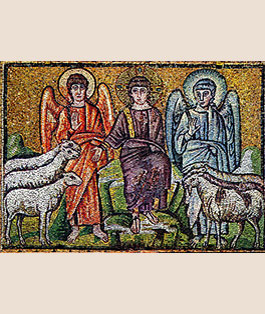
Here is something you might like. This is the first depiction of Satan in Western art. Long before the medieval re-invention of an image borrowed from some of the Pagan cults depicting Pan, the horny devil was unknown to early Christianity.
So here on the ceiling of the Basilica St, Apollinare Nuovo is that image. Central is Christ at judgement day dividing the sheep to the red angel, and goats to the blue angel Satan. This is far more in keeping with how Satan appears in Job, as a servant of God, an ally with a "job" to do (pun intended).
http://1.bp.blogspot.com/-kGYZcNKv-W0/T ... +devil.jpg
-
Jaded Sage
- Posts: 1100
- Joined: Mon Aug 24, 2015 2:00 pm
Re: What accounts for the fact that some students are super-devoted and therefore wholesome and some are not?
I'm glad we've eatablished that you don't belong here.