What started the Big Bang?

How does science work? And what's all this about quantum mechanics?

Moderators: AMod, iMod

User avatar
WanderingLands
Posts: 819
Joined: Wed Jan 08, 2014 3:39 am
Contact:

Re: What started the Big Bang?

Post by WanderingLands »

Ginkgo wrote: The Big Bang theory is not a first cause explanation, so it doesn't posit that particular axiom. Another way of looking at it would be to say that the Big Bang doesn't theorize where the 'something' came from. The Big Bang is not a universe from nothing theory. It is a universe from something theory.
The Big Bang theory is said to be the origin of the Universe, so how it would have to take itself up as a first cause considering that it's an explanation for the origin of existence (even though very flawed). Many scientists have contended that the Universe had came from nothing; it's taught especially in schools, and whole story is about how all of these inflations and fluctuations have came to somehow burst into a Universe.
Ginkgo wrote: I guess the main reason they changed the definition of "nothing" was to avoid the implications of purpose. In other words, they saw more progress in postulating a "how" explanation as opposed to a "why" explanation.
The definition of 'nothing' cannot be changed other than to simply mean no thing, or zero. Eschewing purpose is nihilistic and does not seem to capture the totality of the Universe, which is more than just the quantity of things or reducing it to a simple mathematical equation which science and physics seems to be reduced to.
uwot
Posts: 6092
Joined: Mon Jul 23, 2012 7:21 am

Re: What started the Big Bang?

Post by uwot »

WanderingLands wrote:The Big Bang theory is said to be the origin of the Universe.
The galactic red shift strongly suggests that the universe is expanding. If that is the case, by extrapolating backwards, there is no obvious point where you would stop and say 'The universe was originally so big and so developed.' Bertrand Russell made the point that there is no logical reason that rules out the universe being five minutes old and having started with all your memories and the holes in your socks. The Big Bang theory is basically the idea that the expansion started at a point where everything was as simple as conceivable, any alternative would require an explanation for the initial structure.
WanderingLands wrote:so how it would have to take itself up as a first cause considering that it's an explanation for the origin of existence (even though very flawed).
The galactic red-shift is an empirical fact; technically, the absorption lines for particular elements which can be verified on Earth are found towards the red end (longer wavelength) of the spectrum in galaxies beyond the local cluster. There are all sorts of theories about why this should be so, by far the most compelling is the Doppler effect due to recession. No serious scientist or philosopher would insist that any given interpretation of the empirical facts had to be the 'Truth'; that's what religious nuts and internet cranks do.
WanderingLands wrote:Many scientists have contended that the Universe had came from nothing; it's taught especially in schools,.
I seriously doubt you have any evidence for this claim. Can you name a single school in which ex nihilo is taught as fact anywhere on the planet?
WanderingLands wrote:and whole story is about how all of these inflations and fluctuations have came to somehow burst into a Universe.
As you say, it's a story, but it is coherent, consistent as long as it isn't contradicted by the empirical facts, it might be true. In that regard, it has no serious rivals.
User avatar
WanderingLands
Posts: 819
Joined: Wed Jan 08, 2014 3:39 am
Contact:

Re: What started the Big Bang?

Post by WanderingLands »

uwot wrote: The galactic red shift strongly suggests that the universe is expanding. If that is the case, by extrapolating backwards, there is no obvious point where you would stop and say 'The universe was originally so big and so developed.' Bertrand Russell made the point that there is no logical reason that rules out the universe being five minutes old and having started with all your memories and the holes in your socks. The Big Bang theory is basically the idea that the expansion started at a point where everything was as simple as conceivable, any alternative would require an explanation for the initial structure.

The galactic red-shift is an empirical fact; technically, the absorption lines for particular elements which can be verified on Earth are found towards the red end (longer wavelength) of the spectrum in galaxies beyond the local cluster. There are all sorts of theories about why this should be so, by far the most compelling is the Doppler effect due to recession. No serious scientist or philosopher would insist that any given interpretation of the empirical facts had to be the 'Truth'; that's what religious nuts and internet cranks do.
'Expansion' is different from a 'Big Bang', because expansion only connotes that something is only getting gradually larger while 'Big Bang' connotes a spontaneous explosion, so that would be a misnomer. Redshifts are not proofs of the Big Bang, as they are mostly unreliable and unrelated to distances. It's been shown by Halton Arp and others that the quasars with high redshift values are associated with galaxies and are close by them, which means that the redshifts aren't dopplers, and more conclusively, the Big Bang is not true.

There are actually pictures of varying distances of redshifts done by Halton Arp which you can view here:

http://electric-cosmos.org/arp.htm

And if you want more studies done on redshifts and disproving the Big Bang theory, you can click on an article called "Big Bang Bung":

http://ray.tomes.biz/bigbangbung.html
Philosophy Explorer
Posts: 5621
Joined: Sun Aug 31, 2014 7:39 am

Re: What started the Big Bang?

Post by Philosophy Explorer »

WanderingLands wrote:
uwot wrote: The galactic red shift strongly suggests that the universe is expanding. If that is the case, by extrapolating backwards, there is no obvious point where you would stop and say 'The universe was originally so big and so developed.' Bertrand Russell made the point that there is no logical reason that rules out the universe being five minutes old and having started with all your memories and the holes in your socks. The Big Bang theory is basically the idea that the expansion started at a point where everything was as simple as conceivable, any alternative would require an explanation for the initial structure.

The galactic red-shift is an empirical fact; technically, the absorption lines for particular elements which can be verified on Earth are found towards the red end (longer wavelength) of the spectrum in galaxies beyond the local cluster. There are all sorts of theories about why this should be so, by far the most compelling is the Doppler effect due to recession. No serious scientist or philosopher would insist that any given interpretation of the empirical facts had to be the 'Truth'; that's what religious nuts and internet cranks do.
'Expansion' is different from a 'Big Bang', because expansion only connotes that something is only getting gradually larger while 'Big Bang' connotes a spontaneous explosion, so that would be a misnomer. Redshifts are not proofs of the Big Bang, as they are mostly unreliable and unrelated to distances. It's been shown by Halton Arp and others that the quasars with high redshift values are associated with galaxies and are close by them, which means that the redshifts aren't dopplers, and more conclusively, the Big Bang is not true.

There are actually pictures of varying distances of redshifts done by Halton Arp which you can view here:

http://electric-cosmos.org/arp.htm

And if you want more studies done on redshifts and disproving the Big Bang theory, you can click on an article called "Big Bang Bung":

http://ray.tomes.biz/bigbangbung.html
There is an association between quasars and black holes of which a Wikipedia article describes (http://en.m.wikipedia.org/wiki/Quasar) to help keep this thread up to date.

PhilX
Ginkgo
Posts: 2657
Joined: Mon Apr 30, 2012 2:47 pm

Re: What started the Big Bang?

Post by Ginkgo »

WanderingLands wrote:
uwot wrote: The galactic red shift strongly suggests that the universe is expanding. If that is the case, by extrapolating backwards, there is no obvious point where you would stop and say 'The universe was originally so big and so developed.' Bertrand Russell made the point that there is no logical reason that rules out the universe being five minutes old and having started with all your memories and the holes in your socks. The Big Bang theory is basically the idea that the expansion started at a point where everything was as simple as conceivable, any alternative would require an explanation for the initial structure.

The galactic red-shift is an empirical fact; technically, the absorption lines for particular elements which can be verified on Earth are found towards the red end (longer wavelength) of the spectrum in galaxies beyond the local cluster. There are all sorts of theories about why this should be so, by far the most compelling is the Doppler effect due to recession. No serious scientist or philosopher would insist that any given interpretation of the empirical facts had to be the 'Truth'; that's what religious nuts and internet cranks do.
'Expansion' is different from a 'Big Bang', because expansion only connotes that something is only getting gradually larger while 'Big Bang' connotes a spontaneous explosion, so that would be a misnomer. Redshifts are not proofs of the Big Bang, as they are mostly unreliable and unrelated to distances. It's been shown by Halton Arp and others that the quasars with high redshift values are associated with galaxies and are close by them, which means that the redshifts aren't dopplers, and more conclusively, the Big Bang is not true.

There are actually pictures of varying distances of redshifts done by Halton Arp which you can view here:

http://electric-cosmos.org/arp.htm

And if you want more studies done on redshifts and disproving the Big Bang theory, you can click on an article called "Big Bang Bung":

http://ray.tomes.biz/bigbangbung.html


Yes, expansion is different to a Big Bang, but that's not a problem as far as physicists are concerned. It is only a problem for some laypeople. Physicists and cosmologists have always understood the "Big Bang" to mean a rapidly expanding universe.

Of course the Big Bang could be wrong. It may well turn out the Big Bang was inf fact a collision of branes, or some other explanation. The Big "X" is still a rapidly expanding universe.
Ginkgo
Posts: 2657
Joined: Mon Apr 30, 2012 2:47 pm

Re: What started the Big Bang?

Post by Ginkgo »

WanderingLands wrote:
The Big Bang theory is said to be the origin of the Universe, so how it would have to take itself up as a first cause considering that it's an explanation for the origin of existence (even though very flawed).
As I explain before, the answer is that science is not interested in first causes. The fact that science fails to explain, or address the first cause of the universe isn't a problem. Well, not for science anyway.
WanderingLands wrote: Many scientists have contended that the Universe had came from nothing; it's taught especially in schools, and whole story is about how all of these inflations and fluctuations have came to somehow burst into a Universe.
I agree with uwot. I'd be very surprised if it would be taught in schools. It would need to be a Year 12 advanced physics class at the very least. The other problem is the theory is relatively new so I would imagine that it would take a while to filter down into the High Schools.

Yes, no doubt quantum fluctuations are an important part of any expanding universe theory.

WandingerLands, the impression I get is that you want science to come up with a first cause explanations for the universe.

WanderingLands wrote: The definition of 'nothing' cannot be changed other than to simply mean no thing, or zero. Eschewing purpose is nihilistic and does not seem to capture the totality of the Universe, which is more than just the quantity of things or reducing it to a simple mathematical equation which science and physics seems to be reduced to.
[/quote]

This has a long history in philosophy and obviously still subject to volumes of debate.
uwot
Posts: 6092
Joined: Mon Jul 23, 2012 7:21 am

Re: What started the Big Bang?

Post by uwot »

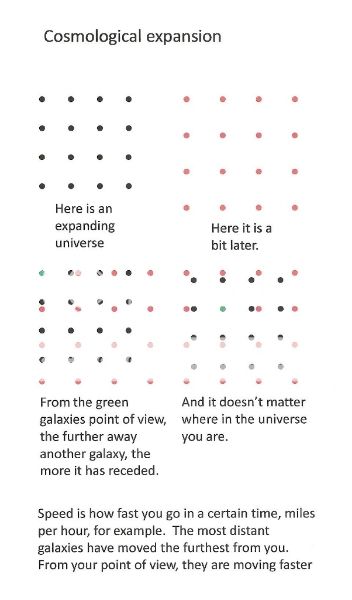
Have a look at this, WanderingLands.
Image

I think it explains why the further away something is, the faster it is moving away from us. The faster something is moving, the greater the Doppler effect; with fire engines this means the pitch of the siren is lower, in galaxies the light is redder. It is extremely simple and can be reproduced under laboratory conditions; it is a very plausible explanation for what we observe.
You say:
WanderingLands wrote:'Expansion' is different from a 'Big Bang', because expansion only connotes that something is only getting gradually larger while 'Big Bang' connotes a spontaneous explosion, so that would be a misnomer. Redshifts are not proofs of the Big Bang, as they are mostly unreliable and unrelated to distances. It's been shown by Halton Arp and others that the quasars with high redshift values are associated with galaxies and are close by them, which means that the redshifts aren't dopplers, and more conclusively, the Big Bang is not true.
Nobody knows the exact conditions or causes of the expansion that happens to be called the Big Bang, but it is nonsense to say that anything Halton Arp discovered proves the Big Bang untrue, particularly since the web page you cite says:
"Arp believes that the observed redshift value of any object is made up of two components: the inherent component and the velocity component."
In other words, the source you claim disproves the Big Bang accepts the most compelling evidence for it.
To be clear, not only is an expanding universe is the most plausible explanation for red shift, it also is the best explanation for why the universe is not collapsing because of gravity. Prior to the Big Bang theory, Einstein tried to account for what he believed to be a stable universe by introducing a completely arbitrary force that just happened to push as much as gravity pulled; he later called this 'cosmological constant' the greatest blunder of his career.
It is a mystery what happened and why, but some version of the Big Bang is overwhelmingly likely, better yet, it doesn't have to posit any 'inherent component' for red shift that has not been observed under laboratory conditions, unlike Doppler, nor does it involve scientists being in cahoots to suppress the 'Truth'.
User avatar
Bernard
Posts: 758
Joined: Tue Apr 13, 2010 11:19 am

Re: What started the Big Bang?

Post by Bernard »

I think the universe is maybe another creature of some sort; like a man , an atom, an ant or a star...whatever. Infinite creatures... that's existence. I don't know what type of creature a universe is. It may be just an aspect of some creature like the ocean is an aspect of earth. We look out and see an expansion, but if we had different ways of perceiving we may see a contraction occurring. Why should the universe be only physical anyway? why is physicality the only possibility? The discovery of dark matter/energy puts all bets off imo.

No, not real big on BBT - or BHT either. But both are adequate enough for practical purposes.
Blaggard
Posts: 2245
Joined: Fri Jan 10, 2014 9:17 pm

Re: What started the Big Bang?

Post by Blaggard »

If there was no first cause and the universe is eternal expanding and expanding till heat death and the break down of time slowly to an approximate >0 then this question is irrelevant. If God did it this is also irrelevant, science doesn't care about why, what for, teleology, ontology that is a philosophical matter, its only concern from a materialistic view point, which science has to by its nature adopt, to maintain empiricism and pragmatic method, is only how.
Ginkgo
Posts: 2657
Joined: Mon Apr 30, 2012 2:47 pm

Re: What started the Big Bang?

Post by Ginkgo »

Blaggard wrote:If there was no first cause and the universe is eternal expanding and expanding till heat death and the break down of time slowly to an approximate >0 then this question is irrelevant. If God did it this is also irrelevant, science doesn't care about why, what for, teleology, ontology that is a philosophical matter, its only concern from a materialistic view point, which science has to by its nature adopt, to maintain empiricism and pragmatic method, is only how.

Exactly. That's how science works.
User avatar
WanderingLands
Posts: 819
Joined: Wed Jan 08, 2014 3:39 am
Contact:

Re: What started the Big Bang?

Post by WanderingLands »

Philosophy Explorer wrote: There is an association between quasars and black holes of which a Wikipedia article describes (http://en.m.wikipedia.org/wiki/Quasar) to help keep this thread up to date.

PhilX
There are no such thing as Black Holes. You can find an explanation of disproving Black Holes from Stephen Crothers, who goes into how they contradict General Relativity and Newtonian Physics.

Stephen J. Crothers on Non-existence of Black Holes,The Failure of General Relativity: http://www.youtube.com/watch?v=jINHHXaPrWA

Another video above, which is from Space News, goes into how these so-called 'Black Hole' photos aren't really Black Holes, and also gets into the development and contradictions of these ideas.

http://www.youtube.com/watch?v=HC-JqZJME8w
User avatar
WanderingLands
Posts: 819
Joined: Wed Jan 08, 2014 3:39 am
Contact:

Re: What started the Big Bang?

Post by WanderingLands »

Ginkgo wrote: Yes, expansion is different to a Big Bang, but that's not a problem as far as physicists are concerned. It is only a problem for some laypeople. Physicists and cosmologists have always understood the "Big Bang" to mean a rapidly expanding universe.

Of course the Big Bang could be wrong. It may well turn out the Big Bang was inf fact a collision of branes, or some other explanation. The Big "X" is still a rapidly expanding universe.
The 'Big Bang' model that scientists use does not show a 'rapidly expanding universe'. As a matter of fact, the Universe, according to the Big Bang theory, is said to have expanded within 13.7 billion years. It cannot possibly 'rapidly expand' within that timing, especially given the complexity in the Universe.
User avatar
WanderingLands
Posts: 819
Joined: Wed Jan 08, 2014 3:39 am
Contact:

Re: What started the Big Bang?

Post by WanderingLands »

uwot wrote:Have a look at this, WanderingLands.
Image

I think it explains why the further away something is, the faster it is moving away from us. The faster something is moving, the greater the Doppler effect; with fire engines this means the pitch of the siren is lower, in galaxies the light is redder. It is extremely simple and can be reproduced under laboratory conditions; it is a very plausible explanation for what we observe.
You say:
WanderingLands wrote:'Expansion' is different from a 'Big Bang', because expansion only connotes that something is only getting gradually larger while 'Big Bang' connotes a spontaneous explosion, so that would be a misnomer. Redshifts are not proofs of the Big Bang, as they are mostly unreliable and unrelated to distances. It's been shown by Halton Arp and others that the quasars with high redshift values are associated with galaxies and are close by them, which means that the redshifts aren't dopplers, and more conclusively, the Big Bang is not true.
Nobody knows the exact conditions or causes of the expansion that happens to be called the Big Bang, but it is nonsense to say that anything Halton Arp discovered proves the Big Bang untrue, particularly since the web page you cite says:
"Arp believes that the observed redshift value of any object is made up of two components: the inherent component and the velocity component."
In other words, the source you claim disproves the Big Bang accepts the most compelling evidence for it.
To be clear, not only is an expanding universe is the most plausible explanation for red shift, it also is the best explanation for why the universe is not collapsing because of gravity. Prior to the Big Bang theory, Einstein tried to account for what he believed to be a stable universe by introducing a completely arbitrary force that just happened to push as much as gravity pulled; he later called this 'cosmological constant' the greatest blunder of his career.
It is a mystery what happened and why, but some version of the Big Bang is overwhelmingly likely, better yet, it doesn't have to posit any 'inherent component' for red shift that has not been observed under laboratory conditions, unlike Doppler, nor does it involve scientists being in cahoots to suppress the 'Truth'.
You have obviously ignored the large amounts of evidence that Halton Arp has found in that article, and you have also apparently ignored the evidence found in the other article that I have presented entitled 'Big Bang Bung'. Those two articles (especially the first one which was on Arp), have shown experiments that have found that most redshifts aren't Dopplers and are unreliable for distance, thus disproving the Big Bang theory.

Let's show an excerpt from the 'Big Bang Bung' article.

Excerpt:
In 1990, the Astrophysical Journal supplement series published "Associations between Quasi-stellar Objects and Galaxies" by G Burbidge, A Hewitt, J V Narlikar and P Das Gupta. They did the same sort of thing as Stockton, but in the intervening 12 years the sky had been considerably better surveyed for quasars and galaxies. They found many more such close pairs. They also looked at another aspect of the data that had not been examined by Stockton. That was because they believed that the big bang was wrong.

In close line of sight pairs which had very different redshifts, they looked for a way to detect that the two objects really were at the same distance. If quasars are actually ejected by galaxies as Halton Arp has argued, then there might be a typical distance apart that they tend to lie. That distance might be about the same as the distance of the Magellanic clouds from the Milky Way because Arp had identified many such arrangements in the sky. However, if the two objects are really together and not just sharing a line of sight, then if they are at a roughly constant distance, they will appear closer if the are far away and further apart if they are closer. This is simply a matter of perspective.

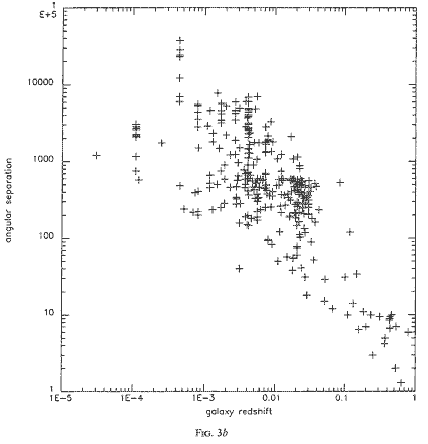
So they looked at the non-matching redshifts, both for Stockton's sample and also for the much bigger sample that they collected from various sources. Here are the results:

Image
User avatar
WanderingLands
Posts: 819
Joined: Wed Jan 08, 2014 3:39 am
Contact:

Re: What started the Big Bang?

Post by WanderingLands »

Blaggard wrote:If there was no first cause and the universe is eternal expanding and expanding till heat death and the break down of time slowly to an approximate >0 then this question is irrelevant. If God did it this is also irrelevant, science doesn't care about why, what for, teleology, ontology that is a philosophical matter, its only concern from a materialistic view point, which science has to by its nature adopt, to maintain empiricism and pragmatic method, is only how.
This is only an upheld and accepted view of what science is. Science, I believe, can be much more broadened to bring something deeper than materialism (ie. spirituality); it's only a matter of thinking outside the box from what is merely told and upheld as science, which is mainly upheld by people and not merely by 'nature'.
User avatar
WanderingLands
Posts: 819
Joined: Wed Jan 08, 2014 3:39 am
Contact:

Re: What started the Big Bang?

Post by WanderingLands »

Ginkgo wrote: As I explain before, the answer is that science is not interested in first causes. The fact that science fails to explain, or address the first cause of the universe isn't a problem. Well, not for science anyway.
You're only confusing 'science' with the 'scientific establishment', because that's the current view of first causes. However, I'm pretty sure that you can quite possibly connect the empirical data of science with the philosophical and metaphysical thought; you just need to have the correct data and not just have the accumulated ones.
Ginkgo wrote: I agree with uwot. I'd be very surprised if it would be taught in schools. It would need to be a Year 12 advanced physics class at the very least. The other problem is the theory is relatively new so I would imagine that it would take a while to filter down into the High Schools.
It's within the very nature of the Big Bang theory that gives off somewhat of a nihilistic connotation; that it was somehow 'expanding' spontaneously by some unknown force or just a 'spontaneous generation' of some kind.
Ginkgo wrote: WandingerLands, the impression I get is that you want science to come up with a first cause explanations for the universe.
What does 'WandingerLands' supposed to mean?
Post Reply