The reason why we need to get rid of the concept of particles is because particles do not actually control how phenomena works. You cannot say that all matter or all things are made up of particles, as you are not actually getting to the underlying mechanism of how phenomena in the universe works, which is what science and physics is actually suppose to do in making sense of things. For example, you can say that electricity is made up of protons and electrons; however, the problem is, is that the concept of 'particles', as in massless particles which are supposedly also made up of 'atoms', is so small that we cannot actually know about the particle or atom itself, despite the models that supposedly are supposed to show what an atom and subatomic particle looks like. Since we don't actually know what a massless particle looks like, other problems arise such as "how many particles are there?", and also "what are causing the particles?"
This is a problem that goes back to the Greek Atomists: the question of where particles come from. This question should actually logically disprove the atom and particle theory, because then you'd be looking at the underlying force that binds all things in the universe, instead of just massless particles. The consequences arising from still upholding the particle theory is that the modern scientific establishment is churning out more particles: protons and neutrons are apparently made of quarks (up, down, strange, charm, bottom, and top). These names of the quarks are clearly not professional and scientific; it goes back to what I'm saying that particles are not the backbone of phenomena. Thus, we should get rid of the particle theory, as well as photon theory and thus Quantum Theory, and get back to learning to explain and study the underlying force that actually does bind the entire universe together. Of course, it may seem anathema to the establishment to introduce philosophy, along with metaphysics and teleology, but it must be done. In conclusion, modern science is dead; Natural Philosophy must be reintroduced.
Get rid of the particle theory
-
WanderingLands

- Posts: 819
- Joined: Wed Jan 08, 2014 3:39 am
- Contact:
Re: Get rid of the particle theory
Sorry, but I couldn't follow any of this.WanderingLands wrote:The reason why we need to get rid of the concept of particles is because particles do not actually control how phenomena works. You cannot say that all matter or all things are made up of particles, as you are not actually getting to the underlying mechanism of how phenomena in the universe works, which is what science and physics is actually suppose to do in making sense of things. For example, you can say that electricity is made up of protons and electrons; however, the problem is, is that the concept of 'particles', as in massless particles which are supposedly also made up of 'atoms', is so small that we cannot actually know about the particle or atom itself, despite the models that supposedly are supposed to show what an atom and subatomic particle looks like. Since we don't actually know what a massless particle looks like, other problems arise such as "how many particles are there?", and also "what are causing the particles?"
This is a problem that goes back to the Greek Atomists: the question of where particles come from. This question should actually logically disprove the atom and particle theory, because then you'd be looking at the underlying force that binds all things in the universe, instead of just massless particles. The consequences arising from still upholding the particle theory is that the modern scientific establishment is churning out more particles: protons and neutrons are apparently made of quarks (up, down, strange, charm, bottom, and top). These names of the quarks are clearly not professional and scientific; it goes back to what I'm saying that particles are not the backbone of phenomena. Thus, we should get rid of the particle theory, as well as photon theory and thus Quantum Theory, and get back to learning to explain and study the underlying force that actually does bind the entire universe together.
If this is the conclusion to your argument then I can follow this bit.Wanderinglands wrote:
Of course, it may seem anathema to the establishment to introduce philosophy, along with metaphysics and teleology, but it must be done. In conclusion, modern science is dead; Natural Philosophy must be reintroduced.
Anyone can introduce as much Natural Philosophy as they wish, but metaphysics isn't modern science and that's all there is to it.
-
WanderingLands
- Posts: 819
- Joined: Wed Jan 08, 2014 3:39 am
- Contact:
Re: Get rid of the particle theory
You seem to start getting simply disgruntled at my posts, and so you revert to the same statements and simply dismissing my ideas now. If you have any evidence against this, then please present it.Ginkgo wrote:Sorry, but I couldn't follow any of this.WanderingLands wrote:The reason why we need to get rid of the concept of particles is because particles do not actually control how phenomena works. You cannot say that all matter or all things are made up of particles, as you are not actually getting to the underlying mechanism of how phenomena in the universe works, which is what science and physics is actually suppose to do in making sense of things. For example, you can say that electricity is made up of protons and electrons; however, the problem is, is that the concept of 'particles', as in massless particles which are supposedly also made up of 'atoms', is so small that we cannot actually know about the particle or atom itself, despite the models that supposedly are supposed to show what an atom and subatomic particle looks like. Since we don't actually know what a massless particle looks like, other problems arise such as "how many particles are there?", and also "what are causing the particles?"
This is a problem that goes back to the Greek Atomists: the question of where particles come from. This question should actually logically disprove the atom and particle theory, because then you'd be looking at the underlying force that binds all things in the universe, instead of just massless particles. The consequences arising from still upholding the particle theory is that the modern scientific establishment is churning out more particles: protons and neutrons are apparently made of quarks (up, down, strange, charm, bottom, and top). These names of the quarks are clearly not professional and scientific; it goes back to what I'm saying that particles are not the backbone of phenomena. Thus, we should get rid of the particle theory, as well as photon theory and thus Quantum Theory, and get back to learning to explain and study the underlying force that actually does bind the entire universe together.
If this is the conclusion to your argument then I can follow this bit.Wanderinglands wrote:
Of course, it may seem anathema to the establishment to introduce philosophy, along with metaphysics and teleology, but it must be done. In conclusion, modern science is dead; Natural Philosophy must be reintroduced.
Anyone can introduce as much Natural Philosophy as they wish, but metaphysics isn't modern science and that's all there is to it.
Re: Get rid of the particle theory
beond fuzzy particals there is a god which is the unmoving relativity in all action and to which the individuals own consciousness seen as a relative conscience to the event is a complete part of.so i can see where ya comming from wanderlands.
Re: Get rid of the particle theory
WanderingLands wrote:
You seem to start getting simply disgruntled at my posts, and so you revert to the same statements and simply dismissing my ideas now. If you have any evidence against this, then please present it.
I'm not disgruntled at your posts. I was simply saying that I don't follow your argument. How can this statement by me amount to a dismissal and criticism of your argument?
The only thing I dismissed was your conclusion. I am pretty sure I made that point abundantly clear.
Re: Get rid of the particle theory
I don't think most of modern science gives much of a damn what philosophy thinks, which is not necessarily a good thing. Just saying, experiment is king, if you can produce data that shows a particle from an experiment then it becomes theoretical, if you can't it doesn't. One thing I can be sure of though is that the two slit experiment shows that photons will behave both as a particle and as a wave depending on whether they are measured, clearly the photon is neither a particle or a wave but somehow has properties of both, a warticle if you like. Discarding particle theory does not discard quantum mechanics either btw since matter has particle/wave duality, quantum mechanics has to describe both the wave and particle behaviours, there are several ideas that do away with particles in quantum mechanics actually.
When we measure the particle in the double slit to determine which slit the photon went through it behaves like a particle, striking the screen in a fairly predictable projectile manner, when we don't measure it it produces interference fringes on the screen which shows it is a wave, neatly demonstrating the photon can exhibit properties that are both wave and particle like according to how we measure it. You can't just say, well I don't like particle theories therefore the experimental evidence that says things have particle wave duality is bunk and they are just waves. That's not philosophy and it certainly isn't science, it's willing things to behave how you want to if the experiment didn't inconveniently tell us otherwise. Prove that there are no particles someone might listen, arm wave around saying what ifs and maybe if, and no one will care.
I think the transfer of photons from electrons explains electro magnetism quite neatly actually and I presume Higgs and gravtions work like wise, I don't see what the issue is tbh.
When we measure the particle in the double slit to determine which slit the photon went through it behaves like a particle, striking the screen in a fairly predictable projectile manner, when we don't measure it it produces interference fringes on the screen which shows it is a wave, neatly demonstrating the photon can exhibit properties that are both wave and particle like according to how we measure it. You can't just say, well I don't like particle theories therefore the experimental evidence that says things have particle wave duality is bunk and they are just waves. That's not philosophy and it certainly isn't science, it's willing things to behave how you want to if the experiment didn't inconveniently tell us otherwise. Prove that there are no particles someone might listen, arm wave around saying what ifs and maybe if, and no one will care.
I think the transfer of photons from electrons explains electro magnetism quite neatly actually and I presume Higgs and gravtions work like wise, I don't see what the issue is tbh.
-
WanderingLands
- Posts: 819
- Joined: Wed Jan 08, 2014 3:39 am
- Contact:
Re: Get rid of the particle theory
First of all, I have not much of an issue with empiricism and experimentation, albeit it is limited since it doesn't have the capacity, as the mind does, to come up with explanations of sensual data. Second, by clearly seeing videos doing the double slit experiment, and even looking at diagrams of it as well, you can clearly see that there is no particle interaction, but wave interaction.Blaggard wrote:I don't think most of modern science gives much of a damn what philosophy thinks, which is not necessarily a good thing. Just saying, experiment is king, if you can produce data that shows a particle from an experiment then it becomes theoretical, if you can't it doesn't. One thing I can be sure of though is that the two slit experiment shows that photons will behave both as a particle and as a wave depending on whether they are measured, clearly the photon is neither a particle or a wave but somehow has properties of both, a warticle if you like. Discarding particle theory does not discard quantum mechanics either btw since matter has particle/wave duality, quantum mechanics has to describe both the wave and particle behaviours, there are several ideas that do away with particles in quantum mechanics actually.
When we measure the particle in the double slit to determine which slit the photon went through it behaves like a particle, striking the screen in a fairly predictable projectile manner, when we don't measure it it produces interference fringes on the screen which shows it is a wave, neatly demonstrating the photon can exhibit properties that are both wave and particle like according to how we measure it. You can't just say, well I don't like particle theories therefore the experimental evidence that says things have particle wave duality is bunk and they are just waves. That's not philosophy and it certainly isn't science, it's willing things to behave how you want to if the experiment didn't inconveniently tell us otherwise. Prove that there are no particles someone might listen, arm wave around saying what ifs and maybe if, and no one will care.
I think the transfer of photons from electrons explains electro magnetism quite neatly actually and I presume Higgs and gravtions work like wise, I don't see what the issue is tbh.
http://www.youtube.com/watch?v=egRFqSKFmWQ
http://www.youtube.com/watch?v=Jqm4f55soJQ
Even if you were to see "little dots" when conducting the double-slit experiment without water, you can still explain it with spherical standing waves, which completely solves the so-called paradoxes within Quantum Theory and also shows the interconnecting flow of energy. You do not need to make any more particles, subatomic particles, or components of particles, to explain energy and matter. It is all right there in your own eyes, which shows interconnectivity.
Re: Get rid of the particle theory
No what you see there in both is waves, waves that interfere with themselves that are hence what happens when both slits are left open. Which is nothing at all remarkable.
http://www.youtube.com/watch?v=xe87Fko1gjk
In video forum for people limited on time.
If you can't watch a short video I can't help you I am afraid.
http://www.upscale.utoronto.ca/GeneralI ... eSlit.html
And wiki if you need another source:
http://en.wikipedia.org/wiki/Double-slit_experiment
I missed out the particle version I am sure we can quite easilly imagine what happens when you fire a machine gun willy nilly through one or two two slits. Suffice to say you get single points which eventually produce the sort of pattern that we would expect if something were particle like, a sort of bell curve, the peak in the middle where most bullets are likely to land or two peaks which add to make one distribution if you use two slits.
http://www.youtube.com/watch?v=xe87Fko1gjk
In video forum for people limited on time.
If you can't watch a short video I can't help you I am afraid.
http://www.upscale.utoronto.ca/GeneralI ... eSlit.html
And wiki if you need another source:
http://en.wikipedia.org/wiki/Double-slit_experiment
I missed out the particle version I am sure we can quite easilly imagine what happens when you fire a machine gun willy nilly through one or two two slits. Suffice to say you get single points which eventually produce the sort of pattern that we would expect if something were particle like, a sort of bell curve, the peak in the middle where most bullets are likely to land or two peaks which add to make one distribution if you use two slits.
In a double slit experiment involving photons though, when you measure which path or which slit a photon goes through what you see is a particle like projection on the back screen, the interference fringes disappear, and you have a back screen which shows a single strike on the back plate.
It's all very well showing standing water waves, but that is just an analogy. When we do the experiment with actual light this is what we see:
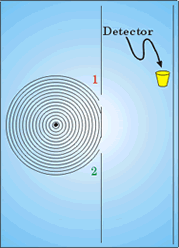
First we show the apparatus. The thing that is tapping the surface of the water is the little black circle in the middle of all the concentric circles. The concentric circles are the water waves spreading out away from the source. Just as before we have two slits and a backstop. Just in front of the backstop is our "detector", which is just a cork floating on the surface of the water. Se we measure how much the cork bobs up and down and determine the amount of wave energy arriving at that position at the backstop. Moving the cork to other positions will allow us the determine the distribution of wave energy at the backstop.
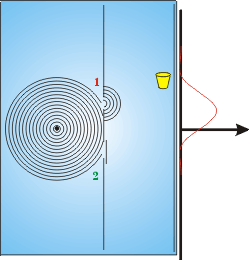
Now we close up the lower slit, and measure the distribution of wave energy arriving at the backstop just from the upper slit. For some combinations of slit width and wavelength, there will be significant spreading of the wave after it passes through the slit. If you have ever observed surf coming in through a relatively small slit in a seawall, you may have observed this.
The distribution is shown by the curve to the right. Note that it is very similar to the distribution of bullets from a single slit.
Last edited by Blaggard on Sun Jul 06, 2014 8:30 pm, edited 5 times in total.
Re: Get rid of the particle theory
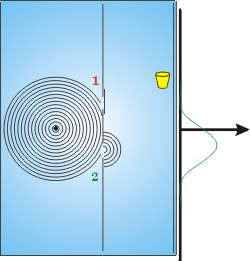
And:
Now we close the upper slit and measure the distribution of wave energy arriving from the lower slit, as shown to the right.
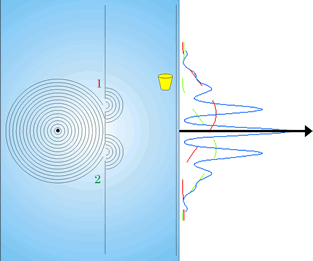
Finally, we leave both slits open and measure the distribution. The result is shown to the right. As we did for the bullets, the dashed lines show the results we just obtained for the distribution from the upper and lower slits alone, while the solid line is the result for both slits open.
This looks nothing like the result for bullets. There are places where the total wave energy is much greater than the sum from the two slits, and other places where the energy is almost zero.
Such a distribution is called an interference pattern.
This completes the "operational definition" that we need to define waves and particles. In the two slit experiment, a particle does not show an interference pattern and the probability of a particle arriving at a location at the backstop with both slits open is just the sum of the probability of it arriving through the upper slit plus the probability of it arriving through the lower slit. A wave shows an interference pattern.
If you think about conservation of energy, you may worry a bit about the interference pattern for waves. There is no problem. The total energy in the interference pattern is equal to the energy arriving from the upper slit plus the energy arriving from the lower slit: the interference pattern re-arranges the energy but conserves the total amount of energy.
We can explain the interference pattern for waves. When the two waves from the two slits arrive at some position at the backstop, except for right in the middle they will have traveled different distances from the slits. This means that their "waving" may not be in sync.
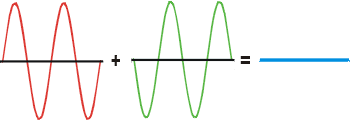
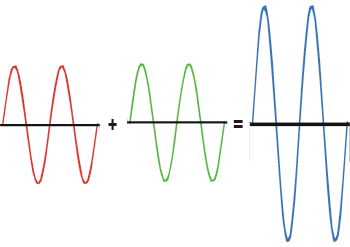
The figure to the right shows two waves totally "out of phase" with each other. Their sum is always zero.
http://www.upscale.utoronto.ca/GeneralI ... struct.gif
Re: Get rid of the particle theory
You forgot to show what happens in both photons and electrons when we measure which path information by placing a detector at either slit. In doing so you missed out half the experiment.This is basically what is happening at the minima in the interference pattern.
destructive interference
The figure to the right shows the two waves in phase. The total wave is the sum of the two. This is what is occurring at the maxima in the interference pattern
http://www.upscale.utoronto.ca/GeneralI ... struct.gif
An electron gun, such as in a television picture tube, generates a beam of electrons. In this section we discuss how it works. These details are not important for our primary purpose here, so you may jump to the next section by clicking here.
A diagram of an electron gun appears to the right. There are two vertical metal plates; the right hand plate has a small hole cut in it. A voltage source, indicated by V, maintains a voltage across the plates, with the left hand plate negative and the right hand plate positive.
When a metal plate is heated, a process called thermionic emission literally boils electrons off the surface of the metal. Normally the electrons only make it a fraction of a millimeter away; this is because when the electron boiled off the surface of the metal, it left that part of the plate with a net positive electric charge which pulls the electron right back into the plate.
picture of electron gun
In the figure, we are heating up the left hand plate so thermionic electrons will be boiled off the surface. But because of the voltage difference being maintained across the plate, electrons that boil off between the two plates do not fall back into the plate, but instead are attracted to the right hand positive plate. Most of the electrons crash into the positive plate, as shown. However, the electron in the middle would have crashed into the plate except that we have cut a hole in that part of it. So we get a beam of electrons out of this "electron gun."
In real electron guns, such as at the back of a TV picture tube, the negative plate is not heated with a campfire as in our figure. Instead, a small filament of wire has a current passed through it. The filament heats up, glows red, and heats up the negative plate. You may have seen that red glow in the back of a TV picture tube.
We control the speed of the electrons in the beam with the voltage, and the number of electrons by how hot we make the negatively charged plate.
One more small point. Because the hole in the right hand plate is not of zero size, electrons can emerge in directions slightly away from perfectly horizontal. Thus, the beam of electrons will tend to "spray" somewhat.
From now on we will put the electron gun in a black box, and represent the electron beam coming from it as shown to the right.
The Two Slit Experiment for Electrons
In the previous section we discussed how to produce a beam of electrons from an electron gun. Here we place the electron gun inside a glass tube that has had all the air evacuated. The right hand glass screen has its inside coated with a phosphor that will produce a small burst of light when an electron strikes it. In a TV picture tube, for example, fields direct the beam of electrons to the desired location, the intensities of the electrons are varied depending on where we are steering the beam, and our minds and/or eyes interpret the flashes as the image we are seeing on the television.
Now, "everybody knows" that electrons are particles. They have a well defined mass, electric charge, etc. Some of those properties are listed to the right. Waves do not have well defined masses etc.
Property Value
Mass 9.11 × 10⁻³¹ kg
Electric Charge 1.60 × 10⁻¹⁹ Coulombs
Spin angular momentum 5.28 × 10⁻³⁵ Joule-seconds
When an electron leaves the electron gun, a fraction of a second later a flash of light appears on the screen indicating where it landed. A wave behaves differently: when a wave leaves the source, it spreads out distributing its energy in a pattern as discussed at the beginning of this document.
Except, when we place two slits in the path of the electrons, as shown, on the screen we see an interference pattern! In fact, what we see on the screen looks identical to the double slit interference pattern for light that we saw earlier.
If this seems very mysterious, you are not alone. Understanding what is going on here is in some sense equivalent to understanding Quantum Mechanics. I do not understand Quantum Mechanics. Feynman admitted that he never understood Quantum Mechanics. It may be true that nobody can understand Quantum Mechanics in the usual meaning of the word "understand."
We will now extend our understanding of our lack of understanding. One possibility about the origins of the interference pattern is that the electrons going through the upper slit are somehow interacting with the electrons going through the lower slit. Note that we have no idea what such a mechanism could be, but are a little desperate to understand what is going on here. We can explore this idea by slowing down the rate of electrons from the gun so that only one electron at a time is in the system. What we do is fire an electron, see where the flash of light occurs on the phosphor screen, wait a while for everything to settle down, then fire another electron, noting where it lands on the screen.
After we have fired a large number of electrons, we will discover that the distribution of electrons is still the interference pattern.
I have prepared a small Flash animation that simulates this result. You may access the animation by clicking on the red button to the right. The file size is 6.4k. You may get the Flash player free from http://www.macromedia.com/; our animation is for Version 5 or later of the player.
Click here for the animation
You may wish to know that in the animation, the position of the electron is generated randomly using a Monte Carlo technique. Thus, if you "Rewind" the animation to start it over, the build-up of the histogram is almost certain to not be identical to the previous "trial."
We conclude that whatever is going on to cause the interference pattern does not involve two or more electrons interacting with each other. And yet, with one electron at a time in the system, with both slits open there are places on the screen where the electrons do not go, although with only one slit open some electrons do end up at that position.
Now, to get an interference pattern we take a wave, split it up into two parts, send each part through one of the slits, and then recombine the waves. Does this mean that a single electron is somehow going through both slits at once? This too is amenable to experimental test.
The result of doing the test turns out to be independent of the details of how the experiment is done, so we shall imagine a very simple arrangement: we place a light bulb behind the slits and look to see what is going on. Note that in a real experiment, the light bulb would have to be smaller than in the figure and tucked in more tightly behind the slits so that the electrons don't collide with it. double slit with light bulb
We will see a small flash of light when an electron passes through the slits.
What we see is that every electron is acting completely "normal": one-half the electrons are going through the upper slit, one-half are going through the lower slit, and which is going to be the case for a given electron appears to be random. A small (24k) gif animation of what we might see in this experiment may be seen here.
But meanwhile, we have a colleague watching the flashes of light on the phosphor coated screen who says "Hey, the interference pattern has just gone away!" And in fact the distribution of electrons on the screen is now exactly the same as the distribution of machine gun bullets that we saw above.
The figure to the right is what our colleague sees on the screen.
Evidently, when we look at what is going on at the slits we cause a qualitative and irreversible change in the behavior of the electrons. This is usually called the "Heisenberg Uncertainty Principle."
Everyone has always known that doing any measurement on any system causes a disturbance in the system. The classical paradigm has been that at least in principle the disturbance can be minimised to the point that it is negligible.
Is it possible to minimise the disturbance being caused by the light bulb? We can turn down the intensity of the light it is emitting. However, if we try it, just at the point that the light is getting so faint that we are missing some of the electrons, the interference pattern starts to come back! In fact, if the light intensity is, say, such that we are missing one-half of the electrons, we have one-half an interference pattern and one-half a particle distribution. So this attempt to minimise the disturbance didn't work out: we still don't know what is going on at the slits when we see the interference pattern.
There is yet another way to minimise the disturbance. The light contains energy, and it turns out that if we increase the wavelength of the light, towards the infrared, the energy of each part of the light goes down. Perhaps if we decrease the energy in the light we won't be scattering it off the electrons so violently. So, we start increasing the wavelength of the light emitted by the light bulb. We continue to see all the electrons, and at first we always see that one-half of them are going through the upper slit and one-half are going through the lower slit.
However, our ability to resolve two positions in space by looking depends on the wavelength of the light that we are seeing with. And just at the point that the wavelength of the light from the lightbulb gets so large that although we can see the electrons we can't tell which slit they went through, the interference pattern comes back.
A student once remarked that we should do a "better" experiment. The Heisenberg Uncertainty Principle says that such a better experiment does not exist. Einstein in particular devoted a lot of time trying to devise such a better measurement; all his attempts failed.
The conclusion of all this is that there is no experiment that can tell us what the electrons are doing at the slits that does not also destroy the interference pattern. This seems to imply that there is no answer to the question of what is going on at the slits when we see the interference pattern. The path of the electron from the electron gun to the screen is not knowable when we see the interference pattern. As Heisenberg said, "The path [of the electron] comes into existence only when we observe it."
We will be discussing interpretations of what all this may mean in great detail later. For now I will briefly mention a "standard" if incomplete interpretation. If we think that the probability of where the electron is in space is a wave, then when we don't look the probability wave has two pieces at the slits, representing the fact that there is a 50% chance the electron went through the upper slit and a 50% chance it went through the lower slit. These two probability waves from the two slits, then, recombine at the screen and cause the interference pattern.
When we look, we "collapse the state" in a 100% chance it went through one slit and a 0% chance it went through the other. And in this circumstance the two probability waves for the two slits cannot then recombine at the screen to cause an interference pattern: for each electron there is only one non-zero probability wave.
Finally, then, we have two contradictory yet complementary models of the two-slit experiment for electrons. In one model the electron is a particle that somehow exhibits an interference pattern. In the other model, the electron is a wave that somehow manifests as a particle whenever we look at it.
A Flash animation of these two models, both incomplete, may be accessed by clicking the red button to the right. The file size is 23k and will appear in a separate window.
You measure which slit a photon goes through you end up with particle behavior, you don't measure it you end up with wave behavior. Long story short you can't have something exhibit particle behavior if it is just a wave and you can't have it exhibit wave like behavior if it is just a particle.
It's all very well showing ripple tanks but if you are going to ignore the most pertinent parts of the experiment that show the duality of matter, you are actually not telling the whole story.
Apologies for spreading it over 3 posts, but you have to to try to get passed the dumbass restrictions placed on posting images on forums. Why we still have ten year old rules for forums is anyone's guess, presumably no one can be assed to change them to keep up with the times. Or perhaps forums are using vastly out of date equipment when most computers probably have more ram and more hard drive space than the forum servers do, But there you go. I can't be assed to put it one post now, I have lost the will to live. My computer could quite happily have 8 terrabytes of hard drive space, which is larger than the amount of information in 20 or so ordinary libraries. Put into perspective it would probably take longer than my life span to fill it with just text and pictures, if I hosted this forum. Img size fair enough, restrictions to two images is antiquated to say the least, computers that are 5 or 6 years old can quite happily handle four or five small images also.

-
WanderingLands
- Posts: 819
- Joined: Wed Jan 08, 2014 3:39 am
- Contact:
Re: Get rid of the particle theory
You certainty gave me a whole bunch of information. I'll look at it and tell you what I think.
Re: Get rid of the particle theory
Frankly I'd just read the wikipaedia article in the first post. It says it all concisely, but I put the rest in for other people who are not quite so well informed on the experiment.
An excerpt actually to be frank this part of the wiki pretty much says it all. What you are looking at is the Young's two slit experiment, a very old experiment that overthrew the earlier particle interpretations in the 18th century. What modern physicists are looking at is a modern version often called the Feynman two slit, where what path information is taken into account and even more refined experiments where single electrons or photons are taken into account. There is a vast difference between the two. If you are interested there are delayed quantum eraser experiments where erasing information seems to bring back wave like effects, but actually, really, ultimately just reinforces the duality of previous experiments. These experiments are more informative than nigh on 250 year old experiments, which is what you showed in your links. What is perhaps interesting is that scientists have been trying to destroy the conclusions of duality and quantum mechanics since it's inception and still do, notably Shrödinger and Einstein to name but two, and yet some still want to label science as a conformity magnet. Science attacks itself with more tenacity than anyone else ever will, and with, what is probably more important, more erudition. But then you don't get to read about that in pop science.Overview
If light consisted strictly of ordinary or classical particles, and these particles were fired in a straight line through a slit and allowed to strike a screen on the other side, we would expect to see a pattern corresponding to the size and shape of the slit. However, when this "single-slit experiment" is actually performed, the pattern on the screen is a diffraction pattern in which the light is spread out. The smaller the slit, the greater the angle of spread. The top portion of the image on the right shows the central portion of the pattern formed when a red laser illuminates a slit and, if one looks carefully, two faint side bands. More bands can be seen with a more highly refined apparatus. Diffraction explains the pattern as being the result of the interference of light waves from the slit.
If one illuminates two parallel slits with a more intense red laser, the light from the two slits again interferes. Here the interference is a more pronounced pattern with a series of light and dark bands. The width of the bands is a property of the frequency of the illuminating light.[15] (See the bottom photograph to the right.) When Thomas Young (1773–1829) first demonstrated this phenomenon, it indicated that light consists of waves, as the distribution of brightness can be explained by the alternately additive and subtractive interference of wavefronts.[3] Young's experiment, performed in the early 1800s, played a vital part in the acceptance of the wave theory of light, vanquishing the corpuscular theory of light proposed by Isaac Newton, which had been the accepted model of light propagation in the 17th and 18th centuries. However, the later discovery of the photoelectric effect demonstrated that under different circumstances, light can behave as if it is composed of discrete particles. These seemingly contradictory discoveries made it necessary to go beyond classical physics and take the quantum nature of light into account.
The double-slit experiment (and its variations) has become a classic thought experiment, for its clarity in expressing the central puzzles of quantum mechanics. Because it demonstrates the fundamental limitation of the ability of the observer to predict experimental results, Richard Feynman called it "a phenomenon which is impossible […] to explain in any classical way, and which has in it the heart of quantum mechanics. In reality, it contains the only mystery [of quantum mechanics]."[3] Feynman was fond of saying that all of quantum mechanics can be gleaned from carefully thinking through the implications of this single experiment.[16] Richard Feynman also proposed (as a thought experiment) that if detectors would be placed before each slit, the interference pattern will disappear. [17]
The Englert–Greenberger duality relation provides a detailed treatment of the mathematics of double-slit interference in the context of quantum mechanics.
A low-intensity double-slit experiment was first performed by G. Taylor in 1909,[18] by reducing the level of incident light until photon emission/absorption events were mostly nonoverlapping. A double-slit experiment was not performed with anything other than light until 1961, when Claus Jönsson of the University of Tübingen performed it with electrons.[19][20] In 1974 the Italian physicists Pier Giorgio Merli, Gian Franco Missiroli, and Giulio Pozzi repeated the experiment using single electrons, showing that each electron interferes with itself as predicted by quantum theory. In 2002, the single-electron version of the experiment was voted "the most beautiful experiment" by readers of Physics World.[21]
-
SpheresOfBalance

- Posts: 5755
- Joined: Sat Sep 10, 2011 4:27 pm
- Location: On a Star Dust Metamorphosis
Re: Get rid of the particle theory
The answers don't lie in the particles, rather the forces which act upon them. The mystery is the electricity, electromagnetic energy, those forces that hold all things together, or not. Truly understand those forces and you understand the truth of everything! So I agree, particles are of no real importance, they are acted upon, I want to understand that which does the acting.WanderingLands wrote:The reason why we need to get rid of the concept of particles is because particles do not actually control how phenomena works. You cannot say that all matter or all things are made up of particles, as you are not actually getting to the underlying mechanism of how phenomena in the universe works, which is what science and physics is actually suppose to do in making sense of things. For example, you can say that electricity is made up of protons and electrons; however, the problem is, is that the concept of 'particles', as in massless particles which are supposedly also made up of 'atoms', is so small that we cannot actually know about the particle or atom itself, despite the models that supposedly are supposed to show what an atom and subatomic particle looks like. Since we don't actually know what a massless particle looks like, other problems arise such as "how many particles are there?", and also "what are causing the particles?"
This is a problem that goes back to the Greek Atomists: the question of where particles come from. This question should actually logically disprove the atom and particle theory, because then you'd be looking at the underlying force that binds all things in the universe, instead of just massless particles. The consequences arising from still upholding the particle theory is that the modern scientific establishment is churning out more particles: protons and neutrons are apparently made of quarks (up, down, strange, charm, bottom, and top). These names of the quarks are clearly not professional and scientific; it goes back to what I'm saying that particles are not the backbone of phenomena. Thus, we should get rid of the particle theory, as well as photon theory and thus Quantum Theory, and get back to learning to explain and study the underlying force that actually does bind the entire universe together. Of course, it may seem anathema to the establishment to introduce philosophy, along with metaphysics and teleology, but it must be done. In conclusion, modern science is dead; Natural Philosophy must be reintroduced.
Re: Get rid of the particle theory
I think you are pretty much correct. Particles are seen as force carriers, so the 'disturbances' in the field can be interpreted as particles.SpheresOfBalance wrote:The answers don't lie in the particles, rather the forces which act upon them. The mystery is the electricity, electromagnetic energy, those forces that hold all things together, or not. Truly understand those forces and you understand the truth of everything! So I agree, particles are of no real importance, they are acted upon, I want to understand that which does the acting.WanderingLands wrote:The reason why we need to get rid of the concept of particles is because particles do not actually control how phenomena works. You cannot say that all matter or all things are made up of particles, as you are not actually getting to the underlying mechanism of how phenomena in the universe works, which is what science and physics is actually suppose to do in making sense of things. For example, you can say that electricity is made up of protons and electrons; however, the problem is, is that the concept of 'particles', as in massless particles which are supposedly also made up of 'atoms', is so small that we cannot actually know about the particle or atom itself, despite the models that supposedly are supposed to show what an atom and subatomic particle looks like. Since we don't actually know what a massless particle looks like, other problems arise such as "how many particles are there?", and also "what are causing the particles?"
This is a problem that goes back to the Greek Atomists: the question of where particles come from. This question should actually logically disprove the atom and particle theory, because then you'd be looking at the underlying force that binds all things in the universe, instead of just massless particles. The consequences arising from still upholding the particle theory is that the modern scientific establishment is churning out more particles: protons and neutrons are apparently made of quarks (up, down, strange, charm, bottom, and top). These names of the quarks are clearly not professional and scientific; it goes back to what I'm saying that particles are not the backbone of phenomena. Thus, we should get rid of the particle theory, as well as photon theory and thus Quantum Theory, and get back to learning to explain and study the underlying force that actually does bind the entire universe together. Of course, it may seem anathema to the establishment to introduce philosophy, along with metaphysics and teleology, but it must be done. In conclusion, modern science is dead; Natural Philosophy must be reintroduced.
Strictly speaking quantum theory and string theory do away with the old classical particle model. I guess in quantum mechanics the term "particle" as delineating something solid is very misleading. It was never meant to be understood in this way. I guess that is the problem when we get into analogies.
Strictly speaking it would be incorrect to say that quantum theory is a theory of particles.

Re: Get rid of the particle theory
Hi WanderingLand!WanderingLands wrote:The reason why we need to get rid of the concept of particles is because particles do not actually control how phenomena works. You cannot say that all matter or all things are made up of particles, as you are not actually getting to the underlying mechanism of how phenomena in the universe works, which is what science and physics is actually suppose to do in making sense of things. For example, you can say that electricity is made up of protons and electrons; however, the problem is, is that the concept of 'particles', as in massless particles which are supposedly also made up of 'atoms', is so small that we cannot actually know about the particle or atom itself, despite the models that supposedly are supposed to show what an atom and subatomic particle looks like. Since we don't actually know what a massless particle looks like, other problems arise such as "how many particles are there?", and also "what are causing the particles?"
This is a problem that goes back to the Greek Atomists: the question of where particles come from. This question should actually logically disprove the atom and particle theory, because then you'd be looking at the underlying force that binds all things in the universe, instead of just massless particles. The consequences arising from still upholding the particle theory is that the modern scientific establishment is churning out more particles: protons and neutrons are apparently made of quarks (up, down, strange, charm, bottom, and top). These names of the quarks are clearly not professional and scientific; it goes back to what I'm saying that particles are not the backbone of phenomena. Thus, we should get rid of the particle theory, as well as photon theory and thus Quantum Theory, and get back to learning to explain and study the underlying force that actually does bind the entire universe together. Of course, it may seem anathema to the establishment to introduce philosophy, along with metaphysics and teleology, but it must be done. In conclusion, modern science is dead; Natural Philosophy must be reintroduced.
I have posted a development similar to yours, here:
viewtopic.php?f=5&t=12042&p=175729#p175729
and am about to tell a more precise information hereafter, the one you asked me...
-Hi Blaggard:
I think you wrote about Huygens interferences...
A saw in a documentary, that physicists did the experiment with electrons. Because of the interferences, they thought first about a simple Coulomb repulsion.
Then, they repeated the experiment with only on electron after the other, and... they re-obtained the interferences !!
Finally, the introduced an observatory device, without incident particle (as photon), as the screen after the holes, was already photo-reactive (to see the result) as in the first steps here.
And then... the electron had a behavior as we were expecting from them, knowing: without interference, as particles we represented from them!..
But I don't know why the experiment is not better known...