
Since no photos of the black slaves exist a film image will have to suffice.
The men who fought against their Portuguese oppressors and won freedom eventually due to a Supreme Court trial.


Nelson Mandela, the former South African president whose stubborn defiance survived 27 years in prison and led to the dismantling of the country's racist and brutal apartheid system, has died. Mandela was 95 years old.
South Africa's President Jacob Zuma, who announced Mandela's death, said, "We've lost our greatest son."
President Obama spoke shortly after Zuma's announcement, praising Mandela as a man who "bent the arc of the moral universe toward justice."
"He no longer belongs to us -- he belongs to the ages," Obama said.
Mandela had a number of issues with his health in recent years including repeated hospitalizations with a chronic lung infection. Mandela had been listed in "serious but stable condition" after entering the hospital in June before returning to home to receive continued medical care.
In April, Mandela spent 18 days in the hospital due to a lung infection and was treated for gall stones in December 2012.
Mandela's public appearances had become increasingly rare as he dealt with his declining health.
His last public appearance was in July of 2010, when he attended the final match and closing ceremonies of the soccer World Cup held in South Africa.
Life of Nelson Mandela: See the Photos
In 2011, Mandela met privately with Michelle Obama when the first lady and her daughters traveled to South Africa.
Mandela and the Legacy He Leaves Behind
One of the giants of the 20th century, Mandela's career was marked not only by his heroic resistance to racism, but also by his poised and soft spoken demeanor.
After enduring nearly three decades of prison, much of it at hard labor in a lime quarry, Mandela emerged as a gentle leader who became South Africa's first black president. He was awarded the Nobel Peace Prize for his leadership in ending apartheid without violence, and later became a global statesman who inspired millions people around the world.
Mandela was born in 1918, the son of a tribal leader, in a remote village in South Africa.
His tribal name, Rolihlahla, meant "troublemaker," a moniker Mandela would more than live up to in his lifetime.
In 1952, he emerged onto the national stage when he helped organize the first country-wide protests called the Defiance Campaign. That same year he opened the country's first black law firm.
Ruth Mopati, his secretary at the firm, wrote about the way he was then in the book "Mandela," saying, "He was able to relate to people with respect and therefore he was respected in return."
While Mandela's party, the African National Congress, had always been dedicated to non-violence, in 1960 the ANC was banned to prevent further protests after police shot dead 69 black protestors in what became known as the Sharpeville massacre.
The events radicalized the organization and led to the creation of the ANC military wing, for which Mandela became its first commander in 1961.
In 1962, Mandela was sent to prison on a charge of inciting a strike.
"At 1:30 in the morning, on March 30, I was awakened by sharp, unfriendly knocks at my door, the unmistakable signature of the police. 'The time has come,' I said to myself as I opened the door to find half a dozen armed security policemen," Mandela said.
Two years later, Mandela was sentenced to life in prison for sabotage and conspiracy to overthrow the white government. Much of the next 27 years in prison were spent in the infamous Robben Island prison where he did hard labor in a lime quarry.
During his nearly three decades behind bars, Mandela would become a myth. The government even banned any use of Mandela's image or words, leaving a whole generation to grow up knowing little about the world's most famous political prisoner.
Nelson Mandela Teamed Up With White Leader F.W. de Klerk
Mandela spoke about his time in his autobiography: "A nation should not be judged by how it treats its highest citizens, but its lowest ones -- and South Africa treated its imprisoned African citizens like animals."
Do you have a source for that?Impenitent wrote:Millions of Egyptian Americans are offended by the assumption that all "African" Americans are black...
-Imp


The blacks have unions now, well I never, they'll be paying them next!African American is doublespeak - I was simply illustrating this point during Black history month because someone's union master keeps his laborers in the dark...
-Imp
HA! That was my thread!Blaggard wrote: I found this on another thread I found it quite interesting...
http://www.youtube.com/watch?v=VEV3-iO3T-I
Yeah it was quite a cool little look into history.WanderingLands wrote:HA! That was my thread!Blaggard wrote: I found this on another thread I found it quite interesting...
http://www.youtube.com/watch?v=VEV3-iO3T-I

Feisal was born in 1885, the third of four sons of Sharif Hussein bin Ali, Grand Sharif of Mecca and ruler of the Hejaz Arabs.
Empowered by the belief that he was descended directly from the Prophet Mohammed, Feisal grew into a worldly, confident and charismatic individual, imposingly tall and strikingly handsome.
Lawrence antd Feisal first crossed paths when the young English captain traveled to Arabia in October 1917. Lawrence had instructions to find out what assistance the Arabs required with their somewhat stalled Revolt, and find a man who could lead their forces.
The Sharif of Mecca was the obvious choice but Lawrence found him inflexible and stubborn. It was Feisal, the Sharif's third son, who made the greatest impression.
Lawrence later wrote in his memoirs:
"I felt at first glance that this was the man I had come to Arabia to seek - the leader who would bring the Arab Revolt to full glory."
Lawrence found Feisal to be open and malleable, efficient and ambitious - full of dreams but with the capacity to realize them. Through him the British Army officer believed he could influence the Revolt.
Feisal in return found in Lawrence a well-connected, faithful companion who effectively produced the guns and gold needed to fund the Revolt and keep his tribesmen happy. He intended to use Lawrence to further the cause of Arab independence and cemented their friendship with fine camels, robes and freedom of movement.
Feisal's army welcomed Lawrence's advice and assistance as it fought its way north to Aqaba, which fell spectacularly to the Arabs in July 1917. Feisal's northern army was then transferred to the direct command of General Allenby, who passed his orders to the Arabs through Lawrence.
Fighting a guerrilla war, the Arabs harassed Turkish transportation lines all the way up to Damascus, which gave Allenby an edge on the Palestine Front. Jerusalem fell in December 1917, followed just under a year later by Damascus.
Feisal met with Allenby in Damascus on October 3, 1918, a few days after the liberation. Their meeting was cordial but tense. It was explained to Feisal that the French - and not the Arabs - were to take control of Syria. Feisal was furious to depart empty-handed.
He later traveled to Paris to lobby for the Arab cause and in February 1919 stood before the Council of Ten - which included the Presidents of France and the United States and the Prime Minister of England - and put forward the case for Arab self-rule.
Again his petition failed. Feisal returned to Damascus to lead a rebellion. He had himself crowned King of Greater Syria in March 1920. The French ejected him within weeks at bayonet point.
The British government tried to make amends at the Cairo Conference the following year and offered Feisal the Kingdom of Iraq, which he reluctantly accepted.
He remained the King of Iraq until his death in 1933 from cancer.


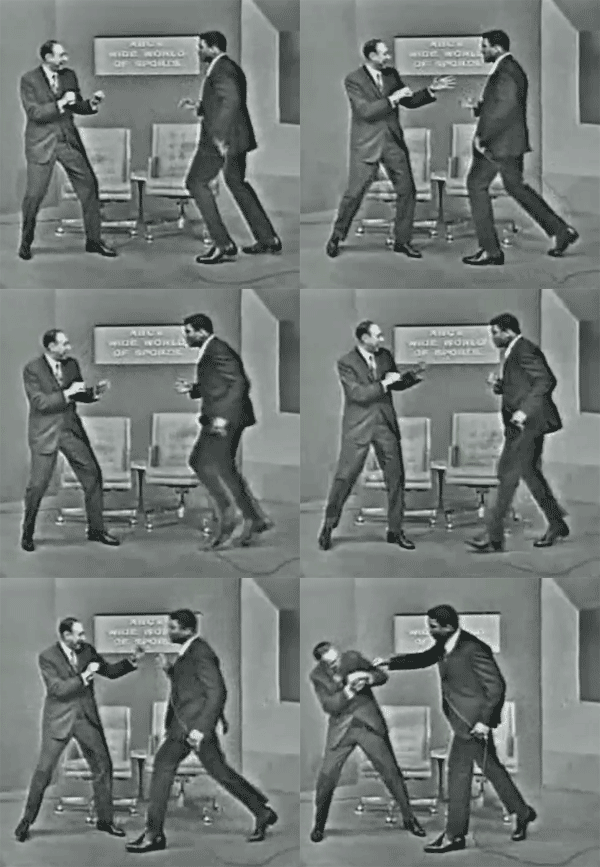
I think it more that at the end of his career he didn't know how or couldn't afford to quit so took on fights where for the first time he got really damaged. As for most of his career he was comparatively unscathed in boxing terms.Blaggard wrote:...
Pity he got Parkinson's disease, but then if you will take that many blows to the head...
That'll be the Arabs and the African tribal leaders then. Although Slavery had been around for thousands of years before them.Blaggard wrote:Let's not forget who perpetrated the crime of slavery in the first place, ...
Be fair, all we asked them was to pay a bit towards the cost of beating the French and Spanish.was it not European imperial machinations that created a need for somewhere like America and then taxed the bugger into rebellion.