Yep just was watching him yesterday
http://www.youtube.com/watch?v=EZRTzOMHQ4s
What is pseudoscience?
Re: What is pseudoscience?
If it is science then can put it to the test.
Does he have a hypothesis?
Has he conducted research and then experimentation?
Does his hypothesis fit the conclusion?
Is the experiment repeatable?
Is the experiment subject to peer review?
If the answers to all of these questions is yes, then it is science.
www.wikipedia.org/wiki/Quasicrystal
Problem solved
Re: What is pseudoscience?
He already got the nobel prize for it...
-
Arising_uk

- Posts: 12255
- Joined: Wed Oct 17, 2007 2:31 am
Re: What is pseudoscience?
When they can get others to believe them and then they repeat the results consistently.socratus wrote:Lecture : Scientific heresy. Nov 1, 2011 in Edinburgh.
/ By Matt Ridley /
My topic today is scientific heresy.
When are scientific heretics right ...

Re: What is pseudoscience?
Scientific heresy.
Matt Ridley lecture at the RSA in Edinburgh.
http://www.bishop-hill.net/blog/2011/11 ... eresy.html
=
Comment by Annonymous
In the nineteenth century many eminent physicists such as Maxwell and Lord Kelvin
believed in the ether theory.
Was the ether theory pseudoscientific?
If you think that the ether theory was pseudoscientific then it begins to seem that almost
all past scientists were pseudoscientists.
If you don't thnk that the ether theory was pseudoscientific but that the phlogiston theory
was could you explain what distinguishes the one as pseudoscientific but not the other?
Another question -
Maxwell spent an enormous amount of intellectual effort attempting to develop a mechanical
model of the electromagnetic field. Long ago virtually all physicists have abandoned this idea
and today it is almost totally forgotten.
Were Maxwell's unsuccessful attempts to develop a mechanical model of the electromagnetic
field an example of pseudoscience?
If so it seems that one of the greatest scientific minds of all time was a pseudoscientist.
You seem to use the term "pseudoscience" to include any scientific theory that is eventually
replaced or modified by a later theory.
Since modern physics consists of a number of mutually inconsistent theories e.g. general
relativity and QED, most physicists today hope that in the future more general theories will
be developed which will replace them.
If this happens does that mean that present day physics is a pseudoscience?
/ Annonymous /
http://www.bishop-hill.net/blog/2011/11 ... 4#comments
===
Matt Ridley lecture at the RSA in Edinburgh.
http://www.bishop-hill.net/blog/2011/11 ... eresy.html
=
Comment by Annonymous
In the nineteenth century many eminent physicists such as Maxwell and Lord Kelvin
believed in the ether theory.
Was the ether theory pseudoscientific?
If you think that the ether theory was pseudoscientific then it begins to seem that almost
all past scientists were pseudoscientists.
If you don't thnk that the ether theory was pseudoscientific but that the phlogiston theory
was could you explain what distinguishes the one as pseudoscientific but not the other?
Another question -
Maxwell spent an enormous amount of intellectual effort attempting to develop a mechanical
model of the electromagnetic field. Long ago virtually all physicists have abandoned this idea
and today it is almost totally forgotten.
Were Maxwell's unsuccessful attempts to develop a mechanical model of the electromagnetic
field an example of pseudoscience?
If so it seems that one of the greatest scientific minds of all time was a pseudoscientist.
You seem to use the term "pseudoscience" to include any scientific theory that is eventually
replaced or modified by a later theory.
Since modern physics consists of a number of mutually inconsistent theories e.g. general
relativity and QED, most physicists today hope that in the future more general theories will
be developed which will replace them.
If this happens does that mean that present day physics is a pseudoscience?
/ Annonymous /
http://www.bishop-hill.net/blog/2011/11 ... 4#comments
===
Re: What is pseudoscience?
socratus wrote:Scientific heresy.
Matt Ridley lecture at the RSA in Edinburgh.
http://www.bishop-hill.net/blog/2011/11 ... eresy.html
=
Comment by Annonymous
In the nineteenth century many eminent physicists such as Maxwell and Lord Kelvin
believed in the ether theory.
Was the ether theory pseudoscientific?
If you think that the ether theory was pseudoscientific then it begins to seem that almost
all past scientists were pseudoscientists.
If you don't thnk that the ether theory was pseudoscientific but that the phlogiston theory
was could you explain what distinguishes the one as pseudoscientific but not the other?
Another question -
Maxwell spent an enormous amount of intellectual effort attempting to develop a mechanical
model of the electromagnetic field. Long ago virtually all physicists have abandoned this idea
and today it is almost totally forgotten.
Were Maxwell's unsuccessful attempts to develop a mechanical model of the electromagnetic
field an example of pseudoscience?
If so it seems that one of the greatest scientific minds of all time was a pseudoscientist.
You seem to use the term "pseudoscience" to include any scientific theory that is eventually
replaced or modified by a later theory.
Since modern physics consists of a number of mutually inconsistent theories e.g. general
relativity and QED, most physicists today hope that in the future more general theories will
be developed which will replace them.
If this happens does that mean that present day physics is a pseudoscience?
/ Annonymous /
http://www.bishop-hill.net/blog/2011/11 ... 4#comments
===
Thomas Kuhn in his, 'Structures of Scientific Revolutions' does a very good job of explaining the problem. The book itself is worth reading but here is a link
http://www.wikipedia.org/wiki/The_Struc ... evolutions
Basically Kuhn is saying that science in any era will eventually undergoe a paradigm shift. Science of the day uses the predominant analytic to ask questions and to problem solve. Anyone who works outside of the paradigm is treated with a great deal of suspicion.
It is not until a new paradigm takers over that the skeptics join the supporters. Kuhn tells us that this is the way science progresses.
Re: What is pseudoscience?
The situation is:
most physicists focus on the symptoms of that is bothering technology and
not addressing the root cause that is producing the symptoms
And they / we frequently think that those symptoms are our root issues
and challenges. However, there is something much bigger and deeper
than those symptoms masking a root cause.
Is it hard to identify the root cause?
In my opinion the root cause is hidden in questions:
Was the ether theory pseudoscientific?
Does ether / vacuum exist?
Can ether / vacuum be absolute - infinite reference frame: T=0K ?
Does absolute zero T=0K have real physical meaning ?
===..
most physicists focus on the symptoms of that is bothering technology and
not addressing the root cause that is producing the symptoms
And they / we frequently think that those symptoms are our root issues
and challenges. However, there is something much bigger and deeper
than those symptoms masking a root cause.
Is it hard to identify the root cause?
In my opinion the root cause is hidden in questions:
Was the ether theory pseudoscientific?
Does ether / vacuum exist?
Can ether / vacuum be absolute - infinite reference frame: T=0K ?
Does absolute zero T=0K have real physical meaning ?
===..
Re: What is pseudoscience?
Those are all interesting questions. I guess Thomas Kuhn would say the answers will be found, addressed and answered within the existing paradigm. In other words the root cause of the problem is science working within the paradigm in order to placate the scientific method. Taking all of this into account we can say that previous scientific theories that we now see as incorrect, seemed correct at the time, so they probably cannot be classified as pseudo scientific.socratus wrote:The situation is:
most physicists focus on the symptoms of that is bothering technology and
not addressing the root cause that is producing the symptoms
And they / we frequently think that those symptoms are our root issues
and challenges. However, there is something much bigger and deeper
than those symptoms masking a root cause.
Is it hard to identify the root cause?
In my opinion the root cause is hidden in questions:
Was the ether theory pseudoscientific?
Does ether / vacuum exist?
Can ether / vacuum be absolute - infinite reference frame: T=0K ?
Does absolute zero T=0K have real physical meaning ?
===..
I saw a two good examples posted here just recently. Brian Schmidt won the Nobel Prize for proving that the universe is expanding at an increasing rate. Now someone has come up with the possibility that that theory may be incorrect. This physicist believes the universe is actually static or even contracting.
If it turn out the universe is not actually expanding at an ever increasing rate then we cannot say that the Nobel Prize was given to someone who had a pseudo-scientific theory.
Re: What is pseudoscience?
You changed the subject.Ginkgo wrote:I saw a two good examples posted here just recently.socratus wrote:The situation is:
most physicists focus on the symptoms of that is bothering technology and
not addressing the root cause that is producing the symptoms
And they / we frequently think that those symptoms are our root issues
and challenges. However, there is something much bigger and deeper
than those symptoms masking a root cause.
Is it hard to identify the root cause?
In my opinion the root cause is hidden in questions:
Was the ether theory pseudoscientific?
Does ether / vacuum exist?
Can ether / vacuum be absolute - infinite reference frame: T=0K ?
Does absolute zero T=0K have real physical meaning ?
===..
Brian Schmidt won the Nobel Prize for proving that the universe is expanding at an increasing rate.
Now someone has come up with the possibility that that theory may be incorrect.
This physicist believes the universe is actually static or even contracting.
If it turn out the universe is not actually expanding at an ever increasing rate
then we cannot say that the Nobel Prize was given to someone who
had a pseudo-scientific theory.
I was talking about reference frame and you about if
" the universe is expanding at an increasing rate"
I ask : in which reference frame the expanding of mass is going ?
in which reference frame a " big bang " and " supernova " expanded ?
I ask:
where did the mass for " big bang " , " supernova " and
" mass of expanding " come from ?
Neither " big bang " nor " supernova " gives answer and
therefore debates about static or expanding universe are abstract.
===..
Re: What is pseudoscience?
Astronomical Pseudo-Science: A Skeptic's Resource List
http://www.astrosociety.org/edu/resourc ... print.html
===
http://www.astrosociety.org/edu/resourc ... print.html
===
Re: What is pseudoscience?
socratus wrote:You changed the subject.Ginkgo wrote:I saw a two good examples posted here just recently.socratus wrote:The situation is:
most physicists focus on the symptoms of that is bothering technology and
not addressing the root cause that is producing the symptoms
And they / we frequently think that those symptoms are our root issues
and challenges. However, there is something much bigger and deeper
than those symptoms masking a root cause.
Is it hard to identify the root cause?
In my opinion the root cause is hidden in questions:
Was the ether theory pseudoscientific?
Does ether / vacuum exist?
Can ether / vacuum be absolute - infinite reference frame: T=0K ?
Does absolute zero T=0K have real physical meaning ?
===..
Brian Schmidt won the Nobel Prize for proving that the universe is expanding at an increasing rate.
Now someone has come up with the possibility that that theory may be incorrect.
This physicist believes the universe is actually static or even contracting.
If it turn out the universe is not actually expanding at an ever increasing rate
then we cannot say that the Nobel Prize was given to someone who
had a pseudo-scientific theory.
I was talking about reference frame and you about if
" the universe is expanding at an increasing rate"
I ask : in which reference frame the expanding of mass is going ?
in which reference frame a " big bang " and " supernova " expanded ?
I ask:
where did the mass for " big bang " , " supernova " and
" mass of expanding " come from ?
Neither " big bang " nor " supernova " gives answer and
therefore debates about static or expanding universe are abstract.
===..
Sorry, I did get off track.
By "abstract" are you talking about observational frames of reference? Perhaps in terms of relativity. In relation to the universe coming into existence are you also talking about it in terms of without a reference to us?
Re: What is pseudoscience?
I want to say that physicists try to explain big-bang ,SRT, quantum particles . . .Ginkgo wrote: Sorry, I did get off track.
By "abstract" are you talking about observational frames of reference?
Perhaps in terms of relativity.
In relation to the universe coming into existence are you also talking about it
in terms of without a reference to us?
. . . without using reference frame.
If we want to know what elephant is then we must to study its surrounded
space- savanna too.
If we want to know what fish is then we must to study its surrounded space -
sea / river / ocean too.
Because the different forms of living beings depend on the surrounded space.
Without using reference frame physicists explain us what fish is when . . . .
. . . this fish is on the plate on the table restaurant.
=...
#
Particle is not any independent subject; it is a particular status of physical space...
You should consider particle in the context of physical space (structure) –
as some structural defect/irregularity:
http://cerveny.in/pic//bergerslarge.gif
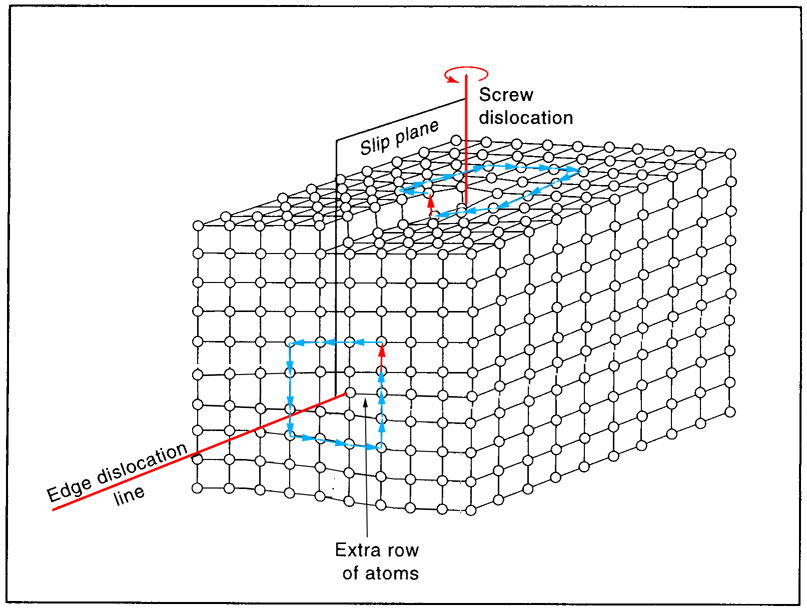
=====...
Re: What is pseudoscience?
This problem has been around since the Greeks started doing philosophy. It was insoluble then and I think it is still insoluble. I don't think we can say the Greeks were doing pseudo-metaphysics and more than we can say quantum scientists are doing pseudo-science. All I can suggest is that we seem to be stuck in a 2,000 year old paradigm. If that makes any sense, but I suspect it doesn't.socratus wrote:I want to say that physicists try to explain big-bang ,SRT, quantum particles . . .Ginkgo wrote: Sorry, I did get off track.
By "abstract" are you talking about observational frames of reference?
Perhaps in terms of relativity.
In relation to the universe coming into existence are you also talking about it
in terms of without a reference to us?
. . . without using reference frame.
If we want to know what elephant is then we must to study its surrounded
space- savanna too.
If we want to know what fish is then we must to study its surrounded space -
sea / river / ocean too.
Because the different forms of living beings depend on the surrounded space.
Without using reference frame physicists explain us what fish is when . . . .
. . . this fish is on the plate on the table restaurant.
=...
#
Particle is not any independent subject; it is a particular status of physical space...
You should consider particle in the context of physical space (structure) –
as some structural defect/irregularity:
http://cerveny.in/pic//bergerslarge.gif
=====...
Not much help I know so I would be interested in your thoughts.
Re: What is pseudoscience?
In my opinion:Ginkgo wrote: This problem has been around since the Greeks started doing philosophy.
It was insoluble then and I think it is still insoluble.
I don't think we can say the Greeks were doing pseudo-metaphysics and
more than we can say quantum scientists are doing pseudo-science.
All I can suggest is that we seem to be stuck in a 2,000 year old paradigm.
If that makes any sense, but I suspect it doesn't.
In every centure humans tried to understand the Indian Veda's ( Greek's)
philosophy from more concrete point of view. In the beginning scientists
( Newton . . . etc ) believed that science would help better to explain
the religion and the God. But the mechanical observation said to physicists :
God doesn't exist. And the power of mechanical ideas began govern in
the scientific community . . . . . till now.
And now we have quantum phenomen and quantum technology.
Genious quantum technology and poor quantum philosophy
with many illusions ideas.
( quarks, higgs - bosons , string-particles and zoo of elementary particles. )
===...
Thank's to your emails i try to understand the philosophical ideas better.Ginkgo wrote: Not much help I know so I would be interested in your thoughts.
Thank you.
=
Re: What is pseudoscience?
Since modern physics consists of a number of mutually inconsistent theories
e.g. general relativity and QED, most physicists today hope that in the future
more general theories will be developed which will replace them.
If this happens does that mean that present day physics is a pseudoscience?
/ Annonymous /
http://www.bishop-hill.net/blog/2011/11 ...
==
Does it mean that string particle is a pseudoscience if:
‘ . . . at least one big idea is missing.
How do we find that missing idea? ’
/ Book: ‘ The trouble with Physics’ by Lee Smolin. Page 308. /
Does it mean that QED is a pseudoscience if:
Feynman described QED as ' The Strange Theory of Light and Matter '
.
Does it mean that SRT is a pseudoscience if:
On September 21, 1908 Hermann Minkowski began his talk at
the 80th Assembly of German Natural Scientists and Physicians
with the now famous introduction:
" The views of space and time which I wish to lay before you have sprung
from the soil of experimental physics, and therein lies their strength.
They are radical. Henceforth space by itself, and time by itself,
are doomed to fade away into mere shadows,
and only a kind of union of the two will preserve an independent reality."
Since then the question of the ontological status of this union of space and time
has become the subject of a continued debate.
.........
. . . . . . etc
==....
e.g. general relativity and QED, most physicists today hope that in the future
more general theories will be developed which will replace them.
If this happens does that mean that present day physics is a pseudoscience?
/ Annonymous /
http://www.bishop-hill.net/blog/2011/11 ...
==
Does it mean that string particle is a pseudoscience if:
‘ . . . at least one big idea is missing.
How do we find that missing idea? ’
/ Book: ‘ The trouble with Physics’ by Lee Smolin. Page 308. /
Does it mean that QED is a pseudoscience if:
Feynman described QED as ' The Strange Theory of Light and Matter '
.
Does it mean that SRT is a pseudoscience if:
On September 21, 1908 Hermann Minkowski began his talk at
the 80th Assembly of German Natural Scientists and Physicians
with the now famous introduction:
" The views of space and time which I wish to lay before you have sprung
from the soil of experimental physics, and therein lies their strength.
They are radical. Henceforth space by itself, and time by itself,
are doomed to fade away into mere shadows,
and only a kind of union of the two will preserve an independent reality."
Since then the question of the ontological status of this union of space and time
has become the subject of a continued debate.
.........
. . . . . . etc
==....