Page 1 of 3
Wheres the big bang point?
Posted: Mon Aug 18, 2008 6:21 pm
by Arising_uk
My understanding is that the Big Bang Theory holds at present in AstroPhysics. So where do we think the point is? Where in observable Space can we point to and say "this is where all the Galaxies are rushing away from". My understanding is that AstroPhysics says that we cannot. As all the Galaxies and everything else is rushing away from each other and Light puts us in a 'light/time-bubble' that will not allow us to pin-point the Universes origin. Given all this, how is it that we can say there was a big-bang and whether, when we talk about the Universe, we know what the Universe is?
a_uk
Posted: Mon Aug 18, 2008 10:50 pm
by S G R
Big Bang theory is based upon Red Shift. I think this theory has problems.
Because the further away something is the greater the Red Shift it is assumed that the further away something is the faster it is travelling away from us. This is because it is assumed that light acts the same way as sound with regard to the Doppler Effect. This is where the pitch of something sounds higher as it travels toward one and lower as it travels away. Similarly light from further away is redder which means its frequency has been stretched out like pitch being lower.
But sound gets quieter the further away from the source it is, partly because it is spreading out, but also because it is using energy to travel.
Red Shifted light has lower energy.
Why is it not the case that light expends energy in travelling and that this explains Red Shift, which would mean that the universe was not expanding and therefore there was no Big Bang?
Posted: Tue Aug 19, 2008 9:01 am
by Nikolai
I agree SGR, also the UV ends of the spectrum are preferentially absorbed by space particles. Therefore, the further the distance, the more matter in between here and there, the more UV is absorbed, the more IR is represented.
In other words, red shift has nothing to do with the Doppler effect and the universe is static.
Posted: Tue Aug 19, 2008 3:08 pm
by Richard Baron
S G R wrote:
Red Shifted light has lower energy.
Why is it not the case that light expends energy in travelling and that this explains Red Shift, which would mean that the universe was not expanding and therefore there was no Big Bang?
I think that with the expanding Universe, we have a metric expansion effect rather than a Doppler effect.
(Comment added on 19 August at 1912 GMT): I have done a bit more digging. I think you are proposing Zwicky's tired light theory, which has gone out of favour with physicists.
Nikolai wrote:I agree SGR, also the UV ends of the spectrum are preferentially absorbed by space particles. Therefore, the further the distance, the more matter in between here and there, the more UV is absorbed, the more IR is represented.
In other words, red shift has nothing to do with the Doppler effect and the universe is static.
My understanding is that the redshift is measured not by the overall weighting of frequencies, but by the location of absorption lines in the spectrum. Particles would not have the effect you suggest on the location of those lines.
Posted: Tue Aug 19, 2008 11:09 pm
by i blame blame
S G R wrote:Big Bang theory is based upon Red Shift. I think this theory has problems.
Because the further away something is the greater the Red Shift it is assumed that the further away something is the faster it is travelling away from us. This is because it is assumed that light acts the same way as sound with regard to the Doppler Effect. This is where the pitch of something sounds higher as it travels toward one and lower as it travels away. Similarly light from further away is redder which means its frequency has been stretched out like pitch being lower.
But sound gets quieter the further away from the source it is, partly because it is spreading out, but also because it is using energy to travel.
Red Shifted light has lower energy.
Why is it not the case that light expends energy in travelling and that this explains Red Shift, which would mean that the universe was not expanding and therefore there was no Big Bang?
Sound gets fainter because it's losing energy, it does not however change pitch (i.e. fequency). Neither does light. Shift in frequency is solely because of relative velocity. When light is absorbed it only becomes dimmer.
Posted: Tue Aug 19, 2008 11:17 pm
by Richard Baron
i blame blame wrote:Sound gets fainter because it's losing energy, it does not however change pitch (i.e. fequency). Neither does light. Shift in frequency is solely because of relative velocity. When light is absorbed it only becomes dimmer.
I think S G R's argument was based on the fact that for a photon, its energy is proportional to its frequency. That fact was what lent plausibility to tired light theories.
Wheres the big bang point?
Posted: Tue Aug 19, 2008 11:22 pm
by Aetixintro
Posted: Tue Aug 19, 2008 11:34 pm
by i blame blame
Nikolai wrote:I agree SGR, also the UV ends of the spectrum are preferentially absorbed by space particles. Therefore, the further the distance, the more matter in between here and there, the more UV is absorbed, the more IR is represented.
In other words, red shift has nothing to do with the Doppler effect and the universe is static.
No, because the characteristic absorption and emission lines from those faraway galaxies are shifted along with the entire spectrum, so we know it's Doppler shift.
EDIT: Sorry, I should've read the whole thread, Rich.
Richard Baron wrote:
I think that with the expanding Universe, we have a metric expansion effect rather than a Doppler effect.
They're equivalent.
Richard Baron wrote:
I think S G R's argument was based on the fact that for a photon, its energy is proportional to its frequency. That fact was what lent plausibility to tired light theories.
I see. I have not lent this theory much thought, that is I don't mean to dismiss it right away. However, tired light has never been observed anywhere else, while Doppler shift has, which gives the expansion theory a head start in terms of credilibity.
Wheres the big bang point?
Posted: Tue Aug 19, 2008 11:49 pm
by Aetixintro
Just a picture, but still the same:
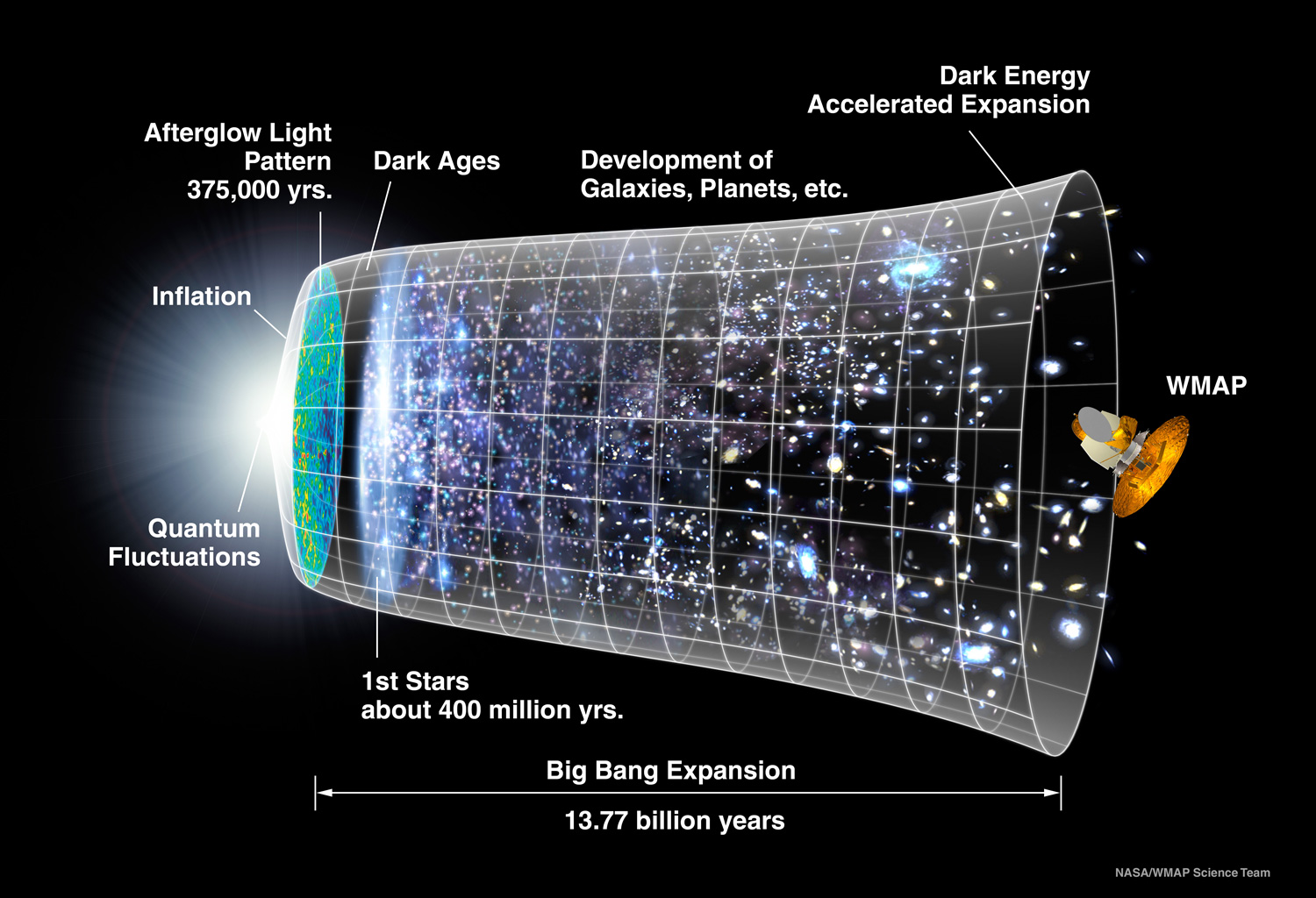
Are we closing?

A.
Posted: Wed Aug 20, 2008 2:38 am
by John W. Kelly
Richard Baron wrote: I think that with the expanding Universe, we have a metric expansion effect rather than a Doppler effect.
What is
metric expansion?
Posted: Wed Aug 20, 2008 8:50 am
by Richard Baron
John W. Kelly wrote:Richard Baron wrote: I think that with the expanding Universe, we have a metric expansion effect rather than a Doppler effect.
What is
metric expansion?
The measured distances between objects increase. Roughly, space gets bigger. It doesn't get bigger by expanding
into anything, it just grows. But this only happens to any detectable extent on a large scale. On a small scale, the expansion of human beings is explained by doughnuts, not by metric expansion.
Posted: Wed Aug 20, 2008 8:59 pm
by John W. Kelly
What is the difference between expansion as opposed to inflation?
Posted: Wed Aug 20, 2008 10:00 pm
by Psychonaut
What is the significance if there is/is not a Big Bang point?
The Big Bang is a proposed singularity. A singularity is a point before which no information can be garnered.
The proposed Big Bang is NOT a proposed first moment in time, only a proposed limit on what time we can know about.
Or is there something else you are driving at?
Posted: Thu Aug 21, 2008 1:35 am
by John W. Kelly
Whats your point?
Posted: Thu Aug 21, 2008 11:06 am
by Richard Baron
John W. Kelly wrote:What is the difference between expansion as opposed to inflation?
Inflation is a short period of very rapid expansion just after the Big Bang. There are however theories around to the effect that inflation can go on at other times.