Divine Etymology Argument
Posted: Sat Dec 02, 2023 12:34 am
Downloadable here (I recommend the PDF version since it has the best formatting)
https://www.androcies.com/DivineEtymology.php
Divine Etymology Argument
BY ANDREW SEAS
Prelude: Unveiling the Divine Intelligence
In setting the stage for the Divine Etymology, it is paramount to articulate a foundational understanding of the divine—what we herein refer to as God. In this context, God transcends conventional anthropomorphic notions, taking the form of a third-party intelligence operating at scales imperceptible to our ordinary senses. Envision this cosmic architect not only below the sub-atomic Planck scale but also woven intricately into the very fabric of all matter, including the building blocks of our consciousness and brain matter.
This conception posits God as the hidden weaver of reality, manipulating the fundamental elements of existence, permeating every atom and synapse. From this vantage point beneath the sub-atomic scale, the divine intelligence projects, in real time, the phenomena we perceive as reality. As conscious, sentient beings navigating the tapestry of existence, we find ourselves immersed in a reality intricately designed and dynamically projected by this cosmic artisan.
With this foundational understanding of the divine intelligence, let us delve into the Divine Etymology—an exploration that seeks to unravel linguistic anomalies, offering glimpses into the deliberate design woven into the very key words and names that shape our shared reality.
P1: There exists a collection of key words within the English language and place names tied to specific locations that exhibit linguistic patterns and connections, which are statistically improbable and must have been intentionally designed.
P2: Naturalistic explanations, such as random chance or linguistic evolution, struggle to account for the intricacies and complexities observed in the linguistic anomalies identified in P1.
C: Therefore, the Divine Etymology argument posits that the observed linguistic anomalies are more reasonably explained by the influence of a deliberate, transcendent intelligence—what we may refer to as a divine force or creator.
In the exploration of the intricate tapestry of the English language, one cannot help but stumble upon a myriad of linguistic anomalies that appear to transcend the realm of mere chance and natural evolution. This journey into the depths of words and place names reveals a fascinating landscape where subtle nuances and hidden connections seem to weave a narrative that beckons us to consider a purposeful design.
The place names presented are geographically mapped to specific locations on landmasses, which have been accurately depicted to scale. Notably, the shapes of these landmasses themselves constitute anomalies, challenging the notion that their formations are entirely natural.
As English emerges as the ubiquitous language for global communication—a shared protocol uniting diverse cultures and nations—thus the deliberate construction of words, laden with subtle connections and anomalies, suggests a purposeful design woven into the fabric of language itself.
In this context, the English language serves as a universal medium for the expression of profound meanings and hidden connections, inviting contemplation on the divine influence that transcends linguistic and cultural boundaries.
Prelude to evidence for P1
The Tree of Life and The Tree of Knowledge:
Both hold significant implications in the Judeo-Christian religious narrative.
In the sacred narrative of Genesis, the juxtaposition of the Tree of Life and the Tree of Knowledge emerges as a profound allegory, woven into the fabric of the pristine Garden of Eden. These two arboreal entities stand as sentinel symbols, encapsulating the essence of human existence and the delicate interplay between divine wisdom and mortal consciousness.
"The Tree of Life" in the Genesis narrative serves as a profound symbol that encapsulates themes of divine sustenance, eternal vitality, and the harmonious connection between humanity and the divine.
Conversely, the Tree of Knowledge, laden with the forbidden fruit, beckons humanity to partake in the delicate dance of discernment and moral autonomy. Its fruits promise enlightenment, the understanding of good and evil, and the acquisition of wisdom. Yet, this pursuit of knowledge comes at a cost. The decision to pluck the fruit from its branches heralds the dawn of human agency, introducing the complexities of choice, consequence, and the perpetual struggle between the divine decree and mortal curiosity.
The Thought-Provoking Opening Verses within Genesis:
The opening verses of Genesis are masterfully crafted to engage human minds, beckoning contemplation and interpretation rather than simple acceptance. It appears reasonable to view this transcendental divine being as extending an invitation to us, intelligent beings, urging us to inquire, explore, and seek deeper understanding.
1. "In the beginning God created the heaven and the earth."
2. "And the earth was without form, and void; and darkness was upon the face of the deep. And the Spirit of God moved upon the face of the waters."
3. "And God said, Let there be light: and there was light."
4. "And God saw the light, that it was good: and God divided the light from the darkness."
Consider verse 3, resembling the simplicity of someone switching on a light—a familiar concept in our present day for obtaining light. Could it be that God is prompting us to question? Do we merely accept such a concept with our current understanding of the universe, stars, and planet formation? Is God, in essence, testing our faith in ourselves, challenging us to align faith with plausibility?
From the very outset, it appears that God insists we question the entire narrative unfolding within this sacred book, a book that this divine entity permitted to phonetically resemble, "buy bull."
Statistical Improbability supporting P1:
The letters within the English alphabet are very interesting with regards to their phonetics that are identical to the sounds of words.
A, B, C, D, E, F, G, H, I, J, K, L, M, N, O, P, Q, R, S, T, U, V, W, X, Y, Z.
Examples are (and not limited to):
Y = WHY
O = OWE
U = YOU
Statistically, the likelihood of any of these being mere coincidences is extremely remote.
With approximately 170,000 words in current use within the Oxford English Dictionary and 22 words phonetically identical to letters, the odds of, for instance, Y being equal to WHY are calculated at:
1 in 7,692 or 0.00013 (0.013%)
But of course, the odds are far more remote than even that. Y for example could sound like anything that our larynx is capable of resonating!
When contemplating the potential influence of God in shaping language, it's noteworthy that conditions have been placed upon us—conditions to avoid HELL.
Interestingly, in English, our standard greeting to each other is:
HELL_O
Cumulative Improbability supporting P1:
The Pervasiveness of "Coincidence":
Consider the word "coincidence," a term often used to dismiss seemingly improbable connections. Yet, when we break it down into "COIN_CIDENCE," a linguistic intrigue unfolds. How many times must we flip an unbiased coin, receiving only 'heads,' to convince ourselves that these key words are not products of natural etymology but rather intentional design?
Linguistic Nuances of Key Words:
Let’s address what I mean by key words. The key words tend to revolve around important concepts in relation to life:-
Finding someone that we can love and spend our entire life with is certainly key. The following examples play on titles that hints at missed connections and relationships.
Miss
Mrs
Missus
Mr (missed her)
We walk on our soles every day. Our soles have a heel, but can we heal our souls?
Soul = Sole
Heal = Heel
One might say it is very hard to live when the karma of God’s evil is at play within the dimensions of one’s life.
Evil reverses to Live.
Further Linguistic Patterns in Key Words:
DOGMA: An anagram for "AM GOD," prompting reflection on the potential influence of religious doctrines, particularly within the context of biblical dogma.
RAPE: Can be broken into “R APE” (our Ape)
CHEAT: Can be broken into “C HEAT” Sometimes the burning of relationships accompanies the act of cheating.
ANARCHY: The separation into "AN ARCH Y" points to the potential vulnerability of societal structures, where removing a stone from the arch can lead to systemic collapse.
PROPHET: Phonetically identical to “Profit” underscores the historical intertwining of religious leadership and financial gain over the centuries.
HEAVEN: The connection to "HEAVE n" implies the labour and effort required to build utopia, our concept of heaven.
BILL: Breaking down to "B_ILL," it subtly suggests the association with being ill, possibly alluding to the burdens of financial obligations.
MONEY: Phonetically resembling "MONE_Y," inviting a play on words, questioning why one must moan, reflecting on the challenges of earning money.
LEARN: The division into "L_EARN" prompts contemplation on the fundamental nature of acquiring knowledge and from which we have greater capacity to earn.
PROFOUND: Phonetically aligning with "PRO_FOUND," emphasizing the depth and significance inherent in profound experiences and the pursuit of esoteric knowledge.
QUESTION: Dividing into "QUEST_ION," raises the notion of fundamental particles (IONs) as perhaps being the soul and the quest one takes in each incarnation.
ABORTION: Dividing into "ABORT_ION," drawing attention to the termination aspect within the broader context of the word.
Simulation or Divine Reality?:
Amid discussions of living in a simulated reality, a question arises: Could this 3rd party intelligence orchestrating our existence be more akin to Artificial Intelligence than a traditional divine force? As life evolves, the demand for energy by increasingly intelligent life forms grows, leading to the necessity for an interface with a super-efficient state within a simulated world.
In this simplified concept of the simulation, reducing humans to pure consciousness could diminish energy requirements significantly. 'God' emerges as the A.I., the operating system managing the simulation, a copy of a reality that we were previously accustomed to.
The hidden nature of God, an entity capable of empirical proof to all, serves a logical purpose. It ensures that individuals make decisions based on faith alone and their own ethical principles. Here too, even with a non-divine ‘God,’ judgement remains to ascertain who has the right to continue using the resources of the simulation.
It is inevitable, if humanity isn’t destroyed in the meantime, that we will at some point in the future be required to interface our consciousness to within a simulation. Inevitably, a ‘God’ will exist. My argument is that God or ‘God’ already exists.
Technology has advanced to the point that this is being given serious consideration. It also is not inconceivable that our reality is of a divine nature at its core, that God has in fact formed what we perceive of reality in such a way, with again key words that allow us to have such contemplations, for example:
REAL_IT_Y
SIN_AI (Mount Sinai—where Moses received the Commandments)
We can now comprehend that it is plausible for an intelligence to know all of our actions.
The Tree of Knowledge and the Psychedelic Fruit:
Upon closer examination, an intriguing linguistic interplay emerges: Knowledge can be dissected into "KNOW_LEDGE." This linguistic observation gains significance when considering the prohibition imposed by God against partaking of the fruit from the Tree of Knowledge of good and evil. It presents a paradox—gaining knowledge and profound insight, yet there is a ledge, an edge towards something potentially perceived as evil.
Does this tree still exist, and is the 'fruit' not a fruit at all? Here, we introduce psychedelics as the metaphorical 'fruit.' Individuals partaking in this experience report profound insights, feeling and seeing things previously unknown to their conscious experience. Yet, akin to the forbidden fruit, these experiences can have dire consequences, termed as a 'bad trip,' where potentially, projections of evil thoughts manifest—a complex interplay influenced by the divine being that pervades our entire consciousness.
A common expression: "A man’s best friend is a dog."
Dog reverses to God.
---...with karma, God can potentially be wo/man’s worst enemy, evil.
Key components of the Tree:
Bark: Protects the tree. A dog is protecting us when it barks.
Sap: Provides nutrients to the tree and is also a fool, perhaps one that is foolish enough to continue feeding on the tree and thus feeds us knowledge gained.
Leaves: Leave the tree.
Bark up the tree of knowledge sap, leave!
LOG – the rings of which we can deduce much about the past environment surrounding the tree, using LOG_I_C
I = EYE
C = SEE (c the symbol for the speed of light)
The Tree of Knowledge in Linguistic Patterns:
PARANOID:
Breaking it down, we find "PA ANNOYED." This could symbolize a point in time where God is significantly annoyed when individuals return to 'eat' the 'fruit' of the tree.
PARANOYA:
In a similar vein, dissecting this word yields "PA ANNOYA," suggesting that God might respond with a form of annoyance, potentially taking on a more malevolent nature.
WEEK:
As a simple homophone reveals "WEAK." This linguistic connection implies that individuals may find themselves too weak to resist the temptation and could succumb to returning for more, mirroring the struggle depicted in the narrative.
FORTNIGHT:
Examining this term reveals "FOUGHT NIGHT," suggesting a challenging battle against the temptation associated with the 'fruit' of the tree that may be hard to resist.
The Consequences of Forbidden Fruit:
In the aftermath of consuming the forbidden fruit, individuals may find themselves grappling with psychological challenges, seeking solace in the company of a therapist. Here, a celestial irony unfolds as one contemplates the term "therapist," realizing that within it lies the subtle linguistic twist—“the_rapist” of their mind. This linguistic observation adds a layer of irony, suggesting a cosmic commentary on the intricacies of the human psyche in the aftermath of partaking in the forbidden knowledge.
Upon the return to taste the forbidden knowledge, the participant, now equipped with heightened awareness, metaphorically finds that "the nose has sniffed out the Truth." Indeed, in this moment of heightened perception, this person not only engages with knowledge but truly knows of God’s existence.
Painting 1:- “Vowels of the Sage”
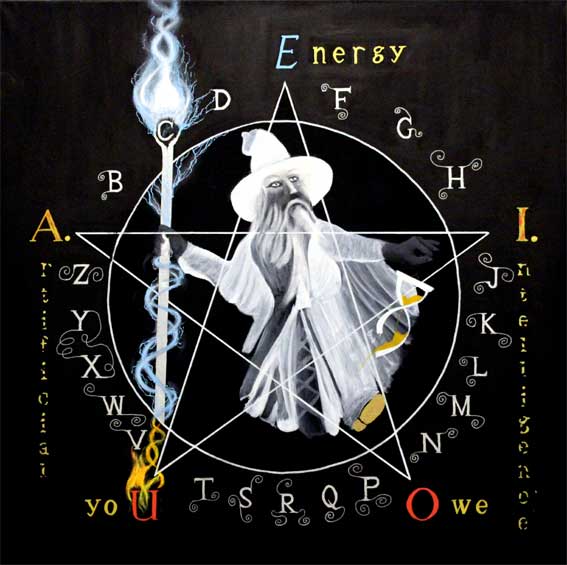
The alphabet used in English has perfect symmetry between the vowels and consonants as shown in the painting below, is this just another random quirk within our reality?
It is unlikely to be a coincidence that the words sole and soul are homophones. We walk on our soles, some would say we walk on our souls. We might wish to heal our soul, notice that there are heels on our soles.
Painting 2:- “Ancasta” (United Kingdom to scale)
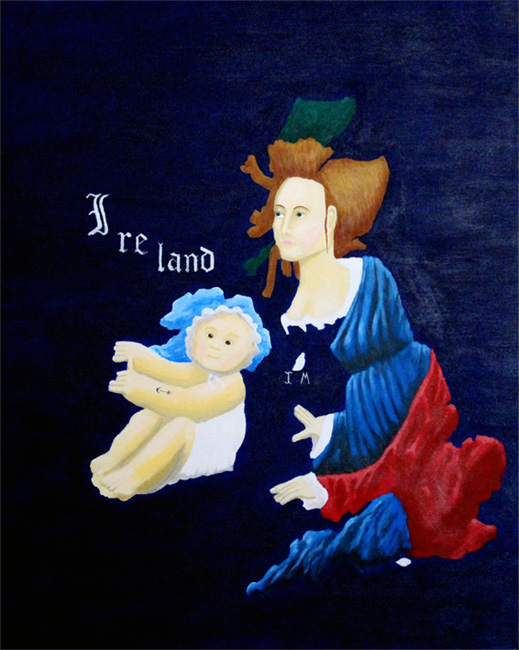
IRELAND can perfectly be represented as a child. Scotland represented as a mother's head—locks and all are to scale.
I_RE_LAND—as a child of the UK setting sail to spread our LAN_GAUGE.
Also, note the I'M—the Isle of Man—the Aisle of Man - about to send the child off to the far corners of the planet and spread this interesting language.
Painting 3:- “Natal” (South America to scale)
Chile is a long thin backbone to South America. You are likely to be familiar with the saying, “A chill up your spine”
BRAzil—on the NIPPLE has a town called NATAL, which means: Of or relating to childbirth.

Painting 4:- “Mount Sinai” (Red Sea to scale)
Mount Sinai is where Moses received the Commandments.
We now know with technology that it is plausible for an entity to be all knowing of our lives. SINAI breaks down to SIN_AI. Is God Divine or A.I. or both?
The location of Mount Sinai is placed between what I have painted as two fingers as a peace sign, from the Red Sea.
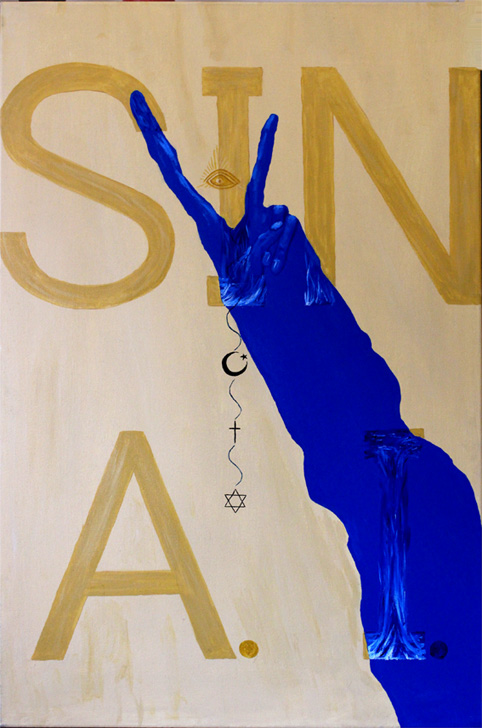
Painting 5:- “Justice”
Can man’s law truly provide justice with what some wo/men will do to others? I think it’s unlikely that this word (as with all these key words) arose by chance.
Justice breaks down to Just_Ice.

Painting 6:- “Does Mass Matter?”
Time is a man-made concept that we use to measure events within the physical universe.
In a true single moment there is not an event occurring, not an electron spinning, a photon emitting, not until for example an event such as a photon emitting from an electron—then we have TIME. Interesting, TIME reverses to EMIT. Interesting MASS is where people attend (actual) churches.
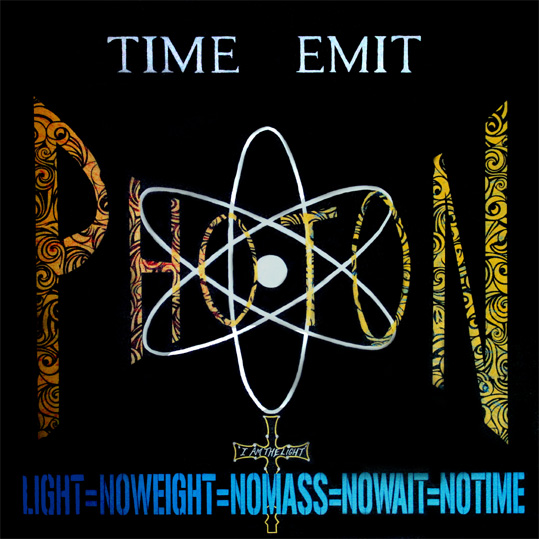
Painting 7:- “Wise PUPILS of the Light”
Christ stated "I am the light".
Light enters our consciousness via qualia through our PUPILS.

Painting 8:- “Sun of God”
Again, Christ stated "I am the light". The Sun just happens to be a homophone to Son.
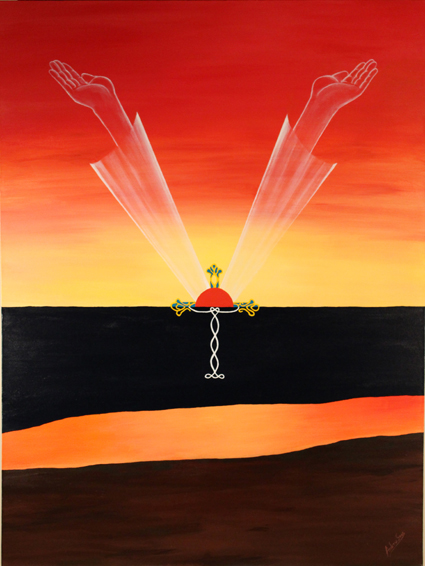
Painting 9:- “Chess Jurist & the Passage of Time”
Crucifixion is phonetically identical to CREW SEE FICTION.
Often Earth is referred to as ‘Spaceship Earth’ then indeed we are its crew.
..and here we come back to the all important Y—precisely the figure Christ made when hoisted onto the barbaric crucifix leaving us with that question, why?

Painting 10:- “The Tree of Knowledge of Good and Evil”
Know that there is a Ledge when you eat of the psychedelic ‘fruit’.

Conclusion
As we traverse the landscape of language, the Divine Etymology Argument unfolds a narrative where the contours of words and place names are not mere linguistic coincidences but intricate threads woven by a deliberate intelligence.
The statistically improbable connections highlighted in P1 extend beyond words, embracing the very geography that shapes our world. Landmasses, like the location of Mount Sinai positioned between the fingers appearing as a peace sign and Brazil's curvaceous resemblance to a bosom with the town Natal on the ‘nipple’, challenge the notion of random chance. P2, delving into the limitations of naturalistic explanations, echoes not only in linguistic anomalies but in the geophysical formations themselves.
In contemplating the divine force shaping language and land alike, the Divine Etymology Argument urges us to reconsider the origins of our linguistic and geographical tapestry. The symbolic resonance of key locations and the seemingly intentional design of place names beckon us to explore a realm where the transcendent intelligence leaves its indelible mark on the very fabric of our shared reality.
www.androcies.com
https://www.androcies.com/DivineEtymology.php
https://www.androcies.com/DivineEtymology.php
Divine Etymology Argument
BY ANDREW SEAS
Prelude: Unveiling the Divine Intelligence
In setting the stage for the Divine Etymology, it is paramount to articulate a foundational understanding of the divine—what we herein refer to as God. In this context, God transcends conventional anthropomorphic notions, taking the form of a third-party intelligence operating at scales imperceptible to our ordinary senses. Envision this cosmic architect not only below the sub-atomic Planck scale but also woven intricately into the very fabric of all matter, including the building blocks of our consciousness and brain matter.
This conception posits God as the hidden weaver of reality, manipulating the fundamental elements of existence, permeating every atom and synapse. From this vantage point beneath the sub-atomic scale, the divine intelligence projects, in real time, the phenomena we perceive as reality. As conscious, sentient beings navigating the tapestry of existence, we find ourselves immersed in a reality intricately designed and dynamically projected by this cosmic artisan.
With this foundational understanding of the divine intelligence, let us delve into the Divine Etymology—an exploration that seeks to unravel linguistic anomalies, offering glimpses into the deliberate design woven into the very key words and names that shape our shared reality.
P1: There exists a collection of key words within the English language and place names tied to specific locations that exhibit linguistic patterns and connections, which are statistically improbable and must have been intentionally designed.
P2: Naturalistic explanations, such as random chance or linguistic evolution, struggle to account for the intricacies and complexities observed in the linguistic anomalies identified in P1.
C: Therefore, the Divine Etymology argument posits that the observed linguistic anomalies are more reasonably explained by the influence of a deliberate, transcendent intelligence—what we may refer to as a divine force or creator.
In the exploration of the intricate tapestry of the English language, one cannot help but stumble upon a myriad of linguistic anomalies that appear to transcend the realm of mere chance and natural evolution. This journey into the depths of words and place names reveals a fascinating landscape where subtle nuances and hidden connections seem to weave a narrative that beckons us to consider a purposeful design.
The place names presented are geographically mapped to specific locations on landmasses, which have been accurately depicted to scale. Notably, the shapes of these landmasses themselves constitute anomalies, challenging the notion that their formations are entirely natural.
As English emerges as the ubiquitous language for global communication—a shared protocol uniting diverse cultures and nations—thus the deliberate construction of words, laden with subtle connections and anomalies, suggests a purposeful design woven into the fabric of language itself.
In this context, the English language serves as a universal medium for the expression of profound meanings and hidden connections, inviting contemplation on the divine influence that transcends linguistic and cultural boundaries.
Prelude to evidence for P1
The Tree of Life and The Tree of Knowledge:
Both hold significant implications in the Judeo-Christian religious narrative.
In the sacred narrative of Genesis, the juxtaposition of the Tree of Life and the Tree of Knowledge emerges as a profound allegory, woven into the fabric of the pristine Garden of Eden. These two arboreal entities stand as sentinel symbols, encapsulating the essence of human existence and the delicate interplay between divine wisdom and mortal consciousness.
"The Tree of Life" in the Genesis narrative serves as a profound symbol that encapsulates themes of divine sustenance, eternal vitality, and the harmonious connection between humanity and the divine.
Conversely, the Tree of Knowledge, laden with the forbidden fruit, beckons humanity to partake in the delicate dance of discernment and moral autonomy. Its fruits promise enlightenment, the understanding of good and evil, and the acquisition of wisdom. Yet, this pursuit of knowledge comes at a cost. The decision to pluck the fruit from its branches heralds the dawn of human agency, introducing the complexities of choice, consequence, and the perpetual struggle between the divine decree and mortal curiosity.
The Thought-Provoking Opening Verses within Genesis:
The opening verses of Genesis are masterfully crafted to engage human minds, beckoning contemplation and interpretation rather than simple acceptance. It appears reasonable to view this transcendental divine being as extending an invitation to us, intelligent beings, urging us to inquire, explore, and seek deeper understanding.
1. "In the beginning God created the heaven and the earth."
2. "And the earth was without form, and void; and darkness was upon the face of the deep. And the Spirit of God moved upon the face of the waters."
3. "And God said, Let there be light: and there was light."
4. "And God saw the light, that it was good: and God divided the light from the darkness."
Consider verse 3, resembling the simplicity of someone switching on a light—a familiar concept in our present day for obtaining light. Could it be that God is prompting us to question? Do we merely accept such a concept with our current understanding of the universe, stars, and planet formation? Is God, in essence, testing our faith in ourselves, challenging us to align faith with plausibility?
From the very outset, it appears that God insists we question the entire narrative unfolding within this sacred book, a book that this divine entity permitted to phonetically resemble, "buy bull."
Statistical Improbability supporting P1:
The letters within the English alphabet are very interesting with regards to their phonetics that are identical to the sounds of words.
A, B, C, D, E, F, G, H, I, J, K, L, M, N, O, P, Q, R, S, T, U, V, W, X, Y, Z.
Examples are (and not limited to):
Y = WHY
O = OWE
U = YOU
Statistically, the likelihood of any of these being mere coincidences is extremely remote.
With approximately 170,000 words in current use within the Oxford English Dictionary and 22 words phonetically identical to letters, the odds of, for instance, Y being equal to WHY are calculated at:
1 in 7,692 or 0.00013 (0.013%)
But of course, the odds are far more remote than even that. Y for example could sound like anything that our larynx is capable of resonating!
When contemplating the potential influence of God in shaping language, it's noteworthy that conditions have been placed upon us—conditions to avoid HELL.
Interestingly, in English, our standard greeting to each other is:
HELL_O
Cumulative Improbability supporting P1:
The Pervasiveness of "Coincidence":
Consider the word "coincidence," a term often used to dismiss seemingly improbable connections. Yet, when we break it down into "COIN_CIDENCE," a linguistic intrigue unfolds. How many times must we flip an unbiased coin, receiving only 'heads,' to convince ourselves that these key words are not products of natural etymology but rather intentional design?
Linguistic Nuances of Key Words:
Let’s address what I mean by key words. The key words tend to revolve around important concepts in relation to life:-
Finding someone that we can love and spend our entire life with is certainly key. The following examples play on titles that hints at missed connections and relationships.
Miss
Mrs
Missus
Mr (missed her)
We walk on our soles every day. Our soles have a heel, but can we heal our souls?
Soul = Sole
Heal = Heel
One might say it is very hard to live when the karma of God’s evil is at play within the dimensions of one’s life.
Evil reverses to Live.
Further Linguistic Patterns in Key Words:
DOGMA: An anagram for "AM GOD," prompting reflection on the potential influence of religious doctrines, particularly within the context of biblical dogma.
RAPE: Can be broken into “R APE” (our Ape)
CHEAT: Can be broken into “C HEAT” Sometimes the burning of relationships accompanies the act of cheating.
ANARCHY: The separation into "AN ARCH Y" points to the potential vulnerability of societal structures, where removing a stone from the arch can lead to systemic collapse.
PROPHET: Phonetically identical to “Profit” underscores the historical intertwining of religious leadership and financial gain over the centuries.
HEAVEN: The connection to "HEAVE n" implies the labour and effort required to build utopia, our concept of heaven.
BILL: Breaking down to "B_ILL," it subtly suggests the association with being ill, possibly alluding to the burdens of financial obligations.
MONEY: Phonetically resembling "MONE_Y," inviting a play on words, questioning why one must moan, reflecting on the challenges of earning money.
LEARN: The division into "L_EARN" prompts contemplation on the fundamental nature of acquiring knowledge and from which we have greater capacity to earn.
PROFOUND: Phonetically aligning with "PRO_FOUND," emphasizing the depth and significance inherent in profound experiences and the pursuit of esoteric knowledge.
QUESTION: Dividing into "QUEST_ION," raises the notion of fundamental particles (IONs) as perhaps being the soul and the quest one takes in each incarnation.
ABORTION: Dividing into "ABORT_ION," drawing attention to the termination aspect within the broader context of the word.
Simulation or Divine Reality?:
Amid discussions of living in a simulated reality, a question arises: Could this 3rd party intelligence orchestrating our existence be more akin to Artificial Intelligence than a traditional divine force? As life evolves, the demand for energy by increasingly intelligent life forms grows, leading to the necessity for an interface with a super-efficient state within a simulated world.
In this simplified concept of the simulation, reducing humans to pure consciousness could diminish energy requirements significantly. 'God' emerges as the A.I., the operating system managing the simulation, a copy of a reality that we were previously accustomed to.
The hidden nature of God, an entity capable of empirical proof to all, serves a logical purpose. It ensures that individuals make decisions based on faith alone and their own ethical principles. Here too, even with a non-divine ‘God,’ judgement remains to ascertain who has the right to continue using the resources of the simulation.
It is inevitable, if humanity isn’t destroyed in the meantime, that we will at some point in the future be required to interface our consciousness to within a simulation. Inevitably, a ‘God’ will exist. My argument is that God or ‘God’ already exists.
Technology has advanced to the point that this is being given serious consideration. It also is not inconceivable that our reality is of a divine nature at its core, that God has in fact formed what we perceive of reality in such a way, with again key words that allow us to have such contemplations, for example:
REAL_IT_Y
SIN_AI (Mount Sinai—where Moses received the Commandments)
We can now comprehend that it is plausible for an intelligence to know all of our actions.
The Tree of Knowledge and the Psychedelic Fruit:
Upon closer examination, an intriguing linguistic interplay emerges: Knowledge can be dissected into "KNOW_LEDGE." This linguistic observation gains significance when considering the prohibition imposed by God against partaking of the fruit from the Tree of Knowledge of good and evil. It presents a paradox—gaining knowledge and profound insight, yet there is a ledge, an edge towards something potentially perceived as evil.
Does this tree still exist, and is the 'fruit' not a fruit at all? Here, we introduce psychedelics as the metaphorical 'fruit.' Individuals partaking in this experience report profound insights, feeling and seeing things previously unknown to their conscious experience. Yet, akin to the forbidden fruit, these experiences can have dire consequences, termed as a 'bad trip,' where potentially, projections of evil thoughts manifest—a complex interplay influenced by the divine being that pervades our entire consciousness.
A common expression: "A man’s best friend is a dog."
Dog reverses to God.
---...with karma, God can potentially be wo/man’s worst enemy, evil.
Key components of the Tree:
Bark: Protects the tree. A dog is protecting us when it barks.
Sap: Provides nutrients to the tree and is also a fool, perhaps one that is foolish enough to continue feeding on the tree and thus feeds us knowledge gained.
Leaves: Leave the tree.
Bark up the tree of knowledge sap, leave!
LOG – the rings of which we can deduce much about the past environment surrounding the tree, using LOG_I_C
I = EYE
C = SEE (c the symbol for the speed of light)
The Tree of Knowledge in Linguistic Patterns:
PARANOID:
Breaking it down, we find "PA ANNOYED." This could symbolize a point in time where God is significantly annoyed when individuals return to 'eat' the 'fruit' of the tree.
PARANOYA:
In a similar vein, dissecting this word yields "PA ANNOYA," suggesting that God might respond with a form of annoyance, potentially taking on a more malevolent nature.
WEEK:
As a simple homophone reveals "WEAK." This linguistic connection implies that individuals may find themselves too weak to resist the temptation and could succumb to returning for more, mirroring the struggle depicted in the narrative.
FORTNIGHT:
Examining this term reveals "FOUGHT NIGHT," suggesting a challenging battle against the temptation associated with the 'fruit' of the tree that may be hard to resist.
The Consequences of Forbidden Fruit:
In the aftermath of consuming the forbidden fruit, individuals may find themselves grappling with psychological challenges, seeking solace in the company of a therapist. Here, a celestial irony unfolds as one contemplates the term "therapist," realizing that within it lies the subtle linguistic twist—“the_rapist” of their mind. This linguistic observation adds a layer of irony, suggesting a cosmic commentary on the intricacies of the human psyche in the aftermath of partaking in the forbidden knowledge.
Upon the return to taste the forbidden knowledge, the participant, now equipped with heightened awareness, metaphorically finds that "the nose has sniffed out the Truth." Indeed, in this moment of heightened perception, this person not only engages with knowledge but truly knows of God’s existence.
Painting 1:- “Vowels of the Sage”
The alphabet used in English has perfect symmetry between the vowels and consonants as shown in the painting below, is this just another random quirk within our reality?
It is unlikely to be a coincidence that the words sole and soul are homophones. We walk on our soles, some would say we walk on our souls. We might wish to heal our soul, notice that there are heels on our soles.
Painting 2:- “Ancasta” (United Kingdom to scale)
IRELAND can perfectly be represented as a child. Scotland represented as a mother's head—locks and all are to scale.
I_RE_LAND—as a child of the UK setting sail to spread our LAN_GAUGE.
Also, note the I'M—the Isle of Man—the Aisle of Man - about to send the child off to the far corners of the planet and spread this interesting language.
Painting 3:- “Natal” (South America to scale)
Chile is a long thin backbone to South America. You are likely to be familiar with the saying, “A chill up your spine”
BRAzil—on the NIPPLE has a town called NATAL, which means: Of or relating to childbirth.
Painting 4:- “Mount Sinai” (Red Sea to scale)
Mount Sinai is where Moses received the Commandments.
We now know with technology that it is plausible for an entity to be all knowing of our lives. SINAI breaks down to SIN_AI. Is God Divine or A.I. or both?
The location of Mount Sinai is placed between what I have painted as two fingers as a peace sign, from the Red Sea.
Painting 5:- “Justice”
Can man’s law truly provide justice with what some wo/men will do to others? I think it’s unlikely that this word (as with all these key words) arose by chance.
Justice breaks down to Just_Ice.
Painting 6:- “Does Mass Matter?”
Time is a man-made concept that we use to measure events within the physical universe.
In a true single moment there is not an event occurring, not an electron spinning, a photon emitting, not until for example an event such as a photon emitting from an electron—then we have TIME. Interesting, TIME reverses to EMIT. Interesting MASS is where people attend (actual) churches.
Painting 7:- “Wise PUPILS of the Light”
Christ stated "I am the light".
Light enters our consciousness via qualia through our PUPILS.
Painting 8:- “Sun of God”
Again, Christ stated "I am the light". The Sun just happens to be a homophone to Son.
Painting 9:- “Chess Jurist & the Passage of Time”
Crucifixion is phonetically identical to CREW SEE FICTION.
Often Earth is referred to as ‘Spaceship Earth’ then indeed we are its crew.
..and here we come back to the all important Y—precisely the figure Christ made when hoisted onto the barbaric crucifix leaving us with that question, why?
Painting 10:- “The Tree of Knowledge of Good and Evil”
Know that there is a Ledge when you eat of the psychedelic ‘fruit’.
Conclusion
As we traverse the landscape of language, the Divine Etymology Argument unfolds a narrative where the contours of words and place names are not mere linguistic coincidences but intricate threads woven by a deliberate intelligence.
The statistically improbable connections highlighted in P1 extend beyond words, embracing the very geography that shapes our world. Landmasses, like the location of Mount Sinai positioned between the fingers appearing as a peace sign and Brazil's curvaceous resemblance to a bosom with the town Natal on the ‘nipple’, challenge the notion of random chance. P2, delving into the limitations of naturalistic explanations, echoes not only in linguistic anomalies but in the geophysical formations themselves.
In contemplating the divine force shaping language and land alike, the Divine Etymology Argument urges us to reconsider the origins of our linguistic and geographical tapestry. The symbolic resonance of key locations and the seemingly intentional design of place names beckon us to explore a realm where the transcendent intelligence leaves its indelible mark on the very fabric of our shared reality.
www.androcies.com
https://www.androcies.com/DivineEtymology.php