Causality and continuous process
Posted: Tue Nov 23, 2021 10:25 pm
The cause and effect cannot lay at the same point. Therefore, the effect comes after the cause. Therefore, there is no continuous causal chain.
I am not talking about a conjunction of events but a sequence of events.Impenitent wrote: ↑Tue Nov 23, 2021 11:43 pm the constant conjunction of events does not necessitate the certain relation of cause and effect
-Imp
The following is a version of the "liar paradox":
No, the cause of paradox is the pairing of two sentences. The effect is the paradox itself. Think of it this way, if you don't pair the sentences you don't have any paradox, therefore, pairing them leads to the paradox, which means that the cause is the pairing.seeds wrote: ↑Wed Nov 24, 2021 10:49 pmThe following is a version of the "liar paradox":The effect of those two sentences is a paradox.
- The sentence below is true.
The sentence above is false.
The cause of the paradox and its effect are simultaneously present in the pairing of the two sentences.
So, in this instance, how do you separate the effect from its cause?
_______
No, bahman, the paradox (i.e., the "effect") is caused by the contradiction implicit in the pairing of the two sentences. Thus the "contradiction" holds both the cause and its effect at the same point.bahman wrote: ↑Thu Nov 25, 2021 12:30 amNo, the cause of paradox is the pairing of two sentences. The effect is the paradox itself. Think of it this way, if you don't pair the sentences you don't have any paradox, therefore, pairing them leads to the paradox, which means that the cause is the pairing.seeds wrote: ↑Wed Nov 24, 2021 10:49 pmThe following is a version of the "liar paradox":The effect of those two sentences is a paradox.
- The sentence below is true.
The sentence above is false.
The cause of the paradox and its effect are simultaneously present in the pairing of the two sentences.
So, in this instance, how do you separate the effect from its cause?
_______
This post I posted in the other thread is relevant.
Exactly What is Time?
There is general agreement among philosophers that time is continuous (i.e. we do not experience it as stopping and starting, or darting about at random), and that it has an intrinsic direction or order (i.e. we all agree that events progress from past to present to future).
http://www.exactlywhatistime.com/philosophy-of-time/
The above basis and fundamentals are Kantian, that is why Kant is indispensable.As I had stated there are many relevant perspectives whether continuous motion is possible or impossible.
In the OP above the said 'thing' that is supposed to be in continuous motion is presumed to be a thing-in-itself. Such a presumption is grounded on an illusion. As such whatever conclusion derived from this presumption is illusory.
Another more realistic perspective is that so-called thing that is subject to continuous motion is not a thing-in-itself [an independent object] but an event or a state.
Here is a point from Timmer,
Note the bolded elements.An event, something happening, entails that a State comes into existence which did not exist before.
It must contain something new which was not contained in the preceding appearance,
and thus perceiving an event means that one Perception follows another Perception (like Hume’s example),
but A is now followed by B (one ball followed after another),
as opposed to perceiving the pool table which is a non-event and therefore undetermined.
Thus, observing an event entails observing a determined order which is necessary, and observing an Object is not;
however, this distinction is not given by Perception, Sensibility does not think, Perception-wise both are exactly the same.[49]
The only way that one can make the distinction is if there is a Rule, a priori (else it would be inductive and contingent), which determines this,
and therefore the Experience of an event is only possible under this presupposition [of a rule]
The implication of the above is;
1. Time is not an independent thing and it flow continually into infinity.
2. The flow of one state/event A into another B is grounded on continuous time.
3. So it is not the case of one independent object A at t1 becoming object A2 at t2.
4. Therefore continuous motion is possible within an event [1 &2].
The above is a crude presentation, the detailed argument with complex premises is rather complex.
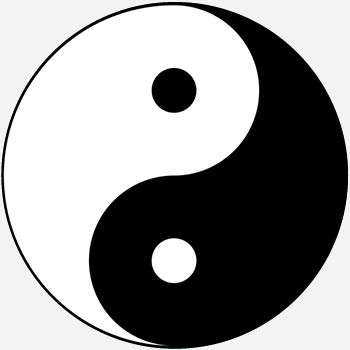
Certainly! The effect(s) of a cause may even be very distant from each other in time or locality. A causal chain is nothing but the sequence of events in some man's story. If God exists then God alone knows the true sequence of events.
I agree. But more often than not Taoist descriptions sound to seekers like mystical gobbledegook. Usually you have to break the description of hard determinism into easy stages.Veritas Aequitas wrote: ↑Thu Nov 25, 2021 6:35 am Note the Yin-Yang image below which demonstrate where continuous causality & motion is possible and a model for how the whole of reality works.
On the surface of it Yin and Yang are seemingly discrete entities.
For example night [Yin] follow from day [Yang], winter [Yin] from autumn [Yang], etc.
Also note day, night, winter, autumn are not discrete entities.
It is the same with whatever things or objects that you perceived as independent entities as discrete things, but they are not, rather they are events of reality which is the bigger event.
However from the Yin-Yang model, the fundamental is that Yin and Yang are not discrete, they are in complementarity.
Note the smaller dots, there is already an inherent black dot [Yin] in white [Yang] and vice-versa. So we need to take into account this fundamental potential within.
That there is already cause [Yin] in effect [Yang], this seem contradictory but the point is both are grounded on the Tao.
This is the same as cause and effect in terms of EVENTS [not discrete objects] are grounded on the fundamental continuous time.
This is like a "flywheel" where there is an inherent potential that drive the continuous motion fundamentally, i.e. where interpreted on the surface is .... effect[cause] to effect [cause] to effect[cause] to effect[cause], and so on continuously.
As such there is no such thing as a discrete 100% Cause and 100% Effect, the reality is that cause and effect are always in a complementarity combination of %, i.e. an event is always x%-Cause/Y%effect thus if Cause is 30% then Effect is 70%, if cause increase to 40% then effect is reduced to 60% and so on.
Therefore cause/effect and effect/cause are a continual process of events changing from one state to another, NOT changing from one discrete object to another discrete object in discrete time.
When those who are so dogmatic that causality and time are not continuous, they are actually infected with some kind of neural parasite that turned them into dogmatic zombies - literally.
This infection is the same as the real cases of parasites infecting insects and their caterpillars turning them into zombies to serve the purpose of their species.
But seeds , it was not bahman, it was you who selected these two sentences. Out of all possible sentences you could have set up for comparison you chose two that clash with each other.seeds wrote: ↑Thu Nov 25, 2021 4:31 amNo, bahman, the paradox (i.e., the "effect") is caused by the contradiction implicit in the pairing of the two sentences. Thus the "contradiction" holds both the cause and its effect at the same point.bahman wrote: ↑Thu Nov 25, 2021 12:30 amNo, the cause of paradox is the pairing of two sentences. The effect is the paradox itself. Think of it this way, if you don't pair the sentences you don't have any paradox, therefore, pairing them leads to the paradox, which means that the cause is the pairing.seeds wrote: ↑Wed Nov 24, 2021 10:49 pm
The following is a version of the "liar paradox":The effect of those two sentences is a paradox.
- The sentence below is true.
The sentence above is false.
The cause of the paradox and its effect are simultaneously present in the pairing of the two sentences.
So, in this instance, how do you separate the effect from its cause?
_______
_______
No, the contradiction or paradox is the effect.seeds wrote: ↑Thu Nov 25, 2021 4:31 amNo, bahman, the paradox (i.e., the "effect") is caused by the contradiction implicit in the pairing of the two sentences. Thus the "contradiction" holds both the cause and its effect at the same point.bahman wrote: ↑Thu Nov 25, 2021 12:30 amNo, the cause of paradox is the pairing of two sentences. The effect is the paradox itself. Think of it this way, if you don't pair the sentences you don't have any paradox, therefore, pairing them leads to the paradox, which means that the cause is the pairing.seeds wrote: ↑Wed Nov 24, 2021 10:49 pm
The following is a version of the "liar paradox":The effect of those two sentences is a paradox.
- The sentence below is true.
The sentence above is false.
The cause of the paradox and its effect are simultaneously present in the pairing of the two sentences.
So, in this instance, how do you separate the effect from its cause?
_______
_______