Why is Rodin considered to be an artist?
Posted: Sat Jan 07, 2017 5:10 pm
Frankly his works don't impress me.
PhilX
PhilX
Also, Frank ...Philosophy Explorer wrote:Frankly his works don't impress me.
PhilX
An artist doesn't have to impress everyone in order to be considered an artist.Philosophy Explorer wrote:Frankly his works don't impress me.
PhilX
Presumably, an artist merely has to be an artist in order to be considered an artist. Much in the same way as a cyclist has to ride a bike in order to be considered a cyclist. Or a wanker has to.... And so on.Conde Lucanor wrote:
An artist doesn't have to impress everyone in order to be considered an artist.
A great artist doesn't have to impress everyone in order to be considered a great artist.
An artist doesn't have to be a great artist in order to be considered an artist.
I'm with you there, up to a point. I know exactly what someone has to do to qualify as a cyclist. Being a wanker is straightforward too, and doesn't require wheels, but I'm not so clear about what activity makes someone an artist.Harbal wrote:Presumably, an artist merely has to be an artist in order to be considered an artist. Much in the same way as a cyclist has to ride a bike in order to be considered a cyclist. Or a wanker has to.... And so on.
He is considered an artist because he acted like one, accepted the label, and made things that artists make, like sculptures and drawings. You not being impressed wouldn't be enough to strip him of the label. You'd have to build a theory around him being an imposter: someone pretending to be an artist, pulling it off, then continuing with the charade because the going was good. Or you would have to define your idea or position on why and how someone is or should be/can be, considered as an artist, and then say why Rodin does not fit your idea(l) or model.Philosophy Explorer wrote:Frankly his works don't impress me.
PhilX
This is a very old position if ever it was one.the artist is an artist simply because he is faithful to reality, and has the technical skill to transfer reality from light reflecting off a source, through...
Not really. Not everyone clearly perceives reality now that the singularity draws nigh for one and all.Pluto wrote:This is a very old position if ever it was one.the artist is an artist simply because he is faithful to reality, and has the technical skill to transfer reality from light reflecting off a source, through...
You get the point and the example illustrates well. Not the case in that other sentence:Harbal wrote:Much in the same way as a cyclist has to ride a bike in order to be considered a cyclist.Conde Lucanor wrote:
An artist doesn't have to impress everyone in order to be considered an artist.
A great artist doesn't have to impress everyone in order to be considered a great artist.
An artist doesn't have to be a great artist in order to be considered an artist.
There is some kind of circular reasoning here, as the phrase "has to be an artist" directly leads to the problem of who is "to be considered an artist". The answer to what is considered an artist is what an artist will be. The answer to what is considered a cyclist should not be: "that which is merely a cyclist", but "that which rides a bike".Harbal wrote:Presumably, an artist merely has to be an artist in order to be considered an artist.
In other words:Pluto wrote:This is a very old position if ever it was one.the artist is an artist simply because he is faithful to reality, and has the technical skill to transfer reality from light reflecting off a source, through...
His most brilliant student was Camille Claudel who, in the opinion of many surpassed Rodin in her all too short career.Walker wrote:Also, Frank ...Philosophy Explorer wrote:Frankly his works don't impress me.
PhilX
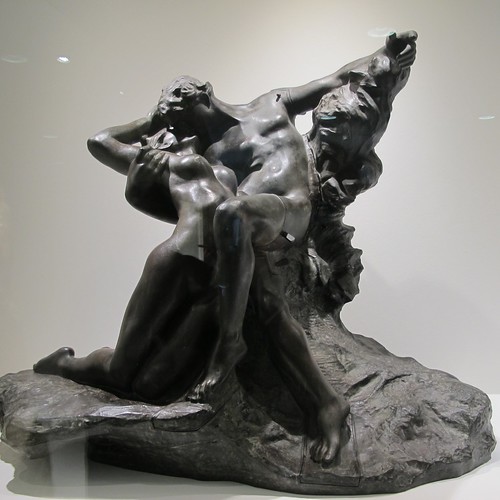
Here’s the thing that grabbed my attention about a picture of a clay sculpture, I think it was clay, that I once saw, which can also be seen in Rodin’s work.
The face was asymmetrical and not only realistic, but therefore of a realistic human, and showed the tension of the movement towards the balance of symmetry in the mind that shapes the face. The artist isn’t an artist because he intended to mold that tension, though he may be conceptually aware of that tension in the process of shaping form with fingertips, and afterwards. Rather, the artist is an artist simply because he is faithful to reality, and has the technical skill to transfer reality from light reflecting off a source, through the optic nerve and into the brain, then through the nerves to the fingertips to reproduce in a particular three-dimensional medium, the same pattern of light reflections that can be objectively recognized by most any brain. The transference process involves as much observation as technique, and observation requires undistracted placement of attention. In the case of the bust, either the observation or the technique is rather pure, perhaps a combination of both, and that in itself is enough to deserve a measure of respect.
Rodin was also a teacher, with at least one student who sculpted him.