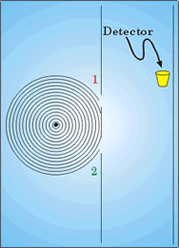
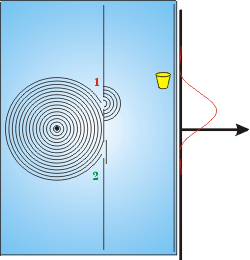
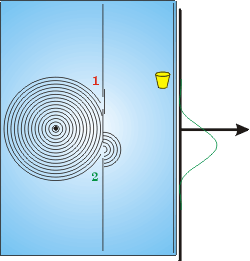
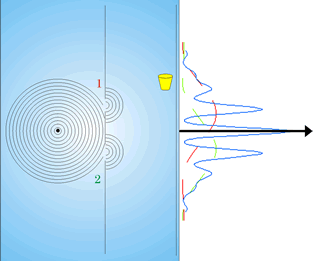
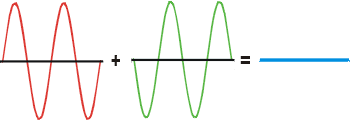
This is basically what is happening at the minima in the interference pattern.
destructive interference
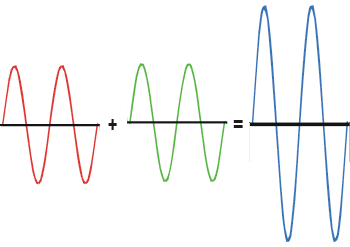
The figure to the right shows the two waves in phase. The total wave is the sum of the two. This is what is occurring at the maxima in the interference pattern
http://www.upscale.utoronto.ca/GeneralI ... struct.gif
An electron gun, such as in a television picture tube, generates a beam of electrons. In this section we discuss how it works. These details are not important for our primary purpose here, so you may jump to the next section by clicking here.
A diagram of an electron gun appears to the right. There are two vertical metal plates; the right hand plate has a small hole cut in it. A voltage source, indicated by V, maintains a voltage across the plates, with the left hand plate negative and the right hand plate positive.
When a metal plate is heated, a process called thermionic emission literally boils electrons off the surface of the metal. Normally the electrons only make it a fraction of a millimeter away; this is because when the electron boiled off the surface of the metal, it left that part of the plate with a net positive electric charge which pulls the electron right back into the plate.
picture of electron gun
In the figure, we are heating up the left hand plate so thermionic electrons will be boiled off the surface. But because of the voltage difference being maintained across the plate, electrons that boil off between the two plates do not fall back into the plate, but instead are attracted to the right hand positive plate. Most of the electrons crash into the positive plate, as shown. However, the electron in the middle would have crashed into the plate except that we have cut a hole in that part of it. So we get a beam of electrons out of this "electron gun."
In real electron guns, such as at the back of a TV picture tube, the negative plate is not heated with a campfire as in our figure. Instead, a small filament of wire has a current passed through it. The filament heats up, glows red, and heats up the negative plate. You may have seen that red glow in the back of a TV picture tube.
We control the speed of the electrons in the beam with the voltage, and the number of electrons by how hot we make the negatively charged plate.
One more small point. Because the hole in the right hand plate is not of zero size, electrons can emerge in directions slightly away from perfectly horizontal. Thus, the beam of electrons will tend to "spray" somewhat.
From now on we will put the electron gun in a black box, and represent the electron beam coming from it as shown to the right.
The Two Slit Experiment for Electrons
In the previous section we discussed how to produce a beam of electrons from an electron gun. Here we place the electron gun inside a glass tube that has had all the air evacuated. The right hand glass screen has its inside coated with a phosphor that will produce a small burst of light when an electron strikes it. In a TV picture tube, for example, fields direct the beam of electrons to the desired location, the intensities of the electrons are varied depending on where we are steering the beam, and our minds and/or eyes interpret the flashes as the image we are seeing on the television.
Now, "everybody knows" that electrons are particles. They have a well defined mass, electric charge, etc. Some of those properties are listed to the right. Waves do not have well defined masses etc.
Property Value
Mass 9.11 × 10⁻³¹ kg
Electric Charge 1.60 × 10⁻¹⁹ Coulombs
Spin angular momentum 5.28 × 10⁻³⁵ Joule-seconds
When an electron leaves the electron gun, a fraction of a second later a flash of light appears on the screen indicating where it landed. A wave behaves differently: when a wave leaves the source, it spreads out distributing its energy in a pattern as discussed at the beginning of this document.
Except, when we place two slits in the path of the electrons, as shown, on the screen we see an interference pattern! In fact, what we see on the screen looks identical to the double slit interference pattern for light that we saw earlier.
If this seems very mysterious, you are not alone. Understanding what is going on here is in some sense equivalent to understanding Quantum Mechanics. I do not understand Quantum Mechanics. Feynman admitted that he never understood Quantum Mechanics. It may be true that nobody can understand Quantum Mechanics in the usual meaning of the word "understand."
We will now extend our understanding of our lack of understanding. One possibility about the origins of the interference pattern is that the electrons going through the upper slit are somehow interacting with the electrons going through the lower slit. Note that we have no idea what such a mechanism could be, but are a little desperate to understand what is going on here. We can explore this idea by slowing down the rate of electrons from the gun so that only one electron at a time is in the system. What we do is fire an electron, see where the flash of light occurs on the phosphor screen, wait a while for everything to settle down, then fire another electron, noting where it lands on the screen.
After we have fired a large number of electrons, we will discover that the distribution of electrons is still the interference pattern.
I have prepared a small Flash animation that simulates this result. You may access the animation by clicking on the red button to the right. The file size is 6.4k. You may get the Flash player free from
http://www.macromedia.com/; our animation is for Version 5 or later of the player.
Click here for the animation
You may wish to know that in the animation, the position of the electron is generated randomly using a Monte Carlo technique. Thus, if you "Rewind" the animation to start it over, the build-up of the histogram is almost certain to not be identical to the previous "trial."
We conclude that whatever is going on to cause the interference pattern does not involve two or more electrons interacting with each other. And yet, with one electron at a time in the system, with both slits open there are places on the screen where the electrons do not go, although with only one slit open some electrons do end up at that position.
Now, to get an interference pattern we take a wave, split it up into two parts, send each part through one of the slits, and then recombine the waves. Does this mean that a single electron is somehow going through both slits at once? This too is amenable to experimental test.
The result of doing the test turns out to be independent of the details of how the experiment is done, so we shall imagine a very simple arrangement: we place a light bulb behind the slits and look to see what is going on. Note that in a real experiment, the light bulb would have to be smaller than in the figure and tucked in more tightly behind the slits so that the electrons don't collide with it. double slit with light bulb
We will see a small flash of light when an electron passes through the slits.
What we see is that every electron is acting completely "normal": one-half the electrons are going through the upper slit, one-half are going through the lower slit, and which is going to be the case for a given electron appears to be random. A small (24k) gif animation of what we might see in this experiment may be seen here.
But meanwhile, we have a colleague watching the flashes of light on the phosphor coated screen who says "Hey, the interference pattern has just gone away!" And in fact the distribution of electrons on the screen is now exactly the same as the distribution of machine gun bullets that we saw above.
The figure to the right is what our colleague sees on the screen.
Evidently, when we look at what is going on at the slits we cause a qualitative and irreversible change in the behavior of the electrons. This is usually called the "Heisenberg Uncertainty Principle."
Everyone has always known that doing any measurement on any system causes a disturbance in the system. The classical paradigm has been that at least in principle the disturbance can be minimised to the point that it is negligible.
Is it possible to minimise the disturbance being caused by the light bulb? We can turn down the intensity of the light it is emitting. However, if we try it, just at the point that the light is getting so faint that we are missing some of the electrons, the interference pattern starts to come back! In fact, if the light intensity is, say, such that we are missing one-half of the electrons, we have one-half an interference pattern and one-half a particle distribution. So this attempt to minimise the disturbance didn't work out: we still don't know what is going on at the slits when we see the interference pattern.
There is yet another way to minimise the disturbance. The light contains energy, and it turns out that if we increase the wavelength of the light, towards the infrared, the energy of each part of the light goes down. Perhaps if we decrease the energy in the light we won't be scattering it off the electrons so violently. So, we start increasing the wavelength of the light emitted by the light bulb. We continue to see all the electrons, and at first we always see that one-half of them are going through the upper slit and one-half are going through the lower slit.
However, our ability to resolve two positions in space by looking depends on the wavelength of the light that we are seeing with. And just at the point that the wavelength of the light from the lightbulb gets so large that although we can see the electrons we can't tell which slit they went through, the interference pattern comes back.
A student once remarked that we should do a "better" experiment. The Heisenberg Uncertainty Principle says that such a better experiment does not exist. Einstein in particular devoted a lot of time trying to devise such a better measurement; all his attempts failed.
The conclusion of all this is that there is no experiment that can tell us what the electrons are doing at the slits that does not also destroy the interference pattern. This seems to imply that there is no answer to the question of what is going on at the slits when we see the interference pattern. The path of the electron from the electron gun to the screen is not knowable when we see the interference pattern. As Heisenberg said, "The path [of the electron] comes into existence only when we observe it."
We will be discussing interpretations of what all this may mean in great detail later. For now I will briefly mention a "standard" if incomplete interpretation. If we think that the probability of where the electron is in space is a wave, then when we don't look the probability wave has two pieces at the slits, representing the fact that there is a 50% chance the electron went through the upper slit and a 50% chance it went through the lower slit. These two probability waves from the two slits, then, recombine at the screen and cause the interference pattern.
When we look, we "collapse the state" in a 100% chance it went through one slit and a 0% chance it went through the other. And in this circumstance the two probability waves for the two slits cannot then recombine at the screen to cause an interference pattern: for each electron there is only one non-zero probability wave.
Finally, then, we have two contradictory yet complementary models of the two-slit experiment for electrons. In one model the electron is a particle that somehow exhibits an interference pattern. In the other model, the electron is a wave that somehow manifests as a particle whenever we look at it.
A Flash animation of these two models, both incomplete, may be accessed by clicking the red button to the right. The file size is 23k and will appear in a separate window.