Page 1 of 1

∞ What Time is it? ∞

Posted: Wed Jun 04, 2014 7:21 pm
by Bill Wiltrack
.


When you think about it -


................................
Image


..................................................
all time fits into just a very few numbers


.

Re: ∞ What Time is it? ∞

Posted: Wed Jun 04, 2014 8:02 pm
by Wyman
And yet, between any two of those numbers there are an infinite series of numbers.

Re: ∞ What Time is it? ∞

Posted: Wed Jun 04, 2014 10:41 pm
by Ginkgo
Wyman wrote:And yet, between any two of those numbers there are an infinite series of numbers.


This would be true of discrete time. On the other hand, wyman could be correct.

Funny you should mention this because it was the topic of a recent thread.

Re: ∞ What Time is it? ∞

Posted: Wed Jun 04, 2014 10:53 pm
by Blaggard
Ginkgo wrote:
Wyman wrote:And yet, between any two of those numbers there are an infinite series of numbers.


This would be true of discrete time. On the other hand, wyman could be correct.
Funny you should mention this because it was the topic of a recent thread.
Wyman makes a very good point about time actually, and post the thread I would be interested in reading it... :)

Set theory does have infinities in it's axioms, it says that cardinality exists amongst infinities ie some infinities are larger than others, which is although conceptual quite interesting, this was originally opined by Cantor in his continuum hypothesis, something some people had trouble with and lead to some interesting mathematical problems like Hilbert's Hotel and so on.

Usually certain axioms in number theory make use of the axioms outlined by ZFC or other axioms in maths, but as yet they have no useful function other than as curiosities in the number lines. That said imaginary numbers were useless 600 years ago, and look at them now so... who knows if they will find an application in real world science, or remain just curiosities of form and merely play things of pure mathematicians.
In mathematics, Zermelo–Fraenkel set theory with the axiom of choice, named after mathematicians Ernst Zermelo and Abraham Fraenkel and commonly abbreviated ZFC, is one of several axiomatic systems that were proposed in the early twentieth century to formulate a theory of sets without the paradoxes of naive set theory such as Russell's paradox. Specifically, ZFC does not allow unrestricted comprehension. Today ZFC is the standard form of axiomatic set theory and as such is the most common foundation of mathematics.

ZFC is intended to formalize a single primitive notion, that of a hereditary well-founded set, so that all entities in the universe of discourse are such sets. Thus the axioms of ZFC refer only to sets, not to urelements (elements of sets which are not themselves sets) or classes (collections of mathematical objects defined by a property shared by their members). The axioms of ZFC prevent its models from containing urelements, and proper classes can only be treated indirectly.

Formally, ZFC is a one-sorted theory in first-order logic. The signature has equality and a single primitive binary relation, set membership, which is usually denoted ∈. The formula a ∈ b means that the set a is a member of the set b (which is also read, "a is an element of b" or "a is in b").

There are many equivalent formulations of the ZFC axioms. Most of the ZFC axioms state the existence of particular sets defined from other sets. For example, the axiom of pairing says that given any two sets a and b there is a new set {a, b} containing exactly a and b. Other axioms describe properties of set membership. A goal of the ZFC axioms is that each axiom should be true if interpreted as a statement about the collection of all sets in the von Neumann universe (also known as the cumulative hierarchy).

The metamathematics of ZFC has been extensively studied. Landmark results in this area established the independence of the continuum hypothesis from ZFC, and of the axiom of choice from the remaining ZFC axioms...[]
[]... Criticisms

For criticism of set theory in general, see Objections to set theory

ZFC has been criticized both for being excessively strong and for being excessively weak, as well as for its failure to capture objects such as proper classes and the universal set.

Many mathematical theorems can be proven in much weaker systems than ZFC, such as Peano arithmetic and second order arithmetic (as explored by the program of reverse mathematics). Saunders Mac Lane and Solomon Feferman have both made this point. Some of "mainstream mathematics" (mathematics not directly connected with axiomatic set theory) is beyond Peano arithmetic and second order arithmetic, but still, all such mathematics can be carried out in ZC (Zermelo set theory with choice), another theory weaker than ZFC. Much of the power of ZFC, including the axiom of regularity and the axiom schema of replacement, is included primarily to facilitate the study of the set theory itself.

On the other hand, among axiomatic set theories, ZFC is comparatively weak. Unlike New Foundations, ZFC does not admit the existence of a universal set. Hence the universe of sets under ZFC is not closed under the elementary operations of the algebra of sets. Unlike von Neumann–Bernays–Gödel set theory and Morse–Kelley set theory (MK), ZFC does not admit the existence of proper classes. These ontological restrictions are required for ZFC to avoid Russell's paradox, but critics argue these restrictions make the ZFC axioms fail to capture the informal concept of set. A further comparative weakness of ZFC is that the axiom of choice included in ZFC is weaker than the axiom of global choice included in MK.

There are numerous mathematical statements undecidable in ZFC. These include the continuum hypothesis, the Whitehead problem, and the Normal Moore space conjecture. Some of these conjectures are provable with the addition of axioms such as Martin's axiom, large cardinal axioms to ZFC. Some others are decided in ZF+AD where AD is the axiom of determinacy, a strong supposition incompatible with choice. One attraction of large cardinal axioms is that they enable many results from ZF+AD to be established in ZFC adjoined by some large cardinal axiom (see projective determinacy). The Mizar system and Metamath have adopted Tarski–Grothendieck set theory, an extension of ZFC, so that proofs involving Grothendieck universes (encountered in category theory and algebraic geometry) can be formalized.
Mathmos, eh, they does like their proofs. :P

Re: ∞ What Time is it? ∞

Posted: Thu Jun 05, 2014 11:21 am
by jackles
the soul is a state of consciouse awarness which exists independent of the brain.in a similar way to the photon being independent of the source frame of ref.

Re: ∞ What Time is it? ∞

Posted: Thu Jun 05, 2014 9:02 pm
by Blaggard
jackles wrote:the soul is a state of consciouse awarness which exists independent of the brain.in a similar way to the photon being independent of the source frame of ref.
A photon is not independent of the frame of reference jackles.

Re: ∞ What Time is it? ∞

Posted: Fri Jun 06, 2014 5:53 am
by jackles
blags the photon is free in a relative sence from its origonal ref frame as it relates equal to all ref frames.but it still relates so its just an analergy to what i believe consciousness to be which is completly nonlocal.

Re: ∞ What Time is it? ∞

Posted: Sat Jun 07, 2014 12:08 am
by Blaggard
jackles wrote:blags the photon is free in a relative sence from its origonal ref frame as it relates equal to all ref frames.but it still relates so its just an analergy to what i believe consciousness to be which is completly nonlocal.
No it isn't and this is half the problem you have, it just isn't at all. Saying it is, is of course your prerogative, say it as much as you like, but it doesn't become any more true the 1 millionth time you say it, k?

It's an analogy of course, but it's an analogy to nothing that makes any sense.

Re: ∞ What Time is it? ∞

Posted: Sat Jun 07, 2014 12:13 am
by Wyman
I have a question for someone who knows physics that this exchange reminded me of. I never completely understood the constancy of the propagation of light in relativity. I often think I understand it and then realize I probably don't. If a star is coming towards you at 1 million units per hour, then is the light propagating from the star in your direction going at c, or at c plus a million?

Re: ∞ What Time is it? ∞

Posted: Sat Jun 07, 2014 12:30 am
by Blaggard
Wyman wrote:I have a question for someone who knows physics that this exchange reminded me of. I never completely understood the constancy of the propagation of light in relativity. I often think I understand it and then realize I probably don't. If a star is coming towards you at 1 million units per hour, then is the light propagating from the star in your direction going at c, or at c plus a million?
No the speeds are not additive the speed of any object relatively speaking is always less than c unless it is light then the speed is c in a relative frame, but it is undefined by special relativity per se, it's taken as a constant, the rest of the science just falls out if you use the speed of light which happens to be c.

Take two photons travelling at light speed moving towards each other because of the Lorentzian nature of the process, they are actually just travelling towards each other at c, if an object has mass though that is slightly different.

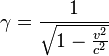
It's not that hard maths though so let me show you the equation and you can plug any mass into it and see the relative speed in comoving objects. By the way, you can put mass anywhere in the equation not everywhere although that would work too if the mass was x; it won't affect it, which is the beauty of the Lorentz mathematics.
Image

ok and the variables are:

Image

The above is just a time space transform by rotation of 90 degrees, about any axis, you can ignore it in 4 dimensions x,y,z and time, a rotation about 90 degrees in that circumstance leaves you in any other axes concern so it's kinda like revolving around a circle you revolve enough you are back at the start or in this case just talking about another axis in space-time.

Now look very carefully at the maths, and plug in some numbers. Velocity is v, and the speed of light is c. This applies to the photon primarily and as you can see in maths you have a square root of 1 with a photon and something less than 1 with a mass object.

In a mass object you have a square root that is not 0, stick mass in there and...

Co moving objects move at less than c and as they travel towards each other they are experiencing time and space dilation which means the speeds are not additive.

I have probably explained this very badly, but suffice to say time dilation and space dilation means that no objects are ever moving at c except photons, and no mass objects which are comoving even if it's two trains running at each other can ever reach c, all the rest of the maths is a result of that, and the fact it works as well, in all experiment the predictions match up, of course you will get the usual suspects saying the maths doesn't work or the science doesn't work, but they never do any experiment to disprove it, so it's just specious I don't like science, so I will talk around it, but there are plenty of forums that indulge in that so suffice to say you can find the utter bilge of the untrained physicist who is apparently smarter than all the best minds in the 19th to 21st century anywhere, without ever studying science or the maths or even knowing what the hell they are talking about. :P :)

End of the day and to sum it up it means things are experiencing a sort of time dilation as they approach c, and a space dilation to that limit all energy and matter to c as the speed limit of the universe. Why this happens is anyone's guess, in fact, it's an open question, suffice to say it seems by experiment that is the way reality works...

Re: ∞ What Time is it? ∞

Posted: Sun Jun 08, 2014 4:27 pm
by jackles
time is consciousness relating its self to an event or change of energy status.