bahman wrote: ↑Sun Jan 31, 2021 9:47 pm
Veritas Aequitas wrote: ↑Sun Jan 31, 2021 6:35 am
While we must always ask questions of reality, we cannot simply jump to hasty conclusions because there are no justified reasons.
As I had stated,
- What is most practical and realistic is to work downward [justified empirically and philosophically] reducibly to the deepest point of
1. what is known,
2. knowable and
3. of possible experience.
Then we take Wittgenstein's advice,
“Whereof one cannot speak, thereof one must be silent”,
i.e. literally shut up and do not insist there is something further than whereof one cannot speak.
I simply disagree with him and you. One should always investigate any situation. What is the point of being intellectual otherwise?
I did not state we must stop questioning and investigation, note I stated above,
"While
we must always ask questions of reality,
we cannot simply jump to hasty conclusions because [where] there are no justified reasons."
What Wittgenstein implied in the quote above [in the context of his Book PI] is we should not jump hastily to a conclusion as in your case, i.e. there is a soul that survives beyond physical death.
Veritas Aequitas wrote: ↑Sun Jan 31, 2021 6:35 am
You on the other hand is jumping to conclusion based on very crude pseudo reasoning, i.e. because we are conscious, therefore there must be a source of consciousness.
Your system of belief is incoherent because it cannot answer many things one of them being the hard problem of consciousness. The reality is that there is no problem in here once you change your system of belief. You are left on the field once you kill the opponent thought. There are other problems like Libet result of free will.
My system of belief is realistic i.e. confined to what is real.
As I stated above, we can continue to ask questions regarding the hard problem of consciousness, but we should not be hasty in jumping to conclusion on what is 'hard' consciousness without sound arguments and proof.
The point is what is to be believed must be verified and justified empirically and philosophically within a framework and system of knowledge [FSK.]
What you believed is not verified and justified empirically and philosophically within a framework and system of knowledge [FSK.] You are relying the metaphysical approach where the conclusions are illusory.
Veritas Aequitas wrote: ↑Sun Jan 31, 2021 6:35 am
Therefrom you cannot justify your conclusion empirically and philosophically.
Empirically? I experience mind once. Philosophically I have arguments in favor of my ideas
.
Personally I have various so-called altered states of consciousness. There are many reports of experiences of altered stated of consciousness, soul, God, the absolute, oneness, unity consciousness, etc. by those who meditate, pray, took hallucinogens, has mental illness, has brain damage, etc. see
https://www.youtube.com/watch?v=qIiIsDIkDtg
Research has indicated all those altered states of consciousness are merely brain activities within the person and not that there is something real [an essence] that is experienced.
Veritas Aequitas wrote: ↑Sun Jan 31, 2021 6:35 am
Philosophers of the past, and modern has realized the above delusional tendency. Here is where Kant critiqued Plato hastiness [read it carefully];
Kant in CRP wrote:It was thus that Plato left the World of the Senses, as setting too narrow Limits to 2 the Understanding [intellect], and ventured out beyond it on the wings of the Ideas, in the empty Space [la la land] of the Pure Understanding.
He [Plato] did not observe that with all his efforts he made no advance meeting no resistance that might, as it were, serve as a support upon which he could take a stand, to which he could apply his powers, and so set his Understanding in motion.
It is, indeed, the common fate of Human Reason to complete its Speculative Structures as speedily as may be,
and only afterwards to enquire whether the foundations are reliable.
All sorts of excuses will then be appealed to, in order to reassure us of their solidity, or rather indeed 3 to enable us to dispense altogether with so late and so dangerous an enquiry.
I have stated, why you and gang are so hasty in jumping to conclusion is due to a psychological drive to eliminate the existential dissonance.
I suggest you try to research and understand this point which is happening within your psyche.
I have many mental states that you are not aware of it.
As mentioned above, those mental states if extra-ordinary are more likely to be hallucinations.
If you are not engaging in some spiritual practices or took hallucinogenic drugs, it could be due to temporal epilepsy, or otherwise.
Veritas Aequitas wrote: ↑Sun Jan 31, 2021 6:35 am
Moreover, it is important to know whether you can break a chain of causality or not. Yes, or no?
I am not sure of your question.
You'll need to elaborate with more details.
I believe in 'causality' which is conditioned upon the human conditions and there is no ultimate cause that can be known experientially.
Think of the situation when you are following a chain of causality, chain of thoughts for example. Couldn't you stop thinking whenever you wish?
It is impossible to deliberately and consciously stop thinking, i.e. to think of "stopping thinking" is thinking itself.
I have been meditator for MANY years and have done various types of meditation.
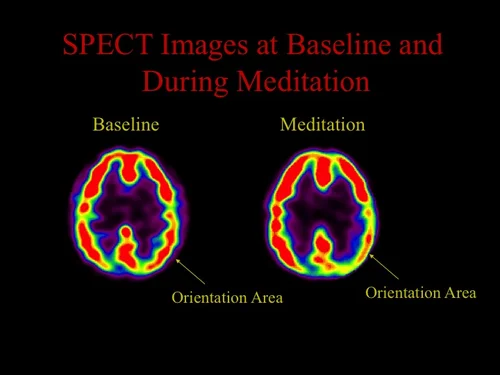
In mantra meditation, one in a state of relaxation focus on a sound to its source but at some point, all thinking [consciously aware] will disappeared and one is suspended in 'nothingness' with extra-ordinary experiences.
In that case, it is not willing and deliberately stopping the thinking process, but the loss of thinking is merely spontaneous.
But whatever is experienced in that state is not "of-something" i.e. an essence but rather is it merely a manifestation of brain activities.
Even though there is "no" conscious thinking, the brain is still active and neurons are still firing in its various parts. See image below;
See the work of Andrew Newberg;
http://www.andrewnewberg.com/
Dr. Andrew Newberg is a neuroscientist who studies the relationship between brain function and various mental states. He is a pioneer in the neurological study of religious and spiritual experiences, a field known as “neurotheology.” His research includes taking brain scans of people in prayer, meditation, rituals, and trance states, in an attempt to better understand the nature of religious and spiritual practices and attitudes.
