Choice or Determinism

So what's really going on?

Moderators: AMod, iMod

User avatar
Arising_uk
Posts: 12259
Joined: Wed Oct 17, 2007 2:31 am

Re:

Post by Arising_uk »

henry quirk wrote:Up-thread, Manny wrote: "Materialism has run it's course."

I wrote: 'It occurs to me Boeree wrote sumthin' on this as well (that -- like piece I linked up-thread -- aligns with my own thinkin'). I'll have to hunt it down (or give you my own dreary synopsis).'

You’re all spared my dreary synopsis…

http://webspace.ship.edu/cgboer/qualityrealism.html
Well! It's nice to be surprised every now and then and have one's preconceptions of others given a big boot and you have definitely done that with this article Henry so thank you.

Good read. Enjoyable to find someone from a different discipline taking an informed opinion upon matters philosophical and making a fair and interesting fist of it. Wasn't sure I was going to read it at first but a quick gander at the author list changed my mind. Didn't know many of them but it's not often I hear two of my favs mentioned, Husserl and Merleau-Ponty(its all Kant this, Descartes that and Neitchze the other(not knocking 'em)) but the clincher was linking-in the motorcycling monk, now that you don't get very often. :D
Thanks again.
p.s.
Reminds me of uwots approach, theres stuff that does the stuff we think the stuff does. :)
Ginkgo
Posts: 2657
Joined: Mon Apr 30, 2012 2:47 pm

Re: Re:

Post by Ginkgo »

Arising_uk wrote:
henry quirk wrote:Up-thread, Manny wrote: "Materialism has run it's course."

I wrote: 'It occurs to me Boeree wrote sumthin' on this as well (that -- like piece I linked up-thread -- aligns with my own thinkin'). I'll have to hunt it down (or give you my own dreary synopsis).'

You’re all spared my dreary synopsis…

http://webspace.ship.edu/cgboer/qualityrealism.html
Well! It's nice to be surprised every now and then and have one's preconceptions of others given a big boot and you have definitely done that with this article Henry so thank you.

Good read. Enjoyable to find someone from a different discipline taking an informed opinion upon matters philosophical and making a fair and interesting fist of it. Wasn't sure I was going to read it at first but a quick gander at the author list changed my mind. Didn't know many of them but it's not often I hear two of my favs mentioned, Husserl and Merleau-Ponty(its all Kant this, Descartes that and Neitchze the other(not knocking 'em)) but the clincher was linking-in the motorcycling monk, now that you don't get very often. :D
Thanks again.
p.s.
Reminds me of uwots approach, theres stuff that does the stuff we think the stuff does. :)

Interesting article, but I think there is a flaw in the argument and it can be found in a single sentence:

"Frank Jackson's famous colour scientist Mary, if she knew everything there is to know about blue, could indeed create blue from the descriptions she has, assuming that she is "open" to blue (capable of seeing it) at all. But this means she will have actually experienced blue prior to anyone finally showing it to her. The thought experiment is a pretty poor one."

I don't think she has actually experienced blue prior to anyone finally showing it to her. What she actually has is all the data needed to recognize blue. However, recognizing doesn't imply experiencing.

It is possible for a computer programme to recognize blue, or any other colour for that matter. This doesn't mean that the computer has prior knowledge of the colour blue.

I think Boeree dismisses the Knowledge Argument without any real justification.
Last edited by Ginkgo on Sun Jan 26, 2014 10:08 am, edited 6 times in total.
Ginkgo
Posts: 2657
Joined: Mon Apr 30, 2012 2:47 pm

Re: Re:

Post by Ginkgo »

double post
User avatar
attofishpi
Posts: 13319
Joined: Tue Aug 16, 2011 8:10 am
Location: Orion Spur
Contact:

Re: Re:

Post by attofishpi »

Ginkgo wrote:double post
lol :D
Blaggard
Posts: 2245
Joined: Fri Jan 10, 2014 9:17 pm

Re: Re:

Post by Blaggard »

Ginkgo wrote:
Arising_uk wrote:
henry quirk wrote:Up-thread, Manny wrote: "Materialism has run it's course."

I wrote: 'It occurs to me Boeree wrote sumthin' on this as well (that -- like piece I linked up-thread -- aligns with my own thinkin'). I'll have to hunt it down (or give you my own dreary synopsis).'

You’re all spared my dreary synopsis…

http://webspace.ship.edu/cgboer/qualityrealism.html
Well! It's nice to be surprised every now and then and have one's preconceptions of others given a big boot and you have definitely done that with this article Henry so thank you.

Good read. Enjoyable to find someone from a different discipline taking an informed opinion upon matters philosophical and making a fair and interesting fist of it. Wasn't sure I was going to read it at first but a quick gander at the author list changed my mind. Didn't know many of them but it's not often I hear two of my favs mentioned, Husserl and Merleau-Ponty(its all Kant this, Descartes that and Neitchze the other(not knocking 'em)) but the clincher was linking-in the motorcycling monk, now that you don't get very often. :D
Thanks again.
p.s.
Reminds me of uwots approach, theres stuff that does the stuff we think the stuff does. :)

Interesting article, but I think there is a flaw in the argument and it can be found in a single sentence:

"Frank Jackson's famous colour scientist Mary, if she knew everything there is to know about blue, could indeed create blue from the descriptions she has, assuming that she is "open" to blue (capable of seeing it) at all. But this means she will have actually experienced blue prior to anyone finally showing it to her. The thought experiment is a pretty poor one."

I don't think she has actually experienced blue prior to anyone finally showing it to her. What she actually has is all the data needed to recognize blue. However, recognizing doesn't imply experiencing.

It is possible for a computer programme to recognize blue, or any other colour for that matter. This doesn't mean that the computer has prior knowledge of the colour blue.

I think Boeree dismisses the Knowledge Argument without any real justification.
Personally I prefer the threefold chord idea as expressed by Hilary Putnam, who started out with a robot idea, code matches code, and then came up with multirealisability, ie the human brain realises red not in the same way as everyone else, but slowly and relevantly hones in on what redness is with experience. So essentially with time subjectivity becomes more objective, but my red is not your red, it's just we can agree on the qualia of red if we accept contingent things as being red, hence there is a red we can agree on but it is independant of the qualia or totally objective experience.

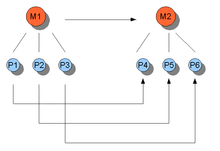
Image

Multiple realizability
An illustration of multiple realizability. M stands for mental and P stands for physical. It can be seen that more than one P can instantiate one M, but not vice versa. Causal relations between states are represented by the arrows (M1 goes to M2, etc.)

Putnam's best-known work concerns philosophy of mind. His most noted original contributions to that field came in several key papers published in the late 1960s that set out the hypothesis of multiple realizability.[24] In these papers, Putnam argues that, contrary to the famous claim of the type-identity theory, it is not necessarily true that "Pain is identical to C-fibre firing." Pain, according to Putnam's papers, may correspond to utterly different physical states of the nervous system in different organisms, and yet they all experience the same mental state of "being in pain".

Putnam cited examples from the animal kingdom to illustrate his thesis. He asked whether it was likely that the brain structures of diverse types of animals realize pain, or other mental states, the same way. If they do not share the same brain structures, they cannot share the same mental states and properties. The answer to this puzzle had to be that mental states were realized by different physical states in different species. Putnam then took his argument a step further, asking about such things as the nervous systems of alien beings, artificially intelligent robots and other silicon-based life forms. These hypothetical entities, he contended, should not be considered incapable of experiencing pain just because they lack the same neurochemistry as humans. Putnam concluded that type-identity theorists had been making an "ambitious" and "highly implausible" conjecture which could be disproven with one example of multiple realizability.[25] This argument is sometimes referred to as the "likelihood argument".[24]

Putnam formulated a complementary argument based on what he called "functional isomorphism". He defined the concept in these terms: "Two systems are functionally isomorphic if 'there is a correspondence between the states of one and the states of the other that preserves functional relations'." In the case of computers, two machines are functionally isomorphic if and only if the sequential relations among states in the first are exactly mirrored by the sequential relations among states in the other. Therefore, a computer made out of silicon chips and a computer made out of cogs and wheels can be functionally isomorphic but constitutionally diverse. Functional isomorphism implies multiple realizability.[25] This argument is sometimes referred to as an "a priori argument".[24]

Jerry Fodor, Putnam, and others noted that, along with being an effective argument against type-identity theories, multiple realizability implies that any low-level explanation of higher-level mental phenomena is insufficiently abstract and general.[25][26][27] Functionalism, which identifies mental kinds with functional kinds that are characterized exclusively in terms of causes and effects, abstracts from the level of microphysics, and therefore seemed to be a better explanation of the relation between mind and body. In fact, there are many functional kinds, such as mousetraps, software and bookshelves, which are multiply realized at the physical level.[25]
Matter of taste though but I think he was in the right ball park, as much as you can think that given the state of consciousness science.


I've thought long and hard if you'll pardon the pun on his book, and I as yet can't see a flaw. Of course that does not mean he is right it means I am limited in arguing with his conjecture.
Ginkgo
Posts: 2657
Joined: Mon Apr 30, 2012 2:47 pm

Re: Re:

Post by Ginkgo »

Blaggard wrote:
Personally I prefer the threefold chord idea as expressed by Hilary Putnam, who started out with a robot idea, code matches code, and then came up with multirealisability, ie the human brain realises red not in the same way as everyone else, but slowly and relevantly hones in on what redness is with experience. So essentially with time subjectivity becomes more objective, but my red is not your red, it's just we can agree on the qualia of red if we accept contingent things as being red, hence there is a red we can agree on but it is independant of the qualia or totally objective experience.

Image

Multiple realizability
An illustration of multiple realizability. M stands for mental and P stands for physical. It can be seen that more than one P can instantiate one M, but not vice versa. Causal relations between states are represented by the arrows (M1 goes to M2, etc.)

Putnam's best-known work concerns philosophy of mind. His most noted original contributions to that field came in several key papers published in the late 1960s that set out the hypothesis of multiple realizability.[24] In these papers, Putnam argues that, contrary to the famous claim of the type-identity theory, it is not necessarily true that "Pain is identical to C-fibre firing." Pain, according to Putnam's papers, may correspond to utterly different physical states of the nervous system in different organisms, and yet they all experience the same mental state of "being in pain".

Putnam cited examples from the animal kingdom to illustrate his thesis. He asked whether it was likely that the brain structures of diverse types of animals realize pain, or other mental states, the same way. If they do not share the same brain structures, they cannot share the same mental states and properties. The answer to this puzzle had to be that mental states were realized by different physical states in different species. Putnam then took his argument a step further, asking about such things as the nervous systems of alien beings, artificially intelligent robots and other silicon-based life forms. These hypothetical entities, he contended, should not be considered incapable of experiencing pain just because they lack the same neurochemistry as humans. Putnam concluded that type-identity theorists had been making an "ambitious" and "highly implausible" conjecture which could be disproven with one example of multiple realizability.[25] This argument is sometimes referred to as the "likelihood argument".[24]

Putnam formulated a complementary argument based on what he called "functional isomorphism". He defined the concept in these terms: "Two systems are functionally isomorphic if 'there is a correspondence between the states of one and the states of the other that preserves functional relations'." In the case of computers, two machines are functionally isomorphic if and only if the sequential relations among states in the first are exactly mirrored by the sequential relations among states in the other. Therefore, a computer made out of silicon chips and a computer made out of cogs and wheels can be functionally isomorphic but constitutionally diverse. Functional isomorphism implies multiple realizability.[25] This argument is sometimes referred to as an "a priori argument".[24]

Jerry Fodor, Putnam, and others noted that, along with being an effective argument against type-identity theories, multiple realizability implies that any low-level explanation of higher-level mental phenomena is insufficiently abstract and general.[25][26][27] Functionalism, which identifies mental kinds with functional kinds that are characterized exclusively in terms of causes and effects, abstracts from the level of microphysics, and therefore seemed to be a better explanation of the relation between mind and body. In fact, there are many functional kinds, such as mousetraps, software and bookshelves, which are multiply realized at the physical level.[25]
Matter of taste though but I think he was in the right ball park, as much as you can think that given the state of consciousness science.


I've thought long and hard if you'll pardon the pun on his book, and I as yet can't see a flaw. Of course that does not mean he is right it means I am limited in arguing with his conjecture.

Yes, I agree it is a very good casual explanation for consciousness. I would like some time to think about the implications of this ( if any) when it comes to a knowledge argument. Could be interesting.
User avatar
henry quirk
Posts: 16379
Joined: Fri May 09, 2008 8:07 pm
Location: 🔥AMERICA🔥
Contact:

Post by henry quirk »

"so thank you"

You're welcome!
EagerForTruth
Posts: 61
Joined: Thu Jan 30, 2014 2:05 pm

Re: Choice or Determinism

Post by EagerForTruth »

Note: My first post on here and the excitement of any philosophical forum after I've been so long away from serious discussion (hard to find in mainstream society in my experience) - but while I consider my logical and intuitive faculties are well functioning, in the context of discussion with people who've been in the circles of established philosophy I haven't versed myself in many of the previous discussions.

Onto main thoughts. This argument between choice and determinism, although always one of the most fun and intractable each time I've had it, could also be considered to be largely about semantics....

One on hand, I can and have made a choice to join this forum and join this discussion - that would be at face a proof of choosing, for at the basic level, people at least (and by extension at some level any being capable of self-awareness) take actions based on choices.

On the other hand, my basic understanding of the determinism argument is that if you trace the entirety of existence down to it's components, each "decision" is inevitable by being a product of the contributing factors. People make "choices" based on their set of facts, priorities, and intentions. Much like a machine or computer program that takes input and generates output without any possibility to go against the variables given, in this case, all events and contributing factors that came before. An earlier post referenced the medical breakthroughs that hint vaguely that our brains act deterministically and we create the sense of choice for ourselves afterward.

Really, to try and say one or the other can be known for certain may not be possible - at least for humans as far as I can tell.

Interestingly I do think it also can be a question that reveals more about the outlook and perspective each individual person has about the world around them. I give some credence to both points of view, but I rather would lean toward a world with choice. If nothing else, to remove choice from the human condition would also remove any responsibility or meaning to being aware. A crude example would be - if a person cannot choose or choose not to commit murder, why should they be responsible for it?

So largely for me - I feel it's largely about semantics, but I like to think we have choice because it gives a strong reason for a moral purpose and desire to engage with and improve both oneself and the world at large.

As my first post and since I "chose" to not fully research every detail in the preceding posts, forgive any small discrepancies. Either way I'm fairly comfortable my the main logic is intact.
bergie15
Posts: 67
Joined: Tue Jun 11, 2013 12:18 am

Re: Choice or Determinism

Post by bergie15 »

This is a response to the experiment with Mary. How would she be able to recognize the color blue without experiencing it previously? She would have to have some prior experience of the color, or else she would not know what it was. I know what certain objects are because I have seen them before and learned what they are. With colors, I think one would have to have prior experience.
Ginkgo
Posts: 2657
Joined: Mon Apr 30, 2012 2:47 pm

Re: Choice or Determinism

Post by Ginkgo »

bergie15 wrote:This is a response to the experiment with Mary. How would she be able to recognize the color blue without experiencing it previously? She would have to have some prior experience of the color, or else she would not know what it was. I know what certain objects are because I have seen them before and learned what they are. With colors, I think one would have to have prior experience.

The idea of the Mary argument is not to show that Mary has had some previous experience with colour. All that is required for the proponents of qualia, is for Mary to gain some type of knowledge upon seeing colour for the first time. Another way of saying this would be: "Does Mary gain any new information that she didn't have prior to her release from the black and white room?" In fact, any new information she gains may not necessarily be an experience of any particular colour(s). He initial response may well be some type of euphoria upon seeing colour for the first time.

The other possibility is that May well be unimpressed by the whole thing. Upon studying everything to know about colour from text books without every seeing actual colour, Mary has all the information, data and mathematics necessary to know exactly what colour is. That is, to say colour from a scientific point of view. Upon being released from the room Mary doesn't need to experience colour in the world to know what colour feels like to view. She already knows.
User avatar
attofishpi
Posts: 13319
Joined: Tue Aug 16, 2011 8:10 am
Location: Orion Spur
Contact:

Re: Choice or Determinism

Post by attofishpi »

Ginkgo wrote:Upon being released from the room Mary doesn't need to experience colour in the world to know what colour feels like to view. She already knows.
I would say she's got a rough idea, but her emotions will be far greater from experiencing 'blue', than from her understanding gained via a book, and only from experience would she state she truly knows.
Ginkgo
Posts: 2657
Joined: Mon Apr 30, 2012 2:47 pm

Re: Choice or Determinism

Post by Ginkgo »

attofishpi wrote:
Ginkgo wrote:Upon being released from the room Mary doesn't need to experience colour in the world to know what colour feels like to view. She already knows.
I would say she's got a rough idea, but her emotions will be far greater from experiencing 'blue', than from her understanding gained via a book, and only from experience would she state she truly knows.
So in other words, you think she has gained some new information that she didn't have previously. I would agree with that as well, but physicalists would disagree.
Blaggard
Posts: 2245
Joined: Fri Jan 10, 2014 9:17 pm

Re: Re:

Post by Blaggard »

Ginkgo wrote:
Yes, I agree it is a very good casual explanation for consciousness. I would like some time to think about the implications of this ( if any) when it comes to a knowledge argument. Could be interesting.
Take as much time as you like mate, I wont be going anywhere. :)

I personally find the whole consciousness debate fascinating, and any insight is always appreciated. :)
User avatar
attofishpi
Posts: 13319
Joined: Tue Aug 16, 2011 8:10 am
Location: Orion Spur
Contact:

Re: Re:

Post by attofishpi »

Blaggard wrote:I personally find the whole consciousness debate fascinating, and any insight is always appreciated. :)
I do to!

The fact that a certain arrangement of atoms results in 'ME'....well, the mind boggles.
Ginkgo
Posts: 2657
Joined: Mon Apr 30, 2012 2:47 pm

Re: Re:

Post by Ginkgo »

Blaggard wrote:
Ginkgo wrote:
Yes, I agree it is a very good casual explanation for consciousness. I would like some time to think about the implications of this ( if any) when it comes to a knowledge argument. Could be interesting.
Take as much time as you like mate, I wont be going anywhere. :)

I personally find the whole consciousness debate fascinating, and any insight is always appreciated. :)

Hi Blaggard,

My guess, in relation to Multiple realizability and the Mary argument is as follows:


The realizability argument suggests to me that there can only be one single type of qualia. Imagine if Mary had a twin who was exactly the same in every single way; they both would emerge from the black and white environment and collectively claim they have gained additiona information l upon seeing colour. As far as the realizability argument is concerned it would have to be exactly the same new knowledge, because there is a claim that for a single type of qualia they both can partake in the same essential state.

The other possibility is that both partake in the same set of underlying scientific properties. In other words, both share the same essential state of non-interest because they both partake in the same essential state. This would make it impossible to have a situation whereby one Mary gains new information while the other gains no new information.


That's the best I can come up with so over to you.
Post Reply