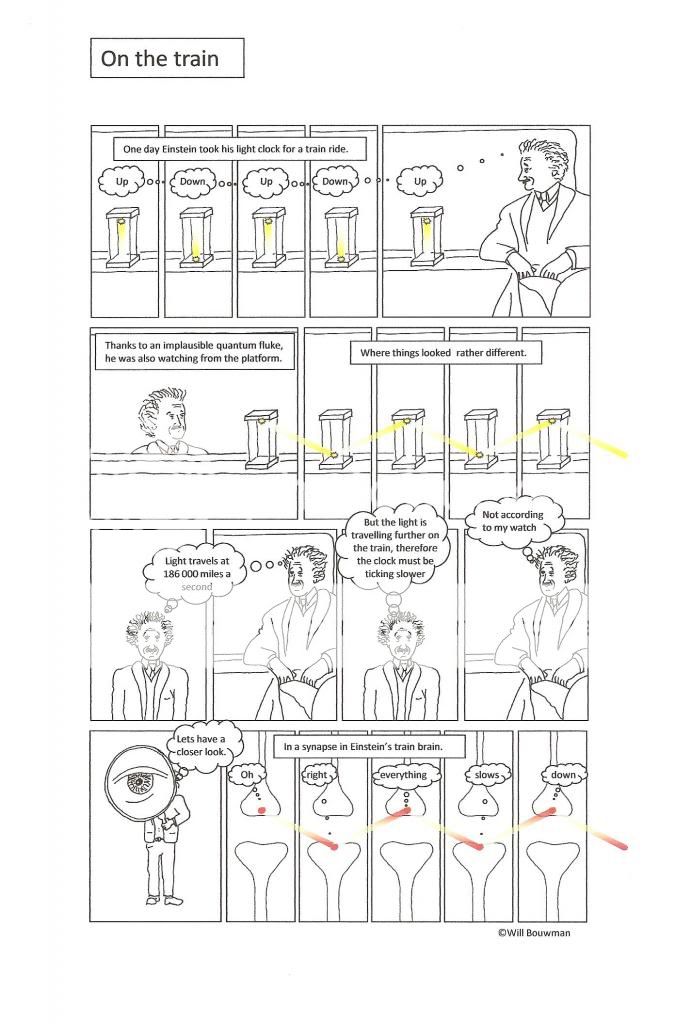
tillingborn wrote:Special Relativity states that matter cannot travel at the speed of light, which for the purpose of illustration, I’m going to ignore. Suppose Einstein’s train was travelling at the speed of light; the photons in the light clock are going as fast as they can just to keep up with the train,
SpheresOfBalance wrote:No, I don't think so, because the light source is traveling on the train just as fast as the train, such that at the instant the photons leave it, they are moving just as fast as the train, such that their speed is in addition to the trains speed, so they need not catch up to the train.
One of the key claims of Special Relativity is that regardless of how a light source is moving relative to you, the light will be traveling at the same speed when it reaches you. In that respect, light behaves like waves. For instance; it doesn't matter whether a sound source is approaching or receding, the sound waves will hit you at the speed of sound. Similarly light will always hit you at the speed of light. The difference is that if it is
you that is moving, the speed that sound waves will hit you changes;this is not the case with light. It's a long story, but there's a perfectly good explanation as to why.
SpheresOfBalance wrote:Do you understand my point, and think me ill?
Yes and no.
tillingborn wrote:Too bad you can't make the meet up, you are to join anyway.
Whoops! Sorry James, that's one of my weirder typos; I meant to say you are welcome to join anyway.
James Markham wrote:Hereandnow, thanks for taking the time to explain a bit about relativity, to be honest I haven't really bothered trying to twist my head around it in the past, mainly because the people trying to explain it to me, haven't understood it themselves, and because I like to jump to the consider the implications of a theory, I've always dismissed it on the grounds that time travel is impossible.
I think the reason that people believe time travel is theoretically possible is that it is mathematically convenient to treat space and time as though they were planes. In order to pin point an event, you need four coordinates; left a bit, up a bit, back a bit, soon, or something of that nature, in Cartesian terms it's x,y,z and t. In Euclidean geometry, those planes are assumed to be flat; so on a piece of paper, if you go from (0,0) to (1,1) for instance, you can draw a straight line. In non-Euclidean geometry, the planes are not assumed to be flat, the paper can be crumpled. This gets some mathematicians very excited, because there is no reason, mathematically, why the paper shouldn't be folded in half, so that two points of 'time' are next to each other. That being so all you need is a short cut, a wormhole, to travel from one time to another. It all rests on the assumption that the mathematically convenient dimensions of spacetime actually exist; a position known as Platonism. I don't know whether they do or not, but as a trained philosopher, rather than mathematician, my first instinct is to apply Occam's Razor and not multiply entities beyond necessity. You can argue that time and spatial dimensions are relations, rather than objects, I have never seen a bucket full of time, for instance. As you note, we only ever see n number of events compared to n' number of events; the Earth rotates once, the small hand on the clock turns 24 times, which you can reduce to pendula swinging or caesium atoms vibrating; there is no measure of 'time' that doesn't involve physical events. For me, the onus is on anyone who believes in time to prove it exists. I will eat my shorts if they succeed.
James Markham wrote:If you think about it logically, all the energy and matter that existed in the early universe, is here with us now, unless there is a constant replication taking place at an infinite number of intervals, and likewise, all the energy and mass that will exist in the universe tommorow, is currently here with us in the present, so in that respect there is no past or future, only an ever changing present.
Indeed; it does seem as if there is some stuff that is just doing it's thing. It looks very like a universe that is getting bigger; I can't see any evidence for time and space.
James Markham wrote:So you seem to be confirming what I have concluded about time, it's simply the relative rates of events, and all events are properly described as the dynamics of energy, changing from one state (a) with potential (b) to state (b) with potential (c).
Does that make sense?
Well, I think I agree with a lot of what you say, but that is different from confirming.
 Well it's certainly not you, not that I'm saying I'm any better, but it's been you that has put more words in my and others mouths, because I believe you honestly believe that 'one's words meaning, can only be found in the response you supply to them.' That's pretty f****** arrogant, and quite stupid actually. Remember, you asked me about your ills.
 Now since the speed of EME is constant at 186,000 m/s, it is traveling both true east and true west at that speed, as it can go no faster or slower, yet the mirrors that are reflecting this EME are traveling true east at 93,000 m/s, half the speed of light. Now if we vary the speed of this train between 1/4, (46,500 m/s), and 3/4's, (139,500 m/s), the speed of light, the EME between the two mirrors still goes 186,000 m/s. And it doesn't matter which observer, measuring this speed of EME, between these two mirrors is standing, either on the train or standing immediately adjacent to the equator on the ground as the train whizzes by, as they both can only measure it going 186,000 m/s because that is the ONLY speed it can go. It is true that the window of opportunity for the observer standing on the ground to measure it's speed, between the two mirrors is extremely narrow, (It's an extremely fast electronic measuring devise whose electronics is cooled to almost absolute zero, such that it operates at the speed of light.), but that's the only measurement he can get, because the speed of EME is only ever constant, it is never relative. It cannot be added to, nor subtracted from.