Page 5 of 7
Re: How abstract can math get and still be useful?
Posted: Fri Sep 19, 2014 11:50 pm
by Blaggard
Looks pretty close to me.
HexHammer wrote: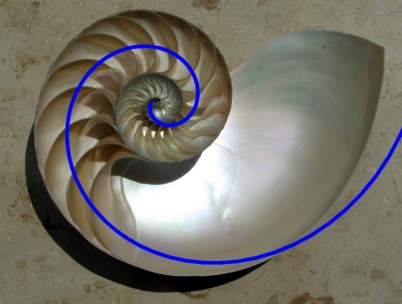
Are you sure you get maths at all Hex?
Are you sure you get biology either? Because in space it would fit the Fibonacci sequence exactly but nautilus shells are subject to pressures that would crush us like a grape, nothing is perfect in nature Hex, except apparently your own view of it.
1.6180339887
There's no arguing with the maths.
The line shows the area within the shell, as a differential, it hence is pretty accurate if you know the maths.
http://www.inspirationgreen.com/fibonac ... ature.html
More FS in nature.
It's close to perfect Hex. It's so close that anyone in natural sciences would not argue with the seeming genetic rules of certain forms. You would, but you would be ill considered by others.
To sum up nature seems to form the most efficient shapes that involve the least energy, be it in a shell, a hurricane, a bees nest in it's hexagonal chambers, or a rain drop; it seems a general rule of nature to always be at this minimal energy value to exhibit the properties it does or may do to engender the ability to be more fecund as regards genetic aptness. The only thing that changes it is the underlying mechanics of nature, and only when it becomes incapable of adapting because the environment changes, that is when things change, they always seem to change with the propensity to fit the least energy over time too, but they may differ also.
The fundamental rules of nature, you'd be a fool to deny them.

Re: How abstract can math get and still be useful?
Posted: Sat Sep 20, 2014 2:55 am
by Philosophy Explorer
Wyman said:
"I have to agree with Hexhammer, but not in spirit. Let me translate: You are being vague about what you mean by 'abstract' and 'useful.'"
So you want a definition on abstract. I'll give you one, but it won't help you. By abstract means to speak in general terms rather than specifically. Science (and math) rests on undefined terms along with axioms. Useful you don't need a definition.
PhilX
PS Before the internet, did you see anyone walk around with dictionaries?
Re: How abstract can math get and still be useful?
Posted: Tue Sep 23, 2014 1:55 pm
by Wyman
Philosophy Explorer wrote:Wyman said:
"I have to agree with Hexhammer, but not in spirit. Let me translate: You are being vague about what you mean by 'abstract' and 'useful.'"
So you want a definition on abstract. I'll give you one, but it won't help you. By abstract means to speak in general terms rather than specifically. Science (and math) rests on undefined terms along with axioms. Useful you don't need a definition.
PhilX
PS Before the internet, did you see anyone walk around with dictionaries?
No, but intelligent ones were precise when discussing certain matters.
So your question is, how much can mathematicians speak in general terms and still be useful? Well, mathematicians do nothing but speak in general terms, so asking 'how much' can they speak in general terms is senseless - hence, me and Hexhammer's objection to a senseless question.
Further, 'useful' is relative to the person who seeks to 'use.' To most people, mathematics is too 'general' to apply to everyday life, except for simple calculation. Vagueness doesn't necessarily imply lack of definition only. You can be vague as to whom you apply your terms or the scope of your questions.
Re: How abstract can math get and still be useful?
Posted: Wed Sep 24, 2014 1:19 am
by Arising_uk
Philosophy Explorer wrote:...
Levels of math abstraction. Hmmmm. ...
Not an answer.
What do you mean by 'levels of maths abstraction'? As maths appears to me to be all abstraction.
Re: How abstract can math get and still be useful?
Posted: Wed Sep 24, 2014 1:30 am
by Ginkgo
Arising_uk wrote:Philosophy Explorer wrote:...
Levels of math abstraction. Hmmmm. ...
Not an answer.
What do you mean by 'levels of maths abstraction'? As maths appears to me to be all abstraction.
Can be, but there is applied mathematics as well.
Re: How abstract can math get and still be useful?
Posted: Wed Sep 24, 2014 1:38 am
by Wyman
Ginkgo wrote:Arising_uk wrote:Philosophy Explorer wrote:...
Levels of math abstraction. Hmmmm. ...
Not an answer.
What do you mean by 'levels of maths abstraction'? As maths appears to me to be all abstraction.
Can be, but there is applied mathematics as well.
OK, since "abstraction" according to Philx and Gingko can meaningfully be quantified, 'how abstract' can math get and still be useful, as the OP asked?
Re: How abstract can math get and still be useful?
Posted: Wed Sep 24, 2014 1:44 am
by Arising_uk
Ginkgo wrote:Can be, but there is applied mathematics as well.
Fair point, what are these 'levels' then?
Re: How abstract can math get and still be useful?
Posted: Wed Sep 24, 2014 1:50 am
by Ginkgo
Arising_uk wrote:Ginkgo wrote:Can be, but there is applied mathematics as well.
Fair point, what are these 'levels' then?
I guess there are many different ways mathematics can be used, but two broad categories would be pure and applied. Pure maths may well be seen as a means for solving particular real world problem in science, so in this respect it can be maths that has application.
Re: How abstract can math get and still be useful?
Posted: Wed Sep 24, 2014 2:00 am
by Arising_uk
Ginkgo wrote:I guess there are many different ways mathematics can be used, but two broad categories would be pure and applied. Pure maths may well be seen as a means for solving particular real world problem in science, so in this respect it can be maths that has application.
No I got that, it's the 'levels of abstraction' bit I was interested in. What levels?
Re: How abstract can math get and still be useful?
Posted: Wed Sep 24, 2014 2:15 am
by Ginkgo
Arising_uk wrote:Ginkgo wrote:I guess there are many different ways mathematics can be used, but two broad categories would be pure and applied. Pure maths may well be seen as a means for solving particular real world problem in science, so in this respect it can be maths that has application.
No I got that, it's the 'levels of abstraction' bit I was interested in. What levels?
I'm not a maths expert by any stretch of the imagination so I found a wikipedia article
www.wikipedia.org/wiki/Abstraction_(mathematics)
Upon reading the article I get the impression that level of abstraction exists on a continuum.
Re: How abstract can math get and still be useful?
Posted: Wed Sep 24, 2014 3:30 am
by Philosophy Explorer
Arising_uk wrote:Ginkgo wrote:I guess there are many different ways mathematics can be used, but two broad categories would be pure and applied. Pure maths may well be seen as a means for solving particular real world problem in science, so in this respect it can be maths that has application.
No I got that, it's the 'levels of abstraction' bit I was interested in. What levels?
I like to use the concept of number to illustrate. Let's use the concept of two apples. Now in reality I may see two apples. I initially learned the number two by counting ("one, two"). Later on I learned that I (explicitly) didn't need to count to know I see two apples in front of me (due to memory). Now memory is abstract while seeing the apples is reality based (hopefully). Once I get the idea of number into my head, it starts becoming abstract. That would represent the first level if abstraction.
The second level of abstraction is when you recognize ways of making numbers more meaningful as I indicated before by extending factorials beyond being defined only on the counting numbers (also recognizing other types of numbers such as complex numbers). This is a reason why I avoid defining too specifically, leaving some wriggle room to expand on some concepts.
Here's a good question for further discussion. Is infinity an abstract concept?
PhilX
Re: How abstract can math get and still be useful?
Posted: Wed Sep 24, 2014 11:42 pm
by Blaggard
Infinity except as it applies to the universe is a concept. That does not make it useless though any more than time being a concept does. Infinity defines the fundamental rules of calculus by making them a limit to which the number line can approach + or -. One can use infinity to solve both pure maths problems and applied maths problems. It is perhaps one of the most useful abstracts there is in maths, probably as useful as the invention of 0 by ancient cultures. There's never nothing nor is there everything (with the exception of the universe, which slides in as a technicality, being everything that exists or can be known, perhaps unbound), but they are incredibly useful.
Re: How abstract can math get and still be useful?
Posted: Thu Sep 25, 2014 12:59 pm
by Ginkgo
Philosophy Explorer wrote:
I like to use the concept of number to illustrate. Let's use the concept of two apples. Now in reality I may see two apples. I initially learned the number two by counting ("one, two"). Later on I learned that I (explicitly) didn't need to count to know I see two apples in front of me (due to memory). Now memory is abstract while seeing the apples is reality based (hopefully). Once I get the idea of number into my head, it starts becoming abstract. That would represent the first level if abstraction.
I wouldn't say memory is abstract. I think there is a clear distinction between memory and understanding the rules of mathematics.
I think I pointed out in another post that a computer has memory and can carry out a algorithmic procedure by using step by step rules. Humans can also do this as well, but only humans understand the rules. Perhaps we can say it is the understanding that is the abstract part of mathematics.
A simple example of this might be the consideration of A+B = B+A
Once we have grasped the understanding of this idea we come to the realization that we can substitute and number we like for A and B - the rule will always hold true. Perhaps we can also say that some abstractions are more complicated than others.
Re: How abstract can math get and still be useful?
Posted: Thu Sep 25, 2014 4:20 pm
by Philosophy Explorer
Ginkgo wrote:Philosophy Explorer wrote:
I like to use the concept of number to illustrate. Let's use the concept of two apples. Now in reality I may see two apples. I initially learned the number two by counting ("one, two"). Later on I learned that I (explicitly) didn't need to count to know I see two apples in front of me (due to memory). Now memory is abstract while seeing the apples is reality based (hopefully). Once I get the idea of number into my head, it starts becoming abstract. That would represent the first level if abstraction.
I wouldn't say memory is abstract. I think there is a clear distinction between memory and understanding the rules of mathematics.
I think I pointed out in another post that a computer has memory and can carry out a algorithmic procedure by using step by step rules. Humans can also do this as well, but only humans understand the rules. Perhaps we can say it is the understanding that is the abstract part of mathematics.
A simple example of this might be the consideration of A+B = B+A
Once we have grasped the understanding of this idea we come to the realization that we can substitute and number we like for A and B - the rule will always hold true. Perhaps we can also say that some abstractions are more complicated than others.
Can we touch memory? Can we see it? Hear it? Taste it? Smell it? This is why I regard memory as an abstraction.
PhilX
Re: How abstract can math get and still be useful?
Posted: Thu Sep 25, 2014 5:42 pm
by Wyman
Philosophy Explorer wrote:Ginkgo wrote:Philosophy Explorer wrote:
I like to use the concept of number to illustrate. Let's use the concept of two apples. Now in reality I may see two apples. I initially learned the number two by counting ("one, two"). Later on I learned that I (explicitly) didn't need to count to know I see two apples in front of me (due to memory). Now memory is abstract while seeing the apples is reality based (hopefully). Once I get the idea of number into my head, it starts becoming abstract. That would represent the first level if abstraction.
I wouldn't say memory is abstract. I think there is a clear distinction between memory and understanding the rules of mathematics.
I think I pointed out in another post that a computer has memory and can carry out a algorithmic procedure by using step by step rules. Humans can also do this as well, but only humans understand the rules. Perhaps we can say it is the understanding that is the abstract part of mathematics.
A simple example of this might be the consideration of A+B = B+A
Once we have grasped the understanding of this idea we come to the realization that we can substitute and number we like for A and B - the rule will always hold true. Perhaps we can also say that some abstractions are more complicated than others.
Can we touch memory? Can we see it? Hear it? Taste it? Smell it? This is why I regard memory as an abstraction.
PhilX
But you said earlier that your definition of 'abstraction' was:
By abstract means to speak in general terms rather than specifically
It didn't have to do with extra-sensory phenomena. See how being precise and utilizing definitions can keep a discussion focused and meaningful, rather than shifting mid-discussion?