Page 5 of 6

Re: Time Slower In Orbit?

Posted: Wed Feb 05, 2014 6:41 pm
by duszek
Time running more slowly or faster some place else sounds like 2 and 2 makes 6 some place else.

And if it were true, say, would the consequence be that we would grow older slowlier or what ?

Just because the mechanism of a chronometer slows down some place does not mean that the thing to be measured slows down accordingly. And: to state this fact we would need another chronometer which would measure the measurement of the first. A more objective one.

Re: Time Slower In Orbit?

Posted: Wed Feb 05, 2014 10:08 pm
by Blaggard
duszek wrote:Time running more slowly or faster some place else sounds like 2 and 2 makes 6 some place else.

And if it were true, say, would the consequence be that we would grow older slowlier or what ?

Just because the mechanism of a chronometer slows down some place does not mean that the thing to be measured slows down accordingly. And: to state this fact we would need another chronometer which would measure the measurement of the first. A more objective one.
All experiment says it does, so we take it as as true as it might be according to those experiments, people don't say shit happens for effect any more, it's not some religious world we live in, shit happens because it is verified by experiment. :)

GPS satellites for example run out of synch if we don't account for both special and general relativity. Counter intuitive it may be but I doubt the universe gives much of a damn about what we think should happen.

Re: Time Slower In Orbit?

Posted: Thu Feb 06, 2014 3:32 am
by Arising_uk
duszek wrote:And if it were true, say, would the consequence be that we would grow older slowlier or what ? ...
Well, it's odd to think so but yes this is what the theory says will happen but theres a nice twist as you will still grow old at the same pace, so your 70 odd years will still be the same seventy odd years but its relative to others so it'll look like you grow older slower compared to others and I guess thats the same as growing older slower. :)
... And: to state this fact we would need another chronometer which would measure the measurement of the first. A more objective one.
Einstein's point is that it's all relative to where you're standing and there is no objective one. There is no Newtonian universal clock is the idea.

Re: Time Slower In Orbit?

Posted: Thu Feb 06, 2014 10:18 am
by uwot
duszek wrote:Time running more slowly or faster some place else sounds like 2 and 2 makes 6 some place else.
Relativity sort of starts with Galileo. When he realised that the Earth really does go round the sun, the question was why, if you drop something, doesn't it get left behind? He knew that if you were on a ship, but couldn't see out side, you couldn't tell if you were moving, just as we can't if we shut our eyes in a car, a train or aeroplane.
If you are on a train and you drop a ball, you expect it to bounce straight back up. And so it does, irrespective of how fast you are going. Somebody watching, as you rush through the station, sees the ball moving sideways, as well as up and down; in other words, they see the ball travel a lot further than you on the train do.
The same thing happens with light; Einstein imagined a light clock on a train, basically two mirrors with a 'ball' of light bouncing up and down, 'ticking' as it hits each mirror. He assumed that no matter how fast you are going, you will always see the light bounce up and down. However, James Clark Maxwell had shown that light always travels at a particular speed. If the train could travel at the speed of light, the ball of light would have to travel faster than light to bounce up and down. It can't, it doesn't, the light clock stops ticking. However, you on the train don't notice anything unusual, because all the processes in your body rely ultimately on the exchange of force carrying 'particles', a bit like photons (particles of light). Just like photons, they cannot travel faster than light, therefore nothing happens to your body, you stop ageing. As far as we know, we wouldn't notice, because our minds are a product of all the interactions in our brain (probably). So it is more the case that 2+2=4 everywhere.
duszek wrote:And if it were true, say, would the consequence be that we would grow older slowlier or what ?

That is exactly what happens. As you zip about on your light speed train with nothing happening to you, the Earth keeps spinning the days away.
duszek wrote:Just because the mechanism of a chronometer slows down some place does not mean that the thing to be measured slows down accordingly. And: to state this fact we would need another chronometer which would measure the measurement of the first. A more objective one.
The thing is, every mechanism slows down, depending on how fast it is going. There isn't any part of the universe that isn't moving. There is no objective clock to compare with.

Re: Time Slower In Orbit?

Posted: Thu Feb 06, 2014 4:33 pm
by Blaggard
Actually Galileo was wrong in one way, the Earth goes around the sun but as Einstein famously opined so does the Sun go around the Earth, because no single frame of reference is static or more precisely no fixed point or centre can be identified in the Universe. ;)

It is hence more correct to say the Earth and sun are both orbiting each other at the same time, and hence the galaxy and so on ad infinitum or ad nauseum.

Which leads to the famous co-moving theories in debt to the Lorentz transforms. All we need is a constant c, everything is thus derived from that, or as Einstien himself said all movement in space/time is a consequence that drops out of the Lorentzian mechanics. It just so happens photons travel at c, and by logical extension can never propagate at less than c, which leads to the conclusion hence, no mass object can achieve c, no non mass object can propagate at less than c, of course some people go further and introduce negative energy on the other side of the equation but negative energy is forbidden by the laws of conservation, so they are just dicking about with maths. ;)

See Michelson-Morley experiment for more advanced ideas about light speed and the hence disproof of luminiferous Aether as a viable thoery.

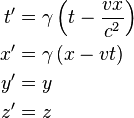
all hence by logical induction we need to know is e=mc^2 and by extension of such induction in both general and special relativity:
Image

where t=time and t' is the consequence of rotation about a 90° axis hence transform.

And x,y,z are the space co-ordinates.

http://www.youtube.com/watch?v=buqtdpuZxvk

This will clear it up, and no it's not a Rick Roll. ;)

So can I have your liver then? :lol:

duszek wrote:Just because the mechanism of a chronometer slows down some place does not mean that the thing to be measured slows down accordingly. And: to state this fact we would need another chronometer which would measure the measurement of the first. A more objective one.
The thing is, every mechanism slows down, depending on how fast it is going. There isn't any part of the universe that isn't moving. There is no objective clock to compare with.
QFT. :)

Think of the universe this way as a sphere that is expanding probably at faster than c (this is allowed because space can break the laws of c being the limit of movement as thusly can time be independently comoving in terms of space), and it becomes more obvious that the idea of a centre of that sphere is a nonsense concept.

Re: Time Slower In Orbit?

Posted: Fri Feb 07, 2014 12:38 am
by uwot
Blaggard wrote:Which leads to the famous co-moving theories in debt to the Lorentz transforms.
How would you explain that? As far as I understand, Lorentz transformations are just equations for measuring what in effect is Doppler shift. We know about Doppler in sound; when a fire engine rushes towards you (or you towards it) if it goes dee, by the time it goes dah, the fire engine is closer to you; so the dee-dahs get squeezed together. When the fire engine has passed and is rushing away, the dee-dahs are stretched out. Same thing happens with the flashing lights, but whereas 100kmph is roughly 10% of the speed of sound, it is a tiny fraction of the speed of light, so while you can hear the difference, you can't see it. But thanks to Lorentz, you can do some sums to work it out. The difference is they don't take account of time dilation, as special relativity does.
Blaggard wrote:All we need is a constant c, everything is thus derived from that, or as Einstien himself said all movement in space/time is a consequence that drops out of the Lorentzian mechanics.
Where'd he say that? What do you think it means?
Blaggard wrote:It just so happens photons travel at c, and by logical extension can never propagate at less than c, which leads to the conclusion hence, no mass object can achieve c, no non mass object can propagate at less than c,
You might have to expand on this. I'm sure it's true, but I don't understand how your logic works.
Blaggard wrote:of course some people go further and introduce negative energy on the other side of the equation but negative energy is forbidden by the laws of conservation, so they are just dicking about with maths. ;)
Well, another of my favourite quotations is: "Mathematics may be defined as the subject in which we never know what we are talking about." Bertrand Russell. That's an ontological point, maths doesn't make any claims about the entities it describes. It doesn't matter what energy is, nor mass, nor gravity, nor charge, nor spin. It doesn't matter whether spatial dimensions or time are real; the measurement works just as well. With time, for instance, what you measure is one number of events compared to another, how many times a pendulum swings compared to how often the world turns, for example. It makes no difference whether there is any such thing as energy, mass or time. E, m, t turn up in all sorts of maths, but nobody really knows what any of them are.
Blaggard wrote:See Michelson-Morley experiment for more advanced ideas about light speed and the hence disproof of luminiferous Aether as a viable thoery.
The luminiferous aether was supposed to be a classical, absolute and stationary 'field' of reference, as such it was definitely shown not to exist.
Blaggard wrote:all hence by logical induction we need to know is e=mc^2 and by extension of such induction in both general and special relativity:

Image

where t=time and t' is the consequence of rotation about a 90° axis hence transform.

And x,y,z are the space co-ordinates.
Wassat in English, Blaggard? What actually happens?
Blaggard wrote:So can I have your liver then? :lol:
Pickle your own.
Blaggard wrote:QFT. :)
Quantum Field Theory! Now you're talking. Basically QFT is a relativistic luminiferous aether, closer to Einstein's idea of a warped 'fabric' of spacetime than the Newtonian fixed 'grid' that Michelson and Morley were looking for. (Or is that 'quoted for truth'? No idea what that means.)
Blaggard wrote:Think of the universe this way as a sphere that is expanding probably at faster than c (this is allowed because space can break the laws of c being the limit of movement as thusly can time be independently comoving in terms of space), and it becomes more obvious that the idea of a centre of that sphere is a nonsense concept.
Well, the universe is 13.7 billion years old, the most distant galaxy so far seen is, from memory, 30 something billion light years away. I don't know if there is any limit to how fast space can expand, but clearly it is 'faster' than c. I think it is more helpful to think of the very young universe, about the size of a ping pong ball. Wherever you start in that ping pong ball, that point has been expanding for 13.7 billion years; even the bits that used to be on the edge. So there is nowhere in the universe where you cannot see at least 13.7 billion light years away, anywhere you look.

Liebnitz

Posted: Fri Feb 07, 2014 12:41 am
by Blaggard
uwot wrote:
Blaggard wrote:Which leads to the famous co-moving theories in debt to the Lorentz transforms.
How would you explain that? As far as I understand, Lorentz transformations are just equations for measuring what in effect is Doppler shift. We know about Doppler in sound; when a fire engine rushes towards you (or you towards it) if it goes dee, by the time it goes dah, the fire engine is closer to you; so the dee-dahs get squeezed together. When the fire engine has passed and is rushing away, the dee-dahs are stretched out. Same thing happens with the flashing lights, but whereas 100kmph is roughly 10% of the speed of sound, it is a tiny fraction of the speed of light, so while you can hear the difference, you can't see it. But thanks to Lorentz, you can do some sums to work it out. The difference is they don't take account of time dilation, as special relativity does.
Blaggard wrote:All we need is a constant c, everything is thus derived from that, or as Einstien himself said all movement in space/time is a consequence that drops out of the Lorentzian mechanics.
Where'd he say that? What do you think it means?
Blaggard wrote:It just so happens photons travel at c, and by logical extension can never propagate at less than c, which leads to the conclusion hence, no mass object can achieve c, no non mass object can propagate at less than c,
You might have to expand on this. I'm sure it's true, but I don't understand how your logic works.
Blaggard wrote:of course some people go further and introduce negative energy on the other side of the equation but negative energy is forbidden by the laws of conservation, so they are just dicking about with maths. ;)
Well, another of my favourite quotations is: "Mathematics may be defined as the subject in which we never know what we are talking about." Bertrand Russell. That's an ontological point, maths doesn't make any claims about the entities it describes. It doesn't matter what energy is, nor mass, nor gravity, nor charge, nor spin. It doesn't matter whether spatial dimensions or time are real; the measurement works just as well. With time, for instance, what you measure is one number of events compared to another, how many times a pendulum swings compared to how often the world turns, for example. It makes no difference whether there is any such thing as energy, mass or time. E, m, t turn up in all sorts of maths, but nobody really knows what any of them are.
Blaggard wrote:See Michelson-Morley experiment for more advanced ideas about light speed and the hence disproof of luminiferous Aether as a viable thoery.
The luminiferous aether was supposed to be a classical, absolute and stationary 'field' of reference, as such it was definitely shown not to exist.
Blaggard wrote:all hence by logical induction we need to know is e=mc^2 and by extension of such induction in both general and special relativity:

Image

where t=time and t' is the consequence of rotation about a 90° axis hence transform.

And x,y,z are the space co-ordinates.
Wassat in English, Blaggard? What actually happens?
Blaggard wrote:So can I have your liver then? :lol:
Pickle your own.
Blaggard wrote:QFT. :)
Quantum Field Theory! Now you're talking. Basically QFT is a relativistic luminiferous aether, closer to Einstein's idea of a warped 'fabric' of spacetime than the Newtonian fixed 'grid' that Michelson and Morley were looking for. (Or is that 'quoted for truth'? No idea what that means.)
Blaggard wrote:Think of the universe this way as a sphere that is expanding probably at faster than c (this is allowed because space can break the laws of c being the limit of movement as thusly can time be independently comoving in terms of space), and it becomes more obvious that the idea of a centre of that sphere is a nonsense concept.
Well, the universe is 13.7 billion years old, the most distant galaxy so far seen is, from memory, 30 something billion light years away. I don't know if there is any limit to how fast space can expand, but clearly it is 'faster' than c. I think it is more helpful to think of the very young universe, about the size of a ping pong ball. Wherever you start in that ping pong ball, that point has been expanding for 13.7 billion years; even the bits that used to be on the edge. So there is nowhere in the universe where you cannot see at least 13.7 billion light years away, anywhere you look.
Er QFT means Quoted For Truth..? But ok quantum field theory is unification of gravity and quantum mechanics. ;)

Frankly though I can't answer your questions, not because I can't just because they are irrelevant. And here's the transform for your edification:

Image

Where gamma is the Lorentz factor and beta is v/c aka the velocity coefficent also by extrapolation a constant.

In English learn calculus though, not that I can make you do that but in English calculus attributed to Newton and Liebniz is your friend, google them. :)
Gottfried Wilhelm von Leibniz (German: [ˈɡɔtfʁiːt ˈvɪlhɛlm fɔn ˈlaɪbnɪts][4] or [ˈlaɪpnɪts][5]) (July 1, 1646 – November 14, 1716) was a German mathematician and philosopher. He occupies a prominent place in the history of mathematics and the history of philosophy.

Leibniz developed the infinitesimal calculus independently of Isaac Newton, and Leibniz's mathematical notation has been widely used ever since it was published. It was only in the 20th century that his Law of Continuity and Transcendental Law of Homogeneity found mathematical implementation (by means of non-standard analysis). He became one of the most prolific inventors in the field of mechanical calculators. While working on adding automatic multiplication and division to Pascal's calculator, he was the first to describe a pinwheel calculator in 1685[6] and invented the Leibniz wheel, used in the arithmometer, the first mass-produced mechanical calculator. He also refined the binary number system, which is at the foundation of virtually all digital computers.

In philosophy, Leibniz is most noted for his optimism, e.g., his conclusion that our Universe is, in a restricted sense, the best possible one that God could have created. Leibniz, along with René Descartes and Baruch Spinoza, was one of the three great 17th century advocates of rationalism. The work of Leibniz anticipated modern logic and analytic philosophy, but his philosophy also looks back to the scholastic tradition, in which conclusions are produced by applying reason to first principles or prior definitions rather than to empirical evidence.

Leibniz made major contributions to physics and technology, and anticipated notions that surfaced much later in philosophy, probability theory, biology, medicine, geology, psychology, linguistics, and computer science. He wrote works on philosophy, politics, law, ethics, theology, history, and philology. Leibniz's contributions to this vast array of subjects were scattered in various learned journals, in tens of thousands of letters, and in unpublished manuscripts. He wrote in several languages, but primarily in Latin, French, and German.[7] There is no complete gathering of the writings of Leibniz.[8]
Liebniz. ;)

Re: Time Slower In Orbit?

Posted: Fri Feb 07, 2014 12:52 am
by uwot
Blaggard wrote:Frankly though I can't answer your questions, not because I can't just because they are irrelevant.
Humour me.

Re: Time Slower In Orbit?

Posted: Fri Feb 07, 2014 12:55 am
by Blaggard
uwot wrote:
Blaggard wrote:Frankly though I can't answer your questions, not because I can't just because they are irrelevant.
Humour me.
http://www.youtube.com/watch?v=aclS1pGHp8o

:)

Re: Liebnitz

Posted: Fri Feb 07, 2014 12:59 am
by uwot
Blaggard wrote:Frankly though I can't answer your questions, not because I can't just because they are irrelevant. And here's the transform for your edification:

Image

Where gamma is the Lorentz factor and beta is v/c aka the velocity coefficent also by extrapolation a constant.
Thanks for that. So what does it describe happening?

Re: Liebnitz

Posted: Fri Feb 07, 2014 1:04 am
by Blaggard
uwot wrote:
Blaggard wrote:Frankly though I can't answer your questions, not because I can't just because they are irrelevant. And here's the transform for your edification:

Image

Where gamma is the Lorentz factor and beta is v/c aka the velocity coefficent also by extrapolation a constant.
Thanks for that. So what does it describe happening?
I already explained the transformation, it's basically a transformation on the time axis to the space axis. That said the galaxy song does it way better than I ever could, and you don't have to give up your liver either, unless you want to of course...

"Pray that there's intelligent life somewhere up in space because there's bugger all down here on Earth."

That guy from Monty Python. ;)


I know no one watches links but hell I did say, this explains it all, sadly though no one will watch it and I'll have to repeat myself a million times, in order to explain what is basically quite simple with or without your liver:

http://www.youtube.com/watch?v=buqtdpuZxvk

Re: Liebnitz

Posted: Fri Feb 07, 2014 1:16 am
by uwot
Blaggard wrote:I already explained the transformation,

I must have forgotten; could you show me where?
Blaggard wrote:it's basically a transformation on the time axis to the space axis.
Have you any idea what that means?
So what's wrong with my explanation?
A couple of posts back I wrote:As far as I understand, Lorentz transformations are just equations for measuring what in effect is Doppler shift. We know about Doppler in sound; when a fire engine rushes towards you (or you towards it) if it goes dee, by the time it goes dah, the fire engine is closer to you; so the dee-dahs get squeezed together. When the fire engine has passed and is rushing away, the dee-dahs are stretched out. Same thing happens with the flashing lights, but whereas 100kmph is roughly 10% of the speed of sound, it is a tiny fraction of the speed of light, so while you can hear the difference, you can't see it. But thanks to Lorentz, you can do some sums to work it out. The difference is they don't take account of time dilation, as special relativity does.

UOT

Posted: Fri Feb 07, 2014 1:20 am
by Blaggard
uwot wrote:
Blaggard wrote:I already explained the transformation,

I must have forgotten; could you show me where?
Blaggard wrote:it's basically a transformation on the time axis to the space axis.
Have you any idea what that means?
So what's wrong with my explanation?
A couple of posts back I wrote:As far as I understand, Lorentz transformations are just equations for measuring what in effect is Doppler shift. We know about Doppler in sound; when a fire engine rushes towards you (or you towards it) if it goes dee, by the time it goes dah, the fire engine is closer to you; so the dee-dahs get squeezed together. When the fire engine has passed and is rushing away, the dee-dahs are stretched out. Same thing happens with the flashing lights, but whereas 100kmph is roughly 10% of the speed of sound, it is a tiny fraction of the speed of light, so while you can hear the difference, you can't see it. But thanks to Lorentz, you can do some sums to work it out. The difference is they don't take account of time dilation, as special relativity does.
http://en.wikipedia.org/wiki/Michelson% ... experiment

Man you are sorely in need of some old fashioned information...
Most famous "failed" experiment
Figure 7. Michelson and Morley's results. The upper solid line is the curve for their observations at noon, and the lower solid line is that for their evening observations. Note that the theoretical curves and the observed curves are not plotted at the same scale: the dotted curves, in fact, represent only one-eighth of the theoretical displacements.

After all this thought and preparation, the experiment became what has been called the most famous failed experiment in history.[A 13] Instead of providing insight into the properties of the aether, Michelson and Morley's article in the American Journal of Science reported the measurement to be as small as one-fortieth of the expected displacement (see Fig. 7), but "since the displacement is proportional to the square of the velocity" they concluded that the measured velocity was "probably less than one-sixth" of the expected velocity of the Earth's motion in orbit and "certainly less than one-fourth."[1] Although this small "velocity" was measured, it was considered far too small to be used as evidence of speed relative to the aether, and it was understood to be within the range of an experimental error that would allow the speed to actually be zero.[A 1] (Afterward, Michelson and Morley ceased their aether drift measurements and started to use their newly developed technique to establish the wavelength of light as a standard of length.[6][7])

From the standpoint of the then current aether models, the experimental results were conflicting. The Fizeau experiment and its 1886 repetition by Michelson and Morley apparently confirmed the stationary aether with partial aether dragging, and refuted complete aether dragging. On the other hand, the much more precise Michelson–Morley experiment (1887) apparently confirmed complete aether dragging and refuted the stationary aether.[A 5] In addition, the Michelson–Morley null result was further substantiated by the null results of other second-order experiments of different kind, namely the Trouton–Noble experiment (1903) and the Experiments of Rayleigh and Brace (1902–1904). These problems and their solution led to the development of the Lorentz transformation and special relativity.
and:
Special Relativity

Albert Einstein formulated the theory of special relativity by 1905, deriving the Lorentz transformation and thus length contraction and time dilation from the relativity postulate and the constancy of the speed of light, thus removing the ad hoc character from the contraction hypothesis. Einstein emphasized the kinematic foundation of the theory and the modification of the notion of space and time, with the stationary aether playing no role anymore in his theory. He also pointed out the group character of the transformation. Einstein was motivated by Maxwell's theory of electromagnetism (in the form as it was given by Lorentz in 1895) and the lack of evidence for the luminiferous aether.[A 21]

This allows a more elegant and intuitive explanation of the Michelson-Morley null result. In a comoving frame the null result is self-evident, since the apparatus can be considered as at rest in accordance with the relativity principle, thus the beam travel times are the same. In a frame relative to which the apparatus is moving, the same reasoning applies as described above in "Length contraction and Lorentz transformation", except the word "aether" has to be replaced by "non-comoving inertial frame". The extent to which the null result of the Michelson–Morley experiment influenced Einstein is disputed. Alluding to some statements of Einstein, many historians argue that it played no significant role in his path to special relativity,[A 22][A 23] while other statements of Einstein probably suggest that he was influenced by it.[A 24] In any case, the null result of the Michelson–Morley experiment helped the notion of the constancy of the speed of light gain widespread and rapid acceptance.[A 22]

It was later shown by Howard Percy Robertson (1949) and others[A 3][A 25] (see Robertson–Mansouri–Sexl test theory), that it is possible to derive the Lorentz transformation entirely from the combination of three experiments. First, the Michelson–Morley experiment showed that the speed of light is independent of the orientation of the apparatus, establishing the relationship between longitudinal (β) and transverse (δ) lengths. Then in 1932, Roy Kennedy and Edward Thorndike modified the Michelson–Morley experiment by making the path lengths of the split beam unequal, with one arm being very short.[8] The Kennedy–Thorndike experiment took place for many months as the Earth moved around the sun. Their negative result showed that the speed of light is independent of the velocity of the apparatus in different inertial frames. In addition it established that besides length changes, corresponding time changes must also occur, i.e. it established the relationship between longitudinal lengths (β) and time changes (α). So both experiments do not provide the individual values of these quantities. This uncertainty corresponds to the undefined factor \phi as described above. It was clear due to theoretical reasons (the group character of the Lorentz transformation as required by the relativity principle) that the individual values of length contraction and time dilation must assume their exact relativistic form. But a direct measurement of one of these quantities was still desirable to confirm the theoretical results. This was achieved by the Ives–Stilwell experiment (1938), measuring α in accordance with time dilation. Combining this value for α with the Kennedy–Thorndike null result shows that β must assume the value of relativistic length contraction. Combining β with the Michelson–Morley null result shows that δ must be zero. Therefore, the Lorentz transformation with \phi =1 is an unavoidable consequence of the combination of these three experiments.[A 3]

Special relativity is generally considered the solution to all negative aether drift (or isotropy of the speed of light) measurements, including the Michelson–Morley null result. Many high precision measurements have been conducted as tests of special relativity and modern searches for Lorentz violation in the photon, electron, nucleon, or neutrino sector, all of them confirming relativity.
So can we have your liver then?

Re: Liebnitz

Posted: Fri Feb 07, 2014 1:26 am
by uwot
Blaggard wrote:Man you are sorely in need of some old fashioned information...
I'm always willing to learn something new. I know all about Michelson-Morley, interferometers and whatnot; the information I'm currently after is your answers to my questions. What have you really got, Blaggard?

Re: Liebnitz

Posted: Fri Feb 07, 2014 1:27 am
by Blaggard
uwot wrote:
Blaggard wrote:Man you are sorely in need of some old fashioned information...
I'm always willing to learn something new. I know all about Michelson-Morley, interferometers and whatnot; the information I'm currently after is your answers to my questions. What have you really got, Blaggard?
Eh I answered your questions what do you want? My liver..?

Seriously dude special relativity has answered your questions. now I can understand if you don't understand it, it's fairly unusual as theories go but it's not worth your liver...


I'll be jiggered though if I am going to sit here and donate my liver, just because someone does not understand the point of donation and livers per se, pari passu to livers. ;)