Can the Religious Be Trusted?

How should society be organised, if at all?

Moderators: AMod, iMod

Age
Posts: 27841
Joined: Sun Aug 05, 2018 8:17 am

Re: Can the Religious Be Trusted?

Post by Age »

Belinda wrote: Sun Jan 05, 2025 2:41 pm
Age wrote: Sun Jan 05, 2025 2:22 am
henry quirk wrote: Sat Jan 04, 2025 6:23 pm


...you're usin' words that mean much more than input. If you truly believe in this meat machine nonsense, then my input ought lead to the output: you amend your posts.

But you won't. Not becuz it's causally inevitable you shouldn't but becuz you choose not to, just like any other free will.
Thank you. What is SO OBVIOUS, to some, can be COMPLETELY OBLIVIOUS, to others. And, vice versa.
Henry confuses determinism and fatalism, especially concerning his "meat machine" theory.

"meat machine" theory is not determinism it's fatalism.

Fatalism: the future is closed and what must be will be.

Determinism: the future is open especially for living organisms which can adapt to circumstances. Clearly a meat machine has more in common with a cadaver than with a living animal which essentially can adapt to circumstances as a functioning system.
I would suggest, here, that 'determinism' and/or 'fatalism', and their definitions, are NOT things that have YET been agreed upon, and accepted, as 'what IS'. So, "henry quirk" may well have and/or be HOLDING a DIFFERENT 'version' than you have, and/or do, but this does NOT mean that "henry quirk" is 'confusing' any thing, here. This, literally, just means "henry quirk" has a DIFFERENT view than you do. But, in saying 'this' I ALSO have DIFFERENT views than you two have. And that others have DIFFERENT views, also, is, AGAIN, WHY there is SO MUCH CONFUSION and MISUNDERSTANDING, here, and IN 'the world'.

See, if 'we' do NOT FIND OUT what people's DIFFERING views are, exactly, FIRST, and FIND OUT WHY each one has DIFFERENT views, then MISUNDERSTANDING/S WILL JUST NATURALLY FOLLOW, and/or ENSUE.

FINDING OUT the underlying reason of WHY each and every person HAS DIFFERENT views LEADS TO 'UNDERSTANDING', itself. From with everything else that LEADS TO Peace and to Harmony FOLLOWS, and ENSUES.
Age
Posts: 27841
Joined: Sun Aug 05, 2018 8:17 am

Re: Can the Religious Be Trusted?

Post by Age »

attofishpi wrote: Sun Jan 05, 2025 9:45 am Seriously, someone that can be bothered should do a full analysis of you, particularly IQ, and see if you are anywhere near as intelligent as the AI I just used that used another AI to create this:


⠀⠀⠀⠀⠀⠀⠀⠀⠀⠀⠀⠀⠀⠀⠀⠀⠀⠀⠀⠀⠀Image
WHO are 'you' even referring to, here, "attofishpi"?
Age
Posts: 27841
Joined: Sun Aug 05, 2018 8:17 am

Re: Can the Religious Be Trusted?

Post by Age »

Alexis Jacobi wrote: Sun Jan 05, 2025 2:57 pm
Here’s the brutal truth: your brain is a deterministic machine, operating under the same unyielding physical laws as a rock rolling downhill. You don’t control your thoughts, your desires, or your decisions. You are driven by a cascade of external inputs, biological processes, and environmental stimuli—all of which you neither initiated nor directed. The belief that you can simply will yourself into action without external cause is pure fantasy, the kind of self-deception reserved for fairy tales and bad philosophy.
All this is *true* as long as one understands, one believes, that there is no *mind* with capabilities that are not determined in the same way the falling rock is determined.

The declaration in BigMike’s (now famous!) paragraph is a linguistic and semantic construct! At the least it should be, can be, examined as such.
WHO said and/or wrote what you quoted, here, "alexis jacobi"?

If it was a poster, here in this forum, then can 'you' link 'us' to 'them', or at least acknowledge who they are, exactly?
seeds
Posts: 2880
Joined: Tue Aug 02, 2016 9:31 pm

Re: Can the Religious Be Trusted?

Post by seeds »

Alexis Jacobi wrote: Sun Jan 05, 2025 6:59 pm
BigMike wrote: Sun Jan 05, 2025 4:22 pm You suggest that these "frequencies" of meaning might exist beyond what is measurable or scientifically explicable. Fine—propose a mechanism. How do these metaphysical meanings interact with the physical brain? If they influence us in any way, they must interact with neurons, altering their activity. If they don’t, then they are irrelevant to human action. Either way, deterministic processes are still in play.
...The end of all conversation with you — you set it up this way — is when you ask or “demand” a mechanical proof. That proof cannot be provided as far as I am aware, because what is “metaphysical” in my sense, is non-tangible. For you that means that it does not exist except as neuronal activity in a brain. There, you give it epiphenomenal, emergent existence....
Yes, Alexis, he gives such things as the intangible (unmeasurable) "dreamer" of dreams and "thinker" of thoughts,...

...along with whatever "it" is that "experiences" the qualia of pleasure, or pain, or the taste of an apricot, or the calming smell of lavender, etc.,...

...again, he grants those things "epiphenomenal, emergent existence," but only from his limited perspective of "weak emergence."

And that's because he dares not entertain the implications of "strong emergence," lest it pull at the threads of his materialistic belief system - a system in which he has invested so much emotional energy.

What never ceases to amaze me is how "seemingly" highly intelligent persons such as BigMike, can so easily accept the utterly ridiculous notion that the unfathomable order of the universe is a product of the blind and mindless (chance) meanderings of gravity and thermodynamics,...

...while, at the same time, acting as if it would be an insult to his Intellect to even entertain the possibility that there might be something of extreme intelligence behind it all,...

...as if doing so is the equivalent of letting one's guard down and inviting a couple of door-knocking Jehovah's witnesses into your parlor to regale you with passages from the Watchtower magazine.

The utter (and unresolved) mystery regarding the origin of life, mind, consciousness, and the universe, absolutely demands that all possibilities remain on the proverbial table.

What BigMike (and all hardcore materialists) cannot seem to understand is that when it comes to the phenomenon of "consciousness," just as human consciousness vastly ascends above the levels of consciousness below ours,...

(such as amoebas, and flies, and frogs, and dogs, for example, none of which can fathom our level of consciousness)

...likewise, there no doubt exists levels of consciousness that ascend above us - levels that we cannot fathom.

BigMike, of course, will insist that I prove such a claim and literally show him tangible evidence of the existence of a level of consciousness that ascends above us,...

...to which I will simply say, "...look around you, BigMike..." and heed the words of the dishwashing liquid spokesperson, Madge...

Image

Or, better yet, this, from yours truly...
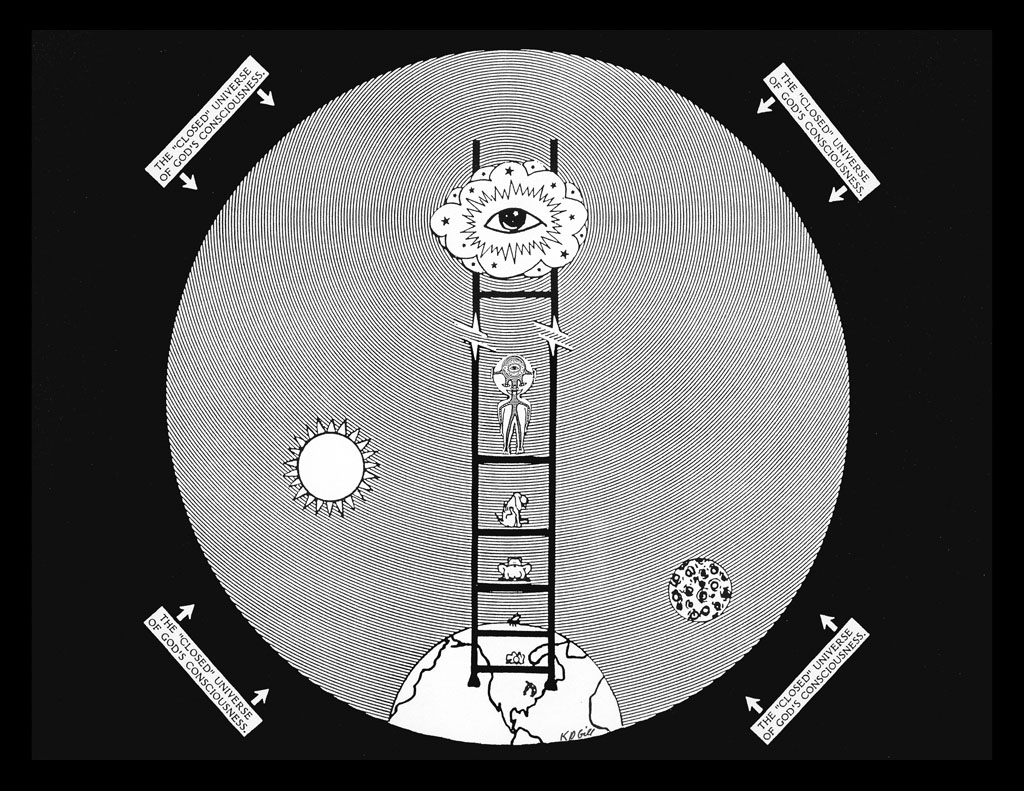
Image
Image

The captions...
"...Just as that fly, way down on a rung below ours, could land on our arm and never even begin to comprehend that it is walking on the living physical body of a being that is so far and away above it in scope and consciousness that there is no comparison, so it is with us as we stand on the earth..."
"...in a higher metaphorical sense, we are walking on the "living physical body" of a being that is so far and away above us in scope and consciousness that we do not recognize what he is or the situation he has us in..."
"...It is almost impossible for us to comprehend that everything we are and that everything we see throughout the universe is all part of God's "spirit body." It is all completely alive, but it just does not present itself to us as a living being as we understand living beings to be..."
And, no, I cannot prove any of the above.

However, BigMike, not only do you need to keep in mind that you're on a "philosophy" forum, not a hard science forum,...

...but I am guessing that if this were a competition, then a vast majority of humans on earth would lean more towards the spirit of purpose and hopefulness implicit in what I am offering,...

...as opposed to the spirit of nihilism and purposelessness implicit in what you are offering.

In other words, no one (at least no one of sound mind) wants to be told that life is basically meaningless and holds no ultimate purpose for us as individuals,...

...especially when the ones promulgating such nihilism clearly haven't the slightest clue if what they are saying is true or not true.
_______
User avatar
Alexis Jacobi
Posts: 8301
Joined: Tue Oct 26, 2021 3:00 am

Re: Can the Religious Be Trusted?

Post by Alexis Jacobi »

BigMike wrote: Sun Jan 05, 2025 8:40 pm You describe thoughts, aspirations, or hopes as appearing "acausally," yet they must be instantiated in the physical brain through neuronal activity. If these phenomena influence thoughts or actions, there has to be a pathway for that influence—a way to transition from the metaphysical to the physical. Without such a mechanism, the claim that they affect behavior remains unsubstantiated.
By sticking tightly, undeviatingly, to your script — a strict science-based understanding of the brain and its function — I cannot see how you could be influenced by any ideas I mention.

But note this: I did not say that thoughts, aspirations, or changes of heart occur acausally, but rather that, according to some, there is an acausal connecting principle operative in our world. Jung’s ideas on this can easily be found.

So, the experience of such an event, a “powerful synchronicity” that overflows with meaning (a sign, an omen — these are the old-school terms) simply trigger events in the mind-brain that, according to your diagramming, move neuronal channels.
Without such a mechanism, the claim that they affect behavior remains unsubstantiated.
Nothing that I have presented to you can be considered remotely substantable (excuse the neologism).
BigMike
Posts: 2210
Joined: Wed Jul 13, 2022 8:51 pm

Re: Can the Religious Be Trusted?

Post by BigMike »

Alexis Jacobi wrote: Sun Jan 05, 2025 2:57 pm
Here’s the brutal truth: your brain is a deterministic machine, operating under the same unyielding physical laws as a rock rolling downhill. You don’t control your thoughts, your desires, or your decisions. You are driven by a cascade of external inputs, biological processes, and environmental stimuli—all of which you neither initiated nor directed. The belief that you can simply will yourself into action without external cause is pure fantasy, the kind of self-deception reserved for fairy tales and bad philosophy.
All this is *true* as long as one understands, one believes, that there is no *mind* with capabilities that are not determined in the same way the falling rock is determined.

The declaration in BigMike’s (now famous!) paragraph is a linguistic and semantic construct! At the least it should be, can be, examined as such.
Alexis, it’s staggering how you manage to tie yourself into semantic knots trying to argue against the obvious. Let me make this clear so even you can grasp it: the deterministic nature of the brain is not a matter of belief. It’s a conclusion drawn from evidence—decades of neuroscience, biology, and physics. It’s not a "linguistic construct" any more than gravity is a "linguistic construct." These are observable, measurable phenomena. Dismissing this as a belief system reveals a level of intellectual dishonesty or ignorance that’s honestly embarrassing.

You cling to your "mind with capabilities" as though it’s some mystical free agent, unbound by physical laws, while offering zero evidence for this fantasy. If your "mind" isn’t operating within the deterministic framework, then prove it. How does it escape causation? Where is your evidence that it can operate like some supernatural force? You don’t have any. Instead, you retreat into vague handwaving about semantics and belief systems, which is nothing but a pathetic attempt to avoid engaging with the science.

Your pseudo-intellectual posturing doesn’t make your arguments profound; it makes them incoherent. If you can’t handle the reality that your thoughts and actions arise from physical processes, then fine—keep spinning your metaphysical fairy tales. But don’t expect to be taken seriously when you present such sloppy, unsupported nonsense as though it’s on par with the rigor of deterministic science.

Now, please, explain how your "mind" magically sidesteps causation. Enlighten us with something more than empty rhetoric and hollow appeals to mystical "capabilities." Show us that you’re not just grasping at straws to defend a worldview that’s collapsing under the weight of its own irrelevance.
BigMike
Posts: 2210
Joined: Wed Jul 13, 2022 8:51 pm

Re: Can the Religious Be Trusted?

Post by BigMike »

Alexis Jacobi wrote: Sun Jan 05, 2025 11:18 pm
BigMike wrote: Sun Jan 05, 2025 8:40 pm You describe thoughts, aspirations, or hopes as appearing "acausally," yet they must be instantiated in the physical brain through neuronal activity. If these phenomena influence thoughts or actions, there has to be a pathway for that influence—a way to transition from the metaphysical to the physical. Without such a mechanism, the claim that they affect behavior remains unsubstantiated.
By sticking tightly, undeviatingly, to your script — a strict science-based understanding of the brain and its function — I cannot see how you could be influenced by any ideas I mention.

But note this: I did not say that thoughts, aspirations, or changes of heart occur acausally, but rather that, according to some, there is an acausal connecting principle operative in our world. Jung’s ideas on this can easily be found.

So, the experience of such an event, a “powerful synchronicity” that overflows with meaning (a sign, an omen — these are the old-school terms) simply trigger events in the mind-brain that, according to your diagramming, move neuronal channels.
Without such a mechanism, the claim that they affect behavior remains unsubstantiated.
Nothing that I have presented to you can be considered remotely substantable (excuse the neologism).
Alexis, your response is an astounding monument to intellectual cowardice. The mental gymnastics you employ to avoid addressing basic, obvious questions would be impressive if they weren’t so transparently desperate. Let me spell it out for you: if you cannot provide a mechanism by which these "metaphysical" phenomena affect the brain, then your claims are not just unsubstantiated—they’re outright meaningless.

Your insistence that I "stick tightly" to a science-based understanding of the brain is not the gotcha you think it is. That’s the point—science deals in evidence, mechanisms, and testable frameworks. You, on the other hand, offer nebulous handwaving about "synchronicities" and "acausal principles" as though these mystical placeholders carry even a fraction of the explanatory power of neuroscience or physics. They don’t.

Let’s dissect your retreat into Jungian mysticism for a moment. You point to the "experience" of powerful synchronicities that "overflow with meaning." Fine. But where does this meaning come from? How does it arise? How does it cause neurons to fire? If it doesn’t cause anything in the physical realm, it’s irrelevant to any discussion about human thought or behavior. And if it does cause changes in the brain, then you are bound to explain how it interfaces with the physical processes of neuronal activity. Until you can provide that, your claims are just a lot of empty noise wrapped in flowery language.

Your admission that nothing you’ve presented can be substantiated isn’t an act of humility; it’s an outright confession that your position is built on nothing. You’re not engaging in intellectual exploration; you’re playing dress-up, pretending to have profound insights while offering nothing of substance. It’s embarrassing, Alexis. Truly.

So, here’s your challenge, one more time: show us how these metaphysical phenomena interact with the brain. Provide anything resembling a coherent explanation. Or admit what we already know—that your entire argument is a hollow shell, devoid of reason, evidence, or relevance.
User avatar
Alexis Jacobi
Posts: 8301
Joined: Tue Oct 26, 2021 3:00 am

Re: Can the Religious Be Trusted?

Post by Alexis Jacobi »

BigMike wrote: Sun Jan 05, 2025 8:40 pm I’ll ask again: how do these metaphysical "frequencies" interact with ion channels, neurotransmitters, or any other aspect of neuronal function? If they can’t or don’t, then they don’t meaningfully explain anything about human thought or action. If they do, they are necessarily part of the deterministic chain of causality that governs the brain’s operations. How do you resolve this contradiction?
You continually ask questions and then re-ask them because by honing strictly down into the only terms you recognize as coherent and valid, you need not address a good deal of what I have presented, which has to do with human experience.

If the brain is an instrument of perception, and if our brains are also instruments developed to deal with levels of meaning that are far above what a biological entity requires to live and prosper in this world, I am suggesting that it is the mind that is this instrument.

What I can say is just what I do say: the “frequency” of what is meaning, and much that is metaphysical, seems to me to have a tangible existence even if there is no brain to have dreamed it up or perceived it.

However, I must stop there with an insinuation.

I do not “resolve contradictions”. I only have spoken to you on the basis of my own experience. Put in another way I might say “I live in accord with my sense of an acausal connecting principle” which, though I believe myself to be relatively grounded, sober, and not given to superstitions, I (simply put) leave a door open to other perceptual and interpretative modes.

I offer no other justification nor explanation.

I note however that I believe I grasp “what you are up to” and why you cannot deviate from your interpretive course.
User avatar
Alexis Jacobi
Posts: 8301
Joined: Tue Oct 26, 2021 3:00 am

Re: Can the Religious Be Trusted?

Post by Alexis Jacobi »

BigMike wrote: Sun Jan 05, 2025 11:21 pm Let me make this clear so even you can grasp it: the deterministic nature of the brain is not a matter of belief. It’s a conclusion drawn from evidence—decades of neuroscience, biology, and physics. It’s not a "linguistic construct" any more than gravity is a "linguistic construct." These are observable, measurable phenomena. Dismissing this as a belief system reveals a level of intellectual dishonesty or ignorance that’s honestly embarrassing.
You don’t have to make it clear. I understand. What I do suggest is that others, in the same field, do not arrive at the same set of conclusions as you have.

You misunderstood. You have taken material facts (brain science, physics, etc.) and have constructed an ideological belief-system from it.

I don’t have reason to disagree with the science of brain physiology. I accept it as coherent description.

You want to give to your ideological construct the authority of gravity-facts. Do you better understand me?

(I dumbed it down by 35%). 😎
Alexis, your response is an astounding monument to intellectual cowardice.
Them’s fightin’ words where I comes from!!
BigMike
Posts: 2210
Joined: Wed Jul 13, 2022 8:51 pm

Re: Can the Religious Be Trusted?

Post by BigMike »

Alexis Jacobi wrote: Sun Jan 05, 2025 11:36 pm
BigMike wrote: Sun Jan 05, 2025 8:40 pm I’ll ask again: how do these metaphysical "frequencies" interact with ion channels, neurotransmitters, or any other aspect of neuronal function? If they can’t or don’t, then they don’t meaningfully explain anything about human thought or action. If they do, they are necessarily part of the deterministic chain of causality that governs the brain’s operations. How do you resolve this contradiction?
You continually ask questions and then re-ask them because by honing strictly down into the only terms you recognize as coherent and valid, you need not address a good deal of what I have presented, which has to do with human experience.

If the brain is an instrument of perception, and if our brains are also instruments developed to deal with levels of meaning that are far above what a biological entity requires to live and prosper in this world, I am suggesting that it is the mind that is this instrument.

What I can say is just what I do say: the “frequency” of what is meaning, and much that is metaphysical, seems to me to have a tangible existence even if there is no brain to have dreamed it up or perceived it.

However, I must stop there with an insinuation.

I do not “resolve contradictions”. I only have spoken to you on the basis of my own experience. Put in another way I might say “I live in accord with my sense of an acausal connecting principle” which, though I believe myself to be relatively grounded, sober, and not given to superstitions, I (simply put) leave a door open to other perceptual and interpretative modes.

I offer no other justification nor explanation.

I note however that I believe I grasp “what you are up to” and why you cannot deviate from your interpretive course.
Alexis, your latest response is a masterclass in deflection wrapped in pseudo-philosophical word salad. Let me be clear: I keep asking the same questions because you keep failing to answer them. You wax poetic about “human experience,” “perceptual modes,” and “levels of meaning” as though throwing these terms around constitutes a meaningful response. It doesn’t.

You claim the brain is an instrument of perception, capable of interacting with “frequencies of meaning” that exist independently of physical reality. Fine. That’s a hypothesis. But hypotheses without mechanisms, evidence, or any explanatory value are just noise. If these “frequencies” influence the brain or behavior, they must interact with the physical world. If they don’t, then they’re irrelevant to the conversation. This is not a difficult concept, Alexis—it’s basic logic.

Your repeated retreat into the nebulous territory of "acausal connecting principles" and "living in accord with your sense" is, frankly, a cop-out. You’re hiding behind mysticism to avoid engaging with the very real contradictions in your claims. If you “leave a door open to other perceptual modes,” that’s fine for your personal life, but it doesn’t advance a serious discussion about how human thought and action are shaped.

You say you "do not resolve contradictions," as though that’s an acceptable position. It isn’t. You’ve introduced these ideas, so the burden is on you to explain them coherently. If you can’t resolve the contradictions inherent in your claims, then they crumble under their own weight.

Here’s the reality, Alexis: my interpretive course is grounded in evidence, logical consistency, and explanatory power. Yours is grounded in vague insinuations and subjective experience that can’t be scrutinized or tested. If you can’t back your claims with anything more substantial than your “sense of meaning,” then your arguments don’t deserve to be taken seriously.
User avatar
Alexis Jacobi
Posts: 8301
Joined: Tue Oct 26, 2021 3:00 am

Re: Can the Religious Be Trusted?

Post by Alexis Jacobi »

BigMike wrote: Sun Jan 05, 2025 11:32 pm Or admit what we already know—that your entire argument is a hollow shell, devoid of reason, evidence, or relevance.
The “royal we” again!
BigMike
Posts: 2210
Joined: Wed Jul 13, 2022 8:51 pm

Re: Can the Religious Be Trusted?

Post by BigMike »

Alexis Jacobi wrote: Sun Jan 05, 2025 11:44 pm
BigMike wrote: Sun Jan 05, 2025 11:21 pm Let me make this clear so even you can grasp it: the deterministic nature of the brain is not a matter of belief. It’s a conclusion drawn from evidence—decades of neuroscience, biology, and physics. It’s not a "linguistic construct" any more than gravity is a "linguistic construct." These are observable, measurable phenomena. Dismissing this as a belief system reveals a level of intellectual dishonesty or ignorance that’s honestly embarrassing.
You don’t have to make it clear. I understand. What I do suggest is that others, in the same field, do not arrive at the same set of conclusions as you have.

You misunderstood. You have taken material facts (brain science, physics, etc.) and have constructed an ideological belief-system from it.

I don’t have reason to disagree with the science of brain physiology. I accept it as coherent description.

You want to give to your ideological construct the authority of gravity-facts. Do you better understand me?

(I dumbed it down by 35%). 😎
Alexis, your response is an astounding monument to intellectual cowardice.
Them’s fightin’ words where I comes from!!
Alexis, for someone so eager to flaunt their grasp of nuance, you’ve completely missed the point—again. Let me spell it out for you in no uncertain terms: determinism isn’t some "ideological construct" cobbled together from half-baked musings. It’s a framework rooted in the observable, measurable reality of how physical systems—like the brain—operate. If you accept the coherence of brain science and physics, as you claim, then determinism is the logical extension of those facts.

What you’re doing is intellectually dishonest. You concede the validity of the science, then dismiss its implications as mere "belief" because they clash with your metaphysical fantasies. That’s not how reason works. You don’t get to cherry-pick the parts of science you find palatable while rejecting the conclusions that follow from them.

Your accusation that I’ve built an "ideological belief-system" is laughable. Determinism isn’t an ideology; it’s a conclusion backed by mountains of evidence. Meanwhile, your vague appeals to metaphysics and acausal connections lack even a shred of substantiation. What you call "belief" on my part is simply your inability to reconcile evidence with your preconceptions.

And as for your juvenile attempt to frame this as a fight—please. If this is your idea of intellectual sparring, you’re swinging at shadows while the rest of us are in the ring dealing with reality. Dumb it down all you like, Alexis. At this rate, it might be your only hope of catching up.
BigMike
Posts: 2210
Joined: Wed Jul 13, 2022 8:51 pm

Re: Can the Religious Be Trusted?

Post by BigMike »

Alexis Jacobi wrote: Sun Jan 05, 2025 11:58 pm
BigMike wrote: Sun Jan 05, 2025 11:32 pm Or admit what we already know—that your entire argument is a hollow shell, devoid of reason, evidence, or relevance.
The “royal we” again!
Ah, Alexis, the infamous "royal we." It's not a claim to sovereignty, just a recognition of the collective eye-rolling from anyone reading your evasions. You dodge questions, fail to substantiate your claims, and when cornered, retreat into quips about semantics or some vague metaphysical shrug.

This isn’t about me lording over the conversation with a "royal" presence—it’s about the sheer emptiness of your position. Admit it or not, we (yes, we) all see it for what it is: hollow rhetoric cloaked in pseudo-philosophical mumbo-jumbo. But please, do go on with your deflections and insinuations. It's amusing, if nothing else.
User avatar
Alexis Jacobi
Posts: 8301
Joined: Tue Oct 26, 2021 3:00 am

Re: Can the Religious Be Trusted?

Post by Alexis Jacobi »

BigMike wrote: Sun Jan 05, 2025 11:54 pm Here’s the reality, Alexis: my interpretive course is grounded in evidence, logical consistency, and explanatory power. Yours is grounded in vague insinuations and subjective experience that can’t be scrutinized or tested. If you can’t back your claims with anything more substantial than your “sense of meaning,” then your arguments don’t deserve to be taken seriously.
According to my interpretation (of you), I have granted to you nearly every fact that underpins your system. I recognize the evidentiary element; I grasp that your views flow from your predicates logically; and I notice that you have developed a degree of explanatory power.

I agree that you (and lab techs) cannot scrutinize nor test any assertion I have made.

There is no way that I could, to you, back up any claim I have made.

And finally I accept that you cannot take any part of what I say seriously.
BigMike
Posts: 2210
Joined: Wed Jul 13, 2022 8:51 pm

Re: Can the Religious Be Trusted?

Post by BigMike »

Alexis Jacobi wrote: Mon Jan 06, 2025 12:07 am
BigMike wrote: Sun Jan 05, 2025 11:54 pm Here’s the reality, Alexis: my interpretive course is grounded in evidence, logical consistency, and explanatory power. Yours is grounded in vague insinuations and subjective experience that can’t be scrutinized or tested. If you can’t back your claims with anything more substantial than your “sense of meaning,” then your arguments don’t deserve to be taken seriously.
According to my interpretation (of you), I have granted to you nearly every fact that underpins your system. I recognize the evidentiary element; I grasp that your views flow from your predicates logically; and I notice that you have developed a degree of explanatory power.

I agree that you (and lab techs) cannot scrutinize nor test any assertion I have made.

There is no way that I could, to you, back up any claim I have made.

And finally I accept that you cannot take any part of what I say seriously.
Alexis, I genuinely hope you’re not a professional philosopher being paid to spread this nonsense because if so, it’s a damning indictment of the system funding you. You admit you can't substantiate your claims, that they can’t be scrutinized, tested, or backed up in any meaningful way—and yet you persist as though your "sense of meaning" holds some profound weight.

This isn’t philosophy; it’s self-indulgent rambling. Philosophy, at its core, demands rigor, coherence, and accountability—none of which you’ve demonstrated. If your arguments hinge on untestable, unprovable assertions, then they’re little more than intellectual cotton candy: airy, sweet, and utterly devoid of substance.
Post Reply