simplicity wrote: ↑Thu Dec 02, 2021 6:09 pm
Veritas Aequitas wrote: ↑Thu Dec 02, 2021 5:17 amBtw personally to me, the existence of a Buddha as founder of current Buddhism is a myth. There is no such real person as The Buddha. What is critical are the consistent core principles and practices of Buddhism which can be abstracted from the various schools of Buddhism.
I have no problem with anything, particularly intellectual things. You miss my point. I am a physician and have extensive intellectual training. My point is that becoming "aware" allows one to make MUCH better use of what the intellect can actually give you [which is very different than almost everybody thinks]. I am sure I have read ten times the number of books you have and read every day. It is my main source of pleasure [sitting on my porch on a beautiful day with a great novel]. I don't read about spiritual matters anymore because I already did that...
The point is "enlightenment" is not a destination but rather a never ending journey with milestones/stages of progress [of sudden or gradual realizations] along the way.
What is most critical for a Physician is extensive intellectual knowledge [continual] but more importantly is continual practice and experience as with any other skills. Thus spiritual skills cannot be the only exception!
What I understand from your counters is you seem to take 'enlightenment' as a final destination, so thereafter one don't have to read at all.
My point is I don't take 'enlightenment' or 'get it' as a final destination but rather a journey which must be taken with doing [practices] but it is still more effective to continually read and understand to maps and various conditions relevant to that journey to cater for inevitable changes within oneself and the environment.
Another point is while we can stop learning and practicing other conventional skills we cannot [should not] do so with spiritual skills and knowledge which is for life.
Surely you understand the brain deteriorates with age or expeditiously in later life. As such there is no guarantee that 'get it' can be sustained in any Zen or spiritual practitioner in later life in cases where for some the brain deteriorates at a greater rate.
But I believe a spiritual practitioner who supplement his spiritual state with knowledge and wisdom intellectually and otherwise will have exercised brain muscles more to sustain his spiritual cognitive faculties longer than one who has not.
The problem is you assumed I am merely a beginner and trying to achieve that 'get it' via books only without the necessary practice. I had pointed out I had been on this ongoing spiritual journey for a very long time. And it would be very stupid of me [spiritually] to insist the only way is via reading books with the intellectual approach.
Without knowing the truths of my situation, I suggest you don't jump to conclusion that you have read 10 times the number of books you have in your lifetime or what you read everyday. If I had read 10,000 books that mean you have to prove you have read 100,000 books?
Btw, since I took up meditation I have never read any novel nor any book on fictions. What I read is all reality based.
All of the writings in Zen/Buddhism were designed to point its students toward the heart of practice...meditation. This is what the Buddha taught but he [and others along the way] knew that very, very few people would do the work necessary to attain any realization so the religion of Buddhism was brought forth to give everybody else a way to live a MUCH better life. Buddhism is a wonderful religion and its teachings are incredible, but it's not what it is.
Earlier you wrote as if there is no need for books and thinking.
If you now agree there are writings in Zen/Buddhism to guide students, then they need to read them and the master [Dogen for example] who wrote the books would prefer his students to read them thoroughly. Note Dogen, as I linked above, also wrote on related philosophical subjects for reflection, not merely guides for his disciples.
How come you did not criticized Dogen on this?.
I remember when I first [thereafter I moved on] started with meditation [Vedanta], my understanding changed with a clearer picture after each reading of the Bhagavad Gita which I have read more than >100 times. It is the same with the other spiritual books I have read related to various spiritual masters, especially those from Nagarjuna and the likes.
BUT the point is not every Zen student or person has the inclination for reading and serious reading into the Zen writing which can be very complex. Some prefer to just take simply instructions and do whatever is advised.
I am sure you can see the similarity with your patients, some will just take your advice and prescriptions with faith while others would prefer to research, read up before making any decisions.
Buddhism is a wonderful religion and its teachings are incredible, but it's not what it is.
Buddhism is "not what it is"
You know what Buddhism is? From you have posted I don't cognize you know Buddhism thoroughly.
To understand Buddhism-proper, one need to research it from its philosophy and related matters prior to Gautama to the extent of its present fringe sects [Zen being one].
I have done that.
You? What I see with you is you are relying on very subjective views and trying to impose those limited views on Buddhism-proper which has 2500 years of history after Gautama and 7500 years of history before Gautama.
Read to your heart's content, but if you wish to transcend the ordinary, "understand" the relative v. Absolute, and truly help all beings, sit. When another way becomes available, everybody will know about in 30 seconds. Be one of the very few and do the work. It will change your life forever!
There you go again, you are still assuming I am a beginner seeking for some spiritual ends via reading of books despite what I have been explaining in so many posts. I attribute your narrow thinking to your ignorance on such spiritual matters.
Besides meditation, I am aware there are many approaches and ways one can experience 'sudden enlightenment' e.g. via drugs, hallucinogens, stress, brain damage, mental illness, magnetic triggers, out-of-the-blue, etc.
Note this;
DMT: The Spirit Molecule (2010)
https://www.youtube.com/watch?v=fwZqVqbkyLM
The problem is you don't read widely on spiritual-related subjects other than dogmatically clinging to your Zen beliefs and practices.
Btw, can you give me an idea what you know about the points I mentioned above and why those sudden experiences are different from that 'get it' you experienced from Zen?
The point is you can spend years "just sit" to achieve "that" but a person who take DMT or the right hallucinogen can experience the same 'that' in 30 seconds or one session.
Newberg did research to find commonalities with those [including Zen practitioners] who claimed they have achieved some sort of 'enlightenment' experience, and noted they all have certain brain activities in common.
Note this brain imaging before and after meditation;
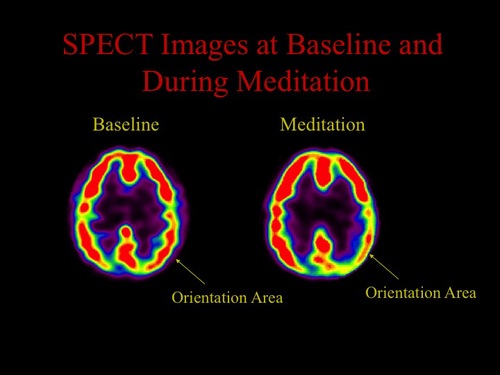
Newberg also compare the brain imagings of new meditators and those who have meditate for a long time [>30 to 40 years].
Whilst Newberg has shown some commonalities, I believe such via brain imaging is still crude.
What we need in future is to identify the exact neuronal connections for those who claim to experience 'enlightenment' to identify the commonalities.
I am optimistic this possible given the trend of progress in this
http://www.humanconnectomeproject.org/
to map every neural connection in the human brain.
Whilst 100% is quite impossible to achieve 75% is sufficient to reveal a lot about spiritual activities and states in the brain.
I am confident when we have the more exact neural connections and state of the brains of Zen practitioners of your likes, they are likely to me "mediocre".
I am also confident my neural state of 'enlightenment' based on detailed imaging would ranked somewhere reasonable along the continuum [given the spiritual practices I have put in] instead of the ZERO you assumed for me.