Re: Christianity
Posted: Sat Apr 16, 2022 2:46 pm
However the issue, as I see it, is not that I doubt your sincerity but rather that I notice in you and bring to your attention that you carry on 'deviously'. I do not doubt that you see yourself as acting correctly, even morally, and the way your frame your perception of yourself, the way you see yourself in your own mirror, is as a true Christian apologist. Your view of yourself is to see yourself, and to describe yourself to others, as *the true Christian* in a world of *false Christians*. You have built for yourself an *unassailable fortress* and so, yes, it is quite clear, that you are "not too concerned" with my assessment of your motives. Why should you be? You are allied with God Himself.I'm not too concerned with your assessment of my motives, honestly. I'd like you to realize I'm sincere, but if you don't, there's little enough that I can do about it, and little enough that it matters, as well. In all cases, the truth is the truth. And we have something upon which, now, we can at least agree.
What I say to you is this: If you were not 'deaf' in the sense that you refer to about those who can hear as-against those who cannot hear (or will not hear) you would not need to ask that question. You would have seen and also recognized what I am up to because at every turn I state and restate exactly what I am up to. But your question is part of your underhanded modus operandi. By asking a question -- apparently sincerely -- you seek to embroil me in the sort of useless bantering argumentation that is your specialty. The fact is, the truth is, you are not in any sense 'prepared to hear' what I say and what I mean. The opposite is more true. So here I would sy that your *sincerity* has a sham element. It is a false-front.
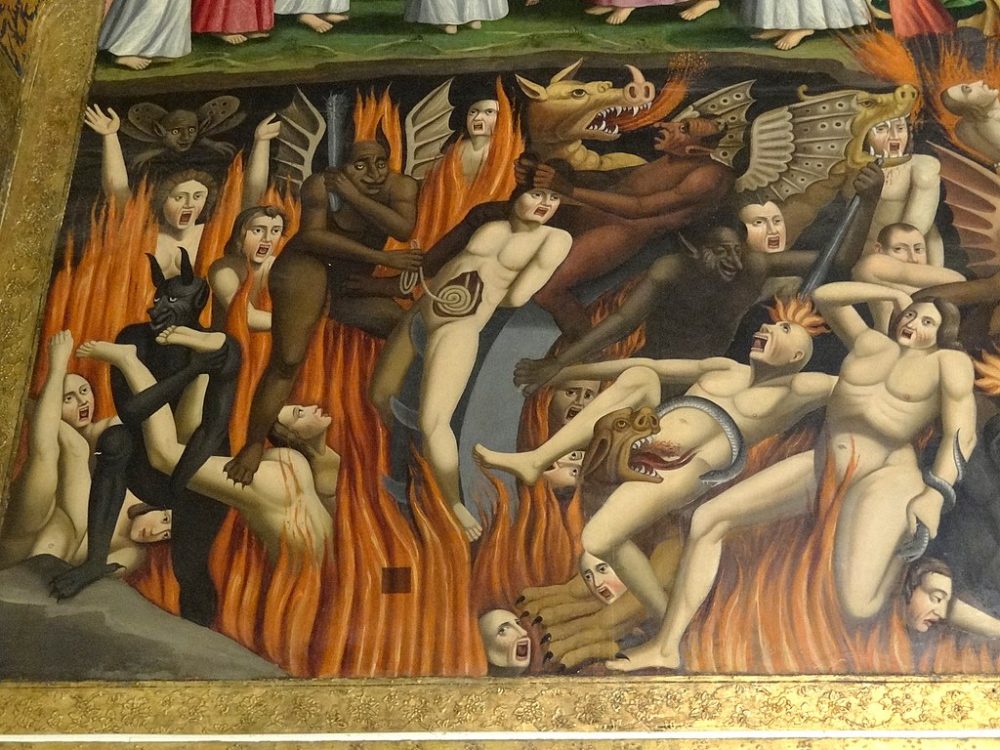
The question I ask is What happens to the Christian Belief System when one solitary element is removed from its foundation. So let's say that I said "I simply cannot believe in the Garden of Eden as a story about a factual reality". The belief is completely core to traditional and historical Christianity is it not? It is part of the entire *story-structure* is it not? What happens when it is no longer possible to believe it? Now here I would have to ask you What is the function of belief? I ask this question because, as we all know, the belief in Jesus Christ's resurrection -- based on the scriptural passage you quoted -- determines if one is or if one is not a Christian. You either believe it, and are a bona fide Christian, or you deny it and are not (and will then be consigned to eternal punishment (*alienation* is your euphemism) in an unending hellish existence as punishment.I would just compare what you say about salvation with what Jesus Christ says. Anybody who does that is going to arrive at the same conclusion. For you, Christianity is a merely a sort of European "social milieu," and salvation is not faith in Christ, but rather something else...I'll let you say exactly what, since what you offer as an alternative is, at the moment, quite difficult to discern.
The reason I use the word *gnostic* is to refer to modes of knowing that are generally seen as heretical. I do not capitalize the word because I do not want it to be confused with specific Gnosticism. Because I do not present or represent such historical Gnosticism. Yet I do certainly believe, and I write about it all the time, that we have to develop a *special way of hearing and of seeing* in order to be able to perceive, appreciate and preserve what I call *the essences* within the Christian system.Do you mean you're a Gnostic, or are you just using the Greek word for "knowledge"? If it's the former, then I know where you're coming from; if it's the latter, I can't really see why you didn't just say "knowledge," unless you were being deliberately obscure.
No, you are not *making things up* but what you are doing, and obviously so, is *wielding a story* within an intellectual/philosophical forum, and within a modern context, that is hyper-mythologized. And what I say is that it is necessary (for thinking people) to step back from hyper-mythologizations and to begin to understand how these operate in our present, socially and culturally. I would not, not necessarily, recommend this sort of incisive endeavor for Mass Man (or mass Christian man to make a stronger point) but it is necessary, in my own case and for certain reasons I could talk about, for me to have undertaken this.That's what I try to do, as often as possible, so you can see I'm not making things up.
What I believe is that I am situated within a physical frame, a biological and material frame, in a *world* that is exceedingly strange and next-to-impossible to fathom. I have faculties, that much is obvious, but they are not always adequate to the task of comprehensive perception. I am a conscious entity, obviously, who tries to make sense of my existence and self-awareness. And I am part of humanity that does this because it must be done! and there is no way around it.Tell me what you do believe.
Was your great great Grandfather real IC ?Immanuel Can wrote: ↑Sat Apr 16, 2022 1:49 pm
So no, they aren't real in any sense, according to your theory.
Not that I agree, of course. I'm just pointing out the problem.
What do you reckon about duty?
What's the alternative? It can only be to believe that "Christian" actually means nothing -- that it is an appraisal to which no criteria attach, even those explicitly given by Christ Himself. In such a case, there is no such thing as a "Christian," and the very use of the word is inauthentic.Alexis Jacobi wrote: ↑Sat Apr 16, 2022 3:50 pm ...to describe yourself to others, as *the true Christian* in a world of *false Christians*.
I have believed in the One He has said to believe in. And in that case, you would be right. However, I am not my own judge, nor yours. We both have a Judge, it's true. But Christ Himself claims the final right of making that assessment, and you won't catch me trying to compete with Him on that.You are allied with God Himself.
As I say, that's not my assessment to make. It's yours. And ultimately, it's His.And this leads me to state, or restate really, that what you think of me is that I am not *one of God's own*
You say that if I don't [believe you/believe your sincerity] "there's little enough that I can do about it, and little enough that it matters, as well" and here I very strenuously disagree with you. I regard your entire position, as I have expressed it here, as immoral.
Those who will not obey.So then: Who then lacks 'ears to hear'?
By the Judge.How will this be decided?
Well, for me it might be one thing, and for you another...who can say? But Christ says those who follow Him must share His word with others...so I know why I'm doing it.And what is the point of even having this, present discussion?
So...no answer, then? Just more personal insult stuff? Okay.What I say to you is this: If you were not 'deaf' in the sense...
The question I ask is What happens to the Christian Belief System when one solitary element is removed from its foundation.[/quote]I would just compare what you say about salvation with what Jesus Christ says. Anybody who does that is going to arrive at the same conclusion. For you, Christianity is a merely a sort of European "social milieu," and salvation is not faith in Christ, but rather something else...I'll let you say exactly what, since what you offer as an alternative is, at the moment, quite difficult to discern.
...as we all know, the belief in Jesus Christ's resurrection -- based on the scriptural passage you quoted -- determines if one is or if one is not a Christian. You either believe it, and are a bona fide Christian, or you deny it and are not (and will then be consigned to eternal punishment (*alienation* is your euphemism) in an unending hellish existence as punishment.
Oh. Well, some things nominal "Christians" have called "heretical" are not, and some that they have not called "heretical" are. So it's hard to know what body of "knowledge" you mean. Do you mean "things that are not Biblical," or merely "things the self-appointed religious authorites have declared heretical"?The reason I use the word *gnostic* is to refer to modes of knowing that are generally seen as heretical.Do you mean you're a Gnostic, or are you just using the Greek word for "knowledge"? If it's the former, then I know where you're coming from; if it's the latter, I can't really see why you didn't just say "knowledge," unless you were being deliberately obscure.
Well, "the essences" are defined therein. It's not really a matter of special "gnosis."...we have to develop a *special way of hearing and of seeing* in order to be able to perceive, appreciate and preserve what I call *the essences* within the Christian system.
Actually, I heard you from the beginning.I have revealed my position right from the beginning.
That's an okay starting point, I suppose...but what else? That's not enough, surely.What I believe is that I am situated within a physical frame, a biological and material frame, in a *world* that is exceedingly strange and next-to-impossible to fathom. I have faculties, that much is obvious, but they are not always adequate to the task of comprehensive perception. I am a conscious entity, obviously, who tries to make sense of my existence and self-awareness. And I am part of humanity that does this because it must be done! and there is no way around it.Tell me what you do believe.
The "prizes" in academia are not financial. They're about peer approval, prestige, tenure, being regarded as a sage, getting publications published, being invited to expound as an expert, gettting letters after your name, being told you're smart, and so on.

That is why I cannot contribute to the thread even though my gggranduncle was an archbishop in the Armenian church. Arguing about the personal God has nothing to do with perennial Christianity the essence of which existed at the beginningIn Simone Weil's life, religion played a dominant role in the years following the mystical epiphanies she experienced in 1938. Long before, however, her wish to partake in the suffering of the distressed led her to a life-style of extreme austerity. It was under these circumstances that, in 1937, Simone Weil became increasingly attracted to Christianity, a religion she considered to be in its true essence a religion of slaves, and therefore in utter contradiction to the actual form it had taken in history. On this assumption, Simone Weil objected against Catholicism -- the denomination she knew best and respected the most --[21] that it had ended by perverting itself for the sake of power. The historical "double stain" on the Church that Simone Weil denounces originates in the fact that Israel imposed on Christian believers the acceptance of the Old Testament and its almighty God, and that Rome chose Christianity as the religion of the Empire.[22] Despite its universal redemptive mission, the Church became from its very beginnings heir of Jewish nationalism and of the totalitarianism inherent in Imperial Rome. As the spiritual locus in which both traditions of power displaced the religion of powerless slaves, Christianity became the actual negation of its own foundational leitmotiv: the self-annulment of divine omnipotence by the godly act of kenosis or self-abasement.
The question is in fact a very good one and is the one that needs to be asked. But I would begin by saying that a certain amount of the answer depends on who is giving the answer and to what purpose. So what I suggested was also a question -- a thought experiment perhaps -- that asked What happens when one brick in the foundation of conventional Christianity is removed. My examples were The Garden and Noah's Ark. Again, these stories were usually seen as 'descriptions of real events in time and history' and not as allegory. The Adam & Eve story especially is completely foundational to Christian belief (that is *belief* of the sort you seem to demand that I take on along with you) because it offers an explanation of 1) how we as human beings came to this place, and 2) why the world is and became a place of tremendous imperfection and also death.Immanuel Can wrote: ↑Sat Apr 16, 2022 8:02 pmWhat's the alternative? It can only be to believe that "Christian" actually means nothing -- that it is an appraisal to which no criteria attach, even those explicitly given by Christ Himself. In such a case, there is no such thing as a "Christian," and the very use of the word is inauthentic.
Is that your version of honesty? Then let me be the first to step outside of that.

Yes, indeed it is.Is that your version of honesty?
Maybe someone should tell Mr Jillette, the comedian, juggler and magician, that expressing an opinion is not at all the same as proselytizing which attempts to convince others to convert or join some party. To proselytize is not simply to have an opinion; it's to be absolutely certain of its apriorism, regardless of reality content, to mandate its preaching to others.“I’ve always said that I don’t respect people who don’t proselytize. I don’t respect that at all. If you believe that there’s a heaven and a hell, and people could be going to hell or not getting eternal life, and you think that it’s not really worth telling them this because it would make it socially awkward—and atheists who think people shouldn’t proselytize and who say just leave me along and keep your religion to yourself—how much do you have to hate somebody to not proselytize? How much do you have to hate somebody to believe everlasting life is possible and not tell them that?
“I mean, if I believed, beyond the shadow of a doubt, that a truck was coming at you, and you didn’t believe that truck was bearing down on you, there is a certain point where I tackle you. And this is more important than that.”
The duty of who, the intellectuals, starving artists, university teachers, authors of academic books, professors?
Yes, that's true. I wonder what you find implausible about it.Alexis Jacobi wrote: ↑Sat Apr 16, 2022 10:42 pm The Adam & Eve story especially is completely foundational to Christian belief
Well, let's find out why you think that, before we decide.So what happens when one is not any longer capable of believing that this describes *reality*?
No, not necessarily. Nobody's salvation depends on them subscribing to everything. What is requisite is spelled out quite specifically by Jesus Christ Himself....if one important or foundational element in the General Story is overturned there is danger that most of or perhaps the entire Belief System will collapse...
I ask "What is the alternative to defining Christianity by criteria?" And there really is no alternative. If there are no criteria, there's no substantive definition either."What is the alternative?" you ask.
I have also said that I think that the Christian Story reflects and expresses Judaic imperialism.

I don't "reflexively" tell you anything, actually. I tell you what the Word of God tells you.... you reflexively tell me that to do so is wrong, anti-Christian and eventually evil and will buy me a ticket to Eternal Punishment. I say that this is immoral even though you believe it is absolutely true.
So far, you're absolutely right: it's the statement of Jesus Christ, who is the rightful authority in the universe. So I cannot possible state it in a way that can be "imperative" or "absolutist" enough. It is the truth...the absolute and imperative truth....that is why I said that "I am the way and the truth and the life. No one comes to the Father except through me" is an imperative, absolutist statement
Well, to say so, you have to accuse the Son of God of not telling the truth...I wouldn't do that....that is necessarily false.
It's not my "rap," actually. It's what the Bible insists is the case.In fact this is how your rap is structured: No peace and well-being on the planet until *the Prince of Peace* finally sets up His office on Earth.
Well, I'm not a JW. Nor are the JW's considered Christians. They're merely acolytes of Charles Taze Russel, the crazy freemason.These views are rather much like hallucinations, elaborate phantasies
Out of context. I only asked it about your criterionless definition."What is the alternative?" you ask.
Okay. But speculation isn't worth very much, is it? And it lasts only as long as no data are brought into the question.promethean75 wrote: ↑Sun Apr 17, 2022 12:52 am "And you know this by....?"
Oh I don't know any of it. I'm speculating here.
I just doubt that anything about 'god' could be known through revelatory experience... and this would exclude Christianity immediately. Islam and Judaism too.
It's hard to see why.Knowledge about 'god', if there were such a thing, would have to be a priori. He'd be like Aristotle's or Spinz'z 'god'.
This is why nothing in the monotheistic religions could be about the nature of 'god', and the things in the bible would never constitute proof of 'god'.
That's an old canard, and it doesn't really work. After all, if "religion" is the longing for a father figure, Atheism is the longing for one's father to be gone or dead....a fantastic father-figure fantasy founded on functional feuerbachian figments and formative Freudianism,
Ok, lets phrase it another way....Immanuel Can wrote: ↑Sat Apr 16, 2022 8:03 pmThat's self-evidently untrue.
I have no idea how you'd even imagine that.
