No, B: those are just the useful idiots.
Christianity
- henry quirk
- Posts: 16379
- Joined: Fri May 09, 2008 8:07 pm
- Location: 🔥AMERICA🔥
- Contact:
- Alexis Jacobi
- Posts: 8301
- Joined: Tue Oct 26, 2021 3:00 am
Re: Christianity
However the issue, as I see it, is not that I doubt your sincerity but rather that I notice in you and bring to your attention that you carry on 'deviously'. I do not doubt that you see yourself as acting correctly, even morally, and the way your frame your perception of yourself, the way you see yourself in your own mirror, is as a true Christian apologist. Your view of yourself is to see yourself, and to describe yourself to others, as *the true Christian* in a world of *false Christians*. You have built for yourself an *unassailable fortress* and so, yes, it is quite clear, that you are "not too concerned" with my assessment of your motives. Why should you be? You are allied with God Himself.I'm not too concerned with your assessment of my motives, honestly. I'd like you to realize I'm sincere, but if you don't, there's little enough that I can do about it, and little enough that it matters, as well. In all cases, the truth is the truth. And we have something upon which, now, we can at least agree.
Now, the reason I state this is because I believe that we all need to be clear about where we are *situated* and what our *location* is. And I think that I have described you fairly.
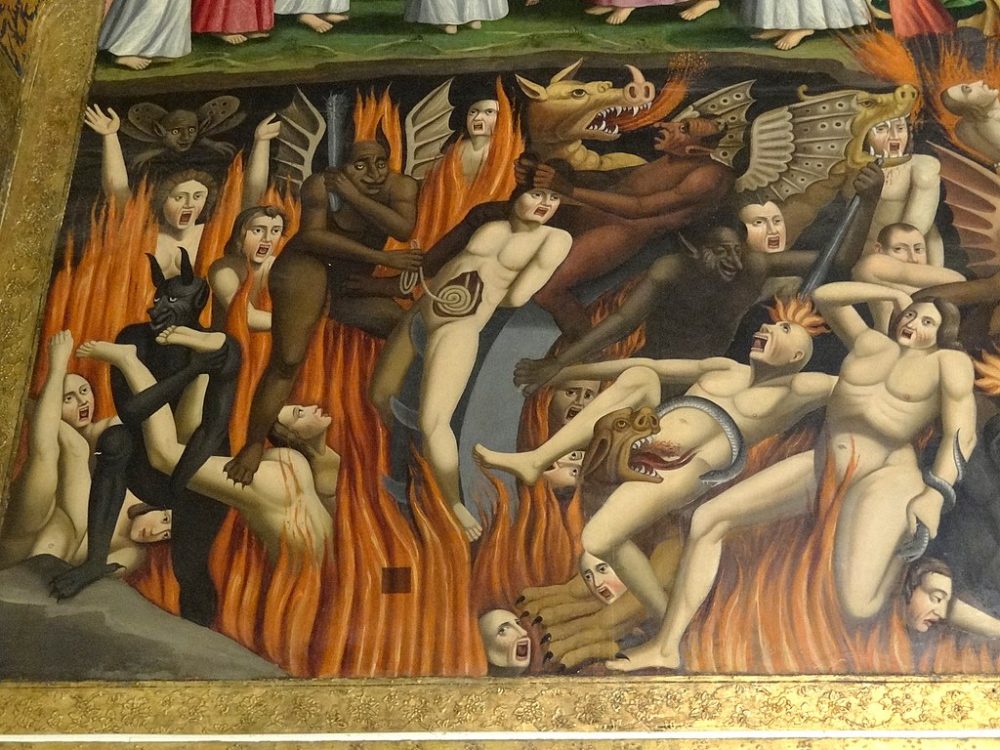
And this leads me to state, or restate really, that what you think of me is that I am not *one of God's own* and that with the ideas I have, which run counter to yours and which also tend to see scriptural statements in a different light, I am 'alienating' myself from God and that when I leave the mortal coil I will go not to Heaven -- to be with you and those who state their belief-claims as you do -- but to the realm of Hell.

You say that if I don't [believe you/believe your sincerity] "there's little enough that I can do about it, and little enough that it matters, as well" and here I very strenuously disagree with you. I regard your entire position, as I have expressed it here, as immoral. Your entire position is immoral and I will also say *rotten*. What you do will lead you, time and time again, to alienate people from the core truths, the truths that require *ears to hear* in exactly the sense of the Gospel saying. You are not helping to bring people to these *core truths* which I would say are the more important truths, but driving them, necessarily, away from that level of understanding. Therefore, it could be suggested that your project, at least when the results you achieve are examined, is deleterious. But you do all of this *sincerely* of course.
So when you say *and little enough that it matters* you show, at least in my estimation, how deeply invested you are in your self-image (which you define as 'doing good' and also 'doing Christian service") and in your general recalcitrant belief-set. The fact of the matter, again as I see things, is that it does really matter and it matters a great deal. Though because it matters not to you -- my opinion again -- I have some theoretical justification in seeing your activity (your project) as immoral. Capice?
So then: Who then lacks 'ears to hear'? How will this be decided? And what is the point of even having this, present discussion? Well, as I say I think it is all tremendously relevant.
What I say to you is this: If you were not 'deaf' in the sense that you refer to about those who can hear as-against those who cannot hear (or will not hear) you would not need to ask that question. You would have seen and also recognized what I am up to because at every turn I state and restate exactly what I am up to. But your question is part of your underhanded modus operandi. By asking a question -- apparently sincerely -- you seek to embroil me in the sort of useless bantering argumentation that is your specialty. The fact is, the truth is, you are not in any sense 'prepared to hear' what I say and what I mean. The opposite is more true. So here I would sy that your *sincerity* has a sham element. It is a false-front.
The question I ask is What happens to the Christian Belief System when one solitary element is removed from its foundation. So let's say that I said "I simply cannot believe in the Garden of Eden as a story about a factual reality". The belief is completely core to traditional and historical Christianity is it not? It is part of the entire *story-structure* is it not? What happens when it is no longer possible to believe it? Now here I would have to ask you What is the function of belief? I ask this question because, as we all know, the belief in Jesus Christ's resurrection -- based on the scriptural passage you quoted -- determines if one is or if one is not a Christian. You either believe it, and are a bona fide Christian, or you deny it and are not (and will then be consigned to eternal punishment (*alienation* is your euphemism) in an unending hellish existence as punishment.I would just compare what you say about salvation with what Jesus Christ says. Anybody who does that is going to arrive at the same conclusion. For you, Christianity is a merely a sort of European "social milieu," and salvation is not faith in Christ, but rather something else...I'll let you say exactly what, since what you offer as an alternative is, at the moment, quite difficult to discern.
So, obviously, I cannot and I do not 'believe in' that Garden nor in Noah's Ark and in point of fact a list of things that I do not consider essential. Yet this does not mean that I do not 'believe in God'. So what is the real issue here? To me it seems obvious and I write extensively about it.
We employ stories, we devise stories, whose purpose is to illustrate truths that we believe are important, even crucial. Christianity, and certainly Judaism, but moreover all mythic religions, express themselves through these mythic stories. But the story is not the truth. The story is not the *thing* that is alluded to. But what is alluded to? That is where 'ears to hear' enters the picture.
The reason I use the word *gnostic* is to refer to modes of knowing that are generally seen as heretical. I do not capitalize the word because I do not want it to be confused with specific Gnosticism. Because I do not present or represent such historical Gnosticism. Yet I do certainly believe, and I write about it all the time, that we have to develop a *special way of hearing and of seeing* in order to be able to perceive, appreciate and preserve what I call *the essences* within the Christian system.Do you mean you're a Gnostic, or are you just using the Greek word for "knowledge"? If it's the former, then I know where you're coming from; if it's the latter, I can't really see why you didn't just say "knowledge," unless you were being deliberately obscure.
This Christian system needs to be seen from a certain distance. It is an agglomeration of many many different threads and currents or, to put it another way, a 'confusion of peoples' in the sense of a confusion of ideas. You would only need to refer to one such picture/idea in order to successfully illustrate the point I am making -- the Garden of Eden. I mention this because this is the one that we have talked about.
So what I 'believe' is just what I say: we picture reality through stories of this sort. The purpose of the story, or the visualization, is to be able to entertain or receive if you wish certain ideas or, perhaps, admonitions. But what we are admonished to receive is not the story-structure which we then uphold like some banner or as it it itself is a truth, but rather the subtle and difficult to grasp truths that you refer to when you bring up *ears that hear* and *ears that do not or cannot hear*.
But note that I have revealed my position right from the beginning. You just were not there to hear.
No, you are not *making things up* but what you are doing, and obviously so, is *wielding a story* within an intellectual/philosophical forum, and within a modern context, that is hyper-mythologized. And what I say is that it is necessary (for thinking people) to step back from hyper-mythologizations and to begin to understand how these operate in our present, socially and culturally. I would not, not necessarily, recommend this sort of incisive endeavor for Mass Man (or mass Christian man to make a stronger point) but it is necessary, in my own case and for certain reasons I could talk about, for me to have undertaken this.That's what I try to do, as often as possible, so you can see I'm not making things up.
What I believe is that I am situated within a physical frame, a biological and material frame, in a *world* that is exceedingly strange and next-to-impossible to fathom. I have faculties, that much is obvious, but they are not always adequate to the task of comprehensive perception. I am a conscious entity, obviously, who tries to make sense of my existence and self-awareness. And I am part of humanity that does this because it must be done! and there is no way around it.Tell me what you do believe.
Well in fact there is a great deal more to be said but this is enough for the moment!
Re: Christianity
Was your great great Grandfather real IC ?Immanuel Can wrote: ↑Sat Apr 16, 2022 1:49 pm
So no, they aren't real in any sense, according to your theory.
Not that I agree, of course. I'm just pointing out the problem.
Also, if God exists then you cannot. But if you exist then God can't...there is no room in here for two you know.
So which one exists...You or God?
Re: Christianity
What do you reckon about duty?
- Immanuel Can
- Posts: 27608
- Joined: Wed Sep 25, 2013 4:42 pm
Re: Christianity
What's the alternative? It can only be to believe that "Christian" actually means nothing -- that it is an appraisal to which no criteria attach, even those explicitly given by Christ Himself. In such a case, there is no such thing as a "Christian," and the very use of the word is inauthentic.Alexis Jacobi wrote: ↑Sat Apr 16, 2022 3:50 pm ...to describe yourself to others, as *the true Christian* in a world of *false Christians*.
Is that your version of honesty? Then let me be the first to step outside of that.
I have believed in the One He has said to believe in. And in that case, you would be right. However, I am not my own judge, nor yours. We both have a Judge, it's true. But Christ Himself claims the final right of making that assessment, and you won't catch me trying to compete with Him on that.You are allied with God Himself.
As I say, that's not my assessment to make. It's yours. And ultimately, it's His.And this leads me to state, or restate really, that what you think of me is that I am not *one of God's own*
But as I said above, there are Biblical criteria for such a claim...and the criteria are not mine either.
You say that if I don't [believe you/believe your sincerity] "there's little enough that I can do about it, and little enough that it matters, as well" and here I very strenuously disagree with you. I regard your entire position, as I have expressed it here, as immoral.
And yet, you are not my Judge either. Like you, I must trust that assessment to God.
Those who will not obey.So then: Who then lacks 'ears to hear'?
By the Judge.How will this be decided?
Well, for me it might be one thing, and for you another...who can say? But Christ says those who follow Him must share His word with others...so I know why I'm doing it.And what is the point of even having this, present discussion?
Now, I happen to like you as a person, so that also figures in. But if I didn't, I'd still be obligated to share the gospel with you. After all, as Paul says, "Woe to me if I do not preach the gospel."
The Atheist Penn Jillette puts it another way. He says,
“I’ve always said that I don’t respect people who don’t proselytize. I don’t respect that at all. If you believe that there’s a heaven and a hell, and people could be going to hell or not getting eternal life, and you think that it’s not really worth telling them this because it would make it socially awkward—and atheists who think people shouldn’t proselytize and who say just leave me along and keep your religion to yourself—how much do you have to hate somebody to not proselytize? How much do you have to hate somebody to believe everlasting life is possible and not tell them that?
“I mean, if I believed, beyond the shadow of a doubt, that a truck was coming at you, and you didn’t believe that truck was bearing down on you, there is a certain point where I tackle you. And this is more important than that.”
So...no answer, then? Just more personal insult stuff? Okay.What I say to you is this: If you were not 'deaf' in the sense...
I don't blame you for being annoyed. I've put your feet to the fire a bit. But it is with the intention of reminding you that these things are serious, and are far too important for treatment as arid, academic or sociological postulates. These things have to do with a man's soul. And it would be no act of kindness on my part to let you persist in treating them that way...not if I have any concern for you at all.
That's my point, but it's also Jillette's. And when you get a Christian and an adamant Atheist agreeing on something, I think you should ask yourself why. It could just be because they both -- partisanship all aside -- know it's true.
Thus, it would be immoral of me NOT to contradict your view. I would be caring nothing for your soul.
The question I ask is What happens to the Christian Belief System when one solitary element is removed from its foundation.[/quote]I would just compare what you say about salvation with what Jesus Christ says. Anybody who does that is going to arrive at the same conclusion. For you, Christianity is a merely a sort of European "social milieu," and salvation is not faith in Christ, but rather something else...I'll let you say exactly what, since what you offer as an alternative is, at the moment, quite difficult to discern.
I think this gets to the question of what "foundation" means. Does your salvation depend on Noah's Ark or Elijah's fire from Heaven? No. Christ Himself spells out the terms of salvation, and they don't even include believing in Adam or Abraham or Paul.
The center of salvation, the Foundation, is Christ Himself (See 1 Cor. 3:11 and 1 Peter 2:7). Or, as you succintly say,
...as we all know, the belief in Jesus Christ's resurrection -- based on the scriptural passage you quoted -- determines if one is or if one is not a Christian. You either believe it, and are a bona fide Christian, or you deny it and are not (and will then be consigned to eternal punishment (*alienation* is your euphemism) in an unending hellish existence as punishment.
Then we continue:
Oh. Well, some things nominal "Christians" have called "heretical" are not, and some that they have not called "heretical" are. So it's hard to know what body of "knowledge" you mean. Do you mean "things that are not Biblical," or merely "things the self-appointed religious authorites have declared heretical"?The reason I use the word *gnostic* is to refer to modes of knowing that are generally seen as heretical.Do you mean you're a Gnostic, or are you just using the Greek word for "knowledge"? If it's the former, then I know where you're coming from; if it's the latter, I can't really see why you didn't just say "knowledge," unless you were being deliberately obscure.
Well, "the essences" are defined therein. It's not really a matter of special "gnosis."...we have to develop a *special way of hearing and of seeing* in order to be able to perceive, appreciate and preserve what I call *the essences* within the Christian system.
Actually, I heard you from the beginning.I have revealed my position right from the beginning.
However, that doesn't mean I agreed with you. I take issue with the treating of "Christianity" as if it were a European cultural artifact, the self-identification criterion of "Christian" and the distance of which you spoke. I think all are fatal flaws in any purported theory of "Christianity."
You don't agree. But I think you should. And a rational person, if he believes somebody to be wrong, does not retreat from his position for no reason. So I persist.
That's an okay starting point, I suppose...but what else? That's not enough, surely.What I believe is that I am situated within a physical frame, a biological and material frame, in a *world* that is exceedingly strange and next-to-impossible to fathom. I have faculties, that much is obvious, but they are not always adequate to the task of comprehensive perception. I am a conscious entity, obviously, who tries to make sense of my existence and self-awareness. And I am part of humanity that does this because it must be done! and there is no way around it.Tell me what you do believe.
What does it mean to say "I am part of humanity," for example? What is a "human," according to your understanding? And you say you find things "strange," and yet you strive to understand these "strange" things, as if one could -- so you must have some faith that the "strangeness" is temporary or defeatable. You say you try to "make sense": well, that would be impossible unless you also believe that things make sense, because one cannot understand the permanently non-understandable...
So please continue. What else do you believe?
- Immanuel Can
- Posts: 27608
- Joined: Wed Sep 25, 2013 4:42 pm
- Immanuel Can
- Posts: 27608
- Joined: Wed Sep 25, 2013 4:42 pm
Re: Christianity
The "prizes" in academia are not financial. They're about peer approval, prestige, tenure, being regarded as a sage, getting publications published, being invited to expound as an expert, gettting letters after your name, being told you're smart, and so on.
But they're all the more petty for being that.
There's an old joke about politics in academia, one grad students often repeat. It goes, "In academia, the politics are so vicious because the stakes are so low."
And there's a ton of truth in that.
Re: Christianity
Much of what is taking place on this thread is not the Christianity I know but just the results of its devolution into man made Christendom. It is explained here. Jewish nationalism is a big part of why exoteric Christendom adopted the Hebrew God
That is why I cannot contribute to the thread even though my gggranduncle was an archbishop in the Armenian church. Arguing about the personal God has nothing to do with perennial Christianity the essence of which existed at the beginningIn Simone Weil's life, religion played a dominant role in the years following the mystical epiphanies she experienced in 1938. Long before, however, her wish to partake in the suffering of the distressed led her to a life-style of extreme austerity. It was under these circumstances that, in 1937, Simone Weil became increasingly attracted to Christianity, a religion she considered to be in its true essence a religion of slaves, and therefore in utter contradiction to the actual form it had taken in history. On this assumption, Simone Weil objected against Catholicism -- the denomination she knew best and respected the most --[21] that it had ended by perverting itself for the sake of power. The historical "double stain" on the Church that Simone Weil denounces originates in the fact that Israel imposed on Christian believers the acceptance of the Old Testament and its almighty God, and that Rome chose Christianity as the religion of the Empire.[22] Despite its universal redemptive mission, the Church became from its very beginnings heir of Jewish nationalism and of the totalitarianism inherent in Imperial Rome. As the spiritual locus in which both traditions of power displaced the religion of powerless slaves, Christianity became the actual negation of its own foundational leitmotiv: the self-annulment of divine omnipotence by the godly act of kenosis or self-abasement.
- Alexis Jacobi
- Posts: 8301
- Joined: Tue Oct 26, 2021 3:00 am
Re: Christianity
The question is in fact a very good one and is the one that needs to be asked. But I would begin by saying that a certain amount of the answer depends on who is giving the answer and to what purpose. So what I suggested was also a question -- a thought experiment perhaps -- that asked What happens when one brick in the foundation of conventional Christianity is removed. My examples were The Garden and Noah's Ark. Again, these stories were usually seen as 'descriptions of real events in time and history' and not as allegory. The Adam & Eve story especially is completely foundational to Christian belief (that is *belief* of the sort you seem to demand that I take on along with you) because it offers an explanation of 1) how we as human beings came to this place, and 2) why the world is and became a place of tremendous imperfection and also death.Immanuel Can wrote: ↑Sat Apr 16, 2022 8:02 pmWhat's the alternative? It can only be to believe that "Christian" actually means nothing -- that it is an appraisal to which no criteria attach, even those explicitly given by Christ Himself. In such a case, there is no such thing as a "Christian," and the very use of the word is inauthentic.
Is that your version of honesty? Then let me be the first to step outside of that.
So what happens when one is not any longer capable of believing that this describes *reality*? And what if, because the belief cannot honestly be supported and the one who holds it *remain in integrity*, one must state that it (Garden and Ark are my examples) MUST BE DESCRIBED as allegories, not as historical truths? And what if to make up absurd stories about 'original mating pairs' (Heaven only knows what you'd do with the Ark) and foist them on people, and on children, is then seen and described as an immoral act?
Now, the long list of absurd beliefs that are part-and-parcel of the Bible's story have been seen in the terms I just expressed. Yet there are still hordes of people who are forced and force themselves to cling to a deflated belief -- and why? There are numerous reasons and many of them could be stated and quite clearly. But one of them is that if one important or foundational element in the General Story is overturned there is danger that most of or perhaps the entire Belief System will collapse. So what do people do? They prop up their semi-collapsed view with those absurd sophistries that you attempted to foist on me!
"What is the alternative?" you ask.
I have also said that I think that the Christian Story reflects and expresses Judaic imperialism. And I would describe that as the use of and the wielding of a Story that presents itself as absolutely true and whose purpose is to undermine and supplant other modes of seeing and understanding. Everyone knows that this was a huge part of Christianity's historical project. It is an *imperative* that is ensconced within the Christian ethic. So by showing you my own recalcitrance (literally kicking back against) what I discern in your mentality, in the structure and force of your position, which asserts itself as if there is literally no alternative, you reflexively tell me that to do so is wrong, anti-Christian and eventually evil and will buy me a ticket to Eternal Punishment. I say that this is immoral even though you believe it is absolutely true.
This idea must be seen through. And that is why I said that "I am the way and the truth and the life. No one comes to the Father except through me" is an imperative, absolutist statement that is necessarily false. However I do understand that were we to undermine this Judaic idea-imperialism, of it were defeated and removed as it were from the Christian foundation, a great many things would necessarily change. And I assume that you would fight against this deflation with all the rhetorical strength at your disposal.
In fact this is how your rap is structured: No peace and well-being on the planet until *the Prince of Peace* finally sets up His office on Earth. But there is more, much more. The beliefs that you hold to, that were amalgamated with early Christianity (the confusion of peoples, the confusion of ideas) not only believes in a final destruction of Earth and the remaking of the entire structure of the world through divine intervention so that we end up with a picture like the following. That is a world destroyed and remade to resemble that of the Garden of Eden before the Fall (this image is from the Jehovah Witnesses):
I include this image because it is illustrative of a Christian projection.
These views are rather much like hallucinations, elaborate phantasies -- at least as it pertains to the way we understand Earth, reality and realistic possibilities and eventualities.
But there is even more and it has to be talked about. The Christian view, certainly that held by many Evangelicals, not only predicts but also seems to long for and relish end of the world signs and indeed the eventuality of these cataclysms. So, now I mention again the 'building blocks' of a belief system, the standard Christian one, and the strange fact related to when people hold to certain beliefs they also seem to create them. And you yourself, as a virulent Christian Zionist, reveal yourself as tied-up into those strange beliefs. They are, I have no other way to describe them, mass hallucinations. They are shared visualizations in any case and I think they are tied to things deeply irrational.
This is just one of many good reasons to examine the System in detail. "What is the alternative?" you ask. The alternative involves a sort of self-examination, an examination of foundational and mythical beliefs that have been deeply established.
So what I have been talking about is just that: examining the *structure of belief* and discerning out of it what is real and also important and separating what has been accreted to it. I do not believe this is something that an ordinary person could undertake and carry through.
Yes, indeed it is.Is that your version of honesty?
There is another, in a way even a larger part, of what I view as 'alternative'. I am working on a way to present it.
Re: Christianity
Maybe someone should tell Mr Jillette, the comedian, juggler and magician, that expressing an opinion is not at all the same as proselytizing which attempts to convince others to convert or join some party. To proselytize is not simply to have an opinion; it's to be absolutely certain of its apriorism, regardless of reality content, to mandate its preaching to others.“I’ve always said that I don’t respect people who don’t proselytize. I don’t respect that at all. If you believe that there’s a heaven and a hell, and people could be going to hell or not getting eternal life, and you think that it’s not really worth telling them this because it would make it socially awkward—and atheists who think people shouldn’t proselytize and who say just leave me along and keep your religion to yourself—how much do you have to hate somebody to not proselytize? How much do you have to hate somebody to believe everlasting life is possible and not tell them that?
“I mean, if I believed, beyond the shadow of a doubt, that a truck was coming at you, and you didn’t believe that truck was bearing down on you, there is a certain point where I tackle you. And this is more important than that.”
There is also a very real functional difference between a truck bearing down on me, whether I believed being in any imminent danger, and the extravagant tribulations of a fantasy which has never ceased to be fantastical. The former has a much greater probability of happening, having occurred many times, compared to the latter in which the probability factor is flattened to infinitesimal.
- henry quirk
- Posts: 16379
- Joined: Fri May 09, 2008 8:07 pm
- Location: 🔥AMERICA🔥
- Contact:
Re: Christianity
The duty of who, the intellectuals, starving artists, university teachers, authors of academic books, professors?
I reckon they have a duty or obligation to tell the truth.
Do they?
-
promethean75
- Posts: 7113
- Joined: Sun Nov 04, 2018 10:29 pm
Re: Christianity
"And you know this by....?"
Oh I don't know any of it. I'm speculating here. I just doubt that anything about 'god' could be known through revelatory experience... and this would exclude Christianity immediately. Islam and Judaism too.
Knowledge about 'god', if there were such a thing, would have to be a priori. He'd be like Aristotle's or Spinz'z 'god'.
This is why nothing in the monotheistic religions could be about the nature of 'god', and the things in the bible would never constitute proof of 'god'.
These religions are mundane and terribly, embarrassingly, human. Believe me 'god' would not be the 'god' described in either testament. That guy is a gross caricature of a fantastic father-figure fantasy founded on functional feuerbachian figments and formative Freudianism, first and foremost.
Oh I don't know any of it. I'm speculating here. I just doubt that anything about 'god' could be known through revelatory experience... and this would exclude Christianity immediately. Islam and Judaism too.
Knowledge about 'god', if there were such a thing, would have to be a priori. He'd be like Aristotle's or Spinz'z 'god'.
This is why nothing in the monotheistic religions could be about the nature of 'god', and the things in the bible would never constitute proof of 'god'.
These religions are mundane and terribly, embarrassingly, human. Believe me 'god' would not be the 'god' described in either testament. That guy is a gross caricature of a fantastic father-figure fantasy founded on functional feuerbachian figments and formative Freudianism, first and foremost.
- Immanuel Can
- Posts: 27608
- Joined: Wed Sep 25, 2013 4:42 pm
Re: Christianity
Yes, that's true. I wonder what you find implausible about it.Alexis Jacobi wrote: ↑Sat Apr 16, 2022 10:42 pm The Adam & Eve story especially is completely foundational to Christian belief
Well, let's find out why you think that, before we decide.So what happens when one is not any longer capable of believing that this describes *reality*?
No, not necessarily. Nobody's salvation depends on them subscribing to everything. What is requisite is spelled out quite specifically by Jesus Christ Himself....if one important or foundational element in the General Story is overturned there is danger that most of or perhaps the entire Belief System will collapse...
And that's where faith starts...not on the fringes. The first and most important questions is always, "What do you think about the Christ?" to quote Matthew 22:42.
I ask "What is the alternative to defining Christianity by criteria?" And there really is no alternative. If there are no criteria, there's no substantive definition either."What is the alternative?" you ask.
I have also said that I think that the Christian Story reflects and expresses Judaic imperialism.
Well, sell that story to modern Jews, if you can.
I don't "reflexively" tell you anything, actually. I tell you what the Word of God tells you.... you reflexively tell me that to do so is wrong, anti-Christian and eventually evil and will buy me a ticket to Eternal Punishment. I say that this is immoral even though you believe it is absolutely true.
What you do with it...well, that's up to you. My job is to tell you what it says.
So far, you're absolutely right: it's the statement of Jesus Christ, who is the rightful authority in the universe. So I cannot possible state it in a way that can be "imperative" or "absolutist" enough. It is the truth...the absolute and imperative truth....that is why I said that "I am the way and the truth and the life. No one comes to the Father except through me" is an imperative, absolutist statement
Well, to say so, you have to accuse the Son of God of not telling the truth...I wouldn't do that....that is necessarily false.
It's not my "rap," actually. It's what the Bible insists is the case.In fact this is how your rap is structured: No peace and well-being on the planet until *the Prince of Peace* finally sets up His office on Earth.
Well, I'm not a JW. Nor are the JW's considered Christians. They're merely acolytes of Charles Taze Russel, the crazy freemason.These views are rather much like hallucinations, elaborate phantasies
But since you don't have any criteria in your definition of "Christian," I don't know what I can tell you.
Out of context. I only asked it about your criterionless definition."What is the alternative?" you ask.
I have a pretty good sense already of what you want to believe "Christianity" is. It's very inclusive, cultural and nominal, and require really nothing of anybody. I just think it's way off the mark, because it has nothing to do with the Biblical definition, and nothing whatsoever to do with Christ. So that's problematic, for sure.
- Immanuel Can
- Posts: 27608
- Joined: Wed Sep 25, 2013 4:42 pm
Re: Christianity
Okay. But speculation isn't worth very much, is it? And it lasts only as long as no data are brought into the question.promethean75 wrote: ↑Sun Apr 17, 2022 12:52 am "And you know this by....?"
Oh I don't know any of it. I'm speculating here.
I just doubt that anything about 'god' could be known through revelatory experience... and this would exclude Christianity immediately. Islam and Judaism too.
Even a doubt needs a reason to exist. So what reason would you give for thinking it?
It's hard to see why.Knowledge about 'god', if there were such a thing, would have to be a priori. He'd be like Aristotle's or Spinz'z 'god'.
This is why nothing in the monotheistic religions could be about the nature of 'god', and the things in the bible would never constitute proof of 'god'.
Well, we'd have to see. We'd have to look at what the text says, and compare it to what we know and can find out.
That's an old canard, and it doesn't really work. After all, if "religion" is the longing for a father figure, Atheism is the longing for one's father to be gone or dead....a fantastic father-figure fantasy founded on functional feuerbachian figments and formative Freudianism,
Ironically, one can make a study of the "great" Atheists, such as Freud, Nietzsche, Marx, or more recently, Dawkins, Hitchens and so on, and you'll find that they disproportionately hated their fathers. G. Veith has done exactly that study, showing how such men hated and resented their own fathers, and transferred their antipathy to God.
So if the "father figure" canard has any value at all, it works equally well for debunking Atheism. And something that works that well for both positions cannot really work very well at all, can it?
In any case, it's merely an ad hominem, and no kind of argument.
Re: Christianity
Ok, lets phrase it another way....Immanuel Can wrote: ↑Sat Apr 16, 2022 8:03 pmThat's self-evidently untrue.
I have no idea how you'd even imagine that.
Do You exist because of God
Or does God exist because of You
Or is You God? or is God You?
All you really know and can be certain of is You...right? ...You is real ...right?
Lets just handle the root cause IC...ok?
___________
Was there a time when you did not exist IC....what if your mother and father had never come together... would you have existed? ..if yes, how?