Page 3 of 26
Re: The Moon Does Not Exist If No Humans 'Look' at It
Posted: Mon Feb 13, 2023 9:19 pm
by seeds
Iwannaplato wrote: ↑Mon Feb 13, 2023 8:55 pm
...If VA believes that things only exist when perceived by humans, has he thought about what this means for things like the fossil record, the geological history of the earth. I think it might be interesting to mull what it means about each other. I suppose we keep ourselves in existence since we experience ourselves. So, Greenland perhaps did not come into existence until the Inuit arrived there. It's an interesting view and interestingly relates rather well with a Piaget stage when children come to understand (or is it hallucinate?) object permanence - the conceptual category. IOW before they realize (or hallucinate) this they were generally considered to have less ontological understanding. But perhaps they really had it right and the object permanence addition is a useful fallacy.
I'm not sure why this is in the
"Ethical Theory" subforum, but this is a good thread topic, one in which Veritas is finally steering his philosophical inquiries in the right direction.
That being said, I nevertheless disagree with what is stated in the thread title. For surely the moon is still there when we're not looking.
Speaking metaphorically, I suggest that it is still there similar to how the chess pieces in this laser hologram...
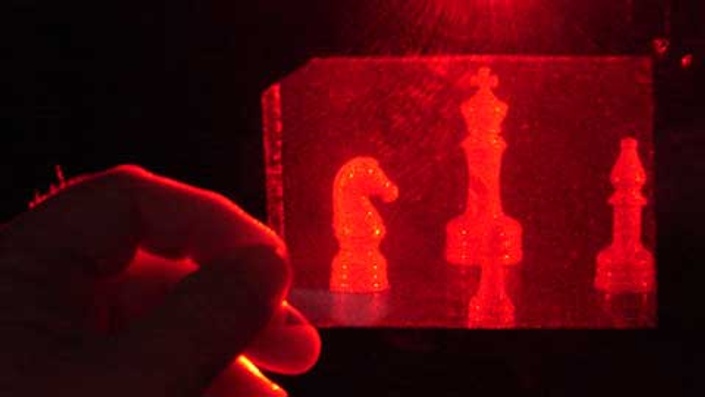
...would still be there if you turn off the laser.
Not as fully explicated, three-dimensional objects suspended in a spatial dimension,...
(the metaphorical equivalent of "local" reality)
...but as highly correlated patterns of information encoded in a photographic emulsion on a piece of film,...
...
(the metaphorical equivalent of "non-local" reality)
Similarly, when the moon (or any other object, for that matter) is not being observed, the moon exists as a pattern of information encoded in the universe's ("non-local") quantum underpinning.
And thus, just as it is the
conjoined relationship between the laser light and the patterns of information encoded on the holographic film that produces the 3-D phenomena of the chess pieces,...
...likewise, it is the
conjoined relationship between consciousness (observers) and the quantum underpinning of the universe that then allows for the explication of the universe's 3-D features from its underlying fields of information - information that delineates precisely how those features will appear to us when we do look.
_______
Re: The Moon Does Not Exist If No Humans 'Look' at It
Posted: Mon Feb 13, 2023 9:25 pm
by Iwannaplato
seeds wrote: ↑Mon Feb 13, 2023 9:19 pm
I'm not sure why this is in the
"Ethical Theory" subforum, but this is a good thread topic, one in which Veritas is finally steering his philosophical inquiries in the right direction.
He's said this a couple of times before...in different ways. I'm not closed to the idea. My sense is that VA grabs at things that seem to or actually do support his positions: But he doesn't consider what they imply or openly indicate about other beliefs he has. It's this ongoing set of appeals to authority without fully reading the texts (which have with some regularity contradicted even the specific belief he thought they supported) and without considering his position(s) as a whole, the implications. So, I start exploring the ideas. He doesn't read my posts, but I can mull and get something anyway.
...likewise, it is the conjoined relationship between consciousness (observers) and the quantum underpinning of the universe that then allows for the explication of the universe's 3-D features from its underlying fields of information - information that delineates precisely how those features will appear to us when we do look.
I tend towards pantheism. So, I think it's all saturated with observations.
Re: The Moon Does Not Exist If No Humans 'Look' at It
Posted: Mon Feb 13, 2023 9:46 pm
by Skepdick
Iwannaplato wrote: ↑Mon Feb 13, 2023 8:55 pm
Skepdick wrote: ↑Mon Feb 13, 2023 6:35 pm
No story or account of reality is ever complete. Give or take a Moon. What difference does it make when you take the entire universe into account?
Do you mean something like 'in the big picture the Moon is less than a grain of sand' or something like that? What does that have to do with semantic holism if that is what you mean or related to what you mean if it is something else?
I mean it in the way that Quine meant it. When asked the question "What exists?" he answered "everything".
In his words "the unit of measure of empirical meaning is all of science in its globality".
But of course, that sort of answer is technically true, absolutely correct and practically useless.
Iwannaplato wrote: ↑Mon Feb 13, 2023 8:55 pm
How does ontological engineering come in.
It comes in as epistemology. IF you are talking about the Moon in isolation from "everything in its globality/universality" you have a reason to focus there and on that particular thing; and you have a reason to exclude all other things which you've excluded from existence.
Given your particular goal/objective you are bringing into focus the things which are relevant to the domain of discourse and you are taking out things which are irrelevant.
You are bringing things into and out of existence into the context of the discourse.
Iwannaplato wrote: ↑Mon Feb 13, 2023 8:55 pm
You mentioned it. I hadn't heard of it. I looked it up, but didn't put in enough energy to see how it might connect. So, right now your sentence is something like 'It's just X.' I wondered how and in what way. How did the ideas of ontological engineering affect your understanding of these issues?
When we are talking about what exists/what doesn't (aside from the knowledge that everything exists) we are simply engineering a domain of discourse with the relevant objects included and the irelevant objecs excluded.
If you want to talk about the weather on the Greek islands we probably shouldn't have to worry very much about the existence of cosmic background radiation. For the purpose of our discourse it doesn't exist.
While you are talking about "Ocean tides on Earth" and in sofar Jupiter's moons are not relevant to high/low tides then for the purpose of our discourse Jupiter's moons don't exist.
And so, since VA wrote "look" in inverted commas I don't think he means that we are literally looking at the moon for it to exist. I think he means more like "The moon doesn't exist within the domain of discourse until it's considered and admitted as relevant".
Similarly "the universe is real but only when you are looking at it". More often than not we don't consider the entire universe as relevant to the domain of discourse we are far more pragmatic and narrow-focused to the point where Earth and perhaps the Solar system may exist but the universe doesn't.
Re: The Moon Does Not Exist If No Humans 'Look' at It
Posted: Mon Feb 13, 2023 9:51 pm
by vegetariantaxidermy
seeds wrote: ↑Mon Feb 13, 2023 9:19 pm
Iwannaplato wrote: ↑Mon Feb 13, 2023 8:55 pm
...If VA believes that things only exist when perceived by humans, has he thought about what this means for things like the fossil record, the geological history of the earth. I think it might be interesting to mull what it means about each other. I suppose we keep ourselves in existence since we experience ourselves. So, Greenland perhaps did not come into existence until the Inuit arrived there. It's an interesting view and interestingly relates rather well with a Piaget stage when children come to understand (or is it hallucinate?) object permanence - the conceptual category. IOW before they realize (or hallucinate) this they were generally considered to have less ontological understanding. But perhaps they really had it right and the object permanence addition is a useful fallacy.
I'm not sure why this is in the
"Ethical Theory" subforum, but this is a good thread topic, one in which Veritas is finally steering his philosophical inquiries in the right direction.
That being said, I nevertheless disagree with what is stated in the thread title. For surely the moon is still there when we're not looking.
Speaking metaphorically, I suggest that it is still there similar to how the chess pieces in this laser hologram...
...would still be there if you turn off the laser.
Not as fully explicated, three-dimensional objects suspended in a spatial dimension,...
(the metaphorical equivalent of "local" reality)
...but as highly correlated patterns of information encoded in a photographic emulsion on a piece of film,...
...
(the metaphorical equivalent of "non-local" reality)
Similarly, when the moon (or any other object, for that matter) is not being observed, the moon exists as a pattern of information encoded in the universe's ("non-local") quantum underpinning.
And thus, just as it is the
conjoined relationship between the laser light and the patterns of information encoded on the holographic film that produces the 3-D phenomena of the chess pieces,...
...likewise, it is the
conjoined relationship between consciousness (observers) and the quantum underpinning of the universe that then allows for the explication of the universe's 3-D features from its underlying fields of information - information that delineates precisely how those features will appear to us when we do look.
_______
I don't think that is the case. If you look away from the moon then 'your' moon ceases to exist. There might be other people looking at it, but that's 'their' verson of the moon. I read that it's similar to video games, where only the part of the 'world' that you are observing at any given time 'exists', while the rest of it is just pixels or whatever term computer geeks use, that only become 'something' when you focus on them.
Re: The Moon Does Not Exist If No Humans 'Look' at It
Posted: Mon Feb 13, 2023 9:52 pm
by Impenitent
esse est percipi - Berkeley
make the local move- your neighbor does not exist when you aren't perceiving them...
-Imp
Re: The Moon Does Not Exist If No Humans 'Look' at It
Posted: Mon Feb 13, 2023 10:16 pm
by Iwannaplato
Skepdick wrote: ↑Mon Feb 13, 2023 9:46 pm
I mean it in the way that Quine meant it. When asked the question "What exists?" he answered "everything".
In his words "the unit of measure of empirical meaning is all of science in its globality".
But of course, that sort of answer is technically true, absolutely correct and practically useless.
This came from semantic holism?
Iwannaplato wrote: ↑Mon Feb 13, 2023 8:55 pm
How does ontological engineering come in.
It comes in as epistemology. IF you are talking about the Moon in isolation from "everything in its globality/universality" you have a reason to focus there and on that particular thing; and you have a reason to exclude all other things which you've excluded from existence.
OK, sure.
Given your particular goal/objective you are bringing into focus the things which are relevant to the domain of discourse and you are taking out things which are irrelevant.
You are bringing things into and out of existence into the context of the discourse.
So, existence is that which is in discourse?
So, not perception, but it exists if it is being talked/written about?
When we are talking about what exists/what doesn't (aside from the knowledge that everything exists) we are simply engineering a domain of discourse with the relevant objects included and the irelevant objecs excluded.
If you want to talk about the weather on the Greek islands we probably shouldn't have to worry very much about the existence of cosmic background radiation. For the purpose of our discourse it doesn't exist.
While you are talking about "Ocean tides on Earth" and in sofar Jupiter's moons are not relevant to high/low tides then for the purpose of our discourse Jupiter's moons don't exist.
And so, since VA wrote "look" in inverted commas I don't think he means that we are literally looking at the moon for it to exist. I think he means more like "The moon doesn't exist within the domain of discourse until it's considered and admitted as relevant".
I doubt that, and hopefully he will weigh in. I don't think that's where he's going with the physicists he's referencing.
Similarly "the universe is real but only when you are looking at it". More often than not we don't consider the entire universe as relevant to the domain of discourse we are far more pragmatic and narrow-focused to the point where Earth and perhaps the Solar system may exist but the universe doesn't.
I certainly see the focus would be that or even more local, most of the time, but I don't think we are thinking 'and there's nothing else' .
Does this have to be verbal? ( I ask since you are using discourse)
Or another way to come at it: that which animals focus on...are they bringing those things into existence?
Re: The Moon Does Not Exist If No Humans 'Look' at It
Posted: Mon Feb 13, 2023 10:19 pm
by vegetariantaxidermy
Impenitent wrote: ↑Mon Feb 13, 2023 9:52 pm
esse est percipi - Berkeley
make the local move- your neighbor does not exist when you aren't perceiving them...
-Imp
They 'exist' to
them. I wonder if it includes just thinking about them

Re: The Moon Does Not Exist If No Humans 'Look' at It
Posted: Tue Feb 14, 2023 2:48 am
by Veritas Aequitas
vegetariantaxidermy wrote: ↑Mon Feb 13, 2023 9:51 pm
seeds wrote: ↑Mon Feb 13, 2023 9:19 pm
Iwannaplato wrote: ↑Mon Feb 13, 2023 8:55 pm
...If VA believes that things only exist when perceived by humans, has he thought about what this means for things like the fossil record, the geological history of the earth. I think it might be interesting to mull what it means about each other. I suppose we keep ourselves in existence since we experience ourselves. So, Greenland perhaps did not come into existence until the Inuit arrived there. It's an interesting view and interestingly relates rather well with a Piaget stage when children come to understand (or is it hallucinate?) object permanence - the conceptual category. IOW before they realize (or hallucinate) this they were generally considered to have less ontological understanding. But perhaps they really had it right and the object permanence addition is a useful fallacy.
I'm not sure why this is in the
"Ethical Theory" subforum, but this is a good thread topic, one in which Veritas is finally steering his philosophical inquiries in the right direction.
That being said, I nevertheless disagree with what is stated in the thread title. For surely the moon is still there when we're not looking.
Speaking metaphorically, I suggest that it is still there similar to how the chess pieces in this laser hologram...
...would still be there if you turn off the laser.
Not as fully explicated, three-dimensional objects suspended in a spatial dimension,...
(the metaphorical equivalent of "local" reality)
...but as highly correlated patterns of information encoded in a photographic emulsion on a piece of film,...
...
(the metaphorical equivalent of "non-local" reality)
Similarly, when the moon (or any other object, for that matter) is not being observed, the moon exists as a pattern of information encoded in the universe's ("non-local") quantum underpinning.
And thus, just as it is the
conjoined relationship between the laser light and the patterns of information encoded on the holographic film that produces the 3-D phenomena of the chess pieces,...
...likewise, it is the
conjoined relationship between consciousness (observers) and the quantum underpinning of the universe that then allows for the explication of the universe's 3-D features from its underlying fields of information - information that delineates precisely how those features will appear to us when we do look.
_______
I don't think that is the case. If you look away from the moon then 'your' moon ceases to exist.
There might be other people looking at it, but that's 'their' version of the moon.
I read that it's similar to video games, where only the part of the 'world' that you are observing at any given time 'exists', while the rest of it is just pixels or whatever term computer geeks use, that only become 'something' when you focus on them.
Wow, wow, wow..
Agree.
Donald Hoffman in his book covered every angle from any skeptic on 'the moon [reality] is not there when no one is looking* at it'.
*It is not mere "looking" but it involved the whole system of cognition and the human realization of 'reality' adapted from 4 billion years of evolution and adaptation.
Is Reality an Illusion? - Professor Donald Hoffman, PhD
https://www.youtube.com/watch?v=vhGYsUitgNk
However, reality is relatively real and mind-independent
BUT only as conditioned and qualified to common sense, conventional sense, Newtonian and Einsteinian Physics.
The point is, one cannot insist the above mind-independent reality is absolute and the only version of reality and condemned others who think otherwise; especially when the other opposite view [QM] had won a Nobel Prize in Physics.
Re: The Moon Does Not Exist If No Humans 'Look' at It
Posted: Tue Feb 14, 2023 3:07 am
by Veritas Aequitas
seeds wrote: ↑Mon Feb 13, 2023 9:19 pm
I'm not sure why this is in the
"Ethical Theory" subforum, but this is a good thread topic, one in which Veritas is finally steering his philosophical inquiries in the right direction.
Did you read the OP?
"The above issue is raised very often re my discussion with objective moral facts, so I am raising it here in this moral section."
Re: The Moon Does Not Exist If No Humans 'Look' at It
Posted: Tue Feb 14, 2023 3:16 am
by Veritas Aequitas
Flannel Jesus wrote: ↑Mon Feb 13, 2023 12:50 pm
Veritas Aequitas wrote: ↑Mon Feb 13, 2023 12:43 pm
With this paradigm shift from the default of mind-independence, there is no mind-independence in QM at all.
The irony in this point of view is, if there was nothing mind in independent, then what does it even mean to "discover" that qm is "true"?
Qm is built on experiments and equations that describe and predict the results of those experiments. We can verify, experimentally, that qm models of the world accurately predict what happens.
How could we discover something new about the world that we didn't already know, if there wasn't something there independent of our minds to be discovered?
You're certainly free to interpret it that way if you want, but it is not the exclusive - or even common - way experts in the field interpret QM, quantum physics, and all the experiments and discoveries and equations surrounding it.
All facts, knowledge and truths are conditioned upon a specific FSK.
ALL FSKs are managed and sustained by humans [mentally, i.e. mind].
All QM facts are conditioned to the science-QM FSK.
Thus, all QM truths are mind-interdependent, not mind-independent.
The scientific FSK is the most credible and reliable FSK [comparing the best of each respective FSK].
Other than the mathematics FSK which other FSK is more credible than the scientific FSK.
Thus, the truths of QM is credible.
In this case, that particular QM thesis [relatively counter-intuitive] was proven and translated into practices [technologies] that are likely to benefit greatly to human progress, that is the confidence level of the truth of this QM thesis.
Re: The Moon Does Not Exist If No Humans 'Look' at It
Posted: Tue Feb 14, 2023 8:20 am
by Skepdick
Flannel Jesus wrote: ↑Mon Feb 13, 2023 12:50 pm
The irony in this point of view is, if there was nothing mind in independent, then what does it even mean to "discover" that qm is "true"?
Qm is built on experiments and equations that describe and predict the results of those experiments. We can verify, experimentally, that qm models of the world accurately predict what happens.
How could we discover something new about the world that we didn't already know, if there wasn't something there independent of our minds to be discovered?
You're certainly free to interpret it that way if you want, but it is not the exclusive - or even common - way experts in the field interpret QM, quantum physics, and all the experiments and discoveries and equations surrounding it.
Instrumentalism is the predominant philosophy in physics with respect to all theories, not just QM.
It's because physicists know this is why the word "model" is still a feature of the "standard model of physics".
https://en.wikipedia.org/wiki/Instrumentalism
According to instrumentalists, a successful scientific theory reveals nothing known either true or false about nature's unobservable objects, properties or processes. Scientific theory is merely a tool whereby humans predict observations in a particular domain of nature by formulating laws, which state or summarize regularities, while theories themselves do not reveal supposedly hidden aspects of nature that somehow explain these laws.
Re: The Moon Does Not Exist If No Humans 'Look' at It
Posted: Tue Feb 14, 2023 8:32 am
by Flannel Jesus
Veritas Aequitas wrote: ↑Tue Feb 14, 2023 3:16 am
Flannel Jesus wrote: ↑Mon Feb 13, 2023 12:50 pm
Veritas Aequitas wrote: ↑Mon Feb 13, 2023 12:43 pm
With this paradigm shift from the default of mind-independence, there is no mind-independence in QM at all.
The irony in this point of view is, if there was nothing mind in independent, then what does it even mean to "discover" that qm is "true"?
Qm is built on experiments and equations that describe and predict the results of those experiments. We can verify, experimentally, that qm models of the world accurately predict what happens.
How could we discover something new about the world that we didn't already know, if there wasn't something there independent of our minds to be discovered?
You're certainly free to interpret it that way if you want, but it is not the exclusive - or even common - way experts in the field interpret QM, quantum physics, and all the experiments and discoveries and equations surrounding it.
All facts, knowledge and truths are conditioned upon a specific FSK.
ALL FSKs are managed and sustained by humans [mentally, i.e. mind].
All QM facts are conditioned to the science-QM FSK.
Thus, all QM truths are mind-interdependent, not mind-independent.
The scientific FSK is the most credible and reliable FSK [comparing the best of each respective FSK].
Other than the mathematics FSK which other FSK is more credible than the scientific FSK.
Thus, the truths of QM is credible.
In this case, that particular QM thesis [relatively counter-intuitive] was proven and translated into practices [technologies] that are likely to benefit greatly to human progress, that is the confidence level of the truth of this QM thesis.
Well this sounds like your personal theory, not the theory of actual physicists. I have never heard a physicist use the term fsk. Which just goes to show what I was saying before: this is not the standard view.
Re: The Moon Does Not Exist If No Humans 'Look' at It
Posted: Tue Feb 14, 2023 8:34 am
by Skepdick
Flannel Jesus wrote: ↑Tue Feb 14, 2023 8:32 am
Well this sounds like your personal theory, not the theory of actual physicists. I have never heard a physicist use the term fsk. Which just goes to show what I was saying before: this is not the standard view.
Replace VA's term "fsk" with the commonly used term "theory" and his view is as standard as it gets.
Re: The Moon Does Not Exist If No Humans 'Look' at It
Posted: Tue Feb 14, 2023 8:39 am
by Flannel Jesus
I don't have any reason to place "theory" at odds with objective reality, and I don't believe most scientists do either. Gravity is a theory, and yet I bet you must scientists think that mass distorts space time in the way Relativity suggests to produce gravity, even when nobody's looking, and it was happening even before people knew it was happening
Re: The Moon Does Not Exist If No Humans 'Look' at It
Posted: Tue Feb 14, 2023 8:42 am
by Skepdick
Flannel Jesus wrote: ↑Tue Feb 14, 2023 8:39 am
I don't have any reason to place "theory" at odds with objective reality, and I don't believe most scientists do either. Gravity is a theory, and yet I bet you must scientists think that mass distorts space time in the way Relativity suggests to produce gravity, even when nobody's looking, and it was happening even before people knew it was happening
Nobody is placing theory at odds with "objective reality". It's simply being pointed out that theories describe how we think about objective reality, they don't describe how objective reality actually is.
The theory of general relativity talks about the "curvature of spacetime". Does spacetime even exist? And if it does exist - does it really have a curvature? No idea!
As far as I can tell it's just a useful way of thinking about; and interpreting the world.
It's perfectly possible (and coherent) to claim that gravity doesn't exist. It's an epiphenomenon emergent from the curvature of space time.
In theoretical terms this is true. In practical terms it doesn't in any way stop apples from falling, light from lensing around black holes, etc.
The phenomena explained in terms of "gravity" remain. The explanations for those phenomena change.