Page 16 of 35

Re: The Limits of Science

Posted: Sat Mar 01, 2014 12:33 pm
by Blaggard
Ginkgo wrote:
HexHammer wrote:
skakos wrote:Then you cannot be certain for many things that atheist scientists talk about.
Like if the universe has a First Cause for example.
Religion on the other hand talks about personal experiences, about what you feel about you and your place in the cosmos.
Religion is also based on empirical evidence.
Are you ready to accept it as a different way of looking at things?
Oh yes, that's why we end up with the inqusition nonsense, nothing but supersticion and babble.

Can you only by religion build a skyscaper? A bridge? A jumbo jet? Do a bypass surgery? ..no ..religion is soul mending.

Yes, plus you also end up with pseudo science. No one to date has been able to successfully meld science and religion. It might happen one day, but that's a long way down the track.
The Christian Science movement would beg to differ but then they are a pretty unorthodox sect of an already unorthodox sect of splitters called protestants. ;)

Re: The Limits of Science

Posted: Sat Mar 01, 2014 12:47 pm
by Ginkgo
Blaggard wrote:
The Christian Science movement would beg to differ but then they are a pretty unorthodox sect of an already unorthodox sect of splitters called protestants. ;)
Haven't heard of that one. I'll google it.

thanks

Re: The Limits of Science

Posted: Sat Mar 01, 2014 12:48 pm
by Blaggard
Ginkgo wrote:
Blaggard wrote:
The Christian Science movement would beg to differ but then they are a pretty unorthodox sect of an already unorthodox sect of splitters called protestants. ;)
Haven't heard of that one. I'll google it.

thanks
They are basically gnostics, and like most sects slightly mental. ;)

Re: The Limits of Science

Posted: Sat Mar 08, 2014 5:06 am
by Hjarloprillar
thedoc wrote: Yet there is no proof that other universes exist. If there is I would like to see it, till then it is idle speculation, and of no value.
There was no proof but speculation that lands existed to the west [over Atlantic]
[idle speculation of no value]

where did you say you lived? :roll: [was it Kentucky or Alabama]

Prill

Re: The Limits of Science

Posted: Sat Mar 08, 2014 6:47 am
by thedoc
Hjarloprillar wrote:
thedoc wrote: Yet there is no proof that other universes exist. If there is I would like to see it, till then it is idle speculation, and of no value.
There was no proof but speculation that lands existed to the west [over Atlantic]
[idle speculation of no value]

where did you say you lived? :roll: [was it Kentucky or Alabama]

Prill
Show me! Build a ship that will travel to other universes, and I will go with you to explore and come back to report the findings. Just get me home in time for dinner.

Re: The Limits of Science

Posted: Sat Mar 08, 2014 7:08 am
by Hjarloprillar
thedoc wrote:
Hjarloprillar wrote:
thedoc wrote: Yet there is no proof that other universes exist. If there is I would like to see it, till then it is idle speculation, and of no value.
There was no proof but speculation that lands existed to the west [over Atlantic]
[idle speculation of no value]

where did you say you lived? :roll: [was it Kentucky or Alabama]

Prill
Show me! Build a ship that will travel to other universes, and I will go with you to explore and come back to report the findings. Just get me home in time for dinner.
Its about technology then?

Well give it time. we go from valves to rooms of supercomputers at 100's of terraflops in 70 years.
Machines will design inter_verse travel. thats what they are for. but 1st we must colonise this galaxy. We need to grow up.

small steps

I believe there many verses. Not because empiricist proof but from faith. "I chose to believe"

http://upload.wikimedia.org/math/d/e/6/ ... 60c87c.png

Re: The Limits of Science

Posted: Sat Mar 08, 2014 7:54 pm
by Blaggard
thedoc wrote:

Show me! Build a ship that will travel to other universes, and I will go with you to explore and come back to report the findings. Just get me home in time for dinner.

Its about technology then?

Well give it time. we go from valves to rooms of supercomputers at 100's of terraflops in 70 years.
Machines will design inter_verse travel. thats what they are for. but 1st we must colonise this galaxy. We need to grow up.
small steps

I believe there many verses. Not because empiricist proof but from faith. "I chose to believe"

http://upload.wikimedia.org/math/d/e/6/ ... 60c87c.png
Quantum computers next, since they already have quantum transistors which use ion traps, that can do 2^2 ie 1,0,0-1,1-0 rather than the more usual binary 1^2 or 1 and 0, which exponentially increases a computers speed without the problems of overheating electrons seem to encounter, if they can get it to work at room temperature the future looks so bright I might have to invest in a new pair of shades, and yes that was a pun. :P

Incidentally they've already run a program that does simple addition of numbers on a quantum computer, it is however not yet that feasible because these computers generally need to run at at least 100 degrees below zero to keep the ions stable and retain the probabilities. We have the materials science just as we did when the transistor replaced the valve what we don't have yet is stability.

Re: The Limits of Science

Posted: Sun Mar 09, 2014 6:33 pm
by skakos
An important note: Back in the days of ancient Greeks (the founders of Logic) there was no disctinction between "science" and "religion". All great polymaths of the time felt "god" and "logic" in their mind. The distinction between "science" and "religion" came some centuries ago. Even in medieval times, the monasteries were a place to worship God and spread/ strudy science. (actually the monasteries were the universities of the time and - indeed - they evolved in the Universities we know today at least in the West, while in the East things were slightly different with the Greek Byzantine Empire)

Re: The Limits of Science

Posted: Sun Mar 09, 2014 8:43 pm
by Blaggard
skakos wrote:An important note: Back in the days of ancient Greeks (the founders of Logic) there was no disctinction between "science" and "religion". All great polymaths of the time felt "god" and "logic" in their mind. The distinction between "science" and "religion" came some centuries ago. Even in medieval times, the monasteries were a place to worship God and spread/ strudy science. (actually the monasteries were the universities of the time and - indeed - they evolved in the Universities we know today at least in the West, while in the East things were slightly different with the Greek Byzantine Empire)
And who can forget the famous pea plants that sparked the need to explain biology and evolution by a little known monk.

http://anthro.palomar.edu/mendel/mendel_1.htm

This observation that these traits do not show up in offspring plants with intermediate forms was critically important because the leading theory in biology at the time was that inherited traits blend from generation to generation. Most of the leading scientists in the 19th century accepted this "blending theory." Charles Darwin proposed another equally wrong theory known as "pangenesis" click this icon to hear the name pronounced. This held that hereditary "particles" in our bodies are affected by the things we do during our lifetime. These modified particles were thought to migrate via blood to the reproductive cells and subsequently could be inherited by the next generation. This was essentially a variation of Lamarck's incorrect idea of the "inheritance of acquired characteristics."

Mendel picked common garden pea plants for the focus of his research because they can be grown easily in large numbers and their reproduction can be manipulated. Pea plants have both male and female reproductive organs. As a result, they can either self-pollinate themselves or cross-pollinate with another plant. In his experiments, Mendel was able to selectively cross-pollinate purebred click this icon to hear the preceding term pronounced plants with particular traits and observe the outcome over many generations. This was the basis for his conclusions about the nature of genetic inheritance.
http://www.youtube.com/watch?v=x7chup0dZ1s

Lol.

That was a field that would backfire on the church and no mistake. ;)

Ah come on that was great pun work. :P

By the way the Muslims inspired by the Greeks built the first universities in countries such as Mali, now known as Mali, the university at Timbouktu being the first so called "modern" place of intelligence gathering. Ah if only them arabs had of ignored the fundamentalist fruit cakes, they'd probably rule the world by now. Sadly they are barely able to rule themselves in this day and age and that is no one's fault, er not even the Romans, sorry I've lost the plot there. ;)

What have the Romans ever done for us?! j/k

Image

I know not exactly Cambridge or wot not but it was a massive draw for scholars in its day.
Around the 12th century, the University of Timbuktu had an attendance of 25, 000 students in a city which had a population of 100, 000 people. The students came from all corners of the African continent in search of excellence in knowledge and trade. On graduation day, students were given Turbans. The turban symbolizes Divine light, wisdom, knowledge and excellent moral conduct. The turban represents the demarcation line between knowledge and ignorance. The knots and circles of the turban represent the name Allah. This means that the graduate students know the Divine obligations and responsibilities to be discharge honorably in their communities and toward their fellowmen.
http://www.africanecho.co.uk/africanech ... mar24.html

this seems the right thread for this...

Posted: Tue Mar 18, 2014 2:46 pm
by henry quirk

Re: this seems the right thread for this...

Posted: Tue Mar 18, 2014 10:26 pm
by Blaggard
henry quirk wrote:http://gizmodo.com/astronomers-discover ... +jesusdiaz

Make of it what you will.
It's cool. And not exactly unexpected. :)

Re: this seems the right thread for this...

Posted: Fri Mar 21, 2014 9:44 pm
by skakos
henry quirk wrote:http://gizmodo.com/astronomers-discover ... +jesusdiaz

Make of it what you will.
What do you make out of it?
I see a scientific discovery for a specific scientific theory.
But theories change. Do you believe science (which builts prediction models) has anything to do with what we call "the truth"?

Re: this seems the right thread for this...

Posted: Fri Mar 21, 2014 9:54 pm
by Blaggard
skakos wrote:
henry quirk wrote:http://gizmodo.com/astronomers-discover ... +jesusdiaz

Make of it what you will.
What do you make out of it?
I see a scientific discovery for a specific scientific theory.
But theories change. Do you believe science (which builts prediction models) has anything to do with what we call "the truth"?
No I think, to jump in there since it was not directed at me, that question: science does not have anything to do with truth which is an absolute, science is always approaching the truth and never reaching it, every theory every law is always as right as it can be given the evidence. Let me make an analogy science and hence theory is dam, and that dam is never strong or unimpeachable, in fact that dam is going to collapse and it's only a matter of time. At which point we need to build a better dam less leaky and more in line with the evidence, which you can call the materials with which we hold back ignorance if you like. It is a scientists duty to destroy dams, if not destroy them to make them solid enough to withstand future fluid attacks. ;)

Re: The Limits of Science

Posted: Sat Mar 22, 2014 6:14 am
by surreptitious57
If other Universes exist [ inflation theory suggests that they do ] it may actually be impossible to travel to them as such even if the technology was
availableto do so. The reason is because they are impervious to light and so therefore cannot be detected. Also one would have to travel in excess of light speed also which is impossible. And the reason for that would be because this Universe is expanding beyond light speed it self. Now this of course does not violate the laws of physics for what applies to with in the Universe does not apply to it itself. This is why inflation theory does not violate the First Law Of Thermodynamics regarding an eternal Multiverse

Re: The Limits of Science

Posted: Sat Mar 22, 2014 12:30 pm
by Blaggard
Other universes that are undetectable are like other gods, about as likely as any other god.

Inflation theory wouldn't break the law of thermodynamics even if the universe expanded at 100 times the speed of light, because it is all there is, it is hence the laws of nature.

Multiverse theories are ten a penny and like most religions are impossible to prove.
Now this of course does not
violate the laws of physics as what applies to within the Universe does not apply to the Universe itself
It does apply to itself in so much as the Universe creates the laws under which all matter operates, it is not outside of itself, and neither is there any inconsistency in the fabric of space and time expanding at more than c, matter travelling through space and time now that is different kettle of albatrosses.

However if you can bend space and time with mass then it follows that you can travel at faster than c at least naively because a journey to say alpha centauri when travelling at the speed of light would take you 4.22 years or so, and those who remained on Earth would have passed through 200 years in their time frame when you arrived. So at least it would seem to those on Earth that you had travelled 4.22 light years in 200 years. And to you you had travelled 4.22 light years in 4.22 years.

Even so of course the energy required to accelerate a mass object beyond .9999999999999999999999999999...c is infinite, in other words mass objects may approach c but never attain or exceed it and photons always propagate at c and never propagate at less than c unless passing through a medium which refracts it. There's no anti particle to photons its anti particle is just itself, the photon has no rest mess and is a point particle that is infinitessimal in size.

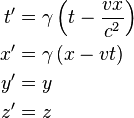
Or to put it in maths gibberish:
Image

Which means the speed of a photon is c and that any other propagation issues are undefined, or in fact undefinable.

Which means that f(x)=f'(x)

And hence time and space as relates to acceleration are proportional to the equation above.

or time is equal to space with a transformational rotation 90 degrees about it's axis.

Image

An object in time in space:
In this animation, the vertical direction indicates time and the horizontal direction indicates distance, the dashed line is the spacetime trajectory ("world line") of an accelerating observer. The small dots are arbitrary events in spacetime that are stationary relative to each other. The events passing the two diagonal lines in the lower half of the picture (the past light cone of the observer) are those that are visible to the observer.

The slope of the world line (deviation from being vertical) gives the relative velocity to the observer. Note how the view of spacetime changes when the observer accelerates. In particular, absolute time is a concept not applicable in Lorentzian spacetime: events move up-and-down in the figure depending on the acceleration of the observer.