Re: Anti-Realism Proper
Posted: Sun Jan 21, 2024 2:40 pm
I cannot imagine any feasible situation that confirms that anti-realism is true. Even in the brain in a vat scenario, a brain, a mad scientist, a supercomputer... exist.
One can imagine that anti-realism is always true.
It matters since otherwise, anti-realists cannot come up with a situation in which the reality is different from what our common sense tells us.
Could you imagine a situation in which the perceiver does not exist? Could you imagine a situation in which the object of experience does not exist? If the answers to these questions are no, then we are sure that the perceiver and the object of experience exist. Then we are either a brain in the vat or we exist as separate entities as our common sense tells us. Either way, there is a reality that provides the object of experience to us.
I don't have to "imagine" it.

My body is an object that I and others can experience.
I agree with what you are asserting in that last sentence, bahman, however, when you have some of the founding fathers of modern physics saying such things as this...bahman wrote: ↑Sun Jan 21, 2024 4:04 pm If the answers to these questions are no, then we are sure that the perceiver and the object of experience exist. Then we are either a brain in the vat or we exist as separate entities as our common sense tells us. Either way, there is a reality that provides the object of experience to us.
"As a man who has devoted his whole life to the most clear headed science, to the study of matter, I can tell you as a result of my research about atoms this much: There is no matter as such. All matter originates and exists only by virtue of a force which brings the particle of an atom to vibration and holds this most minute solar system of the atom together. We must assume behind this force the existence of a conscious and intelligent mind. This mind is the matrix of all matter." -- Max Planck
"Everything we call real is made of things that cannot be regarded as real." -- Niels Bohr
...then it's not a question of whether the phenomenal features of the universe are founded upon something real or not."The atoms or elementary particles themselves are not real; they form a world of potentialities or possibilities rather than one of things or facts." -- Werner Heisenberg
Ok, I got your point but what do you mean?
By the object of experience, I mean the stuff you experience, namely Quidia.
Glad to hear that.seeds wrote: ↑Sun Jan 21, 2024 7:36 pmI agree with what you are asserting in that last sentence, bahman, however, when you have some of the founding fathers of modern physics saying such things as this...bahman wrote: ↑Sun Jan 21, 2024 4:04 pm If the answers to these questions are no, then we are sure that the perceiver and the object of experience exist. Then we are either a brain in the vat or we exist as separate entities as our common sense tells us. Either way, there is a reality that provides the object of experience to us.
I don't find what he says as a proof of concept of an intelligent mind.seeds wrote: ↑Sun Jan 21, 2024 7:36 pm "As a man who has devoted his whole life to the most clear headed science, to the study of matter, I can tell you as a result of my research about atoms this much: There is no matter as such. All matter originates and exists only by virtue of a force which brings the particle of an atom to vibration and holds this most minute solar system of the atom together. We must assume behind this force the existence of a conscious and intelligent mind. This mind is the matrix of all matter." -- Max Planck
I believe in Bohmian interpretation.seeds wrote: ↑Sun Jan 21, 2024 7:36 pm "Everything we call real is made of things that cannot be regarded as real." -- Niels Bohr
"The atoms or elementary particles themselves are not real; they form a world of potentialities or possibilities rather than one of things or facts." -- Werner Heisenberg
Real means actually existing.

Nope.nemos wrote: ↑Sun Jan 21, 2024 12:18 pmDo I understand correctly that in anti-realism theory prevails over facts. If the fact does not fit into the theory, then the fact should be revised, but not the theory?Veritas Aequitas wrote: ↑Mon Jan 01, 2024 11:37 am What is Anti-RealismIn anti-realism, the truth of a statement rests on its demonstrability through internal logic mechanisms, such as the context principle or intuitionistic logic, in direct opposition to the realist notion that the truth of a statement rests on its correspondence to an external, independent reality.[2]
https://en.wikipedia.org/wiki/Anti-realism
In contrast to realism, where the theory is only an approximate model of reality, and which is tested for compliance with known facts and the ability to predict unknown ones.
No. What's with this philosophical predisposition/intuition to pit information sources against each other head on?
The approximation is necessarily right in some aspects and wrong in other aspects.
There was a time when reality was described, or modeled, with Newton's laws, later it was specified with Einstein's(including) laws according to accumulated experience and facts. I don't know about you, but to me it looks like a pretty noticeable advance, without which many technological toys would not be possible. "Black holes" were predicted theoretically from the beginning, as arising from the theory, and only later found actual confirmations.
This is such a confused outlook.nemos wrote: ↑Mon Jan 22, 2024 10:58 amThere was a time when reality was described, or modeled, with Newton's laws, later it was specified with Einstein's(including) laws according to accumulated experience and facts. I don't know about you, but to me it looks like a pretty noticeable advance, without which many technological toys would not be possible. "Black holes" were predicted theoretically from the beginning, as arising from the theory, and only later found actual confirmations.
To me, as a "stupid" realist, this all seems like confirmation of the validity of my "stupidity" over your "sanity". The only criterion for the truth of assumptions that I can see is the trial and error method, which is actually a test of assumptions for compliance with objective reality.
The existence of the moon is objective (independent of your "sanity" point of view) because:
- the moon is a light source that illuminates the earth
- many others see it, regardless of your "sanity" opinion
- it determines the tides of the oceans and the earth's crust
- observation and research stations have been sent there
- there should, as it were, be the footprints of the astronaut and the flag (and even if it is not so, it cannot affect the truth of other facts)
- accurate maps have been created, the relevance of which can be observed both in telescopes from the ground and in video footage taken in close proximity
- all these points are experimentally verifiable and do not contradict the theory
with all due respect to your "sanity"
You asked us to "imagine a situation" in which the perceiver does not exist, and I provided you with one such situation.
Once again, you asked us to imagine a situation in which the object of experience does not exist, and once again I provided one.bahman wrote: ↑Sun Jan 21, 2024 8:47 pmBy the object of experience, I mean the stuff you experience, namely Quidia.
I too like Bohm's ideas.
You stated,...
In which case, I am simply trying to pin down what that foundational "reality" actually consists of, when, in fact, some of the prominent fathers of quantum physics have insisted that it's not actually what we normally call "real.""...there is a reality that provides the object of experience to us..."
Well, actually the perceiver exists as far as there is a change. I call the perceiver the mind. The story is long, but I have an argument for the mind. I can share it with you if you are interested.
Well, if the mind exists then it simply means that the object of experience also exists.
Yes, we have been through this. I however distinguish between Quidia and Qualia, the first one is the object of experience and the second one is the property of the first.
I didn't study his thoughts to that extent. Good to know about them, some food to eat! To me, his idea is attractive because it removes all the absurdity of other interpretations, such as Schrodinger cat,...seeds wrote: ↑Sun Jan 21, 2024 7:36 pmI too like Bohm's ideas.
However, I see a problem with his promotion of the "pilot wave" theory, because even though the proponents of the theory think they are being sensible by suggesting that the subatomic particles themselves are real objects, and that a so-called "pilot wave" allegedly guides the particles into their varying positions on, for example, the phosphorescent screen of the double slit experiment,...
...the theory nevertheless doesn't seem to explain what the "pilot wave" itself is made of.
On the other hand, I really like his musings on what he calls the "Implicate Order"...
(meaning the superpositioned/entangled, "non-local" reality of the quantum realm)
...and the "Explicate Order"...
(meaning the "local reality" of the phenomenal [3-D] features of the universe)
...and how it all seems to be "holographic-like" in nature.
He even goes so far as to call the entangled "Implicate Order" the "Holomovement."
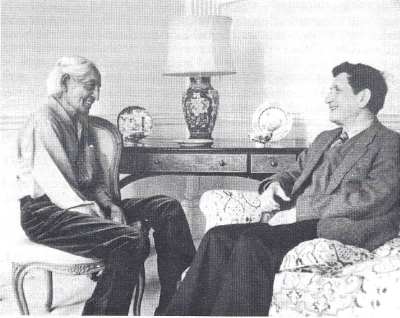
I also appreciate Bohm because he wasn't afraid to risk his credibility by exploring metaphysical ideas with men like Jiddu Krishnamurti...
To me, pilot waves are real and actually exist.seeds wrote: ↑Sun Jan 21, 2024 7:36 pmYou stated,...
In which case, I am simply trying to pin down what that foundational "reality" actually consists of, when, in fact, some of the prominent fathers of quantum physics have insisted that it's not actually what we normally call "real.""...there is a reality that provides the object of experience to us..."
For example, if you say you believe in the Bohmian interpretation, then do you think the "pilot wave" is real and actually exists?
And if the answer is no, and that it is simply a mathematical abstraction, then how in the world does it guide (push) the so-called "real particles" through the double slits and toward their specific positions on the measuring screen?
_______
I really like useful things, and useless things do not.
Not sure what your question has to do with anything.nemos wrote: ↑Mon Jan 22, 2024 7:56 pm-
I really like useful things, and useless things do not.
I can't see anything useful for me in your "theory", so let it be up to you.
Everyone lives in the delusions they create for themselves, you like yours, I like mine.
In your opinion, which theories contributed more to technical progress, including the creation of computers, and how does it relate to the ideas of anti-realism?
First of all, a new theory (Einstein's in particular) does not negate the old one (Newton's in particular), but complements it, because Einstein's equations naturally transform into Newton's at low speeds. Newton's theory is still valid at speeds small compared to the speed of light.